You've finally settled your newborn after a feed. You lower them into the bassinet, hold your breath, and take one step away. A few minutes later, they're awake again, rooting, grunting, or crying. By morning, you may be wondering whether you need a better sleep schedule for your newborn, or whether your baby's sleep is just unpredictable.
In the first weeks, unpredictability is usually normal. Newborn sleep follows feeding, comfort, and development more than the clock. A helpful plan doesn't force a tiny baby into fixed nap times. It gives you a safe, repeatable rhythm that adapts to hunger, sleepy cues, medical needs, and your child's individual sensory profile.
Table of Contents
- What Newborn Sleep Looks Like in the First Weeks
- Safe Sleep and the Feed-Sleep Cycle as Your Foundation
- Reading Wake Windows and Sleepy Cues
- Building a Soothing Pre-Sleep Routine That Sticks
- Tracking Sleep Patterns Without Losing Your Mind
- Common Mistakes That Make Nights Harder
- Your One-Page Newborn Sleep Checklist
What Newborn Sleep Looks Like in the First Weeks
After a feed, your newborn may sleep peacefully for a while, then wake rooting or grunting before you have settled back into bed. This pattern can make a sleep schedule for your newborn feel impossible to find. In the first weeks, sleep is usually organized around feeding, comfort, and care rather than the clock.
Across a full day, a newborn may sleep 14 to 17 hours, including naps and nighttime sleep, according to CDC sleep guidance. The total can sound generous, yet it is divided into short periods. Many babies sleep for one to four hours at a time and wake for feeds or care, as described in WHO newborn sleep guidance.
Your baby's internal clock is still developing. Hunger has a strong influence, so a newborn may sleep more calmly in daylight and wake often overnight. This reflects immature sleep regulation, not stubbornness, poor discipline, or a habit you have caused.
Why newborns look restless while asleep
Newborn sleep can look busy because active sleep makes up about 50% of newborn sleep and falls to about 30% by 6 months. Less-defined indeterminate sleep also fades over time, according to this review of infant sleep development. During active sleep, your baby may twitch, grimace, suck, move their eyes, make small sounds, or startle.
Those movements are easy to mistake for a full waking. Pause briefly, observe breathing and body movement, and see whether the fussing is building. Some babies return to sleep without help. Others need feeding, a diaper change, or close contact.
The first-week goal: build a dependable response, not a perfect timetable.
Formal sleep training can wait during the early newborn period. Responsive care helps you distinguish hunger, discomfort, and tiredness while the nervous system is developing. If your baby arches during sleep or feeding, consider possible discomfort and discuss persistent concerns with a clinician, using this resource on infant arching the back while sleeping.
A workable rhythm often follows feed, burp, change, brief alert time, then sleep. Sensory or developmental differences may make rocking, swaddling, sound, or other conventional soothing methods harder to tolerate, so observe your baby's responses rather than forcing one routine. Frequent diapering, bathing, and skin care are part of the same cycle. A guide to baby hygiene essentials for parents can help organize those tasks. In week one, the “schedule” is a repeating feed-sleep cycle, with interruptions that reflect newborn biology.
Safe Sleep and the Feed-Sleep Cycle as Your Foundation
A newborn may finish a feed, drift off, then wake soon after a wet diaper or another hunger cue. That interruption is not a failed schedule. It is the normal feed-sleep cycle, and safe sleep rules need to hold through every repetition.
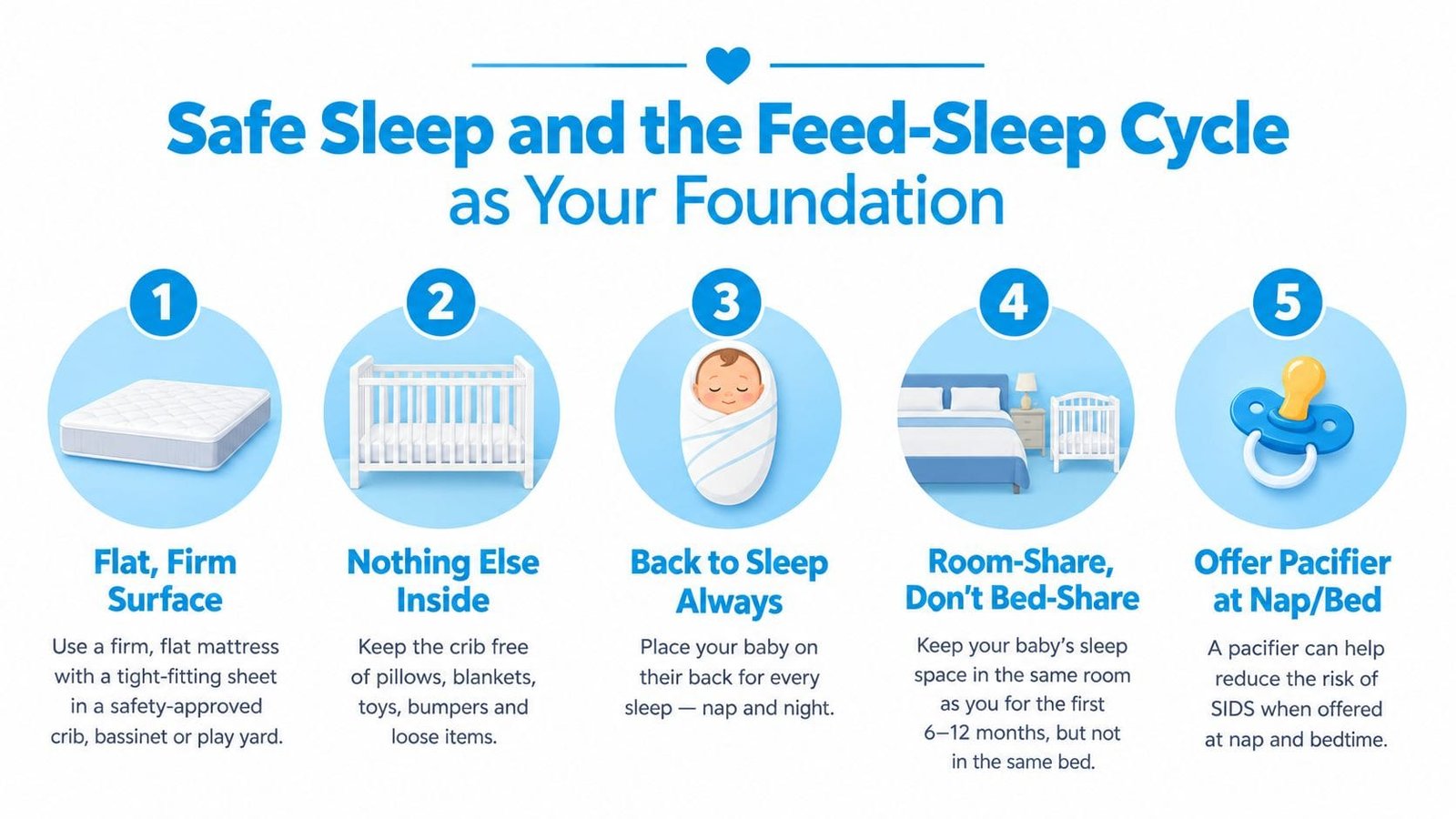
Place your baby on their back for every sleep, including naps, on a firm, flat surface designed for infant sleep. Use a fitted sheet and keep the sleep space otherwise empty. The CDC's safe-sleep guidance supports back sleeping and a clear infant sleep area.
Keep pillows, loose blankets, bumpers, positioners, stuffed toys, and nursing pillows out of the bassinet or crib. You may swaddle a baby who is not showing signs of rolling, but a swaddle does not replace a clear sleep surface. Keep the baby's sleep space in your room, rather than your bed, ideally for at least 6 months. Avoid overheating, smoke exposure, and alcohol around infant sleep.
A clean, protected mattress can reduce disruption during nighttime changes, provided the protector fits securely and leaves the mattress firm and flat. The Protect-A-Bed baby safety guide outlines practical points for choosing infant mattress protection.
Let feeding set the rhythm
Build sleep planning around feeding rather than a fixed nap chart. Newborns commonly wake every 2 to 4 hours for feeds. Breastfed babies often feed every 2 to 3 hours, while bottle-fed babies often feed every 3 to 4 hours. Follow your clinician's instructions if your baby needs scheduled waking because of weight, growth, prematurity, or another medical reason.
Use this sequence flexibly:
- Notice hunger cues and offer the feed.
- Burp and keep your baby upright if needed. This can help when feeding seems to leave your baby uncomfortable.
- Check the diaper. Change before feeding if your baby needs help waking, or afterward if changing first makes settling harder.
- Keep awake time calm and brief. Feeding may use much of the available wake period.
- Place your baby on their back in a separate sleep space.
A pacifier may be offered at sleep onset once feeding is established, if your pediatrician has no specific concerns. Babies with sensory or developmental differences may dislike rocking, swaddling, sound, or other familiar soothing methods. Watch the individual response and adjust the sequence without forcing a standard routine.
The foundation is a safe surface, responsive feeding, and repeated low-pressure care, not clock-perfect timing.
Reading Wake Windows and Sleepy Cues
Wake windows help you estimate how long your newborn can comfortably stay awake, but they're not appointments. Pediatric guidance commonly places newborn awake periods around 1 to 2 hours maximum, with sleep returning every 2 to 4 hours around feeds, as explained by Stanford Children's Health.
A very young newborn may become tired after a short period that includes feeding and diapering. By the later newborn weeks, some babies tolerate a longer stretch. Your baby's cues matter more than a number on a phone.
Watch for the first signs
Early cues are easy to miss because they're quiet:
- Staring into the distance
- Reduced movement
- Softer sucking
- Less interest in faces or interaction
Mid-stage cues are more obvious:
- Yawning
- Rubbing the face
- Pulling at the ears
- Fussy grunting
- Increasing body tension
Late cues often mean the transition will take more work:
- Arching
- Crying
- Flailing
- A sudden burst of alertness, sometimes called a second wind
When a baby becomes overtired, settling can get harder rather than easier. Crying raises the intensity of the moment, and parents may respond by adding more rocking, sound, movement, or light. That extra stimulation can prolong the wake period.
Decision rule: If you see two sleepy cues, or the reasonable wake period has passed, start winding down.
Newborn wake windows and sleepy cues by age
The ranges below are practical starting points, not promises. They should never override feeding needs or a clinician's plan.
| Age Range | Wake Window | Early Cues | Mid Cues | Late Cues |
|---|---|---|---|---|
| First week | About 45–60 minutes | Staring, reduced movement, softer sucking | Yawning, face rubbing, fussy grunting | Arching, crying, second wind |
| Weeks three to four | About 60–90 minutes | Staring, quieter body, reduced engagement | Yawning, ear pulling, face rubbing | Crying, arching, frantic movement |
Count from the moment your baby fully wakes, not from the end of the previous nap's settling process. If the baby feeds slowly, needs a diaper change, and then shows a cue, the feed and care time already count as awake time.
Some babies, particularly those with sensory differences or a more reactive nervous system, may show subtle cues rather than classic yawns and eye rubbing. Reduced movement, turning away, stiffening, or a sudden change in sucking may be more useful signals. Observe your baby's pattern instead of waiting for a universal cue.
Building a Soothing Pre-Sleep Routine That Sticks
A newborn routine doesn't need a bath, a song, a book, and a perfectly timed final feed every time. The most useful routine is short enough to repeat when you're exhausted and flexible enough to use after a nap, a night feed, or a difficult late afternoon.
A smooth evening
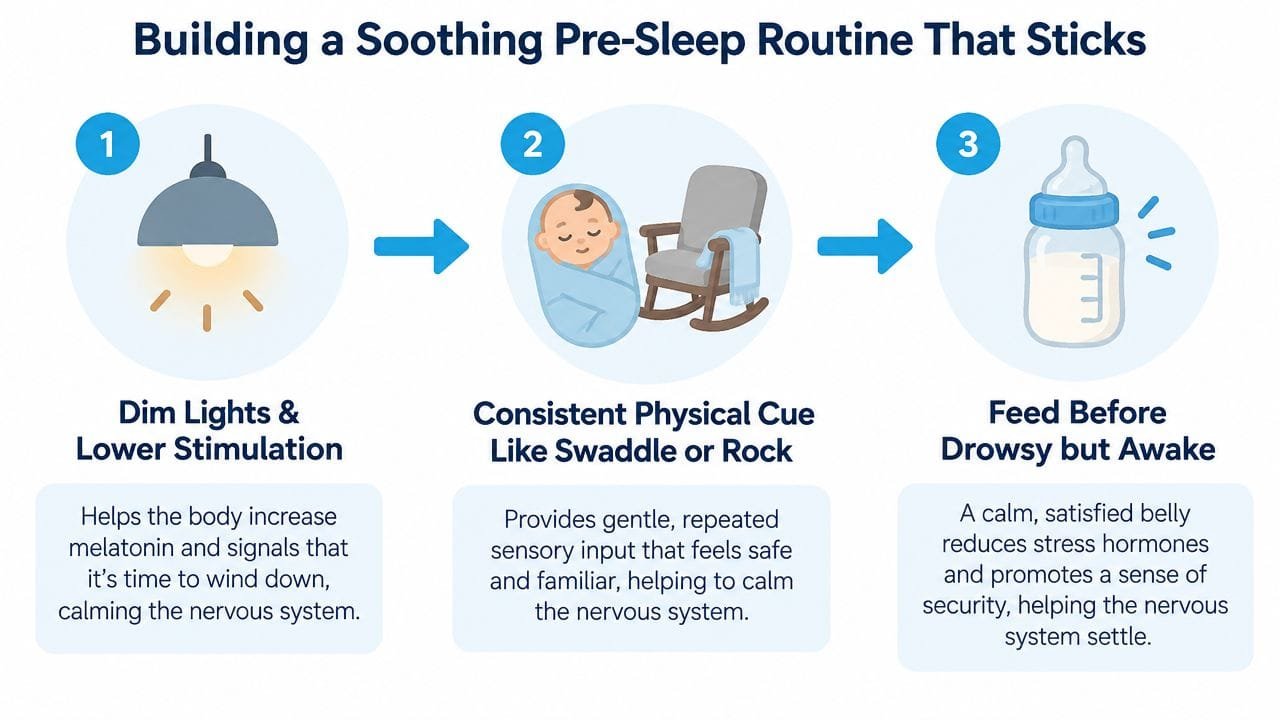
At around 7 p.m., your baby wakes hungry. You feed them with the room lights already dimmed. Afterward, you burp them, check the diaper, hold them in the same quiet position, and use the same short phrase or hum you used before the previous nap.
The baby's eyes grow heavy. You place them on their back in the bassinet while drowsy. They fuss briefly, so you offer calm hands and a quiet voice rather than switching through several new techniques. If they become fully upset, you pick them up, meet the need, and try again.
The cue isn't the exact time. It's the repeated sequence: lower stimulation, provide a familiar physical signal, feed or comfort, then settle safely.
A difficult late-afternoon nap
At 4 p.m., the baby has been awake through a feed, diaper change, and family noise. They're arching and crying when you begin rocking. Instead of increasing movement and volume, you turn off the television, reduce the light, move to a quieter room, and hold them with steady pressure.
A sensory-sensitive or neurodivergent infant may find shifting scents, sudden sounds, or unpredictable touch more alerting than calming. Try a consistent environment and gentle, steady input. Never use a weighted blanket or weighted sleep product in the sleep space, and ask a qualified clinician about appropriate ways to provide supportive pressure while you're awake and supervising.
For families adapting routines around non-speaking children or different communication styles, creating a sleep routine for nonverbal kids can offer ideas for making cues more visual and predictable. The same principle applies here: repetition matters more than a single soothing trick.
Use the routine during naps and nighttime sleep. A calm, familiar pattern helps you respond consistently even when the timing changes.
Tracking Sleep Patterns Without Losing Your Mind
Tracking can help when it answers a specific question. It becomes exhausting when you try to record every sound, movement, and half-open eye. For most families, three variables provide enough information to make a reasonable adjustment:
- Feed time, including breast, bottle, or expressed milk details that matter to your care team.
- Wake-window length, counted from full waking to the start of the next sleep attempt.
- Time to fall asleep, measured from the beginning of settling rather than from the first sleepy cue.
A paper notebook works. So does one simple app template. Pick the method every caregiver can understand at 3 a.m., and avoid maintaining several competing logs.
Look for patterns, not perfection
Review a short run of entries together rather than judging one difficult nap. You might notice that late-afternoon settling takes longer after a particularly stimulating day, or that your baby regularly shows tired cues before you expected. That information can guide a small change, such as starting the wind-down earlier or reducing sound and light.
A single unusual night doesn't prove that the routine is wrong. Newborns vary because feeding, growth, discomfort, and development change quickly. If a concern persists, share the cleanest version of your record with your pediatrician, lactation consultant, or sleep professional.
| Time | Feed (type & duration) | Wake window (mins) | Fell asleep in (mins) |
|---|---|---|---|
| 7:00 a.m. | Breast or bottle, record duration | Record actual time | Record settling time |
| After waking | Breast or bottle, record duration | Record actual time | Record settling time |
| Overnight | Breast or bottle, record duration | Record actual time | Record settling time |
For families who want a central place to record bedtime, naps, overnight disruptions, early waking, and morning mood, the Guiding Growth sleep-tracking app is one option. Keep the goal modest. You're collecting clues, not trying to manufacture a perfect newborn sleep schedule.
When sharing records, include feeding concerns, diaper patterns, unusual breathing, and how alert your baby is during awake periods. Sleep data has more meaning when viewed alongside intake, growth, and health.
Common Mistakes That Make Nights Harder
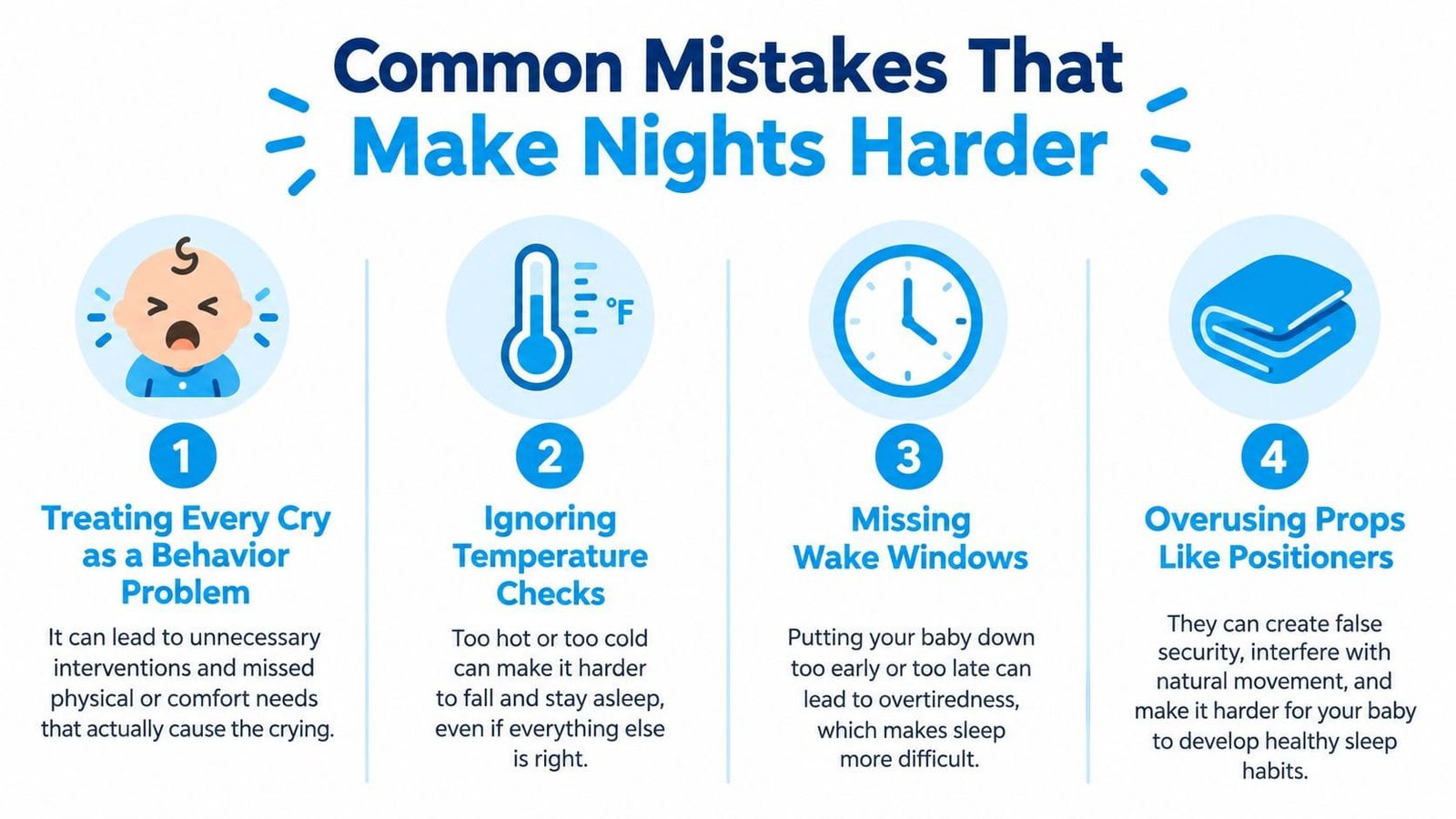
A crying newborn isn't automatically presenting a sleep problem. First check hunger, temperature, a wet diaper, discomfort, and whether the baby has stayed awake beyond their current capacity. Treating every waking as behavior can lead parents to delay a feed or keep adding sleep-training techniques when the baby needs care.
The habits worth changing
- Stretching wake windows: Keeping a newborn awake in the hope of creating a longer nighttime stretch often leads to overtired crying and harder settling. Start the wind-down at the first reliable cues.
- Adding evening stimulation: Bright lights, loud visitors, television, and active play can make nighttime care more alerting. Use a calmer environment for feeds and settling.
- Practicing only at bedtime: If the same cue appears only once each day, it has fewer opportunities to become familiar. Use a short version before naps as well.
- Taking unsafe shortcuts: Exhaustion can make loose blankets, positioners, or bed-sharing seem like practical solutions. Keep the sleep space clear and arrange support so an awake adult can help with feeds and transfers.
Why the “second wind” is misleading
A baby who suddenly appears wide awake after a long stretch may not be ready for more play. Late tiredness can look like energy. Parents often interpret the alert face, kicking, or louder vocalizing as a sign that the baby needs more awake time, then the baby becomes increasingly difficult to settle.
Return to the basics: lower stimulation, offer feeding when appropriate, use the familiar physical cue, and place the baby safely. If the pattern repeats, shorten the next wake period rather than extending it.
These mistakes are predictable. They don't mean you've damaged your baby's sleep or failed as a parent. Small, consistent corrections are more realistic than trying to overhaul every night.
Your One-Page Newborn Sleep Checklist
Save this list to your phone or place it near the changing table. It's designed to help you make the next decision, not to make every day identical.
Every sleep
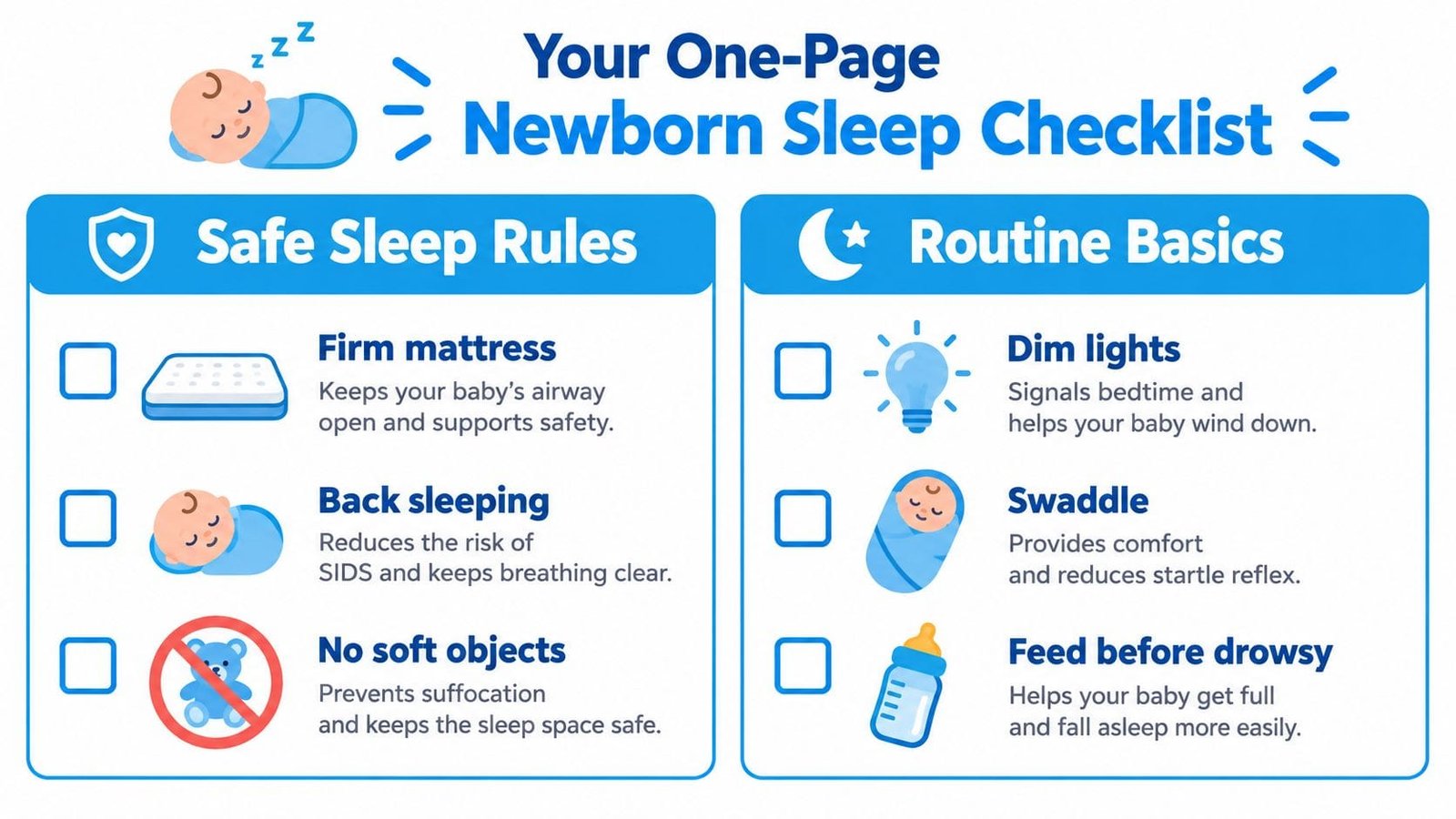
- Back sleeping: Place your baby on their back for naps and nighttime sleep.
- Firm, flat surface: Use an approved bassinet, crib, portable crib, or play yard with a fitted sheet.
- Empty sleep space: Keep pillows, loose blankets, bumpers, positioners, stuffed toys, and nursing pillows outside the sleep area.
- Room-sharing: Keep the baby's separate sleep space in your room, ideally for at least 6 months.
- Comfortable temperature: Avoid overheating, smoke exposure, and alcohol around infant sleep.
During the day
- Start with feeding: Let hunger cues and your clinician's feeding plan guide the cycle.
- Watch the window: Newborns generally manage short awake periods. Begin settling when cues appear.
- Notice two cues: Staring, reduced movement, softer sucking, yawning, face rubbing, and fussiness can all signal tiredness.
- Keep the pattern flexible: Feed, burp, check the diaper, offer calm interaction, and settle.
- Record only what helps: Note feeds, wake windows, and time to sleep.
Before settling
- Dim lights and reduce sound.
- Use the same gentle physical cue, such as a swaddle hold or calm rocking while awake and supervising.
- Feed or comfort as needed.
- Place your baby on their back in the separate sleep space while drowsy.
Call your pediatrician about significant breathing changes, difficulty rousing your baby for feeds, feeding problems, poor intake, or concerns about growth. Babies who haven't regained birth weight, were born preterm, or have medical or developmental needs may need an individualized waking and feeding plan.
You don't have to solve persistent difficulty alone. A lactation consultant, pediatric sleep specialist, or neurodivergent-affirming developmental pediatrician can help you adapt the plan to your baby rather than forcing your baby into a standard routine. For broader sleep support and family resources, you can also explore SleepHabits Restore+ as an additional option.
Guiding Growth helps parents record sleep routines, naps, overnight disruptions, feeding-related context, and other daily patterns in one place, with sharing tools for caregivers and professionals. If your newborn's rhythm is hard to understand, visit Guiding Growth to explore a simpler way to organize observations and bring clearer notes to the people supporting your family.