Your child can explain exactly how to get dressed, pack a school bag, or begin homework, yet still resist the request as if it were impossible. You may offer reminders, encouragement, or a reward, only to see anxiety rise, words disappear, or the whole routine collapse. Demand avoidance can reflect anxiety, sensory overload, emotional dysregulation, processing load, uncertainty, or a strong need for autonomy, not simple unwillingness.
The most useful demand avoidance strategies reduce the conditions that make a request feel threatening. The seven approaches below focus on regulation, predictability, autonomy, communication, timing, task size, and genuine collaboration. None works for every child or every day. Try one change at a time, watch for distress, and record the demand, wording, timing, context, and outcome. Guiding Growth can help caregivers, educators, therapists, and medical professionals share those observations instead of relying on disconnected memories or scattered notes.
Table of Contents
- 1. Sensory and Emotional Regulation First
- 2. Contextual Demand Reduction
- 3. Transparent Expectation Setting
- 4. Collaborative Autonomy
- 5. Indirect Request Framing
- 6. Scaffolded Progression
- 7. Collaborative Problem-Solving Partnership
- Comparison of 7 Demand-Avoidance Strategies
- Turn Daily Experiments Into Shared Understanding
1. Sensory and Emotional Regulation First
A child who arrives home tense, noisy, tearful, silent, or physically restless may not have enough capacity for another request. School can involve sustained sensory input, social interpretation, transitions, and effortful self-control. Asking about homework immediately may add pressure to an already overloaded nervous system.
Start with regulation, not correction. Offer a preferred activity such as movement, music, a fidget tool, dim lighting, or quiet space. A child might need a period of decompression before they can consider schoolwork or chores. You can ask, “Do you need movement first, some music, or quiet time?” Then provide the chosen support without turning it into a test of readiness.
Practical rule: If avoidance is escalating, pause the demand before adding more explanations.
Look for the child's early signs of overload. These might include facial changes, body tension, altered vocal tone, increased or reduced stimming, pacing, covering the ears, or becoming unusually quiet. Record those signs in Guiding Growth alongside the activity that helped. A regulation toolkit in your notes can list preferred sensory activities, their observed usefulness, and the approximate time each usually requires.
The sensory regulation guide for autistic children can support planning around these needs. Guiding Growth also lets families log regulation states, demand avoidance, triggers, and outcomes, then share patterns with teachers and therapists. Over time, you may identify optimal regulation windows, such as a calmer period after movement or a quieter part of the morning.
The trade-off is that postponing a demand can help recovery, but it can also create pressure later if nobody records a realistic return point. Offer a genuine pause, then revisit the task collaboratively when the child's body shows greater capacity.

2. Contextual Demand Reduction
The same request can feel manageable in a quiet, regulated moment and overwhelming after a noisy transition. Timing and surroundings change the amount of effort a child must spend before they even begin. A practitioner should therefore ask not only, “What demand was refused?” but also, “What had already happened?”
A child who avoids homework may cope better after decompression, a quiet snack, and a calm workspace than immediately after school. A student who shuts down during morning transitions may need dressing and eating arranged before the household becomes busy. A child sensitive to auditory input may need one request at a time after a loud environment, rather than a chain of instructions.
Use a simple observation pattern:
- Record the time: Note when the demand was presented and when avoidance began.
- Describe the setting: Include noise, lighting, crowding, temperature, and available space.
- Capture what came before: Record transitions, school activities, sleep quality, meals, and previous demands.
- Compare outcomes: Note whether delaying, simplifying, or relocating the request changed the response.
Guiding Growth's behavior logging can hold these details with timestamps and contextual notes. Its family coordination tools, including shared calendar planning for caregivers, can help adults coordinate decompression periods, appointments, school transitions, and agreed timing windows.
The benefit is reduced unnecessary pressure. The risk is that “later” becomes indefinite, leaving adults to repeat the demand and the child to experience growing uncertainty. Use patterns to identify workable windows, then communicate those windows across home and school. Critical tasks can be scheduled when the child is most regulated, while nonessential tasks can be reduced or postponed.
A well-timed request often requires less support than a reasonable request delivered during overload.
This approach isn't about avoiding every difficult activity. It's about removing environmental stressors that obscure the child's actual ability.
3. Transparent Expectation Setting
Unexpected demands can create anxiety before the task even starts. Clear advance communication gives the child time to understand what will happen, prepare for transitions, and ask for adjustments. It also prevents the adult from introducing a plan as though the child should have known about it already.
Share the essential details plainly. For a medical appointment, you might say, “The appointment is Thursday at 3 p.m. It's a checkup, and we'll go to the park afterward.” For an activity, explain when it starts, what the child will need, how long it may last, and what follows. A visual schedule can show the day's activities, transitions, breaks, and changes in sequence.
Advance notice needs to be individualized. Some children become more anxious when a demand is announced too early, while others need time to process it. Track whether verbal reminders, written notes, pictures, a calendar entry, or a visual timer work best. Also record whether reminders are more helpful several days before, the night before, or shortly before departure.
Guiding Growth notes can store visual schedules and expectation documents so caregivers don't recreate them under pressure. Reminders can support a consistent communication pattern, while shared observations help teachers and family members use the same information. If plans change, record the change and the child's response. That pattern can reveal whether the main difficulty is the activity itself or uncertainty about what will happen.
What transparency should include
- The demand: State what needs to happen without unnecessary detail.
- The timing: Explain when it begins and when the child can expect it to end.
- The sensory context: Mention noise, clothing, crowds, smells, or movement when relevant.
- The sequence: Explain what comes before and after.
- The flexibility: Identify which parts can change and invite the child's input.
Too much information can become another demand. Keep the explanation concrete, revisit it calmly, and avoid presenting a promised reward as the reason the child must comply. Predictability should lower uncertainty, not become a new control system.
4. Collaborative Autonomy
A direct instruction can feel like a loss of control, even when the task itself is familiar. Offering real choices gives the child a role in how the necessary outcome happens. The choices must be meaningful, manageable, and honest. A false choice, or an option that will be withdrawn immediately, can increase distrust.
Instead of saying, “It's time for homework,” try, “Would you like to start at 3:00 or 3:15?” You might ask whether the child wants to begin with math or reading. For a transition, offer a five-minute warning, a song, or a visual timer. For getting into the car, the child might choose whether to walk, skip, or carry a preferred object.
Choices work best when planned during calm periods. Decide which parts are genuinely flexible and which are safety-related or time-critical. Both options should lead toward the necessary outcome, but the child should still have control over the route, sequence, tools, or timing where possible.
Guiding Growth's voice logging can capture which choices help and which create more hesitation. A quick note might show that time-based choices work better than activity choices, or that visual timers are more effective than verbal warnings. Record the setting and the child's regulation state, not only whether the task was completed.
Share successful choice frameworks with teachers, therapists, and other caregivers through Guiding Growth so the child doesn't encounter a completely different approach in every setting.
The trade-off is that choices take time and planning. They shouldn't be used when immediate safety requires a direct instruction, and they shouldn't disguise coercion. If the child rejects both options, pause and reassess capacity rather than adding more alternatives until the choice itself becomes overwhelming.
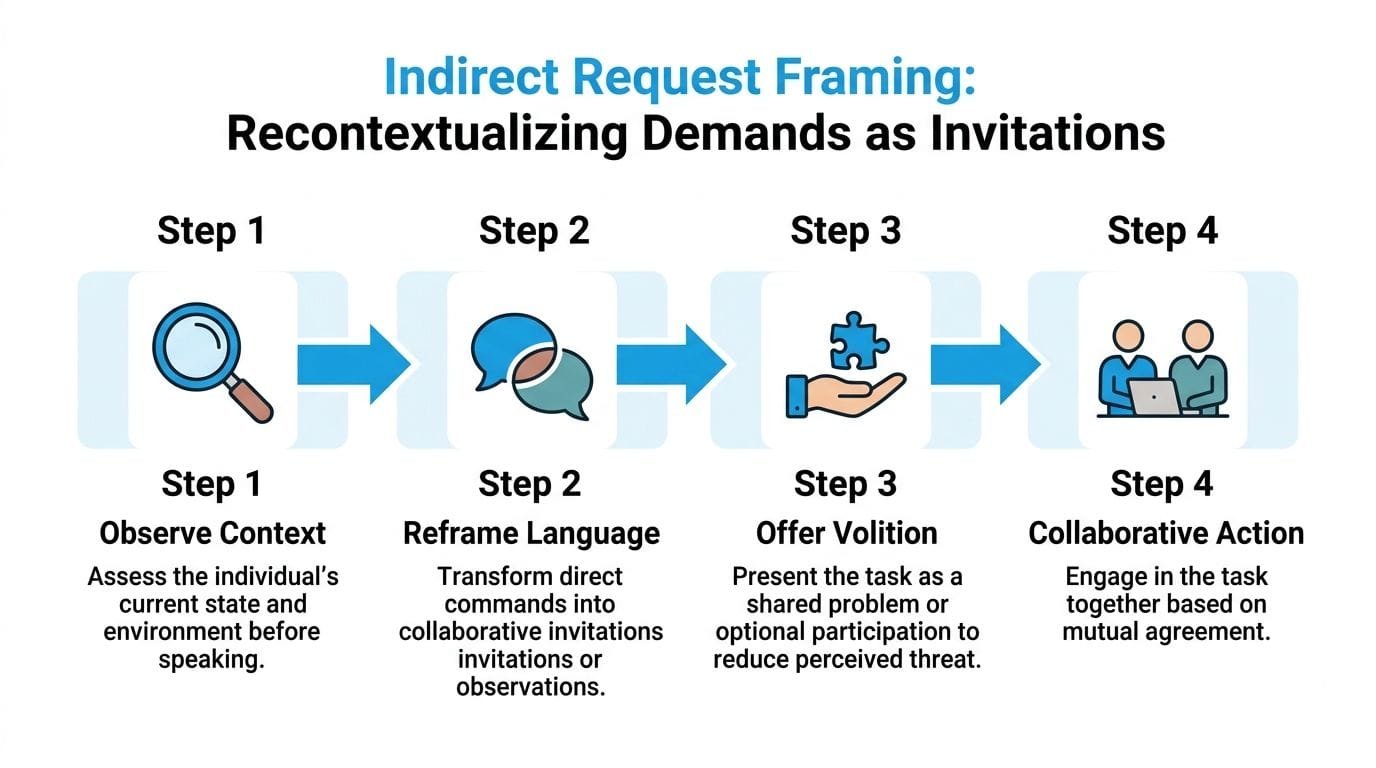
5. Indirect Request Framing
Language changes the emotional meaning of a request. A command places the adult's expectation in the foreground. A collaborative invitation, observation, or open question can reduce the sense of being cornered and leave room for the child's autonomy.
For homework, try, “I'm wondering what would happen if we tried this math problem together?” or, “The homework needs to be done by 6 p.m. How should we tackle that?” For toothbrushing, say, “Your teeth may feel fuzzy. I wonder whether brushing would help,” or, “I'm brushing my teeth before bed. You're welcome to join me.” For a cluttered room, observe, “The floor is getting harder to walk on. What are you thinking about that?”
These phrases aren't magic scripts. A playful invitation may help one day and irritate the child on another, particularly when they recognize that an indirect phrase still carries an expectation. Some children prefer declarative language, while others need a clear, direct explanation without added social interpretation.
Build a phrase library
Use Guiding Growth voice logging to capture the exact wording, context, relationship, time of day, regulation state, and outcome. Over time, your notes can become a personal library of phrases that tend to work for particular routines. Share useful language with teachers and family members so the child receives more consistent communication.
When a child needs support asking for help, practical sensory friendly help seeking tips can offer another perspective on reducing communication pressure.
Avoid turning indirect language into a trick. The child deserves to know what is expected, what is flexible, and what support is available. Record direct and indirect attempts without judging either as universally better. The useful question is which wording lowers distress in which context.
Language should open a door, not hide the demand behind it.
6. Scaffolded Progression
Large tasks often conceal several separate demands. “Get ready for school” may require waking, moving, tolerating light, navigating the bathroom, choosing clothes, managing textures, finding belongings, and switching attention repeatedly. A child may not be refusing the whole routine. They may be stuck at one specific step.
Break the task into visible micro-steps. A morning routine might begin with getting out of bed, placing feet on the floor, walking to the bathroom, turning on the light, sitting near the sink, washing hands, and moving to the clothes area. Homework might start with sitting at the table, opening the backpack, removing the assignment, reading the first problem, solving it, checking the answer, and then approaching the next problem.
The breakdown should match the child's actual sticking point. If “enter the bathroom” is manageable but turning on the light causes distress, the support belongs around lighting, not the entire routine. If opening the assignment triggers avoidance, offer help with materials, reduce visual clutter, or begin with a shared look rather than immediately requiring an answer.
Guiding Growth can record the step where avoidance begins and the conditions around it. Its progress visualizations can make completed steps visible to the child, but don't use the display as a pressure meter. Progress is information, not proof that the child should continue.
The task analysis guide for tying a shoe illustrates how a complex routine can be separated into teachable actions. Apply the same thinking to dressing, bathing, schoolwork, and leaving home.
A micro-step plan can become counterproductive if every movement is controlled by an adult. Invite the child to help choose the sequence, tools, breaks, and stopping points. Share the final plan with teachers and therapists so scaffolding remains consistent rather than becoming another source of unpredictability.
7. Collaborative Problem-Solving Partnership
The most durable solutions often come from understanding what the child finds difficult, not from increasing adult control. Discuss challenging demands when everyone is calm. Start with an observation rather than an accusation: “I've noticed mornings have been hard. Which part feels toughest?”
Listen for the barrier beneath the refusal. The problem may be the transition from breakfast to dressing, the texture of clothing, the number of steps, the uncertainty of a school day, the length of homework, or fear of making a mistake. Ask what would help and accept that the child's first idea may need refinement rather than immediate evaluation.
For homework, you might ask, “Is the subject, the length, the time, or something else making this hard?” Then build a plan together. The child might choose a shorter starting point, body doubling, a different workspace, a break signal, or a way to show understanding without completing every item at once.
Guiding Growth can hold detailed observations without turning them into accusations. Record the child's explanation, the solution they suggest, the adults' adaptations, and the outcome. A shared solutions database helps caregivers notice which ideas have already been tried. Teachers and therapists can add their perspective, while regular reminders support calm check-ins about whether the agreement still works.
Keep collaboration genuine
- Bring observations, not verdicts: Describe what happened, when, and what preceded it.
- Ask before solving: Find out whether the child wants ideas, company, or time.
- Test one adjustment: Change a manageable part of the routine and observe.
- Review together: Ask what helped, what didn't, and what should change.
- Honor a no: A refusal may communicate distress, uncertainty, or insufficient capacity.
A collaborative conversation won't always produce an immediate solution. It does, however, replace an adversarial pattern with shared investigation and gives the child practice in self-advocacy.
Comparison of 7 Demand-Avoidance Strategies
| Approach | Implementation Complexity 🔄 | Resource Requirements ⚡ | Expected Outcomes ⭐ | Ideal Use Cases 📊 | Key Advantages & Practical Tip 💡 |
|---|---|---|---|---|---|
| Sensory & Emotional Regulation First | Medium 🔄, assessment + consistent supports | Medium ⚡, sensory tools, time to implement | High ⭐, fewer avoidance episodes, calmer responses | After sensory overload, before demanding tasks, transitions | Addresses root cause; tip: build a regulation toolkit and track effective strategies |
| Contextual Demand Reduction | Medium 🔄, routine restructuring and timing | Low ⚡, planning, minor environmental tweaks | High ⭐, reduced conflict, better task completion | Post-school, known high-vulnerability windows, noisy environments | Immediate low-cost impact; tip: log high-risk times and cluster demands in high-capacity windows |
| Transparent Expectation Setting | Medium 🔄, advance planning and visuals | Low–Medium ⚡, visual supports, reminders | High ⭐, lowers anxiety-driven avoidance, improves predictability | Appointments, transitions, tasks with deadlines | Increases predictability; tip: use advance notices and track which notice windows work best |
| Collaborative Autonomy (Choices within Boundaries) | Medium–High 🔄, plan acceptable options consistently | Low ⚡, time to pre-plan choices and scripts | High ⭐, boosts cooperation and sense of control | Tasks that allow multiple acceptable approaches, transitions | Restores agency; tip: ensure all offered choices lead to the same required outcome |
| Indirect Request Framing (Invitations) | High 🔄, requires linguistic flexibility and consistency | Low ⚡, caregiver communication skill/time | High ⭐, effective when direct requests fail | Resistance to authority, high-threat perception situations | Reduces perceived coercion; tip: log effective phrasings and avoid manipulative tones |
| Scaffolded Progression (Micro-steps) | High 🔄, detailed task analysis and sequencing | Medium ⚡, visual cues, planning time | High ⭐, reduces overwhelm, builds momentum & confidence | Complex tasks, executive function challenges, perfectionism | Creates repeated wins; tip: celebrate micro-completions and track the step where avoidance begins |
| Collaborative Problem-Solving Partnership | High 🔄, structured conversations, follow-up | Medium ⚡, time, strong communication skills | High ⭐, durable solutions, improved self-advocacy | Recurrent conflicts, willing communicators, long-term change goals | Builds joint solutions; tip: hold calm structured meetings and document mutually agreed strategies |
Turn Daily Experiments Into Shared Understanding
Demand avoidance strategies should be treated as flexible experiments, not compliance formulas. Demand avoidance is not considered a standalone diagnosis in mainstream guidance, and the National Autistic Society explains that reliable prevalence data aren't available because there is no standardized assessment for a diagnosable condition. The organization also describes demand avoidance as an area where evidence remains limited, so families need careful observation rather than certainty based on a label. National Autistic Society guidance on demand avoidance provides useful context for holding that uncertainty responsibly.
The term has a longer history. Developmental psychologist Elizabeth Newson first described pathological demand avoidance in the 1980s and formally presented it in 2003. A Faroe Islands study published in 2015 identified 9 individuals, about 20% of its autistic sample, who met criteria for possible clinical PDA, and estimated 0.18% population prevalence for the combination of autism and PDA. Those findings remain an early reference point, not a universal test for an individual child. The Faroe Islands study and its findings also help explain why broad prevalence claims should be handled cautiously.
Use your records to ask better questions. Was the child regulated? What sensory conditions were present? Did the wording increase pressure? Was the request predictable? Which step caused the block? Did the child have a meaningful choice? Did pausing reduce distress, or did uncertainty make the next attempt harder?
The reported experiences of mothers of autistic children with a PDA profile emphasize adapted parenting, lower direct pressure, flexibility, and attention to anxiety and autonomy needs. This qualitative study of mothers' experiences supports the practical value of individualized, collaborative care rather than standard compliance-based methods. A clinical review of extreme demand avoidance in adults likewise discusses anxiety-reducing, low-demand, low-arousal support and cautions that rigid boundaries or contingency-based approaches can backfire. The clinical review on extreme demand avoidance is relevant when families and professionals are reviewing escalation patterns.
Start with one high-impact change. Log the demand, setting, timing, wording, regulation state, response, and outcome in Guiding Growth. Review those notes with educators, therapists, and medical professionals, especially when avoidance is frequent, distressing, or affecting safety and daily functioning. The aim isn't perfect compliance. It's improved communication, lower distress, greater autonomy, and practical participation when the child has enough capacity.
Guiding Growth can help replace fragmented observations with shared notes that caregivers and professionals can use. Keep safety first, treat communication as meaningful, and change the plan when the child's responses show that a strategy is increasing pressure.
Guiding Growth brings demand avoidance logs, contextual triggers, outcomes, routines, reminders, and shared caregiver observations into one mobile app. Visit Guiding Growth to organize patterns around regulation, timing, communication, and collaboration, then coordinate more consistent support with the people involved in your child's care.