You sit down to work. Your shoulders are already tight. The room isn't loud exactly, but the hum of the laptop, the tag in your shirt, the pressure of staying still, and the constant urge to shift in your seat all start piling up. By mid-morning, you're not just distracted. You feel off in your own body.
A lot of adults live in that space every day. Some feel pulled toward movement and can't focus unless their body is doing something. Others feel overloaded fast and need less input, not more. Both experiences are valid. Neither means you're failing at being “productive” or “calm.”
A sensory chair for adults can help because it gives your nervous system something organized to work with. Instead of fighting your body, you use a chair that supports the kind of input you need. For one person, that might mean a gentle rock while reading. For another, it might mean a low-profile wobble stool at a desk. For someone else, it might mean curling into an enclosed chair after a draining day.
The key is not finding the “best” sensory chair. It's finding the one that matches your body, your goals, and the setting you live in.
Table of Contents
- Finding Your Anchor in a World of Noise
- Understanding the Need for Sensory Regulation
- Common Types of Adult Sensory Chairs
- How to Choose the Right Sensory Chair
- Real-World Use Cases and Alternative Solutions
- Embracing a More Comfortable and Regulated Life
Finding Your Anchor in a World of Noise
An adult client once described it this way: “I'm either underpowered or overwhelmed. I'm rarely in the middle.” That's the experience many people are trying to solve when they start looking for a sensory chair for adults.
Maybe you pace during phone calls because sitting still makes it harder to think. Maybe you avoid certain waiting rooms, shared offices, or family gatherings because your body never quite settles there. Maybe evenings are the hardest part. You get home, sit down, and somehow still can't come down from the day.
A sensory chair isn't magic, and it isn't a cure. It's a tool. The right one can help your body feel more organized, more supported, and less at war with itself.
Sometimes the goal isn't “sit still.” It's “feel steady enough to do what matters.”
That distinction matters for adults because adult life asks a lot of us. You may need a chair that helps you stay engaged during computer work, but doesn't look out of place on a video call. You may want something calming in your living room that feels like furniture, not equipment. You may also need to think about durability, cleaning, shared spaces, and whether the chair fits your body.
Here's where people often get confused. They assume sensory chairs are just children's tools made bigger. Some products are marketed that way. But adult sensory support is different because the context is different. Work, relationships, fatigue, autonomy, and recovery all shape what “helpful” means.
A good sensory chair for adults meets a real need. It might give movement to a body that focuses better with motion. It might provide contained pressure that feels grounding after sensory overload. It might become the one place in your home where your nervous system stops bracing.
Understanding the Need for Sensory Regulation
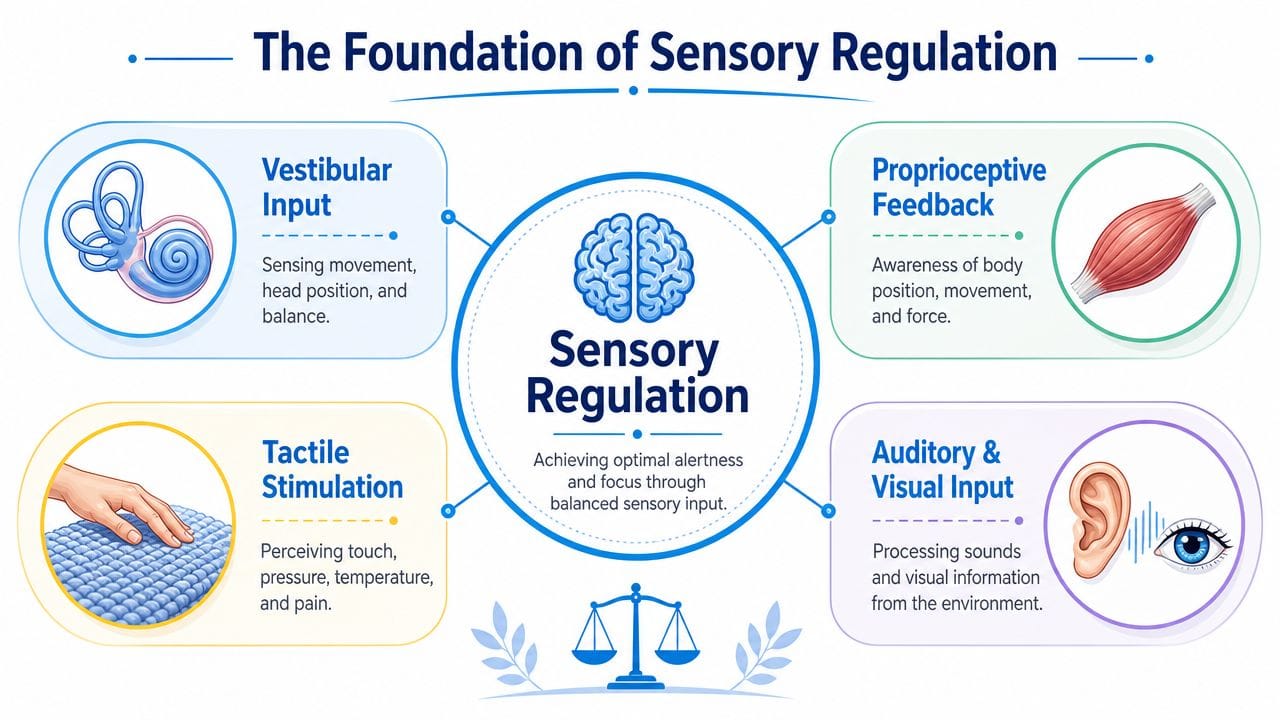
Sensory regulation is your body's way of finding the right level of alertness for the moment. Not too revved up. Not too shut down. Just supported enough to work, rest, talk, think, or recover.
For some adults, that balance happens easily. For others, it takes more active support. That's especially relevant for autistic adults. In a study of 49 autistic adults, 96% reported sensory reactivity differences, including 93.9% with sensory hyperreactivity and 41.4% with sensory seeking in this published study on sensory features in autistic adults. That helps explain why one person may crave movement while another may need a quieter, more contained setup.
Why regulation matters for adults
If you've ever said, “I can't think unless I'm moving,” or “I need everyone to stop talking so my brain can work,” you're already describing sensory regulation.
Some adults need more input to feel awake and organized. Others need less input because their system notices too much at once. Many people move between those states depending on sleep, stress, pain, hormones, workload, or environment.
Here is a simple perspective:
- Vestibular input comes from movement and balance. Rocking, spinning, swaying, and shifting all feed this system.
- Proprioceptive input comes from muscles and joints. Many adults experience this as grounding pressure or body awareness. I often describe it as a kind of “hug” for the nervous system.
- Tactile input comes through touch, texture, and pressure.
- Auditory and visual input come from the surrounding environment, which can either support or drain your focus.
If you want a broader plain-language explanation of what nervous system overload can feel like in daily life, Be Your Best Self & Thrive's guide offers a helpful overview.
What the chair is actually doing
A sensory chair doesn't “fix behavior.” It changes the quality of input your body receives while you sit.
That's why two adults can try the same chair and have opposite reactions. A wobble stool may help one person stay engaged during emails, but make another person feel too activated. A pod chair may feel wonderfully calming to one adult and too enclosed for someone else.
Practical rule: Match the chair to the state you want to reach, not the state you're trying to escape.
If your body seeks movement, controlled motion may help you concentrate. If your body gets overloaded easily, a chair with more containment and less visual exposure may feel better. The chair is not the goal. The goal is a nervous system that feels more workable.
Common Types of Adult Sensory Chairs
The adult market is no longer tiny. One retailer lists 37 adult sensory-chair-related products under adult autism-related searches, which shows that adult demand is established in this overview of sensory chair options and uses. But the options can blur together fast, especially when product names are inconsistent.
The easiest way to sort them is by what kind of input they offer and what kind of task they support.
Chairs for focus and steady movement
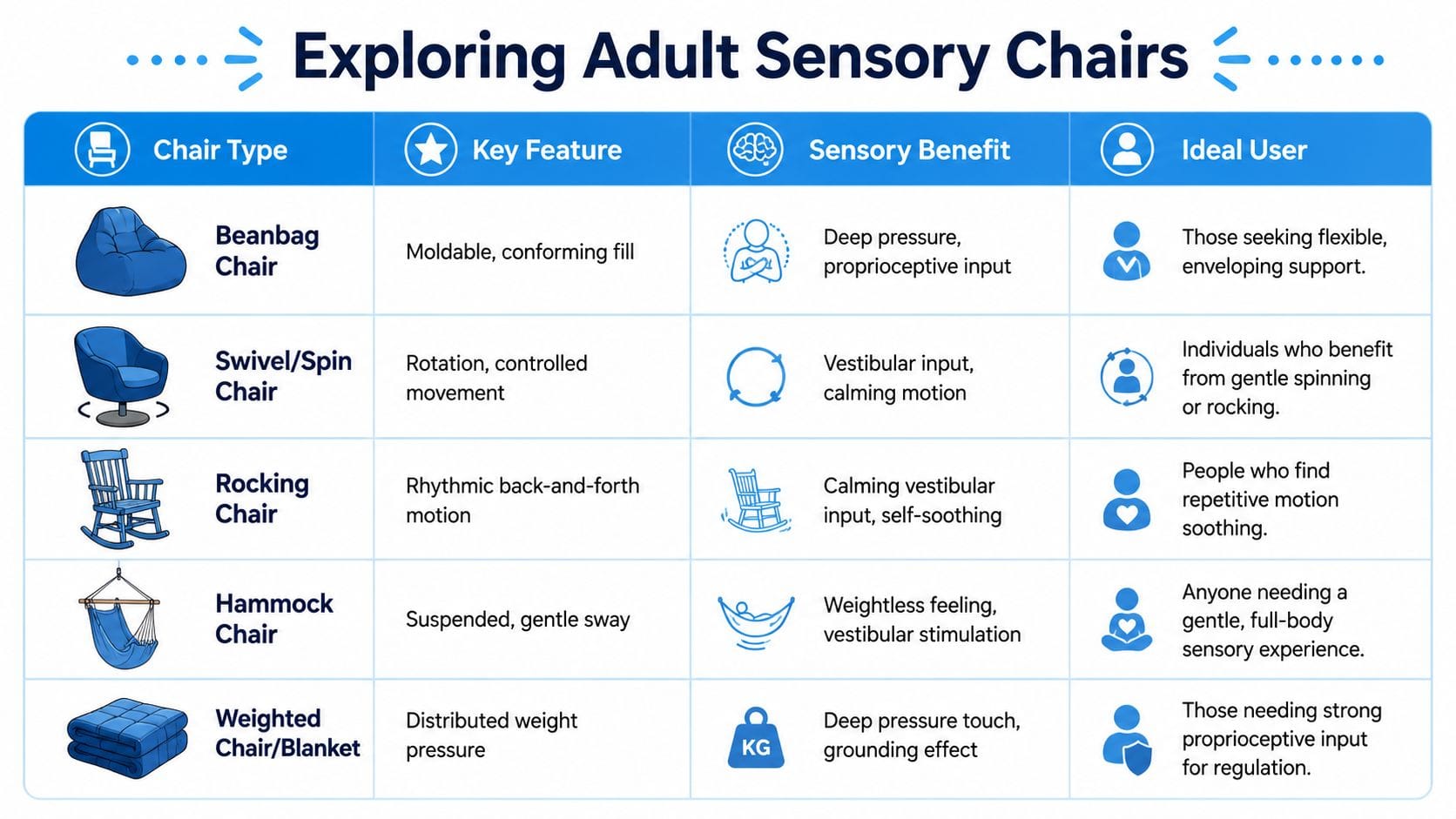
Some adult sensory chairs are best understood as active seating. Independent summaries describe these chairs as delivering vestibular and proprioceptive input through controlled motion, such as spinning, wobbling, or rocking. Those same summaries note that movement can reduce fidgeting, while pod-style chairs add deep-pressure input used to lower anxiety and improve body awareness in people with sensory processing challenges, as described in this sensory chair and pod chair overview.
Here are the most common movement-based options:
| Chair type | What it feels like | Best fit for |
|---|---|---|
| Wobble stool | Small shifts through the hips and core | Desk work, study sessions, short bursts of focus |
| Swivel or spin chair | Rotational movement | Adults who regulate through controlled spinning or turning |
| Rocking chair | Rhythmic back-and-forth motion | Reading, recovery, phone calls, evening wind-down |
| Glider | Smoother, more contained motion than a rocker | Adults who want motion with a more furniture-like feel |
Rockers and gliders are often lumped together, but they don't feel the same. If you're trying to choose between them for a home setup, this plain-language piece that helps compare gliders and rockers can make the difference easier to picture.
Chairs for calm and decompression
Other chairs are less about staying alert and more about lowering demand.
These include pod chairs, cocoon-style seats, beanbag-style loungers, and crash-pad-style setups. They often provide a sense of enclosure, body contact, or deep support. For some adults, that feels protective and organizing. For others, it can feel too warm, too restrictive, or too hard to get in and out of.
A few patterns tend to help:
- Pod and cocoon chairs suit adults who want less visual clutter and more containment.
- Beanbag-style seating can work well for lounging, reading, or decompressing after social effort.
- Hammock-style seating may feel soothing if suspended sway helps your body settle.
- Weighted lap tools paired with a standard chair can be a better fit if you want grounding without changing all your furniture.
The same chair can be calming in one setting and distracting in another. A swivel chair may help during a movement break, then feel like too much during paperwork.
That's why “best sensory chair for adults” is never a single answer. The question is whether the motion, pressure, and posture match the moment you need support.
How to Choose the Right Sensory Chair
If you shop by product category alone, it's easy to buy something that looks promising but doesn't help in real life. Start with the job the chair needs to do.
Start with the goal, not the product
Ask yourself which of these sounds most familiar:
- I need help focusing while I work. A wobble stool, active stool, or subtle swivel seat may fit best.
- I need to come down after work or social time. A rocker, glider, or enclosed pod-style chair may be more useful.
- I want less fidgeting, not no movement. Look for controlled movement rather than a fully fixed seat.
- I want to feel held and grounded. A deeper, more enveloping seat or a standard chair paired with pressure-based supports may be better.
This sounds simple, but it's a common pitfall. Buyers often purchase for appearance first, then try to force the chair into a role it can't do well.
Check adult fit and safety first
Adult use changes the buying criteria. A chair might be labeled for adults, but that doesn't mean it's equally suited for every adult body or every purpose.
One commercially listed adult spinning sensory chair is rated to 220 lb, weighs 16 lb, and has a 7.8 in seat depth, while pod chairs marketed for adults may have a 300 lb weight capacity and an enclosed design intended to create a sensory cocoon, as shown in this retail listing describing adult spinning and pod chair specifications.
Those details matter because they tell you what the chair is built to do.
Use this quick screening checklist:
- Weight capacity: Make sure the listed capacity fits the intended user with margin for comfortable use.
- Base stability: Check whether the base is broad and steady enough for the kind of movement the chair allows.
- Seat geometry: Seat depth, width, and back support affect whether a chair feels regulating or awkward.
- Transfer ease: If you have pain, fatigue, dizziness, or mobility concerns, test how easy it is to get in and out.
- Surface feel: Texture matters. Some fabrics soothe. Others irritate immediately.
If you're also exploring wearable sensory supports, this guide on how weighted wearables help with sensory regulation can help you think through whether your needs are better met through seating, body-based pressure, or both.
Selection shortcut: If a chair doesn't fit your body safely, its sensory features don't matter.
Think about where you'll actually use it
The same adult may need different tools in different rooms.
At work, a discreet active stool might be ideal because it lets you move without drawing attention. At home, you may prefer a deeper chair that signals rest. In a shared household, sound matters too. Some rockers are quiet. Some swivel bases scrape or click. That can change whether a chair feels calming or aggravating.
Here's a useful demo to help you visualize movement and setup before buying:
Also think about routine. If the chair lives across the house from the place where you get overloaded, you may not use it in time. The best sensory chair for adults is often the one you'll reliably reach for when your system starts drifting.
Real-World Use Cases and Alternative Solutions
A sensory chair is most helpful when it fits into ordinary life, not just ideal conditions.
What this can look like in daily life
In a home office, an adult might use a low-profile wobble stool during computer work because it gives subtle movement without taking over the room. In a reading nook, a glider or rocker may work better because the rhythm supports longer, quieter attention. In a den or bedroom, a pod-style chair may become the place where someone decompresses after noise, errands, or masking through the day.
Those are all valid uses. So is using a sensory chair for only ten minutes at a time.
A few practical examples:
- Workday support: Use movement-based seating during admin tasks, meetings without cameras, or brainstorming.
- Transition time: Sit in a calming chair after commuting, grocery shopping, or a demanding social event.
- Shared household reset: Keep one chair in a lower-traffic corner where visual and sound demands are lower.
- Reading and hobbies: Choose gentle motion if stillness makes it harder to stay with the activity.
If a chair isn't the right fit
Sometimes a chair helps, but not enough. Sometimes it's the wrong tool entirely.
If you need more environmental control, sound may be the bigger issue than seating. In that case, a resource on how to choose noise-canceling headphones for autism can be more relevant than another chair comparison.
Other options can also work well:
- Weighted lap pads or blankets: Useful when you want grounding pressure in an existing chair.
- Footrests or resistance bands on chair legs: Helpful for adults who regulate through leg movement.
- Fidgets or therapy putty: Good for hand-based input during calls or meetings.
- Lighting changes: Softer, less harsh light can reduce overall load.
- Scheduled movement breaks: Sometimes the body needs a walk, stretch, push, or carry task more than seated input.
A sensory tool doesn't have to be impressive to be effective. It just has to meet the need you actually have.
That wider view matters because adult sensory support isn't about owning a special product. It's about building a daily setup that helps you focus, recover, and feel more comfortable in your own space.
Embracing a More Comfortable and Regulated Life
Adult sensory needs are real. They don't disappear because you have a job, bills, responsibilities, or years of practice pushing through discomfort.
The right sensory chair for adults can make daily life feel less effortful. It can support focus without forcing stillness. It can offer calm without requiring you to explain why you need it. And it can help replace the exhausting habit of overriding your body with something more sustainable, which is listening to it.
The most useful shift is this one. Stop asking whether a chair looks “normal” enough or whether you should be able to cope without it. Start asking whether it helps you think, rest, recover, or participate with less strain.
For some adults, that answer will be a wobble stool at a desk. For others, it will be a glider, a pod chair, or even a standard recliner with motion that feels soothing. If you're exploring motion-based comfort in a more traditional furniture style, looking at an auto glide power recliner can also help you notice which movement qualities appeal to you, even if you choose a different final setup.
The broader lesson goes beyond seating. Sensory support works best when your environment matches your nervous system instead of fighting it. If workplace comfort is part of the puzzle, this guide to an ultimate sensory-friendly workplace design guide offers more ideas for shaping a space that feels usable, not draining.
You don't need the perfect setup on the first try. You need a thoughtful one. A chair that fits your body, your setting, and your reason for using it can become an anchor point in the day. That's not a luxury. It's a form of care.
If you're supporting a neurodivergent child and want the same kind of clarity around sensory needs, Guiding Growth can help. The app makes it easier to track triggers, routines, calming strategies, sleep, food, and behavior patterns in one place, so families can spot what's working and share useful insights with caregivers and professionals.