You hear it through the baby monitor or from the next room. A harsh, repetitive grinding sound in the middle of the night. In the morning, your child seems fine, but you're left wondering whether this is sensory, stress, sleep, pain, or something else entirely.
If you're dealing with teeth grinding and autism in your home, you're not overreacting. This is a real concern, and it deserves more than “wait and see” or “just get a mouthguard.” Parents usually need a clearer answer to the question underneath the behavior. Why is my child doing this, and what will actually help?
Table of Contents
- That Sound at Night Is a Common Concern
- Why Teeth Grinding Is Common in Autistic Children
- Recognizing the Signs and Potential Health Risks
- Practical Management and Support Strategies
- How to Monitor and Document Episodes for Better Insights
- Building Your Child's Collaborative Care Team
- A Path Forward for Your Family
That Sound at Night Is a Common Concern
For many parents, teeth grinding becomes real the first time they hear it at night. It doesn't sound minor. It sounds forceful, uncomfortable, and hard to ignore. A lot of families tell me the same thing. They aren't sure whether to call the dentist, the pediatrician, or nobody at all.
The first helpful thing to know is that this isn't rare in autistic children. Reported rates range up to 60% in autistic children, compared with approximately 7.2% in neurotypical peers in research summarized in this review on bruxism in autism. That matters because it reframes the behavior. This is not merely a bad habit or a parenting failure.
Practical rule: When a behavior is common in autistic children, start by asking what function it serves before trying to stop it.
Some children grind mostly during sleep. Others clench or grind during transitions, while concentrating, or when they're overloaded. In some homes, the sound shows up during periods of poor sleep, which is one reason nighttime waking and grinding often need to be looked at together. If sleep has also become a struggle, this guide on why autistic kids wake at night and common causes can help you think more broadly about what may be happening.
You may also want a plain-language dental overview such as this article on DentalHealth.com for bruxism help, especially if you're trying to sort out immediate tooth-protection questions while you investigate the deeper cause.
Why Teeth Grinding Is Common in Autistic Children
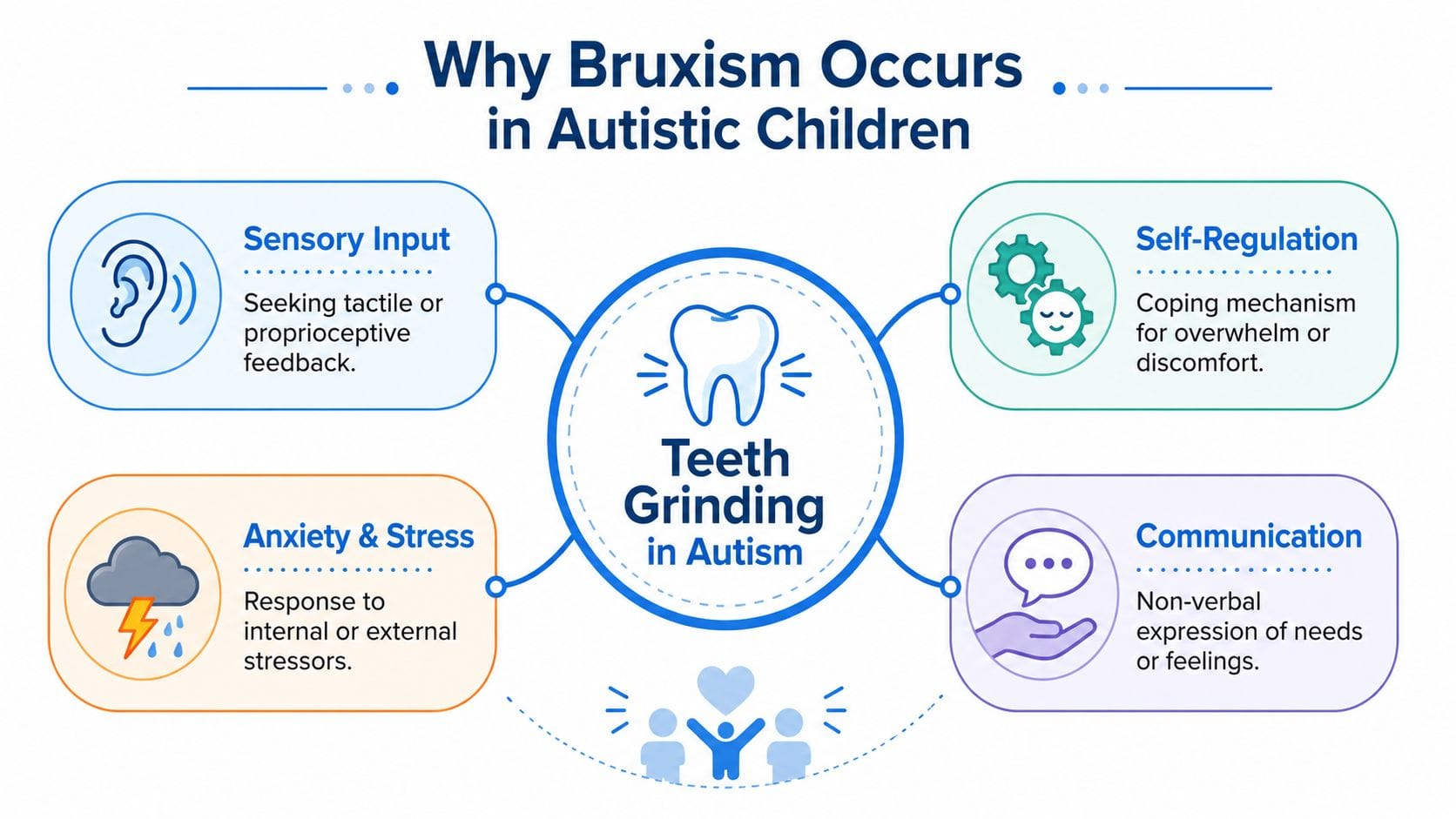
Teeth grinding often makes more sense when you stop viewing it as only a dental problem. In many autistic children, it functions more like a body-based strategy. It can provide input, release tension, communicate discomfort, or show up when the nervous system has trouble settling.
It can be sensory, emotional, physical, or sleep-related
A child who seeks strong oral input may grind because jaw pressure feels organizing. Another child may grind during stress because clenching gives their body a predictable signal when everything else feels chaotic. Some children start when they're uncomfortable but can't easily explain what hurts.
These are common patterns clinicians consider:
- Sensory seeking: Grinding can provide heavy jaw input and oral feedback.
- Self-regulation: Some children grind when they're trying to calm, focus, or stay organized.
- Stress or anxiety: Grinding may increase during hard transitions, overload, or internal tension.
- Pain or discomfort: Dental issues, jaw tension, or other physical discomfort can drive the behavior.
A useful mindset shift is this. Teeth grinding is sometimes less like “misbehavior” and more like a clue. If you only try to block the grinding, you may miss the reason it started.
If grinding changes with stress, sleep, transitions, or pain, the pattern usually tells you more than the sound itself.
Sleep deserves more attention than it usually gets
Sleep is one of the most overlooked parts of the picture. A 2024 Japanese birth-cohort study found that shorter neonatal sleep duration was associated with later bruxism in children with ASD, with an approximately 1.6-fold higher risk according to the published study. That doesn't mean every child who grinds has the same sleep pathway. It does mean sleep shouldn't be treated as a side issue.
For parents, the practical takeaway is straightforward. If grinding is frequent, look at the whole night. Bedtime resistance, short sleep, fragmented sleep, early waking, and next-day irritability can all matter. Sometimes the grinding is one piece of a broader arousal pattern rather than a standalone oral habit.
Here's how I explain it to families. A mouthguard protects teeth. It does not calm an overloaded nervous system, reduce bedtime stress, or solve repeated night wakings. That's why treatment works better when the plan matches the function.
A quick way to think about it is this:
| Pattern | What it may suggest |
|---|---|
| Grinding during overload or transitions | Sensory or stress response |
| Grinding mostly at night | Sleep dysregulation or jaw habit during sleep |
| Grinding with facial tension or complaints of pain | Dental, jaw, or physical discomfort |
| Grinding during boredom or under-arousal | Sensory input seeking |
That's the foundation for everything that follows. Parents usually get the best results when they stop asking only, “How do I stop this?” and start asking, “What is this doing for my child right now?”
Recognizing the Signs and Potential Health Risks
Sometimes the first sign is the noise. Sometimes there is no noise at all, and the first clue comes from the teeth, jaw, or morning routine.
What parents often notice first
Night grinding is the most obvious sign, but it's not the only one. Daytime jaw clenching can look quieter and easier to miss. Some children tighten their jaw during transitions, screen time, or tasks that demand a lot of focus.
Look for signs like these:
- Audible grinding: A scraping or crunching sound during sleep.
- Morning discomfort: Jaw soreness, facial tension, headaches, or complaints around the ears after waking.
- Visible tooth changes: Flattened biting surfaces, small chips, or teeth that suddenly seem more worn.
- Oral sensitivity: Avoiding cold foods, brushing discomfort, or reacting to pressure around the mouth.
- Jaw mechanics: Clicking, stiffness, or reluctance to open wide when eating or brushing.
Parents also notice behavior changes that don't sound dental at first. A child may wake irritable, chew more aggressively, avoid certain textures, or resist toothbrushing because their mouth already feels tender.
Don't wait for a child to describe jaw pain clearly. Many children show discomfort through behavior before they put it into words.
When grinding starts affecting health and daily life
The risk isn't that every child who grinds will develop a serious problem. The risk is that repeated grinding can slowly create wear, pain, and poor sleep if nobody is tracking the pattern.
The main concerns include:
- Tooth wear: Enamel can wear down over time.
- Chips or cracks: Forceful grinding can damage teeth.
- Jaw strain: Repeated clenching may irritate the jaw joint and surrounding muscles.
- Sleep disruption: Grinding can go along with restless nights for the child and for everyone else in the house.
A simple response often works best at first. Check the mouth in good light. Notice whether your child avoids chewing on one side, rubs their jaw, or seems uncomfortable with brushing. If you're seeing damage, pain, or worsening sleep, it's time to involve professionals rather than trying random products at home.
Practical Management and Support Strategies
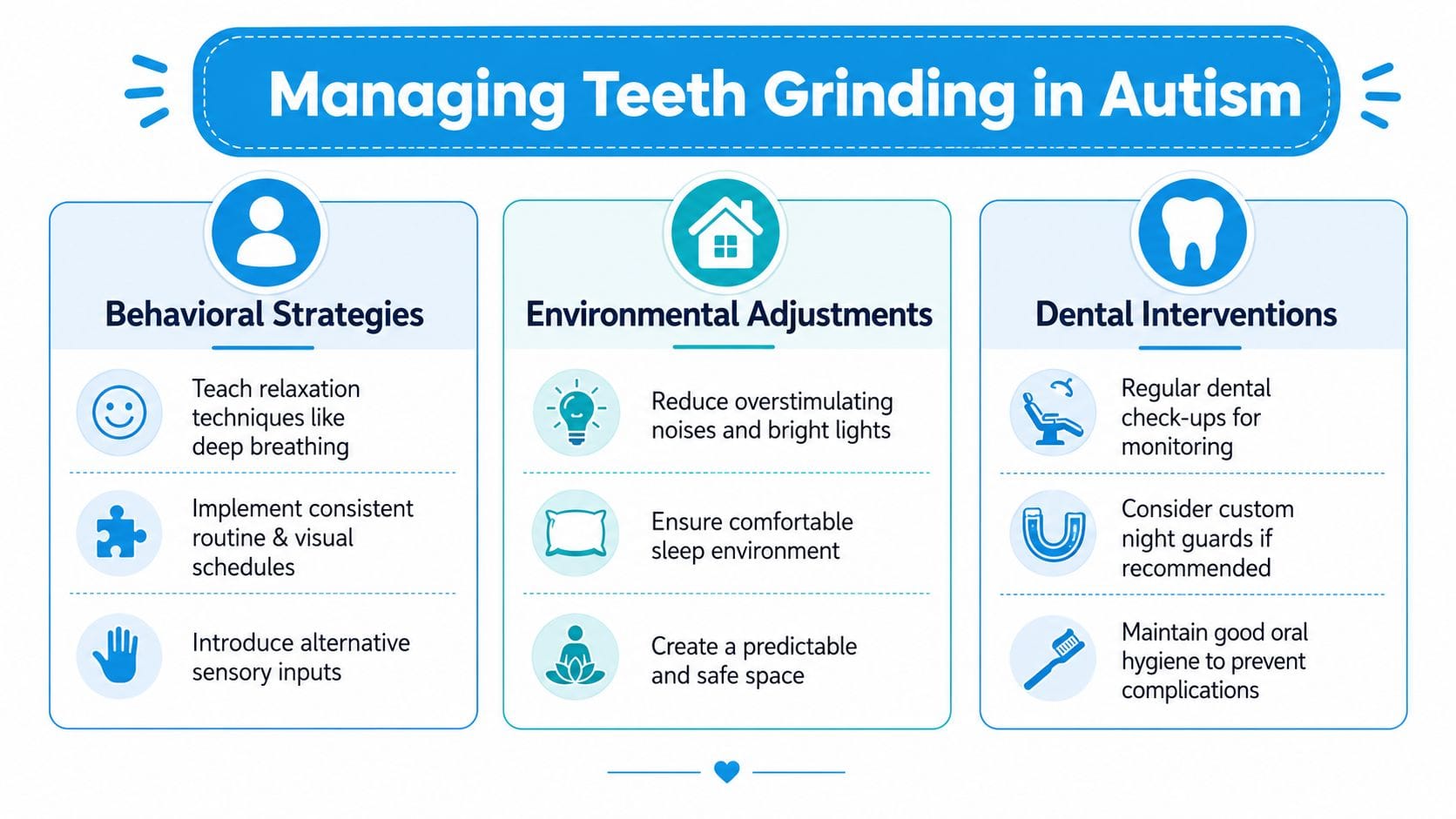
The best plan usually combines behavior support, sensory support, sleep support, and dental protection. Families often get stuck when they try one tool in isolation. A chew necklace may help one child and do nothing for another. A mouthguard may protect teeth but still leave the actual trigger untouched.
Start with function, then build the plan around that.
Behavioral supports that address the function
If the grinding appears to meet a sensory need, offer another way to meet that need before the child gets to the point of clenching hard. For some children that means chewy foods, safe oral sensory tools, or structured heavy-work activities earlier in the day. Families looking at broader regulation tools may find this guide on sensory tools that help calm meltdowns useful because oral input often fits into a bigger sensory pattern.
For older children and teens who can notice the behavior, a more direct behavior approach may help. Habit reversal training has been discussed in clinical settings for adolescents with autism, including awareness training, a competing response, and reinforcement, as described in this discussion of HRT for teeth grinding in adolescents with autism. This is not the right fit for every child. It works best when the child has enough awareness and buy-in to practice a replacement response.
Useful behavior supports often include:
- Replacement input: Give safe chewing or oral sensory options during times the grinding usually appears.
- Pattern interruption: If the child can tolerate it, cue a neutral competing action such as relaxing the jaw, sipping water, or using a planned oral tool.
- Reinforcement: Notice and reward the replacement behavior, not just the absence of grinding.
One thing that usually doesn't work well is constant correction. Repeatedly saying “stop grinding” often adds stress without solving the reason the child started.
A short video can help if you're trying to think about calming strategies more broadly before bed or during stress.
Environmental changes that lower the load
Children who grind more when they're overwhelmed often benefit from reducing the total load on the nervous system. That means looking beyond the jaw.
Try adjusting the environment in practical ways:
- Evening routine: Keep the pre-sleep routine predictable and low-demand.
- Sensory load: Reduce bright lights, abrupt noise, and rushed transitions when possible.
- Recovery time: Build in quiet breaks after school, therapy, or busy outings.
- Body comfort: Watch for hunger, congestion, reflux, or other discomfort that may increase tension.
Many parents notice trade-offs. A child may need more oral input during the day but less stimulation at night. Another child may benefit from crunchy foods earlier, but not close to bedtime if chewing revs them up.
The question isn't “What's the best tool?” It's “What reduces this child's need to grind right now?”
Dental protection has a role, but it is not the whole plan
Dental care matters. If teeth are wearing down, chipping, or becoming sensitive, a pediatric dentist should assess the mouth and jaw. Some children tolerate a custom night guard well. Others reject it completely or remove it in their sleep.
Mouthguards are protective, not curative. They can be very useful when the goal is preventing damage, but they don't treat sensory seeking, anxiety, pain, or sleep disruption. If you want a general dental overview of ways to prevent teeth grinding, that can be a good starting point for questions to bring into your child's appointment.
A practical way to decide what's worth trying is to ask:
| Approach | Best use | Limitation |
|---|---|---|
| Sensory replacement | When grinding meets an oral sensory need | May not help if pain or sleep is the driver |
| Bedtime routine changes | When grinding clusters around poor sleep | Takes consistency and time |
| Habit reversal training | For older children with awareness | Not suitable for every child |
| Mouthguard | Protecting teeth from wear | Doesn't address the cause |
How to Monitor and Document Episodes for Better Insights
Parents usually know more than they think they do. The problem is that the information is scattered. A note in your phone. A message to your partner. A vague memory that the grinding was worse after a short night or a rough school day. Patterns stay hidden when the data lives in fragments.
Use simple tracking that answers real questions
The most useful method is antecedent, behavior, consequence tracking, often shortened to ABC tracking. You write down what happened before the grinding, what the grinding looked like, and what happened after. This helps separate guesses from patterns.
Sleep should be part of that record. Clinically, the sleep-bruxism connection is strong enough that providers recommend logging grinding episodes alongside total sleep time, night wakings, sleep onset, and next-day irritability. If you want a practical framework, this article on how to track sleep and health for autistic kids shows the kind of observations that make appointments more productive.
Here's what parents often discover once they track for a while:
- A timing pattern: grinding is heavier on nights with delayed sleep or fragmented rest.
- A trigger pattern: it spikes after school, transitions, illness, or sensory overload.
- A relief pattern: it drops when pain is treated, sensory input is planned earlier, or evenings become more predictable.
A good log turns “It happens a lot” into “It happens after these conditions.”
What to write down after each episode
Keep it short enough that you'll do it. You don't need a perfect diary. You need usable clues.
Record details such as:
- When it happened: bedtime, middle of the night, waking, car ride, homework time.
- What came before: stress, hunger, noise, transitions, illness, screen time, toothbrushing, denied request.
- What it looked like: grinding, clenching, chewing, facial tension, duration if you can estimate it.
- What came after: fell asleep, escalated, calmed, complained of pain, woke fully.
- Other body signals: congestion, drooling, reflux signs, ear pulling, headache, irritability.
If you're sharing care across households or with grandparents, consistency matters more than detail. Everyone should use the same labels. “Grinding,” “clenching,” and “chewing shirt collar” may look related but mean different things.
A brief weekly review is often enough. Ask yourself three questions. When does it happen most? What seems to set it off? What makes it easier? Those answers are far more useful than a long list of isolated incidents.
Building Your Child's Collaborative Care Team
Teeth grinding often sits at the intersection of multiple systems. Mouth, jaw, sleep, stress, sensory regulation, behavior. That's why one professional rarely sees the full picture alone.
Who to involve and what each person adds
A collaborative team usually starts with the people most likely to touch the problem from different angles.
- Pediatrician: Rules out medical contributors, reviews sleep concerns, and helps think through pain, reflux, congestion, medication timing, or broader health issues.
- Pediatric dentist: Checks for wear, cracks, bite concerns, oral pain, and whether a protective device is realistic.
- Occupational therapist: Helps if the grinding appears sensory-based or tied to regulation and oral-motor needs.
- Behavior specialist or therapist: Helps identify patterns, build replacement behaviors, and reduce triggers when the behavior has a clear functional pattern.
Some families also benefit from seeing practices that work comfortably with neurodivergent children. If you're looking for examples of how dental and orthodontic care can be adapted, this page from Impact Orthodontics on diverse abilities gives a useful sense of what supportive care can look like.
Bring observations, not just worry
The most productive appointments happen when parents arrive with examples instead of only a summary. “He grinds at night” is a start. “He grinds after short sleep, during hard transitions, and when he has congestion” is much easier to act on.
Function-based assessment matters because the same behavior can come from different drivers. In practice, antecedent-behavior-consequence tracking helps distinguish sensory seeking, stress, pain, and sleep-related patterns, which is why treatment may need sensory replacement, a dental workup, or a sleep intervention rather than one universal fix. That's the core reason coordination works better than isolated advice.
A simple handoff sheet for appointments can include:
| Bring to the visit | Why it helps |
|---|---|
| Recent grinding patterns | Shows frequency and timing |
| Sleep notes | Helps identify overnight links |
| Photos or notes on tooth changes | Gives the dentist specific concerns |
| Trigger list | Helps narrow likely function |
| What you already tried | Prevents repeating unhelpful steps |
When everyone sees the same information, the plan gets sharper. Parents often become the connector on that team, and that role matters more than people realize.
A Path Forward for Your Family
Teeth grinding and autism can feel urgent, especially when it interrupts sleep or you start worrying about tooth damage. But this is a manageable problem when you approach it with curiosity instead of panic. The key is to stop treating grinding as a single issue and start reading it as a signal.
When you identify the likely function, protect the teeth when needed, reduce triggers, and track patterns carefully, you give your child a much better chance of relief. You don't need to solve everything tonight. You need a clear next step and a way to notice what changes.
If you want one place to organize sleep, behavior, triggers, routines, and care notes without relying on scattered paper logs, Guiding Growth can help. It's built for parents of autistic and neurodivergent kids who need a simpler way to track patterns, share observations, and make calmer, better-informed decisions with their child's care team.