You ask a simple question. Your child freezes.
Maybe you're in the grocery store and they suddenly can't answer whether they want the red crackers or the blue box. Maybe you're in the car line at school and they look overwhelmed, upset, and completely done with words. Maybe at home they usually speak in full sentences, but once they're tired, sick, overloaded, or pushed too hard, speech seems to disappear.
That moment can feel confusing. Parents often wonder, “If my child can talk sometimes, why can't they talk now?” The short answer is that communication isn't always steady. For many autistic children, it changes with stress, sensory load, fatigue, illness, and emotional state.
That's where ASD communication cards can help. Not as a backup for “only non-speaking kids,” and not as a last resort, but as a practical support your child can reach for when speech is hard, slow, or unavailable. A simple visual card can turn a meltdown spiral into a clear message: break, help, too loud, I need water, don't touch me, yes, no.
Parents often feel relief when they realize communication cards don't have to be complicated. They can start small. They can be personalized. And they can become part of a calmer daily rhythm, especially when paired with other visual supports for communication and connection, like these visual supports for social skills training.
Table of Contents
- Bridging the Communication Gap with Visual Tools
- What Are ASD Communication Cards
- Exploring Types of Communication Card Systems
- Why Visual Supports Are So Effective for Autistic Brains
- How to Create and Customize Your First Card Set
- Introducing and Using Cards Effectively
- Advanced Strategies and Team Collaboration
Bridging the Communication Gap with Visual Tools
A parent once described mornings this way: her son could tell her every dinosaur fact he knew at breakfast, but if she asked him to put on shoes after a noisy, rushed start, he dropped to the floor and stopped talking. To people outside the home, that looked inconsistent. To her, it felt impossible to predict.
What changed things wasn't forcing more speech. It was giving him another path.
She started with three cards on a small ring: help, break, and all done. At first, she handed him the card while saying the word. Later, he began reaching for one himself. The problem wasn't that he had nothing to say. The problem was that in hard moments, speech wasn't the easiest tool available.
That's the heart of ASD communication cards. They reduce the number of steps a child has to take to get a message out. Instead of finding the word, organizing the sentence, pushing through stress, and getting it all out in time, your child can point, hand over a card, or show an image.
Practical rule: If your child communicates well in calm moments but struggles under pressure, cards may still be a strong fit.
Visual tools also help adults respond better. When a child hands you a card that says too loud, you don't have to guess whether they're refusing, ignoring, or “acting out.” You have usable information. That changes the interaction right away.
Many families start using cards because they want fewer meltdowns. That makes sense. But the bigger benefit is often this: your child feels understood faster, and you stop carrying the full burden of constant interpretation.
What Are ASD Communication Cards
ASD communication cards are small visual supports that help a child send or understand a message. Think of them as a portable visual language. Some cards show wants, like snack or iPad. Others show body states, feelings, directions, people, places, or responses such as yes, no, wait, and stop.
They don't all look the same. One child may use color photos of real objects. Another may use simple symbols. A third may use written words with small icons. The right format depends on what your child notices, understands, and uses comfortably.
What cards can help a child say
Cards often support four everyday jobs:
- Express needs: bathroom, drink, help, break
- Make choices: apple or banana, swing or slide
- Understand what happens next: first work, then snack
- Share internal states: mad, sad, too loud, tired
That last category is where parents often see a major shift. Children don't just need a way to ask for things. They also need a way to tell you what's happening inside their body and mind.
They don't replace speech
A very common fear is, “If I give my child cards, will they stop talking?”
The evidence doesn't support that fear. A meta-analysis of 28 studies found that for 89% of individuals, AAC interventions, including picture-based systems, led to an increase in speech production, while the remaining 11% showed no negative impact, according to this ASHA abstract on AAC and speech production.
Cards don't take language away. They give language another route.
For many children, spoken language and visual language work together. A child might point to drink and then say “juice.” Another might hand over help first, then explain more once their body feels calmer. Communication grows when the demand is manageable.
What they are not
Communication cards aren't bribery. They aren't “babyish” if your child can speak. And they aren't only for the child who never uses words.
They're tools. The same way a step stool helps a child reach the sink, a card helps a child reach communication when speech alone isn't enough.
Exploring Types of Communication Card Systems
Parents often hear “use picture cards” as if that's one single method. It isn't. Some systems are highly structured. Others are loose and practical. The best fit depends on what your child needs to communicate right now.
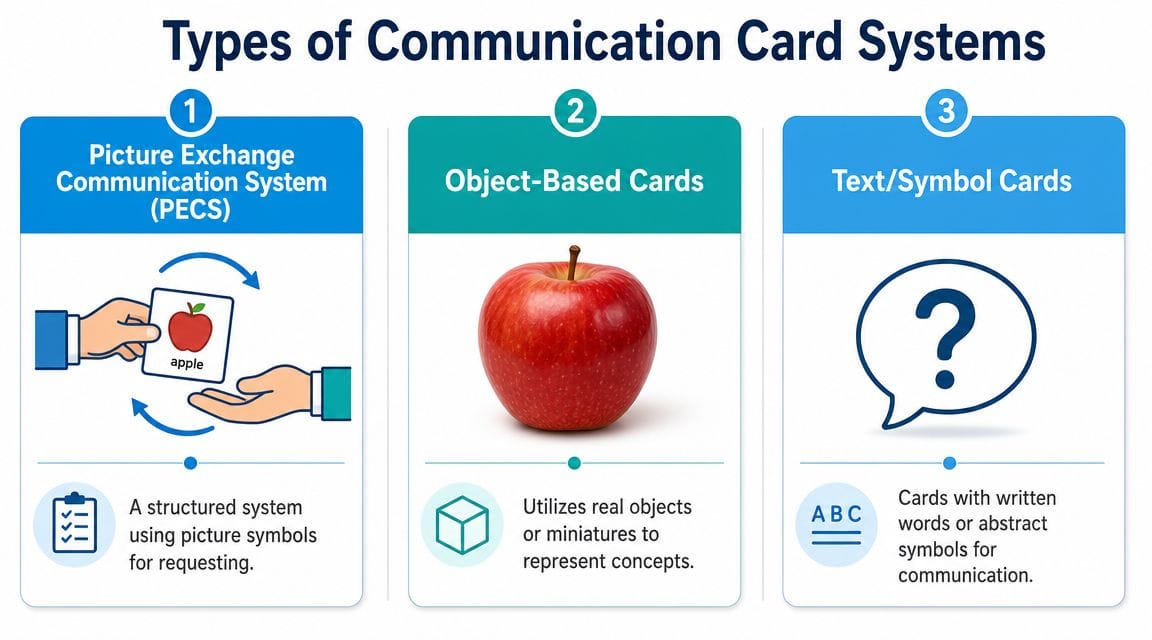
PECS as a structured teaching system
The Picture Exchange Communication System (PECS) is more than a stack of pictures. It's a six-phase intervention that starts with a physically assisted exchange of one highly motivating picture and gradually moves toward more spontaneous, flexible communication, as described in this overview of PECS phases.
That structure matters. In the earliest stages, the child isn't asked to sort through lots of symbols. They start with a small number of highly motivating pictures, which reduces confusion and increases the chance that communication starts successfully.
PECS is often a good match when a child is learning the basic idea that communication with another person gets a result.
Flexible picture and symbol cards
Some families don't need a full PECS program. They need a practical set of cards for daily life.
These flexible card systems might include:
- Need cards: help, bathroom, hungry, drink
- Regulation cards: break, too loud, squeeze, quiet space
- Choice cards: favorite foods, toys, shows, or activities
- Community cards: I need more time, I can't answer right now, please speak slowly
These card sets are often low-tech AAC supports made with pictures or symbols, then laminated and ring-bound so a child can carry them from home to school to the community. The key recommendation is customization. The vocabulary should match the child's immediate routines, interests, and needs rather than a generic set.
Routine cards and visual schedules
Routine cards help with a different communication job. Instead of helping a child request an item, they help the child understand sequence and expectations.
Examples include:
| Part of day | Example routine cards |
|---|---|
| Morning | toilet, get dressed, breakfast, shoes, bus |
| After school | snack, rest, homework, outside, dinner |
| Bedtime | bath, pajamas, story, lights off |
These cards reduce uncertainty. They also cut down on repeated verbal reminders, which many children stop processing when they're stressed.
Communication Card Systems at a Glance
| System Type | Primary Goal | Best For… | Example of Use |
|---|---|---|---|
| PECS | Teaching the act of communication through exchange | Children who need a structured path from requesting toward broader communication | Child hands over a picture of bubbles to request bubbles |
| General picture or symbol cards | Quick functional communication across settings | Children who need flexible support for needs, choices, feelings, or regulation | Child points to break during homework |
| Visual schedules and routine cards | Understanding sequence and transitions | Children who struggle with uncertainty, waiting, or moving between tasks | Child checks “snack, bath, story” before bedtime |
A child can use more than one system. That's normal. A structured teaching approach may build core skills, while a simpler ring of cards handles real-life moments in the car, on the playground, or in a waiting room.
Why Visual Supports Are So Effective for Autistic Brains
Words vanish quickly. You say, “Put your shoes on, then get your backpack, then come to the door,” and the sentence is already gone. If your child is overloaded, they may only catch a piece of it, or none of it.
A visual doesn't disappear in the same way. It stays there long enough for the child to look again, process it, and act on it.
Spoken language disappears fast
Many autistic children understand more when information is concrete and stable. A card gives the message a fixed form. That can lower pressure because the child doesn't have to hold the whole instruction in working memory while also managing sound, movement, emotion, and expectation.
This is especially helpful during stress. When a child's nervous system is working hard to cope, speech may become harder to process and harder to produce. A visual support reduces the load.
Visuals stay available
A 2018 systematic review of AAC tools for autism found that they were effective in promoting communication and social skills, increasing communication initiation and joint attention, and improving classroom behavior. The same review also noted that iPad apps can teach communication skills and improve language, placing card-based supports within a broader evidence base of structured AAC, as summarized in this systematic review on AAC for autistic children.
That lines up with what parents often notice at home. When the message is visible, children can:
- Respond with less pressure: They don't have to answer instantly.
- Show more independence: They can point, carry, or check a card without waiting for a full verbal prompt.
- Recover faster: A card like break or too loud can interrupt escalation before frustration grows.
A visual support often works because it gives the child time. Time to process, time to choose, time to communicate.
If your child is also learning to identify body states and emotional shifts, a simple teaching guide for Zones of Regulation can pair well with communication cards. It gives adults and children shared language for states like calm, overwhelmed, or dysregulated, which makes regulation cards easier to understand and use.
How to Create and Customize Your First Card Set
A first card set doesn't need to be pretty. It needs to be useful.
Start small enough that you can use it this week. Many parents get stuck trying to build a perfect deck with dozens of images. That's usually too much for the adult and too much for the child.

Choose the first words that matter most
Pick cards for the moments that break down most often. If mornings are rough, don't start with farm animals or weather icons. Start with what your child needs during the hard parts of morning.
A useful first set often includes:
- One help card for tasks that trigger frustration.
- One stop or all done card for boundaries.
- One break card for overload.
- Two or three high-interest choices like favorite snacks or activities.
- One body-based card such as tired, hungry, or too loud.
Start where communication fails most often, not where it looks most educational.
Some families choose these cards by memory. Others do better when they look at patterns. A tracking tool can help you notice whether speech drops during transitions, after poor sleep, around hunger, or in crowded settings. If you're already logging routines and communication patterns, something like Guiding Growth's autism speech patterns tracker can help you decide which cards to create first based on what happens in your child's day.
Pick visuals your child can understand quickly
For early learning, more realistic images may help. A study on object-to-picture matching found that autistic children performed significantly better with color photographs than with black-and-white line drawings, according to this research record on object-to-picture matching.
That doesn't mean every child must use photographs forever. It means that if your child isn't understanding abstract symbols yet, realism is a sensible place to begin.
Try this decision guide:
- Use a real photo if your child only recognizes the exact cup, exact snack, or exact toothbrush they use.
- Use a simple symbol if your child already understands pictures broadly.
- Add text if your child is beginning to read or benefits from seeing the printed word.
Build the cards for real life
Physical format matters more than parents expect. Portable cards get used. Loose papers often don't.
Simple materials work well:
- Small printed images
- Card stock or thick paper
- Lamination or clear tape
- A hole punch and binder ring
- Velcro if you want removable choices on a board
A short demonstration can make this process feel much more doable:
You don't need one giant set. Many children do better with mini sets by context. A bathroom ring. A car ring. A bedtime strip. A community card in a pocket or backpack.
That setup respects a simple truth. Communication is contextual. The words your child needs in the bathtub are different from the words they need in a noisy store.
Introducing and Using Cards Effectively
Parents sometimes hand over a new set of cards and hope the child will instantly use them. Most children need gentle teaching first. The good news is that this part can stay low pressure.
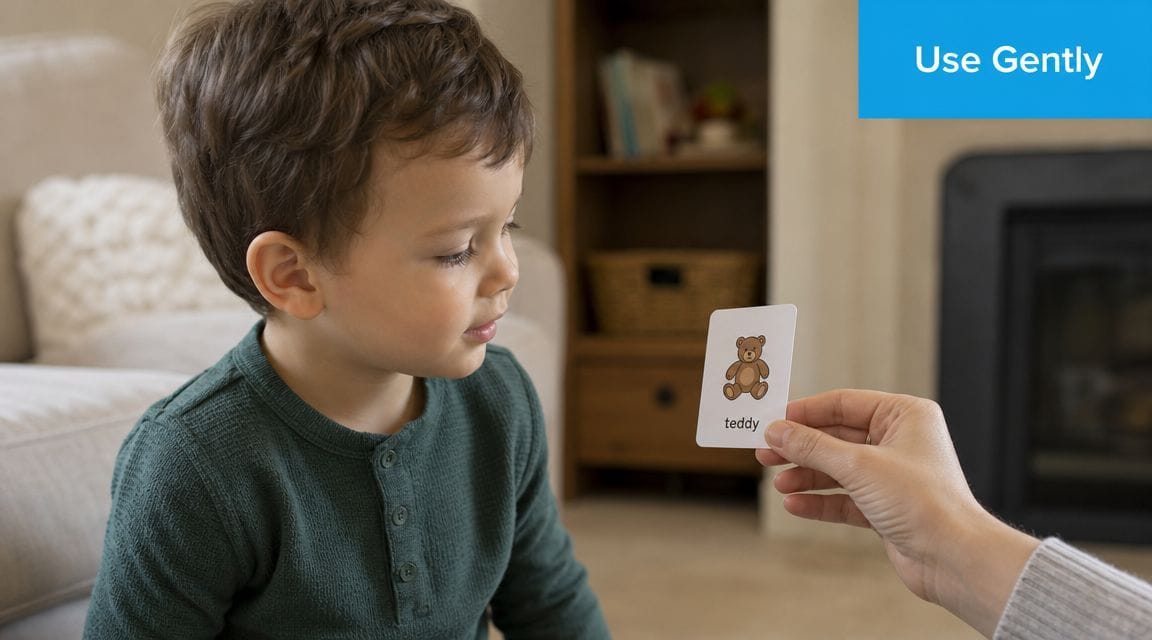
Start with one successful exchange
Pick one moment in the day when your child strongly wants something. A favorite snack works well. So does a preferred activity.
Show the card, say the word plainly, and help your child use it. If needed, guide the action physically in a gentle way. Then respond right away. The child needs to learn, “This card gets my message across.”
A few reminders help here:
- Keep language short: “Snack.” “Help.” “Break.”
- Respond quickly: Fast feedback builds meaning.
- Use motivating items: Strong interest creates clearer learning.
Model first and lower the pressure
Some children won't grab the card right away. That's okay. You can model card use yourself.
If the room is noisy, you might tap the too loud card and say, “Too loud. Let's go quiet.” If your child is melting down during work, you might show break and walk with them to a calm corner. This teaches what the card means before expecting independent use.
Don't wait for a crisis to introduce a regulation card. Practice it during calm, manageable moments.
It also helps to keep cards visible where the need happens. Put drink and snack near the kitchen. Keep help near difficult tasks. Clip a few travel cards to a bag for waiting rooms, stores, or long car rides. For families preparing for community outings, these travel communication tips for nonverbal kids can spark ideas that also work well for children who lose speech under stress.
What adults should do when a card is used
Consistency matters more than perfection. When your child uses a card:
- Acknowledge the message: “You said break.”
- Honor it when you can: If the card says help, step in.
- Translate for others: “He's telling us it's too loud.”
- Keep your response calm: The card should reduce pressure, not start a debate.
If a card isn't being used, don't assume it failed. Often the issue is one of these: the card isn't accessible, the symbol isn't clear, the child didn't learn the meaning yet, or the adult response hasn't been immediate enough for the child to see the connection.
Advanced Strategies and Team Collaboration
The most overlooked use of ASD communication cards is for children who can speak, but can't always access speech. That's common during shutdowns, meltdowns, sensory overload, illness, fatigue, or intense demand.
State-dependent communication matters
Public guidance often treats cards as tools for children who are always non-speaking. That misses a large group of kids. Some children are verbal in calm states and temporarily non-speaking in stressed states. For them, cards aren't a replacement for speech. They're a bridge back to communication.
A key gap in guidance is exactly this issue. Communication cards can serve as state-dependent supports for autistic children who become non-speaking under stress, offering a reliable output method during shutdowns, meltdowns, or sensory overload, as discussed in this resource on communication cards for community interactions.
That means a verbal child may still need cards like:
- I can't talk right now
- Yes
- No
- Need space
- Come with me
- Call Mom
- Too bright
- Too loud
Everyone should respond the same way
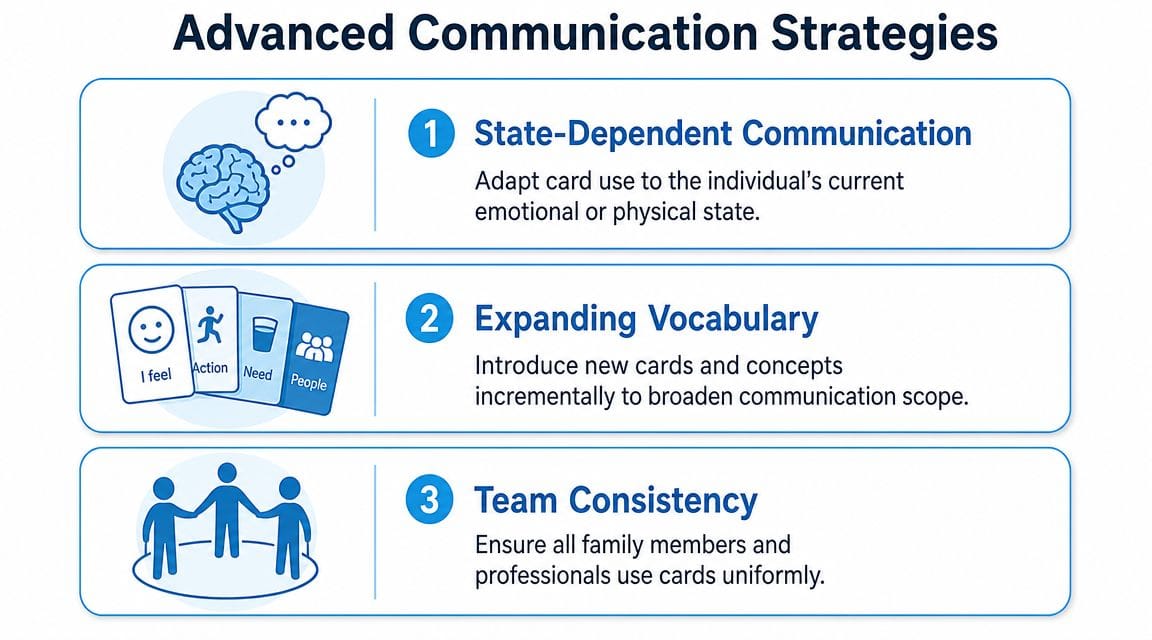
A card only works well when other people understand what to do next. If school treats break as avoidance, home treats it as a regulation need, and grandparents forget to offer the cards at all, your child gets mixed messages.
Create a simple shared plan:
- Which cards travel everywhere
- What each card means
- How adults should respond
- Which situations tend to block speech
- When speech, gestures, cards, or device-based AAC are most useful
A shared tracking system can reduce confusion. If parents, teachers, and therapists can all see which cards were effective, what happened before they were used, and how the child recovered, support becomes more consistent and less guess-based.
Communication cards work best when they're treated as part of a larger support plan, not a one-off printable. If you want one place to track shutdowns, meltdowns, routines, speech changes, and the communication supports that helped, Guiding Growth gives families and care teams a shared record they can use to make clearer decisions over time.