Your child may do well in class, speak in full sentences, and surprise adults with a sharp memory or advanced vocabulary. Then the day falls apart over a change in plans, a loud cafeteria, a confusing friendship, or the wrong socks. That mix can leave parents feeling stuck. If my child is doing so much “right,” why do daily life and relationships still feel so hard?
That question often leads families to search for autism high functioning symptoms. The phrase is common, but it can also blur what parents most need to see. A child may look capable on the outside while working extremely hard just to get through ordinary moments. The struggles are real even when they're quiet, inconsistent, or hidden from teachers and relatives.
Many families also notice an uneven profile. A child may be bright, creative, and highly knowledgeable in one area while needing far more support in flexibility, sensory regulation, or social understanding. If that sounds familiar, resources on advice for parents of twice-exceptional kids can also help, especially when giftedness and support needs seem to exist side by side.
Table of Contents
- Recognizing the Signs Beneath the Surface
- What Does High Functioning Autism Actually Mean Today
- Unpacking the Social and Communication Symptoms
- The Less Visible Symptoms You Might Overlook
- The Hidden Toll of Masking and Social Camouflage
- Understanding Common Co-occurring Conditions
- How to Track Symptoms for a Clearer Picture
- Your Path Forward as Your Child's Advocate
Recognizing the Signs Beneath the Surface
Parents often notice a pattern before they have words for it. Their child is articulate, funny, and capable in many settings, yet something still feels off. Social situations drain them. Minor changes can trigger major distress. They may seem mature in one moment and overwhelmed in the next.
That contradiction confuses people because many old descriptions of autism focused on what others can easily see. But some of the most meaningful signs are internal. A child may be pushing through sensory discomfort, trying to decode social rules, or holding in stress all day until they finally get home.
Practical rule: Don't judge support needs by how “smart,” verbal, or independent a child appears in short bursts.
A helpful way to think about it is this. Some children move through the day like they're carrying an invisible backpack full of weight. Teachers may only see that they arrived. Parents see what happens when they finally set the backpack down.
When families search for autism high functioning symptoms, they're often trying to explain exactly that gap between appearance and lived experience. The key is not asking, “Can my child perform?” The better question is, “What does this performance cost them?”
What Does High Functioning Autism Actually Mean Today
The term high-functioning autism is still used in everyday conversation, but it isn't an official medical diagnosis. Historically, it was used for autistic people with average or above-average intelligence and relatively lower support needs. Current diagnostic systems don't use it that way. The DSM-5 classifies autism by support levels, and Level 1 is the closest match to what many people previously called “high-functioning,” as explained in this Child Mind Institute overview of the term and DSM-5 support levels.
That shift matters because the old label can mislead families. It sounds like a description of how well someone is doing. In real life, it often describes how well someone can appear to be doing.
Why the old label causes confusion
Consider judging a house only by the front porch. The porch may look neat and stable. You still don't know whether the wiring inside is overloaded, whether the rooms are hard to move through, or how much effort it takes to keep everything running.
Children who get called “high-functioning” may have fluent speech and strong academic skills, yet still need meaningful support with routines, relationships, sensory overload, and emotional regulation. The label can make adults underestimate that need.
A more useful frame is support, not appearance.
- Speech isn't the whole picture. A child can speak well and still struggle to read social cues or process fast-moving conversation.
- Grades don't measure stress. Academic success can sit right alongside shutdowns, rigidity, and exhaustion.
- Independence may be situational. A child may manage school tasks but fall apart with transitions, group play, or unstructured time.
What Level 1 usually suggests
Level 1 is often used for children who need support but may not match the stereotypes many people picture when they hear “autism.” They may talk early, read well, or seem socially interested. Even so, autism can still affect how they communicate, handle change, manage sensory input, and recover from stress.
A child can need fewer supports than another autistic child and still need real supports every day.
That's why many parents feel dismissed at first. Others see competence. Parents see the effort behind it.
Unpacking the Social and Communication Symptoms
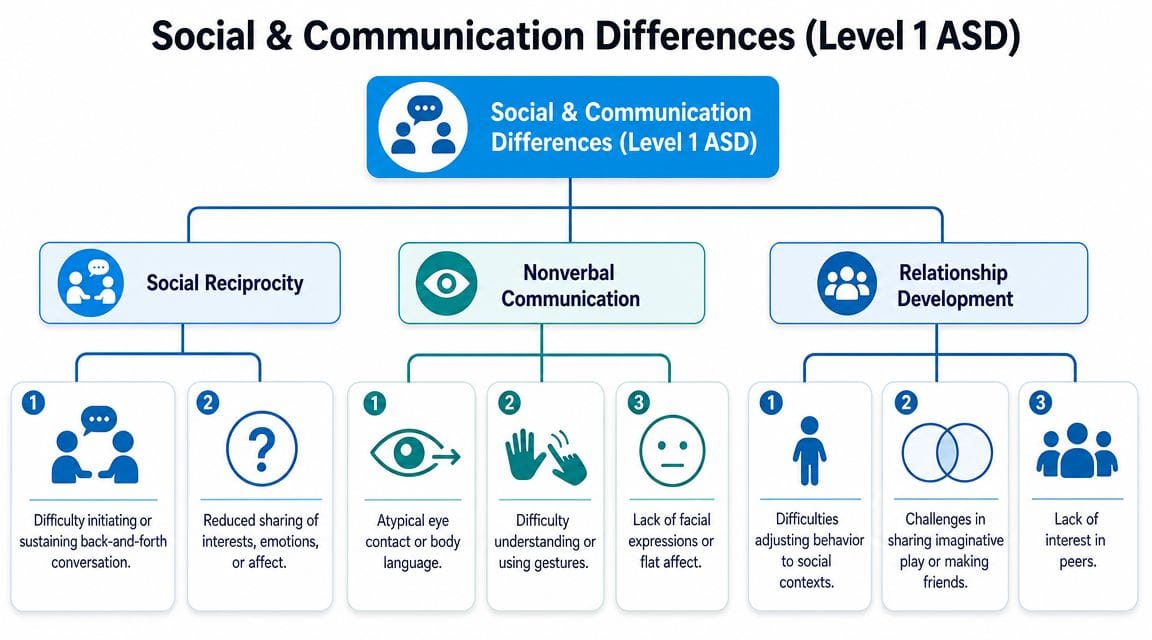
Social and communication differences in Level 1 autism aren't always obvious. A child may talk a lot, make eye contact sometimes, and want friends. The challenge is often not a lack of interest in people. It's a difference in how social information is understood, processed, and expressed.
When conversation looks fluent but feels one-sided
Some children sound advanced for their age. Adults may describe them as “a little professor.” They use big words, remember facts, and can speak at length about favorite topics. But conversation isn't only about talking. It also involves timing, turn-taking, noticing the other person's interest, and adjusting in the moment.
A few examples parents often notice:
- Back-and-forth is hard. Your child may answer questions well but struggle to ask follow-up questions or keep a shared topic going.
- Literal interpretation shows up. Sarcasm, teasing, and vague language may be missed or taken personally.
- Topic shifting feels abrupt. They may return to a preferred subject even when others have moved on.
Some speech patterns can offer extra clues. Parents who want clearer examples may find this guide to autism speech patterns useful when trying to put observations into words.
What social confusion can look like at home and school
Social difficulty doesn't always mean a child avoids others. Sometimes it means they approach peers in ways that don't quite match the moment. They may stand too close, sound overly formal, miss signs that someone is bored, or dominate play with strict rules.
They may also misread faces, tone, and body language. A classmate's joking comment may feel hostile. A teacher's vague instruction may not be clear enough to follow. Group situations can be especially hard because they require constant interpretation.
Children with autism may know the words in a conversation but still miss the unwritten rules.
Parents sometimes see this after social events. Their child may come home upset, replaying a small interaction over and over, convinced they said the wrong thing. To outsiders, nothing dramatic happened. To the child, the social puzzle never quite clicked.
The Less Visible Symptoms You Might Overlook
Parents often search for autism high functioning symptoms by focusing on social awkwardness first. That's understandable, but it can leave out some of the most disruptive parts of daily life. Sensory differences, rigid routines, and organization struggles often shape a child's day just as much as conversation does.
Sensory differences are often the missing piece
A child may seem “picky,” “dramatic,” or “easily irritated” when the underlying issue is sensory overload. Sound, light, touch, smell, texture, or movement can feel much stronger, or sometimes much weaker, than expected.
One child may cover their ears in a busy store. Another may tolerate noise at school and then melt down the second they get into the car. If you're trying to sort out whether a repeated behavior fits a sensory pattern, this article on covering ears as a sign of autism can help you think through context.
Rigidity and executive functioning can hide behind competence
Many verbally fluent children are described as flexible thinkers because they do well academically. Yet daily life may tell a different story. They may need routines to stay regulated. A sudden change in dinner plans, seating, clothing, or bedtime order can feel much bigger than adults expect.
Executive functioning challenges can also be easy to miss. A child may understand a task but still struggle to start it, organize materials, shift between steps, or estimate how long it will take.
Here's a quick way to group what parents often see:
| Symptom Domain | Common Examples |
|---|---|
| Sensory differences | Covering ears, refusing certain clothes, distress in bright or crowded places, strong reactions to smells or textures |
| Need for sameness | Upset over changes in plans, needing routines in a specific order, difficulty with transitions |
| Focused interests | Deep knowledge in one topic, repetitive discussion of favorite subjects, intense collecting or researching |
| Executive functioning | Trouble starting homework, losing materials, difficulty planning multi-step tasks, poor time awareness |
| Regulation after stress | Meltdowns after school, shutdowns, irritability, needing long recovery time after social or sensory demands |
World Health Organization descriptions of autism also note that autistic people can have difficulty with transitions, detail-focused attention, unusual sensory reactions, and a wide range of abilities and needs, as summarized in this overview discussing the term and broader autism features.
The Hidden Toll of Masking and Social Camouflage
Some children learn to copy what peers do well enough to pass at school, in short conversations, or during brief visits. That doesn't mean the interaction felt easy. It may mean they were working hard to appear natural.

Why home can look so different from school
Masking, sometimes called social camouflaging, is the effort to hide autistic traits or consciously imitate expected behavior. A child may rehearse what to say, force eye contact, suppress stimming, or closely watch others for cues. Teachers may describe them as quiet, compliant, or only mildly awkward. Then home becomes the place where all the strain spills out.
That pattern can confuse families. Parents hear, “They were fine all day,” while the child unravels over something small that evening. Often, home is where they no longer have to hold everything in.
Newer expert coverage highlights internalized signs such as chronic anxiety, social exhaustion, rigid or black-and-white thinking, delayed processing of conversations, hyperfocus, and sensory overload that are easy to miss because they aren't always externally disruptive. It also emphasizes that masking is a major reason symptoms are overlooked, as discussed in this Prosper Health article on high-functioning autism traits and misconceptions.
Internal signs parents often notice first
Parents may notice signs that look less like “classic autism” and more like strain.
- After-school collapse: The child has held together all day and then melts down in the safest place.
- Perfectionism: Small mistakes feel catastrophic because they're already using so much energy to stay regulated.
- Social replaying: They revisit conversations later, trying to decode what happened.
- Black-and-white thinking: Ambiguous situations feel unsettling, so strict categories feel safer.
When a child falls apart after school, it doesn't always mean school went well. It may mean school took everything they had.
Some families find it helpful to hear other explanations of masking in a more visual format:
A child who masks may not need less understanding. They may need more, because their distress is easier to miss.
Understanding Common Co-occurring Conditions
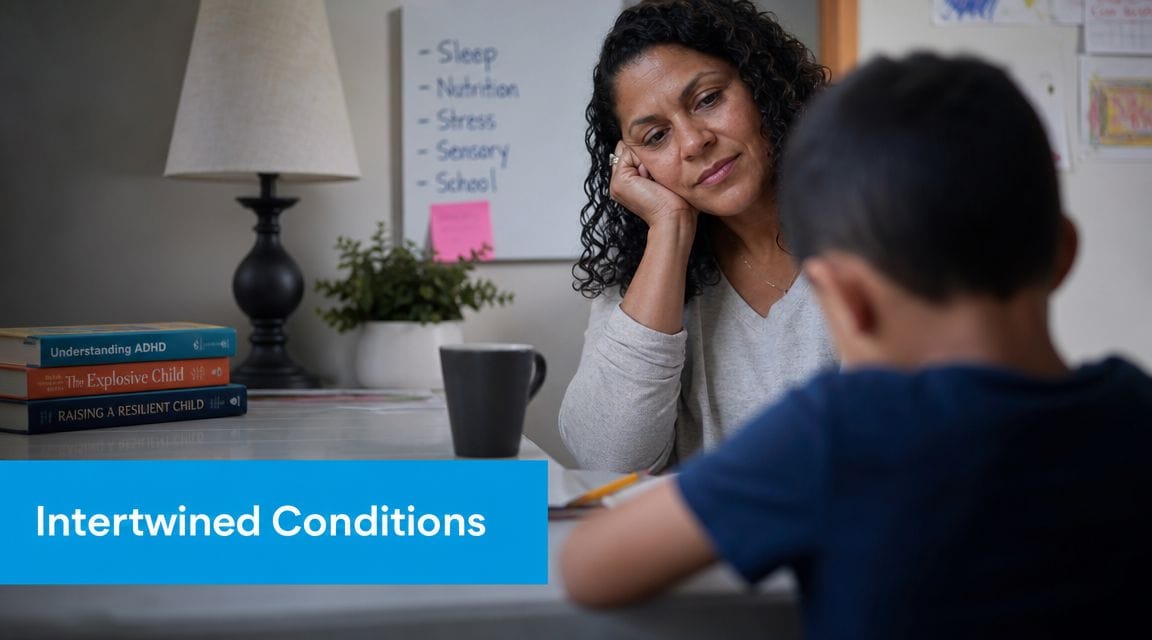
Autism often doesn't travel alone. Anxiety, attention differences, sleep issues, and mood concerns can all shape what parents see day to day. That's one reason the phrase “high-functioning” can be so misleading. A child may seem capable in one area while struggling in several others at the same time.
Anxiety is common and often easy to miss
In a clinical study of high-functioning youth with autism, approximately 50% experienced clinically significant anxiety, and 91.6% met criteria for two or more anxiety disorders. The most common primary anxiety diagnoses were social phobia at 41.7% and generalized anxiety disorder at 25.9%, according to this clinical study on anxiety in high-functioning youth with autism.
That matters because anxiety can hide inside behaviors adults misread. Avoiding a birthday party may look oppositional. Repeated reassurance-seeking may look immature. Perfectionism may look like high standards, but it is fear.
ADHD can complicate the picture
ADHD can overlap with autism in ways that muddy the picture. A child may be intensely focused on one interest but unable to organize school materials. They may crave routine and still act impulsively. They may want to follow directions but lose track halfway through.
If you're trying to separate overlapping traits, this guide to ADHD and autism differences can make those patterns easier to compare.
Nearly 75% of participants in the same study had at least one additional non-anxiety diagnosis, and ADHD symptoms were present in 63%, underscoring that “high-functioning” does not mean symptom-free or unaffected.
How to Track Symptoms for a Clearer Picture
Parents usually remember the big moments. What gets lost is the pattern. Which situations trigger shutdowns? How long does recovery take? Does your child struggle more after noisy environments, unstructured play, or transitions between preferred and non-preferred tasks?
That kind of detail matters during evaluations and care planning. A short appointment rarely gives families enough time to reconstruct weeks of examples from memory. Vague summaries like “he gets upset sometimes” or “she's fine at school but not at home” don't capture what clinicians need.
What to write down
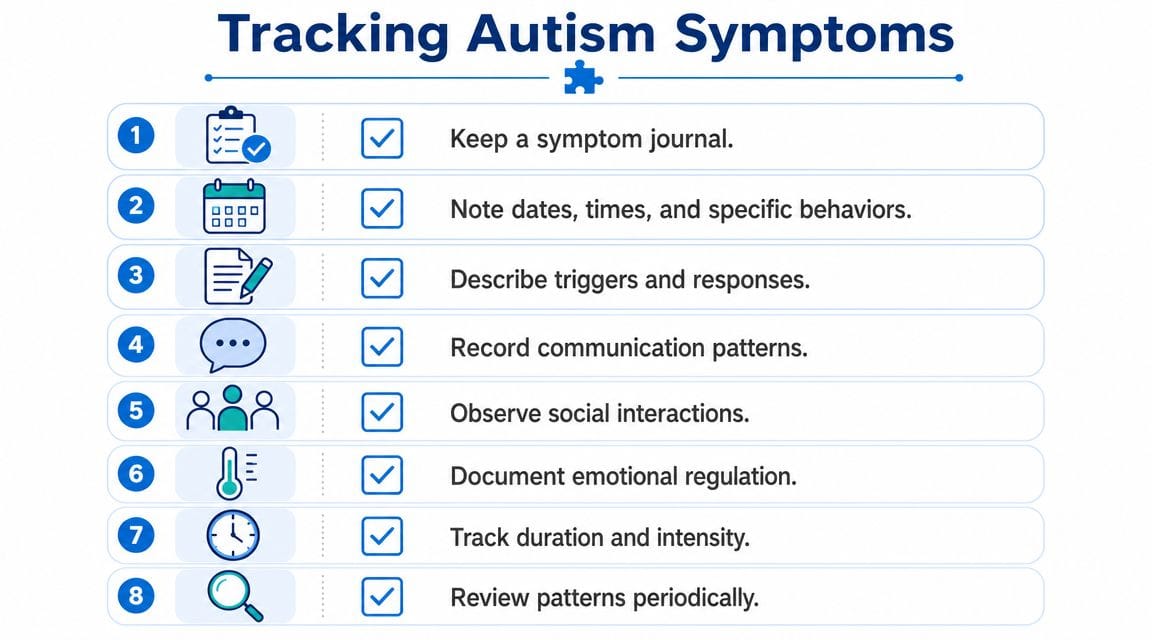
You don't need a perfect system. You need a usable one. Brief notes recorded consistently are more helpful than a long, polished summary written the night before an appointment.
Try tracking these categories:
- What happened first: Was there noise, a transition, a social misunderstanding, hunger, fatigue, or a change in plans?
- What the behavior looked like: Crying, pacing, silence, covering ears, arguing, leaving the room, repetitive questioning.
- How intense it was: Mild distress, full meltdown, shutdown, lingering irritability.
- How long it lasted: A few minutes, the rest of the evening, or longer into the next day.
- What helped recovery: Quiet time, movement, food, alone time, a script, reduced demands.
For busy parents, voice notes are often the most realistic option. If you already capture observations by speaking into your phone, tools that support accurate voice memo transcription can make those notes much easier to organize and share later.
How tracking helps appointments go better
When parents bring concrete examples, clinicians can see the difference between isolated quirks and recurring patterns. Teachers and therapists can also respond more effectively when they know the sequence, not just the outcome.
Useful prompt: Write down what happened before, during, and after the hard moment. The trigger is often not the behavior you noticed first.
A strong log might say: “Came home from school, refused snack, cried when sibling asked a question, hid under blanket for 30 minutes after a fire drill day.” That tells a clearer story than “rough afternoon.”
This kind of record also helps families communicate across settings. One adult may notice sensory overload. Another may notice delayed emotional release. Tracking lets those pieces fit together instead of living in separate notebooks, texts, and memories.
Your Path Forward as Your Child's Advocate
If you've been trying to make sense of a child who looks capable yet struggles in ways other people miss, your instincts matter. Many parents recognize the pattern long before they have the right language for it. The important part is not whether a child appears “high functioning.” It's whether they're carrying more than others can see.
Support starts with understanding the whole child. That includes social communication differences, sensory stress, rigidity, masking, and any overlapping anxiety or attention challenges. Once those patterns come into focus, decisions about evaluation, school support, and everyday accommodations become much clearer.
Some families also need practical help around care routines, transitions, and burnout at home. If that's part of your reality, guidance on finding a special needs nanny may be worth exploring alongside clinical support.
Trust what you're observing. Write it down. Bring examples. Ask specific questions. Your child doesn't need to struggle loudly to deserve support.
If you want one place to log behaviors, routines, sensory triggers, sleep, appointments, and share clearer patterns with caregivers or clinicians, Guiding Growth can help you turn daily observations into practical next steps.