You're watching your child line up for the school bus, or bounce at the park, or tear open a birthday gift they've wanted for weeks. Then their hands start moving fast. Up and down. Maybe both hands at once. Maybe with a squeal, a big grin, or a tense face that tells you they're overloaded.
A lot of parents have the same thought in that moment. What is hand flapping, and should I be worried?
If that's where you are, you're not overreacting, and you're not alone. Hand flapping can mean very different things depending on a child's age, the setting, and what else is going on around it. Sometimes it's part of typical toddler excitement. Sometimes it's a child's way of regulating stress, sensory input, or emotion. Sometimes it's a sign that it's time to look more closely. And sometimes, this part gets missed, it can get stronger when a child is dealing with physical discomfort.
The most helpful place to start isn't “How do I stop it?” It's “What is my child's body trying to do right now?”
Table of Contents
- A Parent's First Question About Hand Flapping
- Understanding Hand Flapping as a Form of Stimming
- Why Children Flap Their Hands Common Causes and Contexts
- Is It Hand Flapping Tics or Something Else
- When to Talk to a Professional
- Practical Ways to Support Your Child
- How to Uncover Patterns with a Behavior Log
A Parent's First Question About Hand Flapping
A parent once described it to me this way. “My daughter looked so happy opening her new toy, and then she started flapping her hands. I smiled for a second, then I felt this wave of panic. Was that normal? Was I missing something?”
That mix of love and worry is common. You see something repeated enough times that it catches your attention, but you don't yet know how to interpret it. You might notice it when your child is thrilled, frustrated, waiting in line, hearing a loud sound, or trying to settle after a long day. The movement can look surprising if you've never thought about it before.
Hand flapping usually means a child is having a strong internal experience and their body is helping them manage or express it. That's why context matters so much. The same movement can happen during delight, tension, sensory overload, or anticipation.
Hand flapping is more useful to think of as information than as a problem label.
Parents often get stuck because online advice jumps too quickly to diagnosis or discipline. That skips the most important question. What is the behavior doing for the child?
If you start there, things become clearer. You can notice when it happens, what came right before it, how long it lasts, and whether your child returns to play, learning, or connection afterward. Those details matter far more than the movement alone.
Understanding Hand Flapping as a Form of Stimming
What stimming means in everyday language
When parents ask me what is hand flapping, I usually start with one simple word: stimming. Stimming is short for self-stimulatory behavior. That sounds technical, but the idea is straightforward. It's a body-based way to regulate feelings, attention, or sensory input.
A useful picture is a pressure-release valve for the nervous system. When a child feels too much, or not enough, movement can help their body find a better balance. Some children flap their hands. Others rock, hum, spin, pace, or repeat sounds.
Hand flapping often looks like rapid, rhythmic up-and-down waving of one or both hands. It can be brief and occasional, or it can show up more often in children who rely on it to regulate.
It isn't exclusive to autism
This information often brings relief to parents. Hand flapping is a self-stimulatory behavior observed in approximately 45.1% of autistic children, though it is not exclusive to autism. Many toddlers flap their hands when excited, and this typically resolves by age three without intervention, as described in this hand flapping overview for parents.
That distinction matters. A behavior can be common in autism and still also appear in children who are not autistic. Toddlers especially use their whole bodies to express big feelings because language, impulse control, and self-regulation are still developing.
Here's a practical way to look at it:
- In a very young toddler: hand flapping may show up during excitement, anticipation, or playful arousal.
- In an older child: the meaning depends more on pattern, intensity, and whether it's linked with sensory needs, anxiety, communication differences, or other developmental signs.
- In any child: the question is still, “What function is this serving right now?”
Practical rule: Don't treat one movement as a diagnosis. Look at the child's age, the setting, and the whole developmental picture.
Why the why matters first
If you only focus on stopping the motion, you can miss the need underneath it. A child who flaps when excited may need time to learn other ways to express intensity. A child who flaps when overwhelmed may need a quieter environment, a break, or sensory support.
That's why understanding what is hand flapping starts with function, not fear.
Why Children Flap Their Hands Common Causes and Contexts
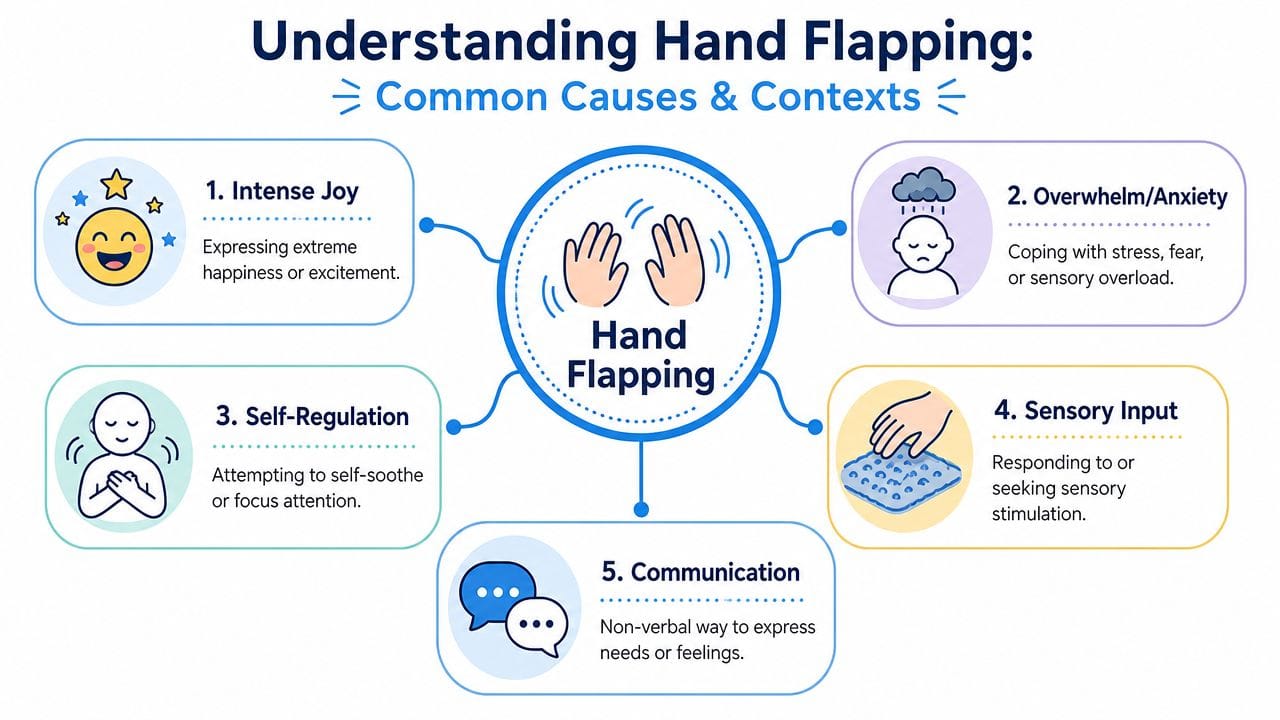
Some children flap in a very predictable pattern. Others do it only in certain situations. Once you begin sorting the moments into categories, the behavior often makes more sense.
Joy that spills out into movement
Sometimes hand flapping is pure excitement. A child sees bubbles, hears a favorite song, wins a game, or spots a grandparent at the door. Their body moves because the feeling is bigger than their words.
This can be especially common in younger children. They may laugh, jump, flap, and squeal all in the same burst. In that moment, the movement is expressive. It's not necessarily a warning sign.
Stress anxiety or overwhelm
Hand flapping can also show up when a child feels tense. Crowded rooms, transitions, waiting, fear, frustration, and uncertainty can all push the nervous system into a higher state of alert. The rhythmic motion may help the child settle.
Hand flapping serves as a form of self-stimulatory behavior that helps regulate emotions and sensory input by either calming an overstimulated nervous system or providing needed sensory stimulation for under-aroused states, according to this explanation of why children flap their hands.
That's why two children can flap for very different reasons. One is delighted. Another is trying to keep from falling apart.
Sensory regulation and communication
For some children, the movement helps organize sensory input. It may happen in a loud cafeteria, a bright store, or after a very stimulating school day. For others, it may appear when things feel too quiet or their body is seeking more input.
It can also work like nonverbal communication. A child who doesn't yet have the words for “too much,” “I'm waiting,” “I'm excited,” or “I need a break” may show you with movement first.
If you're trying to connect hand flapping to your child's sensory world, this guide on identifying sensory triggers in autism can help you think through what happens before the behavior starts.
A simple observation exercise can help:
- Notice the moment before: Was there a noise, demand, transition, or exciting event?
- Look at your child's face and body: Do they seem joyful, tense, tired, or overloaded?
- Watch what follows: Do they calm down, get more upset, or move into another behavior?
When parents start finishing the sentence “My child flaps their hands when…,” support becomes much more targeted.
Is It Hand Flapping Tics or Something Else
Parents often ask a hard but important question. “Could this be a tic?” Sometimes they worry about seizures too. That anxiety makes sense because repeated movements can look similar at first glance.
What hand flapping usually looks like
Hand flapping is often rhythmic and patterned. It may involve both hands and may appear in specific emotional or sensory contexts. A child may flap when excited, stressed, or overstimulated, and then stop when the state changes or support is provided.
In the United States, ASD is diagnosed in about 1 in 36 children, and hand flapping is one of the most recognizable stereotypic motor movements, with detection models identifying it with 92.6% accuracy. Understanding these movements is key to early developmental screening, based on this review of autism prevalence and movement recognition.
That doesn't mean every repeated hand movement is hand flapping. It means clear observation is useful.
Hand Flapping vs. Tics vs. Seizures
| Characteristic | Hand Flapping (Stimming) | Motor Tics | Seizures |
|---|---|---|---|
| Pattern | Often rhythmic and repetitive | Often quick, jerky, less rhythmic | Can vary widely and may not look rhythmic |
| Context | Often linked to excitement, stress, or sensory input | May happen across settings without a clear emotional trigger | May occur without an obvious trigger |
| Body awareness | Child is often awake and engaged with the environment | Child is usually awake, though the movement may feel hard to suppress | Awareness may change during some seizure events |
| Body parts involved | Commonly hands and arms, sometimes both sides together | Can involve face, shoulders, neck, or other areas | Can involve many parts of the body and other changes |
| After the event | Child may return to activity quickly | Child often resumes activity quickly | Child may seem confused, tired, or different afterward |
This table isn't a diagnostic tool. It's a parent observation tool. If something seems sudden, unusual, or hard to explain, record what you saw and talk with your child's clinician.
If the movement changes dramatically, includes loss of awareness, or you notice a concerning recovery period afterward, medical guidance is the right next step.
When to Talk to a Professional
Age matters but function matters too
One reason parents stay confused is that many articles say hand flapping can be “normal,” but they don't say for how long. That missing timeline leaves families guessing.
A helpful benchmark is this: while hand flapping from excitement is normal in toddlers, it typically diminishes by age 4 in neurotypical children. If the behavior persists past this age or significantly interferes with daily activities, it warrants a professional evaluation, according to this parent-focused explanation of hand flapping and typical development.
That age range matters because toddlers often use movement as part of ordinary emotional expression. As children grow, many develop other ways to communicate excitement, cope with stress, and regulate their bodies.
Signs that deserve a closer look
A conversation with a pediatrician, developmental specialist, or occupational therapist makes sense when the behavior moves beyond occasional excitement and starts affecting daily life.
Consider reaching out if you notice any of these:
- Persistence past the usual toddler window: the flapping continues beyond the age when it typically fades in children without developmental concerns.
- Interference with participation: it gets in the way of eating, dressing, learning, play, writing, or other routines.
- Self-injury or safety issues: your child hits objects, falls, or gets hurt during intense episodes.
- A larger developmental picture: you're also noticing differences in communication, social interaction, play, or attention.
- A strong increase in frequency or intensity: the behavior is becoming harder for your child to manage.
A professional evaluation isn't a verdict. It's a way to understand what your child's nervous system, development, and environment may be asking for.
When parents bring specific examples instead of a general worry, appointments tend to be much more productive. “He flaps every time the cafeteria gets loud” is more useful than “He does this a lot.”
Practical Ways to Support Your Child
Support works better than correction. If hand flapping is helping your child express joy, release tension, or regulate sensory input, trying to shut it down without understanding it can backfire.
Start with safety and observation
If your child flaps intensely, check the environment first. Move sharp or unstable objects. Give them enough space. Notice whether the episode happens in noisy stores, crowded gatherings, before meals, during transitions, or after school.
A few low-pressure supports often help:
- Reduce extra input: dim bright lights, lower noise, or step into a quieter room.
- Add predictability: use simple routines, visual schedules, or a transition warning.
- Protect the body: make sure your child has space if they move broadly when excited.
Rule out pain before focusing on behavior
This is one of the most overlooked steps. Many guides overlook the link between stimming and physical discomfort. Autism Parenting Magazine reports that underlying medical conditions like GI pain or infections can significantly worsen stimming, meaning parents should rule out medical causes before focusing solely on behavioral strategies, as summarized in this article on causes and management of stimming.
That means a sudden increase in hand flapping should make you think broadly. Is your child pulling at an ear? Eating differently? Arching, pressing on their belly, or waking more at night? Are they less comfortable in the car, at the table, or during bowel movements? Pain doesn't always look like crying. Sometimes it looks like more movement.
Offer regulation not correction
Once you have a better sense of the trigger, you can offer another way to meet the same need. Some children do well with squeezes, heavy work, movement breaks, fidgets, a quiet corner, or a weighted lap pad during seated tasks. Others benefit from simple calming routines.
If you're building a toolkit for anxious or overstimulated moments, this parents' guide to calming strategies offers practical ideas you can adapt at home.
You can also explore examples of sensory tools that help calm meltdowns when hand flapping seems to rise alongside overload.
What helps most is a shift in mindset:
- See the need first: ask what the movement is doing for your child.
- Teach alternatives gently: offer another regulation tool, don't demand instant replacement.
- Keep joy safe: if the flapping is an expression of happiness and isn't harmful, it may not need stopping at all.
How to Uncover Patterns with a Behavior Log
When hand flapping feels unpredictable, a behavior log turns scattered moments into something you can use. Repetitive motor behaviors like hand flapping appear in up to 80% of children with autism, making them a key indicator during early developmental screening. Tracking these behaviors provides invaluable data for discussions with healthcare professionals, as noted in this hand flapping and screening overview.
What to write down
You don't need a perfect chart. You need enough detail to see a pattern. Try logging:
- Time and place: when it happened and where.
- What came before: noise, transition, waiting, demand, excitement, hunger, fatigue, pain signs.
- What the behavior looked like: both hands or one, brief or prolonged, mild or intense.
- What came after: your child calmed, escalated, needed space, or returned to activity.
If you've ever tried to understand your migraine triggers, the idea is similar. Patterns often become obvious only after you track the context around the event, not just the event itself.
Why patterns change the conversation
A good log helps you stop guessing. You may realize the flapping happens most before dinner, only in echoing spaces, or after poor sleep. That changes what you do next.
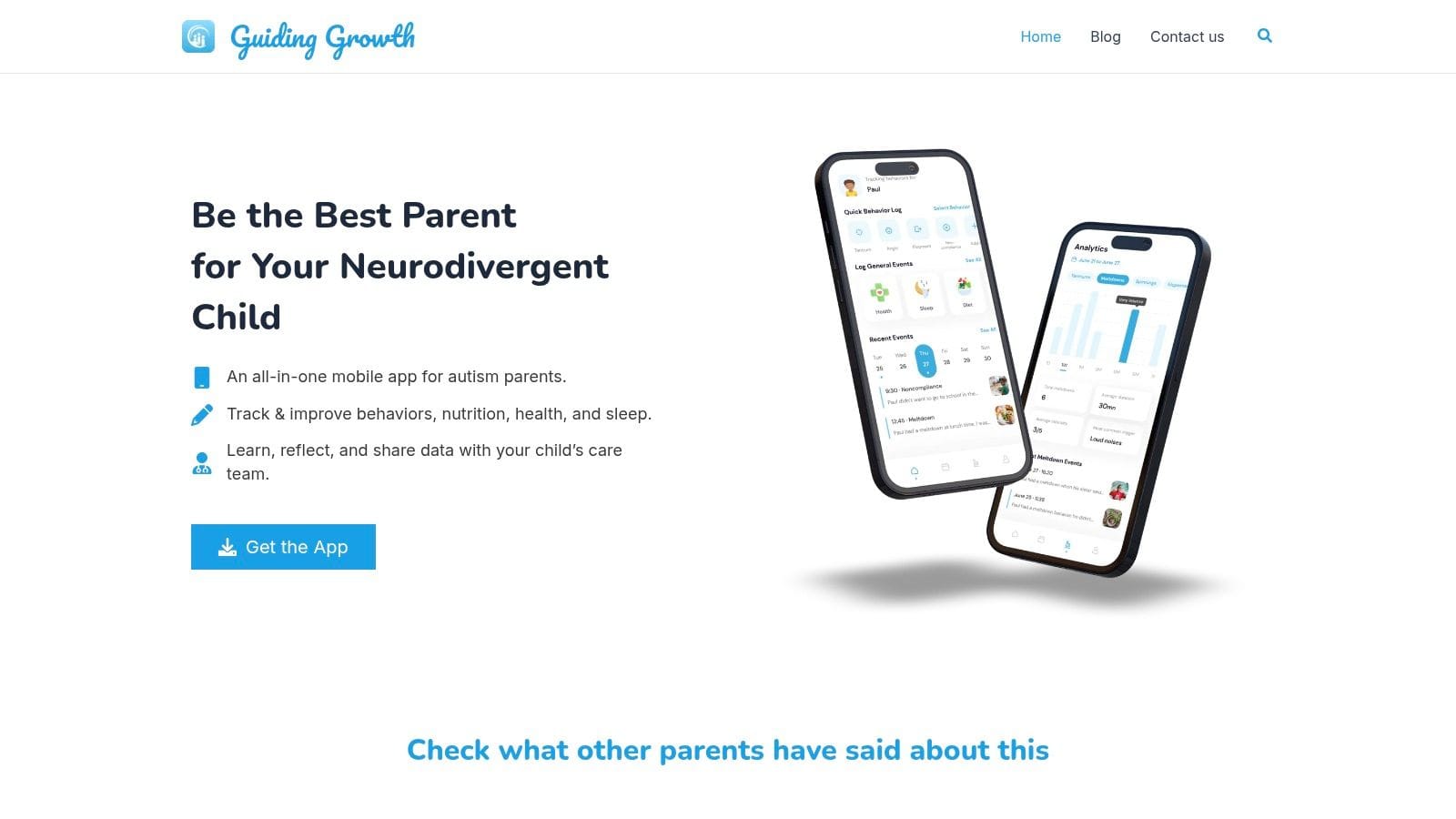
For families who want one place to track behavior, routines, diet, appointments, and context, Guiding Growth is one option. It lets parents log behaviors such as hand flapping, use quick voice logging instead of typing, review patterns, and share information with therapists or doctors. Some parents also use it to organize related details like sleep, food, medications, and therapy notes so the full picture is easier to see.
The goal of logging isn't to count every flap. It's to learn what your child's body is telling you.
If you want a simpler way to track hand flapping, routines, sensory triggers, meals, sleep, and appointments in one place, Guiding Growth can help you keep clear records and bring more useful information to conversations with your child's care team.