Finding ways to connect with a nonverbal autistic child can feel like solving a puzzle while the day is already moving. The child may be alert, curious, and clearly opinionated, but speech isn't the bridge that works best. What usually helps is not more pressure, it's better access to communication, sensory comfort, and predictable routines that let the child participate in a way that feels safe.
The best activities for nonverbal autistic child are the ones that create room for choice, request, pause, repeat, and respond in whatever mode works, whether that's pictures, gestures, devices, movement, or just a look and a reach. In practice, that means communication-rich play matters more than chasing verbal responses. It also means the same activity can be helpful or overwhelming depending on the child's sensory profile, timing, and the demands built into it.
Table of Contents
- 1. Visual Communication with AAC Devices
- 2. Sensory Play and Sensory Bins
- 3. Structured Turn-Taking Games with Visual Supports
- 4. Music and Sound-Based Activities
- 5. Sensory-Motor Activities Movement and Gross Motor Play
- 6. Interest-Based and Self-Directed Play
- 7. Predictable Routine-Based Activities with Visual Schedules
- 7-Activity Comparison for Nonverbal Autistic Child
- Turn Activities into Actionable Insights
1. Visual Communication with AAC Devices
AAC works best when it's treated as real communication, not a side activity. That includes picture boards, speech-generating devices, signs, and app-based systems that let a child request, refuse, choose, comment, or ask for help. ASHA's AAC guidance describes both unaided methods like gestures and sign language and aided systems like picture boards and speech-generating devices, and it emphasizes matching the system to the child's motor, sensory, and cognitive profile rather than to speech alone (ASHA AAC guidance).
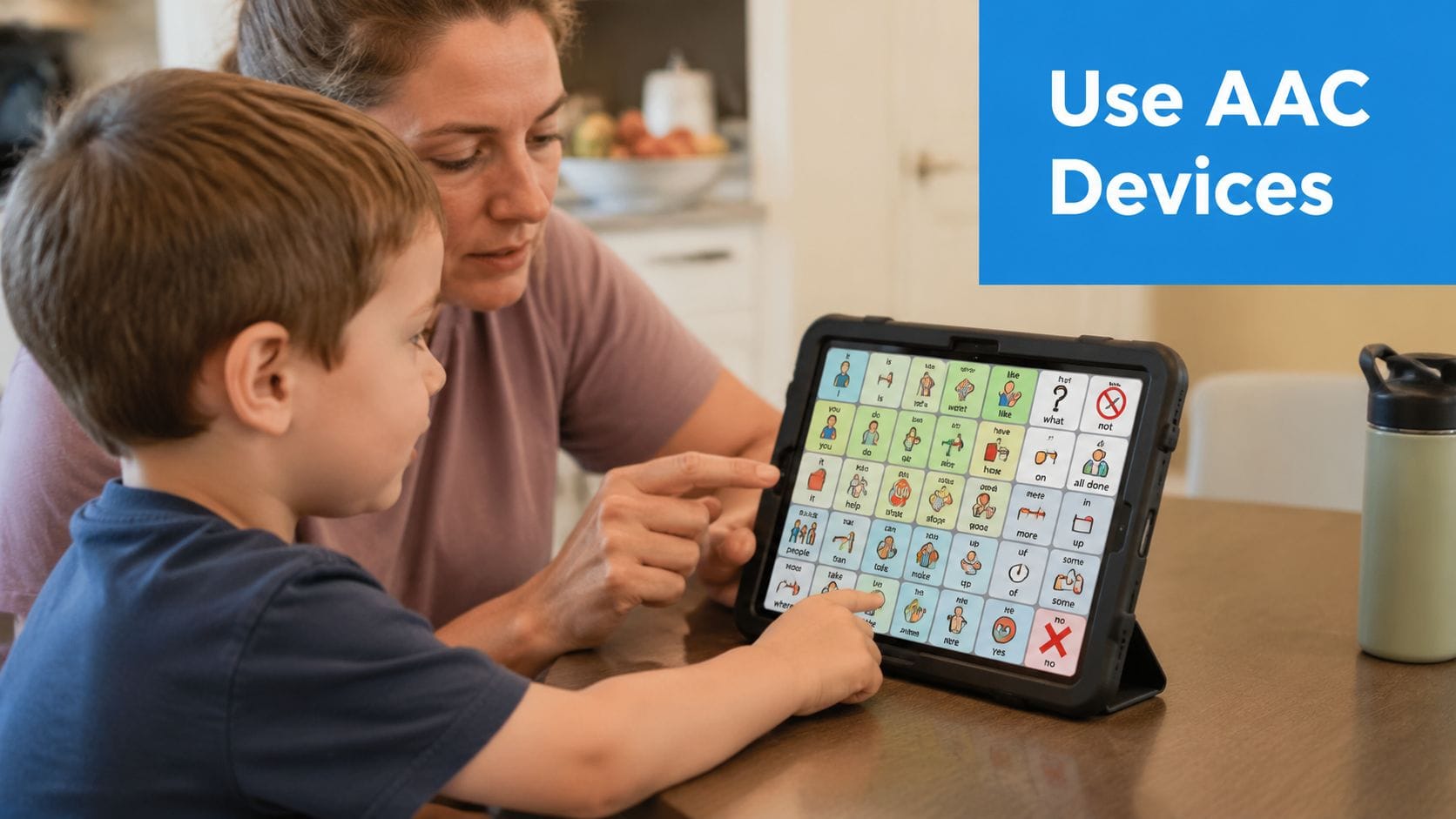
A useful way to begin is with a small set of 4 to 8 high-preference items, then expand once the child is using the system with confidence. Keep the device in the child's line of sight during meals, play, and transitions, and model the symbols yourself so it feels natural. A child using Proloquo4Text can request a favorite snack by typing or selecting icons, while TD Snap, JABtalk, or a PECS board can support transitions and classroom requests. For structured support around device use, Guiding Growth's communication device resource fits well with daily tracking.
Practical rule: if the child has to stop enjoying the activity to use AAC, the setup is too demanding. Put the communication tool inside the activity, not beside it.
Track the activity like a communication sample, not just a play session. Log whether the child initiated, which symbols were used, and whether the exchange succeeded without frustration. In Guiding Growth, those notes help families and therapists see which vocabulary gets used most, which situations trigger more requests, and where a child is already communicating well.
After a few sessions, patterns usually become obvious. Snack requests may come easily, while transition words or emotion words need more modeling. That kind of data is far more useful than guessing whether the child is “ready” to communicate.
2. Sensory Play and Sensory Bins
Sensory play gives a child something to do with the hands, eyes, and body without asking for speech. That's why kinetic sand, rice bins, water beads, shaving cream, and foam show up so often in practical autism support guides. These activities let the child explore texture, pressure, and movement while staying in control of the pace, and that can lower the demand load during a stressful part of the day (Heartlinks ABA activities guide).
A sensory bin works best when it has a clear purpose, not when it's overloaded with objects. A rice bin with hidden toy animals invites searching and fine motor play. A kinetic sand tray can be a quiet reset before school pickup or dinner. Water beads or foam can be calming for some children, but the same materials can irritate a child who dislikes wet hands or visual clutter.
Here's the trade-off. Sensory play can regulate beautifully, but it can also become overstimulating if the room is noisy, the bin is too full, or the child already looks dysregulated. Start small, watch the child's body, and use the bin as a support tool rather than assuming all sensory input is soothing.
You can make the activity more useful by logging the details. In Guiding Growth, note the texture used, how long the child stayed engaged, and what happened right before and after the play. That makes it easier to see whether a specific bin helps with transitions, meal prep, or after-school stress. If a child calms more quickly after a kinetic sand bin than after a water bead tray, that is useful information for home, school, and therapy planning.
For families already thinking about sensory regulation, Guiding Growth's sensory chew toy resource pairs well with this kind of observation. Chew tools are not the same as sensory bins, but both can be part of a broader regulation plan when they're matched to the child's preferences and used consistently.
3. Structured Turn-Taking Games with Visual Supports
Turn-taking is easier when the child can see what's happening next. Visual timers, colored tokens, and visual turn boards remove the ambiguity that often makes social games stressful. That's why simple games like Connect 4, Jenga, matching games, and even block stacking can work well when the adult makes the structure obvious.
A child playing a matching game with a therapist may not need to speak at all to practice reciprocity. The child sees the turn board, takes a turn, waits, and watches the adult respond. That sequence teaches social rhythm without forcing a verbal answer. It's also easier to keep the interaction short, which matters because a child who tolerates three turns today may manage more later.
Use motivation first, skill second. If the child already likes cars, use car-themed matching cards. If the child is drawn to building, use blocks or a marble run. The point is not to pick a “social” game and hope for the best, it's to make social structure feel worth staying in.
Keep the first sessions short enough that the child can finish while still regulated. A game that ends well teaches more than a game that goes on after fatigue starts.
A few simple logging points help a lot here.
- Turn Length: Write down how many turns the child tolerated before disengaging.
- Support Level: Note whether a visual timer, token, or adult prompt was needed.
- Emotional Response: Record whether the child stayed calm, resisted, or escalated.
- Best Game Match: Track which game held attention longest.
Those notes are useful inside Guiding Growth because they show whether the child is ready for more back-and-forth or whether the current game is still too socially dense. For a child who struggles with transitions, repeated data from these activities can show which formats feel safest and which ones need fewer turns, more predictability, or a different reinforcer.
4. Music and Sound-Based Activities
Music can hold attention without demanding speech, and that makes it one of the strongest activities for nonverbal autistic child routines. Singing, drumming, listening to preferred songs, and moving to rhythm can support regulation and make transitions less abrupt. Many children respond to melody before they respond to direct verbal instruction, which is why music often opens a door that conversation can't.
A simple setup works well. Put on background music during a transition, or use the same song each night before bed. Some children like a drum, shaker, or keyboard because the cause-and-effect is immediate. Others do better with passive listening first, then movement, then instrument play once they're comfortable.
The key is to look for the child's actual response, not your idea of a “good” music activity. One child may settle with soft piano, another may get activated by the same sound and need something more rhythmic or familiar. That's why repetition matters. A routine song tied to meals or bedtime can become a cue that the next step is coming.
The sources on activity guidance consistently include music, movement, and visual storytelling as common supports, and classroom guidance also emphasizes predictable transitions and visual schedules to reduce stress during activities (Neurolaunch activities guidance). Music fits that same pattern because it gives structure without a verbal burden.
A strong practical approach is to log the music itself. In Guiding Growth, note the song, the setting, the child's body language, and whether the music reduced stress or increased movement. That helps you identify whether the child needs calming music before demands, energizing music before gross motor play, or no music at all during certain parts of the day.
5. Sensory-Motor Activities Movement and Gross Motor Play
Movement is often communication support in disguise. Jumping, swinging, climbing, running, and trampoline play give proprioceptive and vestibular input, and those inputs can help a child organize the body before a transition or a social demand. For many children, movement is not a reward after learning, it's what makes learning possible in the first place.
A swing can become a daily calming ritual. A trampoline session before homework can create the body pressure some children seek. An obstacle course can turn a difficult afternoon into a series of clear steps, each with a beginning and an end. Outdoor play also helps because the environment usually has fewer demands and more room for spontaneous movement.
The important trade-off is intensity. Too much speed, spinning, or chaos can push a child past regulation instead of supporting it. Start with the movement the child already seeks, then build from there. If the child loves swinging, don't force a climbing challenge first. If the child loves running, use that before you introduce a more complex obstacle path.
The practical value shows up in behavior patterns. The Heartlinks ABA activity guide and other independent activity guides consistently point to sensory play, music, movement, and visual supports because they fit how many children regulate in everyday settings. That doesn't mean every movement activity works for every child. It means movement is often the most direct way to reduce the pressure that leads to resistance.
Log what changes after movement. In Guiding Growth, record the movement type, how long it lasted, and whether the child handled the next demand more smoothly. Over time, that gives you a clear picture of whether swinging before dinner helps more than jumping before bath time, or whether the child needs a different movement input entirely.
6. Interest-Based and Self-Directed Play
Some of the best progress happens when the child is left alone to enjoy what already matters to them. Trains, letters, spinning wheels, arranging objects, rocks, sticks, color sorting, and favorite characters can all become meaningful play if the adult joins without taking over. This is when respect matters. A child who lines up objects or repeats the same action is often showing regulation, curiosity, or mastery, not “wasting time.”
The most effective move is to start with the interest itself, then gently widen it. A child who loves trains can sort them by color, count them, match them to pictures, or move them through a simple track with stop-and-go turns. A child who likes arranging can be offered bowls, containers, or picture cards that extend the same pattern into a new context. That keeps the activity familiar while adding a tiny layer of learning.
This approach works because it lowers social pressure. The child does not have to prove anything, and the adult does not have to force eye contact, speech, or performance. The child leads, and the adult follows with small invitations. That's often where the most genuine engagement starts.
Follow the interest first. If the child is calm and absorbed, you already have a strong foundation for communication, imitation, or joint attention.
The gap in a lot of activity advice is that it talks about “fun” without explaining how to tell whether the activity is supporting the child. That is where tracking helps. In Guiding Growth, note which interests lead to longer play, fewer conflicts, and more spontaneous interaction. A child who stays regulated while sorting rocks may need very different support from a child who becomes frustrated when an adult interrupts train play.
That kind of detail helps families and therapists protect what's already working. It also makes it easier to decide when to introduce a new variation and when to leave a favorite interest alone.
7. Predictable Routine-Based Activities with Visual Schedules
Predictability lowers stress for many nonverbal autistic children because it answers the question of what happens next. A visual schedule with pictures, symbols, or objects gives structure to the day without requiring verbal explanations. That is why morning, evening, and school routines often go more smoothly when the child can see the sequence instead of having to process repeated spoken reminders.
A simple morning line-up, such as wake up, breakfast, get dressed, school, can do more than a long speech about the day. An evening sequence, dinner, bath, pajamas, music, bed, can reduce negotiation because the child can see the routine moving forward. Visual schedules and clear task breakdowns are also repeatedly highlighted in autism support guidance as tools that improve predictability and reduce daily stress (Magrid evidence-based autism practices).
The best routines are not rigid. They are clear. If the child knows what's next, you can still adjust the details without creating a surprise. A choice board can sit inside the routine so the child chooses between two activities while the broader sequence stays stable.
For families who want a more concrete starting point, Guiding Growth's morning routine visual schedule is a practical fit for this kind of daily structure. It pairs naturally with the same approach used in home, school, and therapy, which matters because consistency across settings usually helps more than a perfect routine in only one place.
Use the schedule as a data source, not just a visual aid. In Guiding Growth, log which transition creates the most resistance, where the child does well, and whether a visual timer helped. That tells you where to add more support and where to simplify. It also helps care teams compare the child's behavior in the morning, after school, and at bedtime without relying on memory alone.
7-Activity Comparison for Nonverbal Autistic Child
| Item | Implementation Complexity 🔄 | Resource & Cost ⚡ | Expected Outcomes 📊 ⭐ | Ideal Use Cases 💡 | Key Advantages ⭐ |
|---|---|---|---|---|---|
| Visual Communication with AAC (Augmentative and Alternative Communication) Devices | 🔄 High, setup, customization & training needed | ⚡ Moderate–High (apps/devices, SLP support) | 📊 Strong: increases expressive communication, reduces frustration, ⭐⭐⭐⭐ | 💡 Nonverbal children needing functional language across home, school, community | ⭐ Enables independent requests; supports language/literacy growth |
| Sensory Play and Sensory Bins | 🔄 Low, easy setup; requires supervision for safety | ⚡ Low (common materials) | 📊 Moderate: improves regulation & fine motor skills, ⭐⭐⭐ | 💡 Calming/pre-transition regulation; tactile exploration with minimal demand | ⭐ Calming, low-effort, easily adapted |
| Structured Turn-Taking Games with Visual Supports | 🔄 Medium, initial adult facilitation and visual setup | ⚡ Low–Moderate (games, timers, tokens; adult time) | 📊 Moderate–High: builds social reciprocity and waiting tolerance, ⭐⭐⭐⭐ | 💡 Teaching turn-taking, peer play, therapy social goals | ⭐ Teaches predictable social interaction and patience |
| Music and Sound-Based Activities | 🔄 Low, minimal setup; requires identifying preferences | ⚡ Low–Moderate (instruments, playlists, subscriptions) | 📊 High: strong regulatory and engagement effects, ⭐⭐⭐⭐ | 💡 Calming during transitions, motor engagement, routine cues | ⭐ Powerful emotional regulation; accessible to most ability levels |
| Sensory-Motor Activities: Movement and Gross Motor Play | 🔄 Medium, needs safe space, supervision, routine | ⚡ Moderate (equipment) or Low (simple movement activities) | 📊 High: provides proprioceptive/vestibular input; improves sleep and regulation, ⭐⭐⭐⭐ | 💡 Energy release, pre-demand preparation, daily sensory regulation | ⭐ Effective for body regulation and reducing challenging behaviors |
| Interest-Based and Self-Directed Play | 🔄 Low, observe and provide access; minimal prompting | ⚡ Variable (depends on specific interests) | 📊 Moderate–High: increases engagement, motivation, wellbeing, ⭐⭐⭐⭐ | 💡 Building skills and confidence via preferred interests; low-pressure engagement | ⭐ Honors autonomy, leverages intrinsic motivation for learning |
| Predictable Routine-Based Activities with Visual Schedules | 🔄 Medium, initial time to create; must be used consistently | ⚡ Low–Moderate (printables, apps; caregiver time) | 📊 High: reduces anxiety and transition problems; supports independence, ⭐⭐⭐⭐ | 💡 Daily routines, transitions, cross‑setting consistency (home/school) | ⭐ Dramatically reduces anxiety; clarifies expectations and supports independence |
Turn Activities into Actionable Insights
The most effective activities are the ones your child enjoys and can tolerate without added pressure. A child who stays regulated during sensory play, reaches for an AAC button during snack, or settles with the same song before bed is giving you useful information. The goal is not to fill the day with activity for its own sake. The goal is to find the activities that make communication easier, reduce stress, and support steady participation.
That's where observation becomes powerful. The same activity can help one day and fall apart the next if the child is tired, hungry, over-stimulated, or faced with too much demand. Caregivers who keep track of what happened before, during, and after an activity usually spot patterns faster than memory alone can. They also notice when a child is showing communication through movement, avoidance, gesture, or a small shift in attention that might otherwise be missed.
Guiding Growth is built for that kind of day-to-day tracking. It lets families log behavior, note context, see patterns over time, and share information with the rest of the care team. For nonverbal autistic children, that matters because progress often shows up as better regulation, clearer requests, smoother transitions, and more reliable engagement long before speech changes.
Structured logging also helps reduce disagreement across adults. When parents, caregivers, therapists, and teachers are looking at the same observations, it becomes easier to compare notes and keep support consistent. That's especially useful when one setting is using AAC, another is using visual schedules, and another is testing out movement breaks or sensory supports.
The strongest path forward is simple. Pick one or two activities your child already likes, use them consistently, and track what happens with enough detail to see patterns. Over time, those notes turn into a clear picture of what helps, what overwhelms, and what deserves more attention.
If you're ready to turn daily play into useful communication data, visit Guiding Growth and start logging the activities that help your child regulate, request, and engage. Use it to share patterns with caregivers and therapists so everyone is working from the same observations. The more clearly you track what works, the easier it gets to build routines your child can trust.