You're feeding your child dinner, helping with homework, or waiting for the next stoplight, and you notice the same motion again. A gentle sway in the chair. A steady rock back and forth. Maybe it looks calming. Maybe it looks intense. Maybe you're unsure whether to ignore it, redirect it, or call the pediatrician.
That uncertainty is common, and it's exactly why rocking in chair autism deserves a clear, respectful explanation. For many autistic children, rocking is neither random nor “bad behavior.” It can be a regulated response to sensory input, emotion, or discomfort, and it can also be a clue that something else is going on. The hard part for families is separating helpful rocking from rocking that signals distress or safety risk.
Table of Contents
- What Rocking in a Chair Looks Like in Real Homes
- Why Autistic People Rock in the First Place
- Common Triggers and What They Reveal
- When Rocking Is a Safety or Medical Concern
- How to Track Rocking Patterns That Actually Help
- Seating and Movement Options Worth Trying
- Working With Therapists, Schools, and Doctors
- Bringing It Together and What to Do This Week
What Rocking in a Chair Looks Like in Real Homes
A parent usually notices rocking in the middle of something ordinary. A child sits in a kitchen chair before dinner, rocking just enough to make the chair legs whisper against the floor. Another child does it while reading homework, eyes still on the page, body moving in a steady rhythm that seems to make concentration possible.
That's where confusion starts. The movement may look small, but it can carry a lot of meaning. For one child, it's a way to settle before a transition. For another, it's the only thing that makes a noisy room feel manageable. For someone else, it may be linked to pain, fatigue, or frustration.
A useful way to think about it
Rocking is a signal, not a verdict. A child rocking in a chair is not automatically in crisis, and they're not automatically “fine” either. The motion needs context, because the same movement can be soothing in one moment and a warning sign in another.
Practical rule: don't judge the movement first, judge the pattern around it.
That's why this guide works as four things at once. It's an explainer for the behavior itself, a safety check for the times it needs attention, a strategy library for daily life, and a tracking companion for the patterns that are too easy to miss by memory alone. A structured log can turn “I keep seeing this” into “I know what happened before it started.”
The goal isn't to force stillness. The goal is to understand what the rocking is doing for the child, and what the environment may be asking of them.
Why Autistic People Rock in the First Place
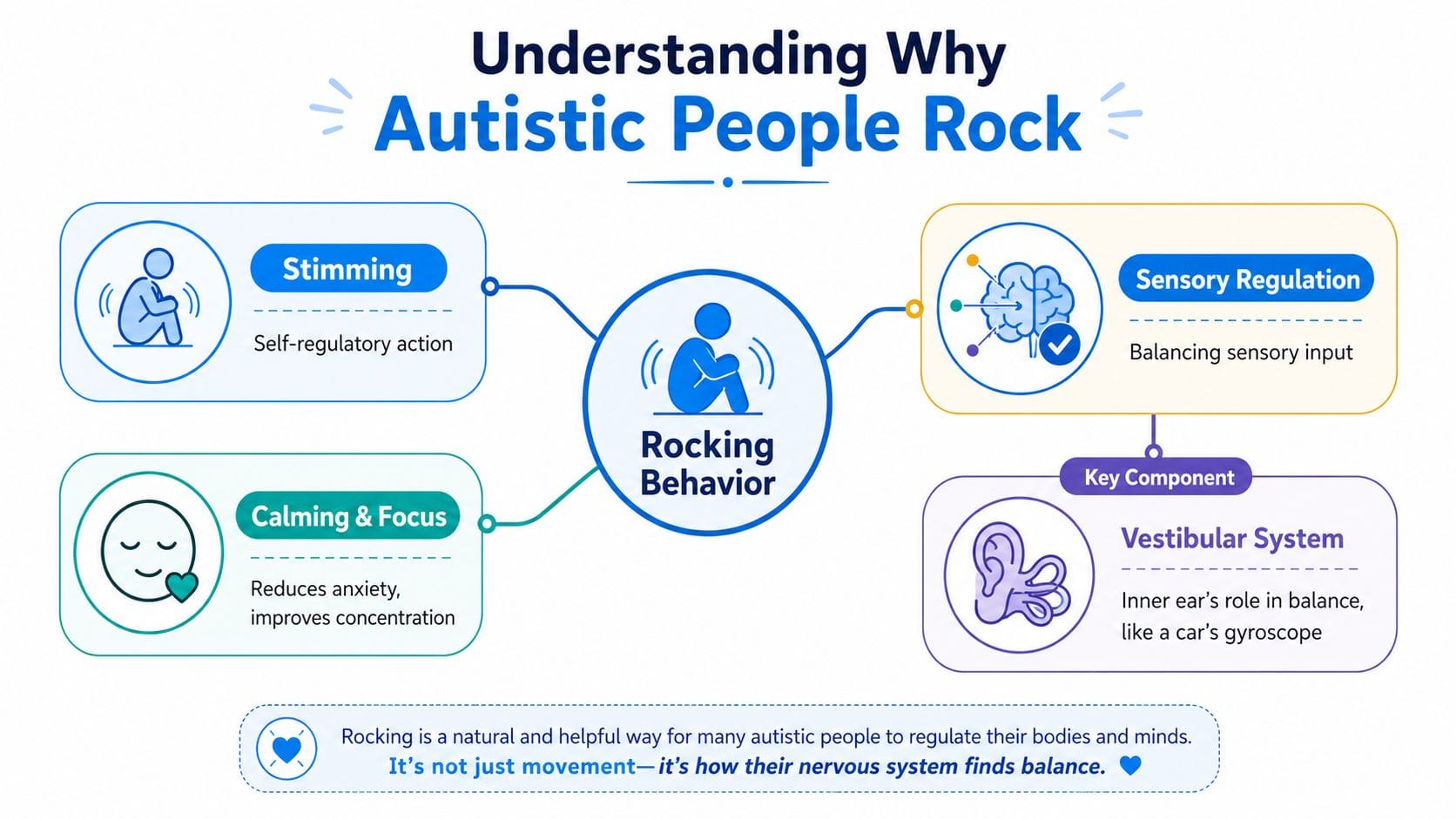
Rocking is one of the most common motor stereotypies seen in autistic people, with a 2017 systematic review and meta-analysis of 37 studies reporting a median prevalence of 51.8% and study estimates ranging from 22% to 97.5%. The same analysis found that stereotypies were more likely in people with lower IQ scores, with an odds ratio of 2.5, and in those with a formal autism diagnosis independent of IQ, with an odds ratio of 4.7 (scienceinsights.org). That makes rocking a well-established neurodevelopmental behavior, not a quirky habit to dismiss.
The body is often asking for rhythm
Think of the vestibular system as the body's motion sensor. It helps the brain understand balance, orientation, and movement. Rhythmic rocking gives that system predictable input, which can feel organizing when the world is too loud, too fast, or too uncertain.
Clinical guidance describes rocking as a form of stimming, a self-regulatory behavior that helps many autistic people manage sensory input and emotional load. One review notes that up to 90% of autistic people experience some form of sensory processing difference, which helps explain why movement can matter so much (apexaba.com). The motion can soothe an overloaded nervous system, help a child express feelings they can't yet say, or support focus during demanding tasks.
Respect matters here too
In autistic-community language, stimming is often understood as self-regulation, communication, and sometimes even comfort or joy. That framing matters because it pushes back on the old instinct to treat every repetitive movement as something to stop. A better lens is functional, not punitive. The key question is not “How do I make this disappear?” It's “What need is this movement meeting?”
If you're trying to make sense of that answer over time, the definition of stereotyped behavior is a useful starting point for understanding how repetitive movements fit into the bigger picture of regulation.
Common Triggers and What They Reveal
A child rarely starts rocking for no reason. The trigger may be obvious, like a crowded room. It may also be subtle, like a hard transition, a missed snack, or a change in routine that others barely notice. The same motion can point to very different needs depending on what came before it.
Sensory, emotional, and physical triggers
Sensory triggers include noise, bright light, scratchy clothing, busy visuals, or a room that feels overwhelming. A child might start rocking harder after entering a supermarket, not because they're defiant, but because their system is trying to cope with too much input.
Emotional triggers can include anxiety, excitement, frustration, or the stress of switching tasks. A child who rocks before leaving for school may not be “stalling.” They may be trying to steady themselves before a transition they find hard.
Physiological triggers are easy to miss. Fatigue, hunger, pain, illness, medication timing, or general discomfort can all change a child's need for rhythmic input. A parent might see rocking increase late in the day and assume it's only behavior, when the underlying cause is exhaustion.
A helpful parent question is simple, “What changed right before the rocking changed?”
That kind of observation lines up with the practical guidance in Providers for Healthy Living autism resources, which emphasizes noticing the context around behavior instead of reacting only to the behavior itself.
A simple cause-and-effect loop
Therapists often look at antecedent, behavior, consequence. In plain language, that means: what happened before, what the child did, and what happened after. If rocking starts after a loud hand dryer and stops when the child leaves the bathroom, the environment is telling you something. If rocking appears before a math worksheet and eases after a break, the task demand may be the issue.
The same motion can be regulatory, communicative, or both. Logging the moment makes that visible faster than memory ever will.
When Rocking Is a Safety or Medical Concern
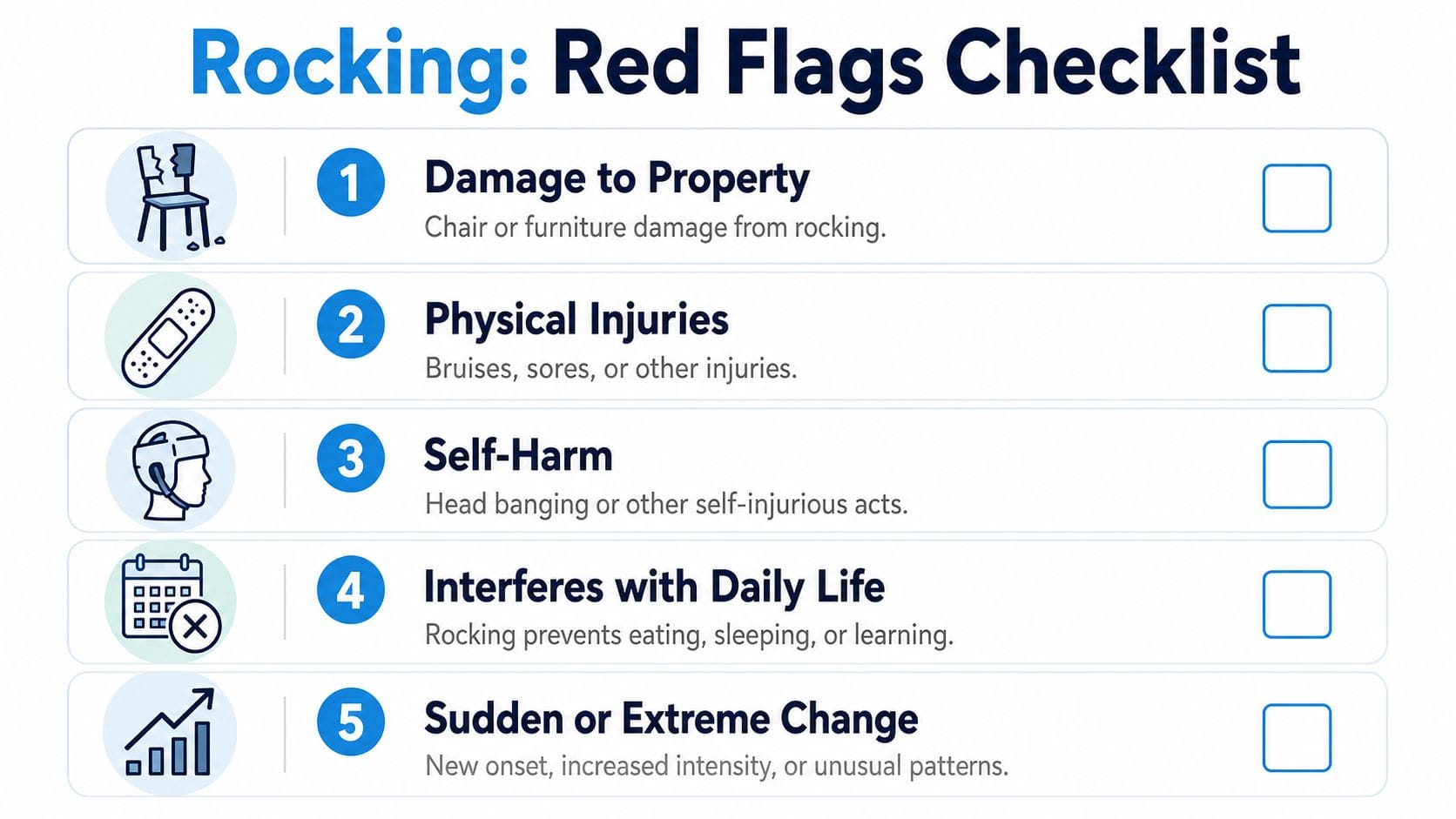
Most rocking is not dangerous. Some rocking deserves closer attention because the movement itself, or what it's happening alongside, may point to pain, injury, or another problem. The goal is not to panic. The goal is to notice the difference between regulation and risk.
Red flags that change the response
- Chair or furniture damage: A chair tipping back, scraping hard floors, or repeatedly hitting walls can create injury risk. The practical move is to make the space safer right away.
- Physical injuries: Bruises, sores, or other marks suggest the movement is no longer benign. That deserves a pediatric check-in.
- Self-injury: Head-hitting or other harmful acts need prompt attention and a safety plan.
- Interference with daily life: If rocking blocks eating, sleeping, or learning, the behavior is affecting function, not just comfort.
- Sudden or extreme change: A new pattern, a sharp increase in intensity, or a major shift in frequency deserves review.
Pain can hide inside the pattern
Rocking can coexist with reflux, constipation, ear infections, fatigue, postural instability, anxiety, or another source of discomfort. That's why stopping the movement without asking why it increased can miss the underlying issue. A child who rocks harder while grimacing or holding their body may be communicating pain even if they can't describe it.
Watchful support means you observe, reduce risk, and note the pattern.
Talk to the pediatrician this week when the behavior changes suddenly, causes interference, or seems tied to discomfort.
Seek urgent evaluation when there's injury, dangerous movement, or a rapid change that looks medically concerning.
The clearest way to make that conversation useful is to bring timestamps, context, and what happened when the environment changed. Two weeks of notes can turn vague worry into a concrete clinical discussion.
How to Track Rocking Patterns That Actually Help
Good tracking doesn't take a long form. It takes the right details. A useful note tells you what happened before the rocking, what the child was doing, how intense the movement was, and what changed after you adjusted the environment.
What to write down
Use a short record with these pieces:
- Time of day and general setting
- Activity happening right before the rocking
- Sensory load, such as noise, lighting, crowding, or texture
- Demand level, like homework, dressing, waiting, or transitions
- Duration and intensity of the rocking
- What helped or escalated it
- What happened next, including calmness, shutdown, or a bigger reaction
A vague note like “upset after school” is hard to act on. A stronger note says, “After 10 minutes of fluorescent lighting in the grocery store, rocked hard for 4 minutes, stopped when we stepped outside.” That kind of entry tells you something usable.
One useful example
A parent logs this: “6:15 p.m., kitchen chair, before dinner, child started rocking after sibling started talking loudly and the room got busier. Movement lasted 3 minutes. Rocking eased after I lowered the noise and gave them a few minutes alone.” That one entry already suggests a sensory trigger and a helpful accommodation.
For families who want to make this faster, a behavior tracking app can keep the entries structured and easy to review later. The time savings matter most on busy days, when nobody has bandwidth to type a perfect note while managing a child.
What a week of entries can show
A few days of tracking often reveal the underlying pattern, not the one memory keeps guessing at. You may notice rocking spikes during noisy settings, before hard transitions, or when a child is tired. You may also see that one accommodation works in one room and fails in another. That's the value of a week-in-review view. It turns scattered moments into a pattern you can use.
Seating and Movement Options Worth Trying
Some children rock because their current seat gives them no good way to regulate. Others need a different kind of motion or a safer place to move. The right option depends on what the rocking seems to do, where it happens, and how the child uses their body.
Seating choices compared
| Option | Best For | Setting | Watch For |
|---|---|---|---|
| Rocking chair | Children who seek steady rhythmic motion | Home, calm corners, supervised routines | Tipping, speed, or overuse |
| Wobble stool | Kids who need movement while staying at a table | Homework, therapy, classroom tasks | Fatigue or distraction |
| Therapy ball | Short movement breaks and core engagement | Home or therapy room | Balance loss and bouncing too hard |
| Floor cushion | Children who want lower pressure and flexibility | Reading corner, quiet play | Slouching or sliding out of position |
| Beanbag | Rest, decompression, and low-demand downtime | Quiet spaces at home | Difficulty getting up quickly |
| Hammock-style swing | Strong vestibular seekers who need larger movement | Home therapy areas or supervised spaces | Safety clearance and supervision |
| Outdoor swing | Rhythmic movement with fresh air and space | Yard, park, supervised play | Overstimulation or rough motion |
A dedicated chair can be helpful when a child rocks during seated work, because it gives the body a controlled way to move without leaving the task. A wobble stool or therapy ball may fit better when the goal is to stay engaged at a table. A floor cushion or beanbag may work better when the child needs to decompress rather than focus.
Best-fit matters more than the product name. A child who rocks gently to settle before bed needs something different from a child who rocks hard during homework.
If you're comparing options, a product like My Comfort rocking chair is the kind of seat families often look at when they want a calm, predictable motion at home. The right seat is the one that fits the child's body, the room, and the routine.
The most useful question is not “Which seat is best?” It's “Which seat helps this child regulate in this setting, right now?” That's why the same child may need different supports over time. As noted in the sensory rocking chair guide, the point is support, not forcing stillness.
Working With Therapists, Schools, and Doctors
A tracked pattern becomes powerful when other adults can use it. Therapists, teachers, and pediatricians can only help well if they can see what the rocking looks like in real life, not just hear a quick summary at pickup.
What to share and who needs it
An occupational therapist may want to know when rocking happens, what sensory input was present, and which movement options helped. An ABA therapist may look for antecedents, escalation, and how the child responded to changes in demand. A pediatrician needs the bigger picture, especially if pain, sleep, appetite, or sudden changes are part of the story. A classroom teacher usually needs practical adjustments, like a movement break or alternate seating.
A simple script helps:
“We're seeing rocking most often during noisy transitions and homework. It settles when the room is quieter or when they have a movement break. Can we talk about a seating or sensory accommodation that supports regulation without disrupting class?”
When to ask for more formal help
Some changes belong in a routine conversation. Others need a written note or a clinician's input, especially if the child needs a school accommodation or the rocking seems tied to pain, sleep changes, appetite changes, or skill regression. The key is to bring evidence, not just concern.
A resource like the guide on youth mental health programs can also help families think about when behavior, stress, and mental health support need to be considered together, especially if the child's distress is broad rather than isolated to movement.
When adults see the same data, meetings get shorter and more useful. The child doesn't have to become the evidence. The pattern already is.
Bringing It Together and What to Do This Week
Start with three moves. First, observe and log without judgment for seven days. Second, look for one or two rocking hotspots, the situations where the motion shows up most often. Third, try one accommodation that matches the most common trigger, whether that's quieter space, a different chair, or a short movement break.
The big shift in modern care is simple. Rocking is not something to suppress by default. It's information. Sometimes it's regulation, sometimes it's communication, and sometimes it's a sign that something needs attention.
A short checklist for this week
- Notice the pattern: write down when rocking starts, what happened right before it, and what changed after.
- Pick one likely trigger: noise, transitions, fatigue, hunger, or discomfort.
- Test one support: a seat change, a quieter space, or a brief movement break.
That kind of careful attention is often the first step toward understanding bigger patterns around sleep, diet, meltdowns, and daily stress. Parents already have the most important ingredient, close observation. What helps most is a system that turns those observations into something you can use.
If you want one place to capture rocking, triggers, sleep, routines, and what helps, Guiding Growth gives families a structured way to log the details without losing them in scattered notes. It's built for the moments when you need to notice patterns fast and share them with the people helping your child.