Your child is escalating at the kitchen table again. The timer hasn't helped, the demand hasn't stopped, and you can feel the whole routine sliding into another hard afternoon. Then the BCBA shares the functional assessment result, attention is maintaining the behavior, and suddenly the question changes from “What do we do right now?” to “How do we use that information well?”
That is where noncontingent reinforcement becomes useful. It's one of the most practical tools in ABA because it doesn't guess at the problem, it matches the reinforcer to the function and delivers it on a schedule the child doesn't have to earn in the moment. For families, that can feel like relief, but it also raises the hard questions people live with, how often, how long, how do you fade it, and how do you know whether it's working or just creating timer-dependence?
If you've ever looked up related sleep and regulation topics, you may have noticed how much timing matters in family routines. A helpful parallel is why your baby wakes hourly, because the same basic problem shows up there too, a pattern gets established and then the family has to decide how to respond without making the pattern stronger.
Table of Contents
- A Scene Most ABA Families Recognize
- What Noncontingent Reinforcement Means
- How NCR Compares to Other ABA Strategies
- What the Research Shows
- Implementing NCR Step by Step
- Two Real-World NCR Scenarios
- Avoiding Schedule Dependency and Knowing When to Fade
- Tracking NCR Progress and Building Skills Beyond It
A Scene Most ABA Families Recognize
The parent has one hand on the cereal box and the other on the child's wrist, trying not to turn the whole breakfast into a battle. The therapist is nearby, writing notes because the pattern has already been identified, the behavior is getting attention, and that attention is the reinforcer. Everyone in the room can feel the tension, and everyone also knows that “just ignore it” is not a plan when the behavior has a function.
That's the moment many families first hear noncontingent reinforcement aba in a report or team meeting. It sounds technical, but the idea is simple, give the maintaining reinforcer on a time-based schedule so the child doesn't have to use the problem behavior to get it. In practice, that often means the team is using the functional assessment to answer a question that matters more than the label, what exactly is this child getting from the behavior, and how can we provide some of that proactively?
Practical rule: NCR makes the most sense after assessment, not before it. If the team hasn't identified what's maintaining the behavior, the schedule is just a guess.
That's why NCR shows up when a team wants to be more precise, not more dramatic. It's not a magic fix, and it's not the same as giving in. It's a structured way to lower the pressure in the environment while the child learns something more useful than escalation.
Parents often tell me they want the version that tells them what to do at 7:30 a.m., not the definition they already read in a report. They want to know when to start, how to keep track, and how to avoid setting themselves up for a relapse later. That's the lens for the rest of this guide, because the value of NCR is in the details most summaries leave out.
What Noncontingent Reinforcement Means
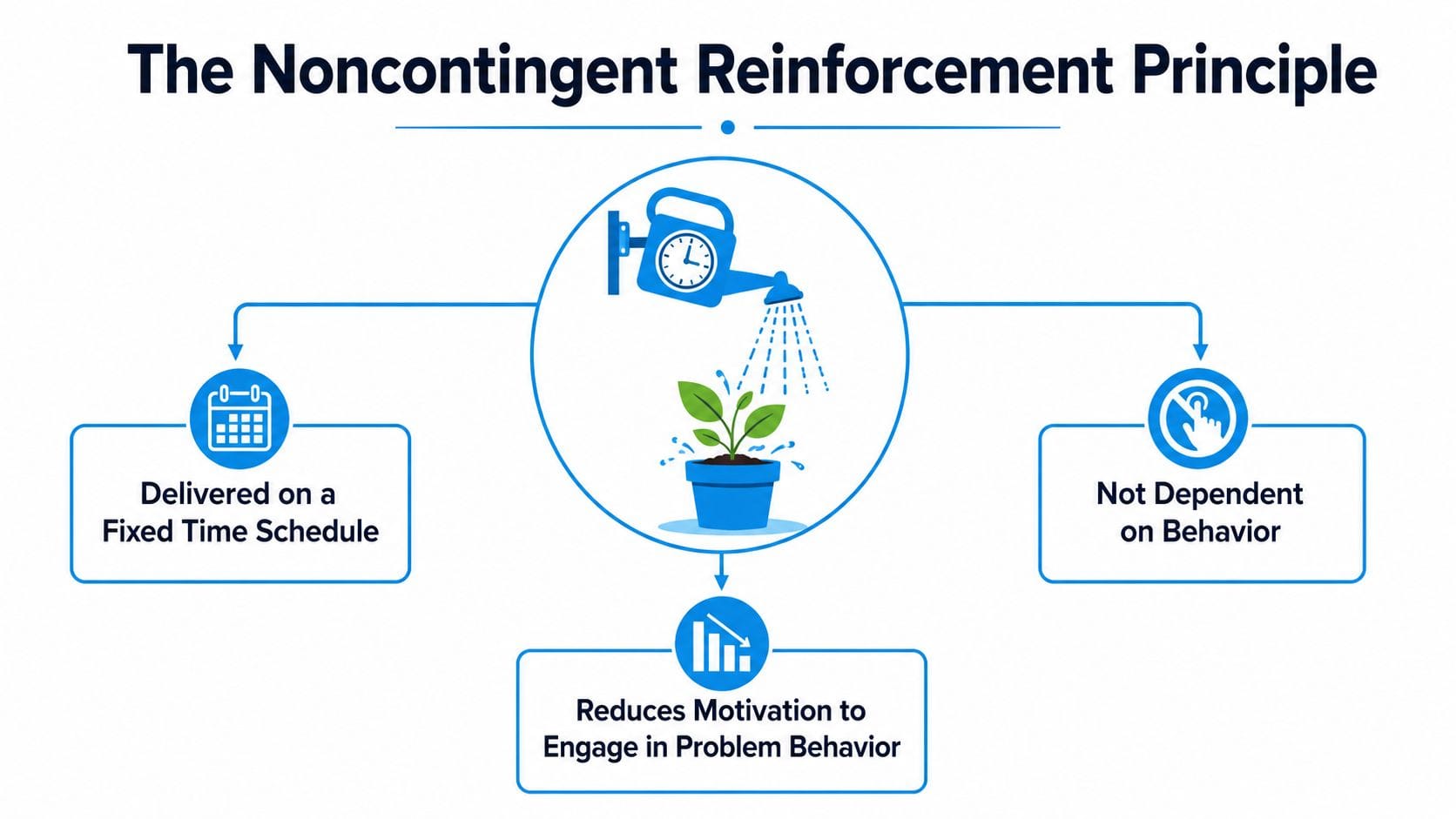
A child starts calling out every few minutes because attention is what keeps the behavior going. If the adult only responds after the calling gets louder, the child learns that escalation is the path to access. Noncontingent reinforcement changes that pattern by delivering the maintaining reinforcer on a time-based schedule, so the child does not have to use the problem behavior to get it.
The core idea in plain English
In ABA, NCR is a response-independent, time-based intervention, which means the reinforcer is delivered on a fixed-time or variable-time schedule, not because the learner did something in that exact moment PMC explanation of NCR as response-independent. If attention is what keeps the behavior going, the team may deliver attention on a schedule. If escape is the function, the team may schedule breaks. The reinforcer should match the function, not just the form of the behavior.
That distinction matters in home plans and clinic plans. NCR is planned from a behavioral hypothesis, so the adult is not handing out random rewards or giving in after a hard moment. The adult is delivering the same kind of access the behavior has been producing, but in a calmer, predictable way. It is also not a replacement for teaching, because the child still needs a communication response, coping skill, or tolerance skill that can take the place of the old pattern.
What the schedule is doing
The schedule does two jobs at once. It lowers the immediate motivation to seek the reinforcer through problem behavior, and it gives the team a cleaner way to watch whether the child stays regulated when the reinforcer is already available on a predictable basis.
NCR is most accurate when the reinforcer is intentionally matched to the behavior's function. Attention for attention-maintained behavior, breaks for escape-maintained behavior, or another validated alternative when that is what the assessment supports.
That is also why the schedule matters so much. A timer that is too long can let the problem behavior reappear before the next delivery. A timer that is too short can create a constant stream of access that is hard to maintain and hard to thin later. For escape-maintained behavior, teams often need to coordinate NCR with a careful plan for how escape extinction works in ABA, because the child can still learn that problem behavior changes the environment unless the plan is consistent.
NCR is often described as a treatment for aberrant behavior rather than a full developmental program. It can reduce problem behavior and make the learning environment safer, but it does not automatically build the long-term skills a child needs to function independently.
How NCR Compares to Other ABA Strategies
Families often hear NCR, DRO, DRA, extinction, and contingent reinforcement in the same conversation, then leave the meeting unsure which one fits. The difference usually comes down to one question, what has to happen before the adult delivers the reinforcer?
| Strategy | What triggers the reinforcer | Best fit for | Main trade-off |
|---|---|---|---|
| Noncontingent reinforcement | Passage of time, not behavior | Lowering motivation for a problem behavior when the function is known | It can reduce behavior without teaching a replacement response by itself |
| Contingent reinforcement | A target behavior happens | Building new skills and strengthening specific responses | It depends on the learner already doing the response you want |
| DRO | A set period passes without the problem behavior | Reducing a behavior when absence of the behavior can be monitored clearly | It can miss what the learner should do instead |
| DRA | A replacement behavior happens | Replacing problem behavior with a better communication or coping response | It requires the replacement behavior to be available and usable |
| Extinction | No reinforcer is delivered for the problem behavior | Weakening behavior that has been reinforced by attention, escape, or tangibles | It can produce short-term escalation and needs careful planning |
The biggest advantage of NCR is that it removes the response requirement. That's exactly why it can work when behavior is frequent, intense, or hard to interrupt. The biggest limitation is just as important, it doesn't automatically teach a new skill, so most strong plans pair it with teaching or use it as a bridge while teaching catches up.
NCR is also commonly discussed alongside extinction in the research base review of NCR treatment classification. That doesn't mean every plan needs extinction, but it does mean teams should think carefully about what's still paying off the behavior. If you want a deeper look at the distinction, the practical use of escape extinction in ABA helps clarify why the two procedures are often discussed together.
What the Research Shows
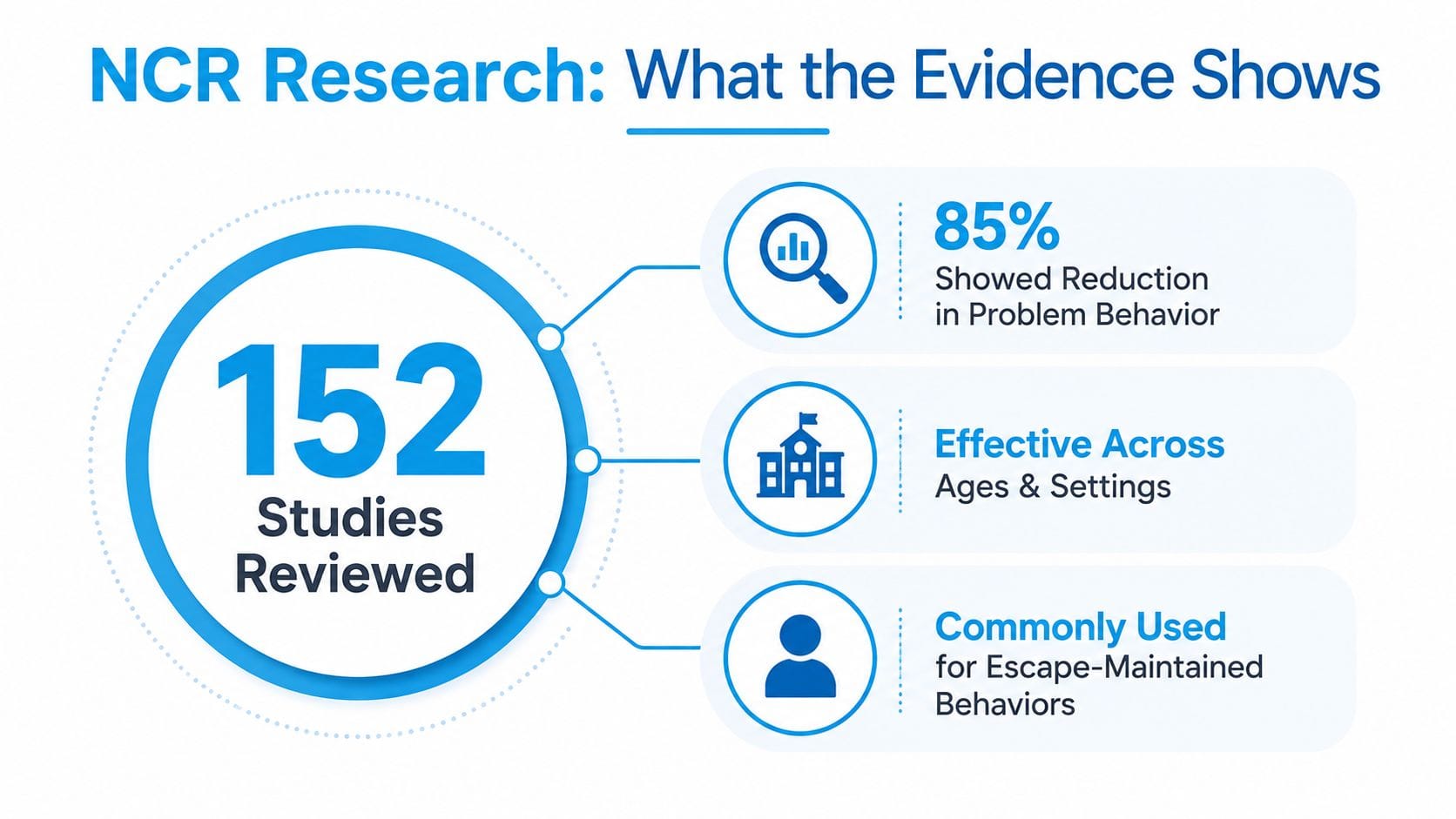
The evidence for NCR is stronger than many parents expect, but the results make the most sense as behavior reduction, not as a cure-all. A review of 152 functional analyses of self-injurious behavior found that NCR using attention or play reduced SIB in 127 cases, which is 83.6% of the sample. In another inpatient-focused study, NCR reduced severe problem behavior by at least 80% in 20 of 27 applications across 21 individuals, and by 90% in 19 of 27 applications.
What those numbers mean in real life
Those results are encouraging because they show NCR can work well when the function is identified and the plan is carried out carefully. They are not magic. They describe situations where the team knew what reinforcer mattered and used it on purpose, instead of guessing.
That matters because NCR is function-based. If a child is seeking attention, then giving attention on a schedule can reduce the need to seek it through problem behavior. If a child is escaping demands, then scheduled breaks may reduce refusal and escalation. The intervention works best when the reinforcer fits the function, not when it is chosen because it is easy to hand out.
A functional assessment example helps make that point concrete. If the assessment shows that problem behavior most often follows removal of attention, then the NCR plan should deliver attention before that pattern builds, using the same logic shown in a functional behavior analysis example. If the team skips that step, the schedule may still run, but it may not connect to the reason the behavior is happening.
The 2008 review also matters here. It identified 59 studies, with 24 meeting criteria for treatment classification, and classified fixed-time reinforcer delivery plus extinction and schedule thinning as well established, while fixed-time plus extinction and variable-time plus extinction were rated probably efficacious 2008 review. That tells teams something practical, the literature does not treat NCR as a casual trick. It treats it as a treatment with a real evidence base and real implementation details.
The broader summary is just as clear in the research record and in an infographic summarizing research showing that 152 studies confirm noncontingent reinforcement effectively reduces problem behaviors. NCR can reduce behavior that is already being maintained by attention, escape, or access to tangibles, but the team still has to choose the function carefully, deliver the schedule consistently, and plan for what happens after the first signs of progress.
Bottom line: The research supports NCR most strongly when the function is known, the schedule is deliberate, and the team is prepared to thin support instead of leaving the schedule frozen forever.
Implementing NCR Step by Step
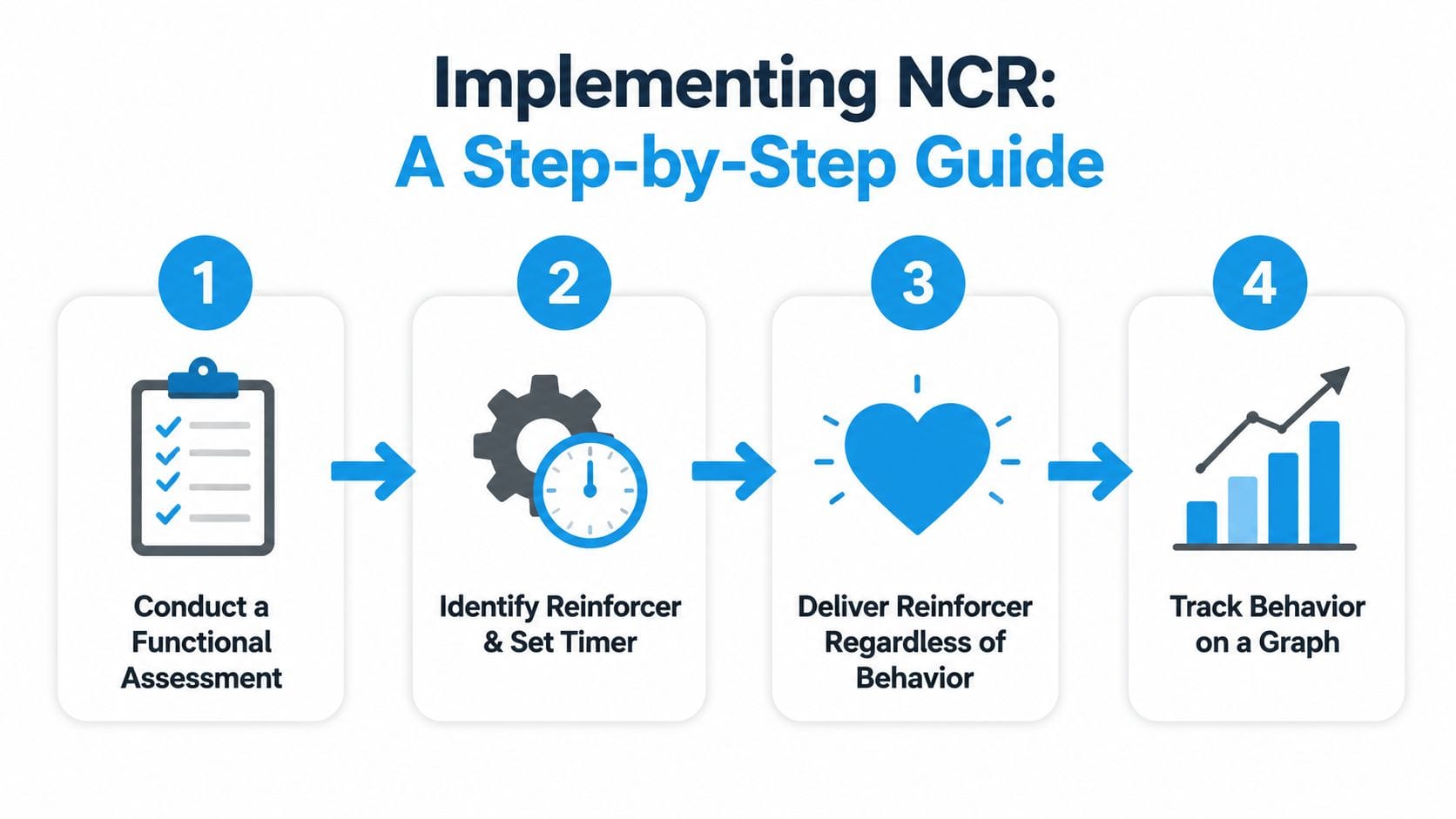
A strong NCR plan starts before the timer ever goes off. The first question is whether the team has a functional assessment, or at least a very solid hypothesis about the maintaining reinforcer. Without that, the reinforcer choice is shaky, and shaky choices usually show up later as weak effects or accidental schedule dependency.
Pick the reinforcer from the function
If attention is maintaining the behavior, the reinforcer should look like meaningful attention. If escape is maintaining the behavior, the reinforcer should look like a planned break or a way to pause demands. The match matters more than the label.
Practical guidance recommends using functional assessment or preference and competing-stimulus assessment to identify the reinforcer, then setting the initial interval shorter than the usual time between problem behaviors NCR guidance. One instructional source gives a simple example, 40 minutes of observation with 30 instances yields an initial interval of about 1.3 minutes interval calculation example. That's not a universal formula, but it's a good reminder that the interval should come from real observation, not guesswork.
Choose the schedule and log the context
NCR is usually delivered on a fixed-time or variable-time schedule. Fixed-time is easier to run because the timing is predictable. Variable-time can help reduce timer-watching and schedule dependency, especially when the child starts to wait for the reinforcer instead of staying regulated more broadly.
The first schedule is usually richer than the baseline rate of problem behavior, then thinned gradually as behavior improves practical NCR guidance. The team should record what was happening at each delivery, who was present, what demand was active, and what the child was doing when the timer went off. That context is what helps later when you decide whether the schedule can stretch.
Here's the practical sequence many teams use:
- Confirm the function. Start from assessment, not assumptions.
- Select the reinforcer. Match attention, escape, tangibles, or another identified need.
- Set the first interval. Make it slightly shorter than the usual time between problem behaviors.
- Deliver on schedule. Don't wait for the behavior to earn it.
- Track the effect. Look for fewer problem behaviors and calmer transitions before changing the plan.
If you want a deeper example of how assessment informs intervention, this functional behavior analysis example gives helpful context for the decision-making that comes before NCR.
Two Real-World NCR Scenarios
A six-year-old interrupts every few minutes during play because attention is the payoff. The parent sets a five-minute variable-time attention schedule during structured play, gives brief positive attention on the timer, and logs the context carefully each day. By the end of the week, the family can see that the interruptions are dropping, but there's also one rough spot, the child starts looking toward the timer early, which tells the team the schedule is helping but also needs a plan for thinning.
A school-based BCBA sees a different pattern. Writing tasks trigger escape-maintained behavior, so the team uses a fixed-time break schedule and pairs it with a functional communication response, so the learner can ask for a pause instead of escalating. The first days are messy because the student tries to earn an extra break with refusal, but the data show that the schedule is preventing the full blow-up, which gives the team enough confidence to keep going rather than abandon the plan too quickly.
What changes in each setting
The home plan and the school plan look different because the reinforcer functions differently. In the home case, the parent is using attention proactively so the child doesn't need to chase it. In the school case, the breaks are doing the same job for escape, but the replacement response gives the learner a more durable way to communicate the need.
The useful part isn't just that both plans “worked.” It's that both teams watched the right data. They noticed when behavior dropped, when it clustered around the timer, and when the child began to use something more functional than escalation. That's the level of detail that makes NCR feel like a real tool instead of a generic strategy.
Each family or team ends up with a slightly different rhythm. One child does better with short, frequent check-ins. Another needs longer spacing and a clearer replacement response. The point is to build a plan that responds to the behavior's function and then evolves as the child shows more tolerance.
Avoiding Schedule Dependency and Knowing When to Fade
Many NCR guides get vague here, and families usually get stuck here. A child can look calmer because NCR is helping, or because the child has learned that the timer is the only thing worth waiting for. Those are not the same outcome.
Warning signs you should watch
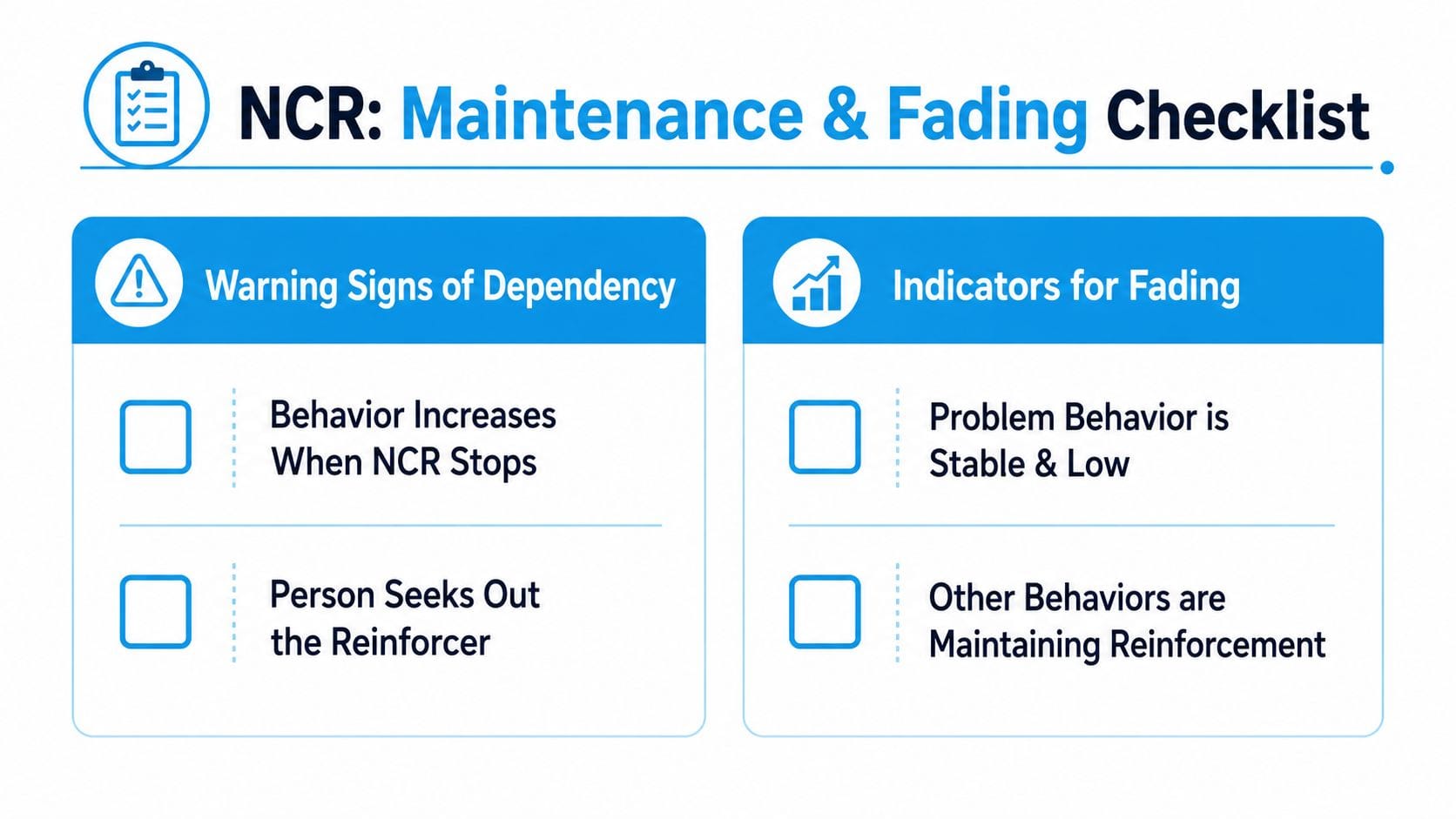
If behavior spikes right before the interval ends, the child may be timing the reinforcer. If the learner starts seeking out the reinforcer in a patterned way, that can also signal dependency. And if the behavior is quiet during NCR but falls apart the moment the schedule stops, the plan may be holding the child together more than it is building tolerance.
The practical fix is usually not to panic, it's to adjust the schedule thoughtfully. Teams often shift from fixed-time to variable-time delivery, increase the interval length in small steps, and keep pairing the plan with functional communication training so the child has a durable response that isn't tied to the timer. That combination is especially important when the team wants more than short-term suppression.
If the child only succeeds when the timer is obvious, the plan needs fading, not celebration.
When to fade and when to keep support
A good fading decision starts with data showing the problem behavior is stable and low, not just quieter for a moment. The schedule should thin only after the child tolerates the current interval well, and the team should watch whether other behaviors are starting to carry the reinforcement more appropriately. If support disappears too quickly, relapse becomes more likely.
Families sometimes feel pressured to remove NCR as soon as things improve. That can be premature. In some cases, NCR is a bridge while communication, waiting, or tolerance skills catch up. In other cases, it's a short-term support that should be faded more aggressively because the replacement skills are already in place.
The hardest part is being honest about what the data are really saying. If behavior comes back as soon as NCR stops, that's not a failure of the child. It's a signal that the team needs a slower fade, a better replacement skill, or a more careful look at the function again.
Tracking NCR Progress and Building Skills Beyond It
The most useful NCR plans are the ones you can read later. That means logging the time of each delivery, what was happening in the environment, the rate of problem behavior, and any sign that the child was using a skill instead of waiting for the next reinforcer. A plan without clean notes turns into a memory contest, and families already have enough of those.
What to track every day
Look at the NCR interval itself, then look at the context around it. Was the child on a demand, in transition, hungry, tired, or in a noisy room? Did the reinforcer land smoothly, or did the child react right before it arrived? Those small details often explain why one day feels easy and the next feels brittle.
A weekly review should ask a few blunt questions. Is the problem behavior lower? Is the child showing more tolerance between deliveries? Are the same triggers still present, just less explosive? Those answers tell you whether NCR is doing its job or whether the plan needs to shift.
Where the skill-building lives
NCR should move the learner toward more independence, not turn into a permanent crutch. That's why it belongs alongside communication, waiting, coping, and routine skills. If the child can ask for attention, ask for a break, or tolerate brief delays, NCR becomes easier to fade and less likely to become schedule-dependent.
For families who want better structure around that process, how to track and understand behavioral triggers is a useful companion mindset, because the quality of the tracking often determines the quality of the next decision. If you're also working on daily independence skills, help your child become independent is a good reminder that the end goal is growth, not permanent support.
That's where a tool like Guiding Growth fits naturally. It helps families centralize behavior logs, capture context around NCR intervals, and share the story with caregivers and the BCBA without rebuilding it from scratch. For parents juggling notes, appointments, and real-life routines, that kind of structure can make the difference between guessing and knowing.
If you're trying to decide whether NCR is helping, fading too fast, or creating timer-dependence, track the interval, the context, and the child's skill use in one place every day. Guiding Growth gives families a simple way to log behavior patterns, see what's happening around each reinforcer delivery, and share clear data with the people supporting your child.