It's 6:14 on a Tuesday, dinner's half-made, and your child is on the kitchen floor. You might call it a meltdown, a shutdown, a tantrum, or just a hard night, because in the moment those words all feel close enough. The trouble is that one word can hide the detail that helps, and detail is what clinicians, teachers, and tired parents need when they're trying to understand what happened and what to do next.
If you've ever walked away from an evening like that thinking, “I know what I saw, but I can't explain it clearly,” you're already halfway to understanding topography of behaviour. In applied behavior analysis, topography is the physical form or shape of a behavior, and experts treat it as the measurable, observable dimension that lets you record what the behavior looks like rather than why it occurs. That simple shift, from label to visible form, changes the quality of your notes immediately.
Table of Contents
- The Evening Everything Looked the Same
- What Topography Means
- Three Topographies You Probably Already Know
- Why the Form Changes Over Time
- How to Observe and Record Topography at Home
- Turning Logs Into Patterns You Can See
- Sharing Topography Notes With Therapists and Clinicians
- Common Misconceptions and Quick Answers
The Evening Everything Looked the Same
Dinner was on the stove, the broccoli was still too crunchy, and your child had slid down the cabinet and onto the kitchen tiles. Maybe they were crying. Maybe they weren't. Maybe they were yelling, refusing, hiding, or just done for the night. From the outside, it can all blur into one exhausting scene.
That blur is where topography matters. A behavior's topography is its physical form, the visible shape of what it looked like and sounded like, not the reason you think it happened. In practical terms, one child might flop to the floor and go silent, while another might scream, kick, and throw a spoon. Both moments may get called “a meltdown” at home, but they're not the same behavior in observable form.
A kitchen note that says “meltdown at dinner” can be too thin to help later. A note that says “dropped to the floor, covered ears, and stopped speaking after the smell of food changed” gives you something concrete to compare with tomorrow night. It also gives a therapist, teacher, or caregiver a clearer picture of what happened without asking them to guess at intent.
Practical rule: write what the camera would catch first, then write your best guess about why it happened in a separate field.
That separation is the core value. When form and function get mixed together, the note becomes fuzzy. When they're split apart, you can start seeing whether the same kind of evening keeps producing the same kind of response, or whether the behavior looks different depending on who is there, what was asked, or what changed in the room.
What Topography Means
Form is what you saw
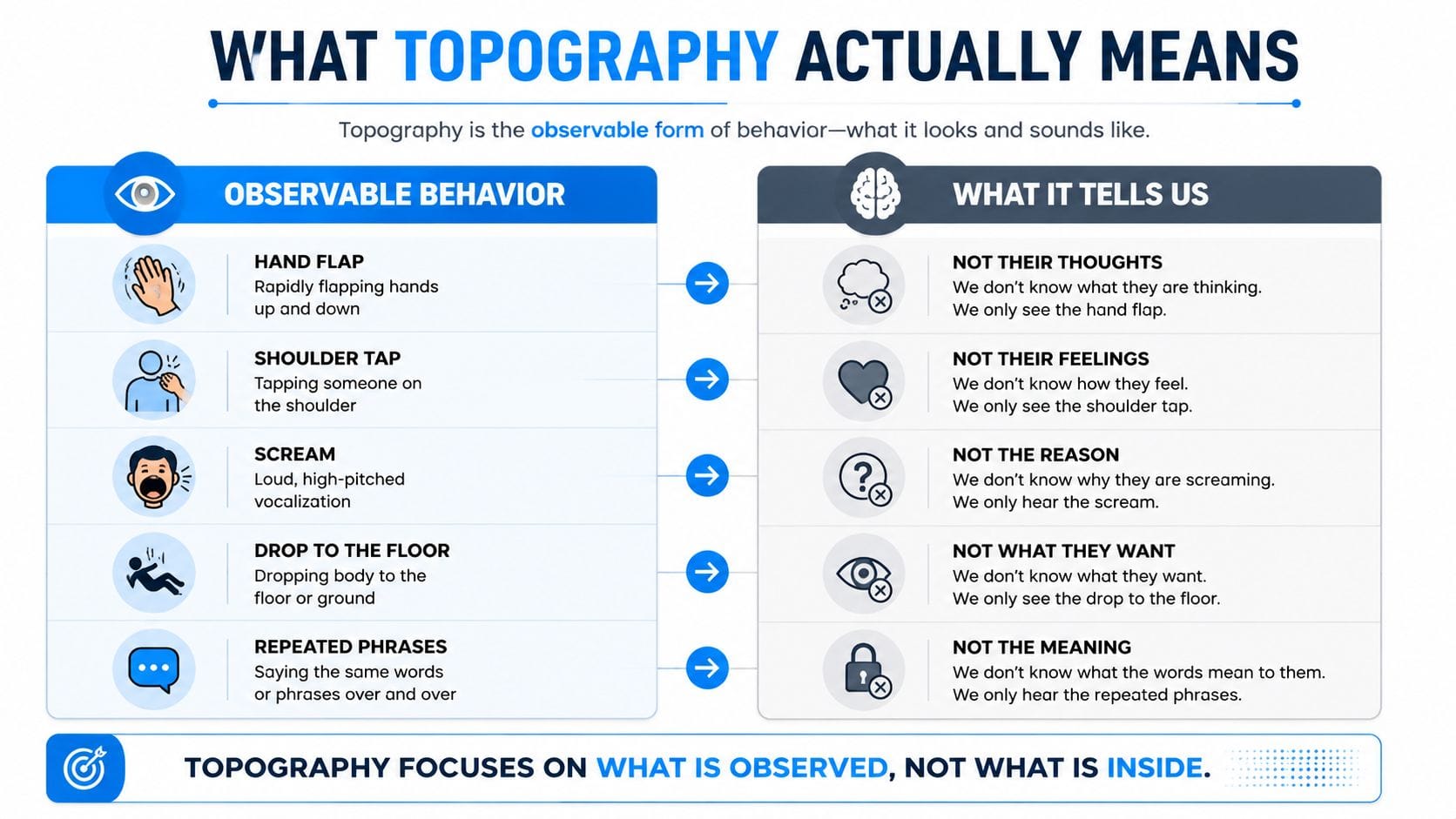
A child covers their ears at the dinner table. Another drops to the floor in the hallway. A third repeats the same phrase while staring at the wall. Those are all examples of topography, the visible shape of behavior, the part you could describe if someone asked, “What happened?”
That is why clinicians ask caregivers to write in observable language. “He was upset” gives a feeling, but it does not give a scene. “He covered his ears, paced to the doorway, and repeated the same sentence five times” gives something a parent, teacher, or therapist can picture and compare later. Practitioner guidance recommends describing the exact movements, vocalizations, and posture, and leaving labels like tantrum or noncompliance for a separate interpretation step, because those labels already bundle in meaning (Praxis Notes on topography versus behavior function).
Function is the reason or result
Function answers a different question, why did it happen, or what did it accomplish? A child might yell to get attention, flap to regulate, or drop to the floor to avoid a demand. The same function can appear in very different forms. Recent work on verbal behavior describes this split clearly, with different antecedent stimuli controlling different response forms in topography-based verbal behavior, while selection-based responding works through visually distinct choices (PMC on verbal behavior forms).
A hand flap and yelling can share a function even though they look nothing alike. A note that mixes the two together becomes hard to use later, because the scene and the explanation get tangled. Good logs keep those two pieces in separate fields, so the form stays clean and the interpretation can be revised if needed.
| Form vs function at a glance | ||
|---|---|---|
| Question | Topography (form) | Function (why) |
| What do I see or hear? | Exact movement, sound, posture | Not answered here |
| Why did it happen? | Not answered here | Escape, attention, access, regulation |
| What belongs in the note? | Visible actions | Your later interpretation |
Topography-based definitions are especially useful when behavior changes gradually. In ABA, shaping reinforces successive approximations toward a target form, so the behavior may change in small steps before it reaches the final version (shape the form gradually). A note that records those small shifts can show that the same response is changing shape over time, which helps when you are trying to compare one evening with the next.
Three Topographies You Probably Already Know
A lot of parents already track behavior, they just do it with broad labels. Once you start looking at form, those familiar labels break into smaller, more useful pieces.
Meltdowns are usually a sequence, not one thing
A meltdown can include dropping to the floor, kicking, throwing, screaming, covering the ears, going non-verbal, or leaving the room. Each of those is a different topography, even if they happen in the same five-minute stretch. A note that says “meltdown” misses the sequence, while a note that names each form gives you a timeline you can compare later.
That matters because one child's visible form may be loud and physical, while another child's form may be quiet and withdrawn. In a peer-reviewed study of challenging behaviors in individuals with autism spectrum disorder, stereotypy was the most commonly reported topography, followed by noncompliance and aggression, while escape was the most commonly reported function of behavior, which shows why topography and function need separate attention (Chapman University study).
Echolalia can look similar but still differ in form
Echolalia is the repetition of words, phrases, or scripts. It can be immediate or delayed, soothing or self-stimulating, and the timing of the repetition is a topographical detail worth writing down. A child repeating the last line of a cartoon right after hearing it is not the same topography as a teen repeating a phrase from earlier in the day while trying to calm down after school.
Hand flapping changes more than most people notice
Hand flapping is often treated as if it's one fixed thing. In real life, it varies in speed, height, hand position, and context. A child who flaps while smiling during play is not showing the same look as a child who flaps harder, faster, and while backing away from a noisy room. Those small changes can tell you a lot about whether the child is escalating, settling, or excited.
Small details matter: the same label can hide three different forms, and those forms often point to different support needs.
This note on stereotyped behavior can help if you want a clearer way to separate repetitive movement from the rest of the episode in your own records.
Why the Form Changes Over Time
One week, a child slams a door and shouts. A few months later, the same child may stop answering, hide in a bedroom, or speak so softly that parents have to lean in to catch it. The stress is still there, but the topography of behaviour has changed, and that change is often the first clue that something in the child's day, body, or coping system has shifted.
A moving target, not a fixed label
A topography of behaviour is not a permanent stamp. It can change with sleep, routine, school demands, puberty, family stress, or new coping skills. A child who used to kick may now freeze. A child who once cried loudly may now whisper, pace, or leave the room. Those changes matter because the same concern can take a different form when the child is tired, overwhelmed, or trying to hold it together.
A parent's notes get more useful when they separate form from function. “What happened?” and “what was it for?” are different questions. A note that only says “meltdown after homework” hides the shape of the episode, while a note that says “stared at the page, tapped the pencil, then slid off the chair and covered ears when the second question was read aloud” gives a clearer picture. That kind of description helps you compare one evening to the next, instead of treating every hard moment as the same event.
The literature also points to a real gap here. A review in PMC notes that fine-grained behavioral patterns can be highly informative, and that precursors to severe behaviors appear in only a minority of published studies, which leaves early-warning signals underexplained in many public-facing resources (PMC review on topography over time).
Precursors give you an earlier window
A precursor response is a behavior that tends to show up before a larger one. In plain language, it is the early warning sign. A child may start pacing near the doorway before yelling, rub their hands together before bolting from the table, or go silent before tears begin. When parents learn to spot that first shift, the log stops being a record of only the peak and starts becoming a record of the build-up.
A small example makes this easier to see. If a child usually covers their ears, then hums, then cries when the blender starts, the ear-covering and humming are not random extras. They are part of the pattern. If you write them down, you can see whether the same warning shows up after a noisy room, a rushed transition, or a long day at school.
Useful rule: log the first visible warning sign, not just the moment everything broke.
That early layer matters because it gives you something to act on before the child reaches the most intense form of the behavior. If you only record the peak, you lose the lead-up. If you record the lead-up too, patterns start to show whether the same precursor keeps showing up after the same kind of demand, transition, or sensory load.
How to Observe and Record Topography at Home
Good logging doesn't require clinical training. It requires a clear eye, a short routine, and language that stays with the facts. If you can write down what you saw before the moment fades, you're already collecting more useful information than a label alone can give you.
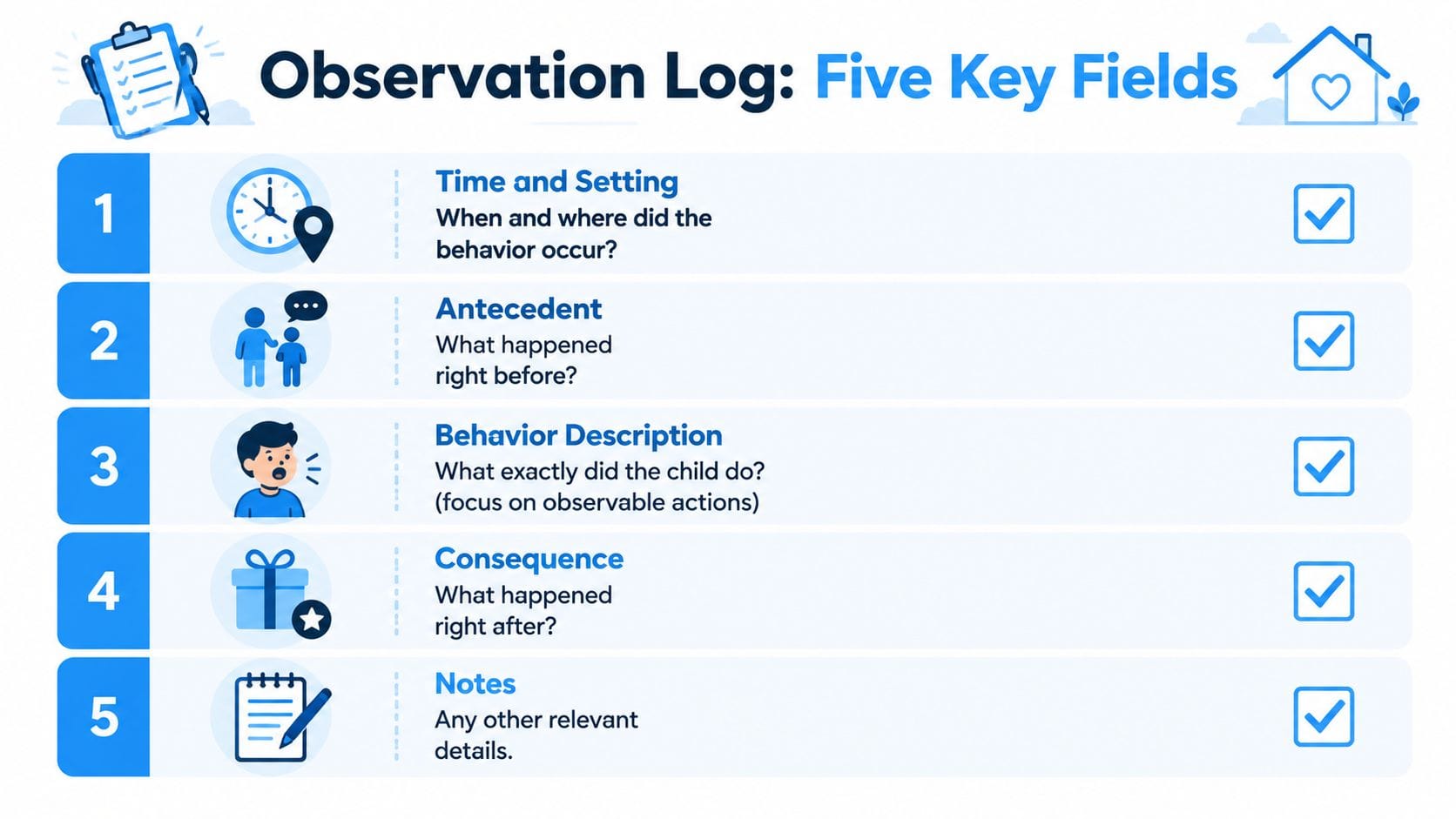
Use five fields every time
A simple observation note works best when it keeps the pieces separate:
- Time and setting, when and where it happened.
- Antecedent, what happened right before.
- Behavior description, what the child did in observable words.
- Duration or intensity, how long it lasted or how big it looked.
- What happened after, including co-regulation, removal of a demand, or comfort from another person.
A note like this is much more useful than “tantrum after dinner.” Try, “6:14 p.m., kitchen, asked to sit at the table, dropped to knees, screamed for 30 seconds, covered ears, then accepted water and moved to the hallway.” That's not a diagnosis, and it doesn't pretend to be. It's a readable description of form, trigger, and outcome.
Keep the wording short and visible
Write in present-tense, observable language. If you can, log the episode the same day while the memory is still fresh. Voice notes help when typing isn't realistic, especially on hard nights when nobody has the energy for a full write-up.
- Use exact actions: “lay on floor,” “repeated ‘no',” “hit the pillow,” not “was bad.”
- Separate guesses from facts: put “maybe hungry” in a note field if you want, but keep it apart from the behavior description.
- Keep it brief enough to finish: a small, completed note beats a perfect note you never write.
Turning Logs Into Patterns You Can See
A few scattered notes can help. A few weeks of structured notes can show you where to look next.
Read the repeats, not just the one-offs
A single entry can be misleading. One hard evening might be about hunger, noise, fatigue, or a missed routine. When the same topography keeps showing up after the same antecedent, the pattern starts to speak for itself. Maybe the child covers their ears after the blender turns on. Maybe the same vocal escalation keeps happening on school days. Maybe one caregiver sees more pacing while another sees more withdrawal. Those differences matter because they point to context, not just behavior.
This is why one shared place for entries helps. When notes live in paper scraps, phone memos, and text threads, the pattern gets harder to see. A structured log keeps the form, trigger, and outcome in the same place, so you can compare entries across days and caregivers. Guiding Growth is one option for keeping that kind of structured logging together, with behavior tracking, quick voice logging, and shared timelines that help families compare what happened before, during, and after an episode.
Look for simple visual clues
You do not need statistics training to spot a pattern on a chart. A timeline that shows repeated entries after bedtime changes, school pick-up, or a certain meal can point you toward the next question. Visual summaries work like a set of labels on a messy shelf. They let you compare forms side by side instead of rereading every note from scratch.
If you want a clearer way to scan those notes, these ways to visualize data fit family behavior logs well and can turn a stack of entries into something easier to use at home.
Shared language prevents mixed signals
When everyone describes the same behavior in a different way, the pattern gets blurred. One person writes “tantrum,” another writes “shutdown,” and a third writes “refusal.” A structured log helps the whole family use the same words for the same form, so the behavior is easier to compare over time. That matters when a tired parent is trying to remember whether the child cried, froze, shouted, or dropped to the floor. If the labels stay consistent, the notes stay useful.
A clean summary also helps if you later need to track client progress with notes. That kind of structure makes it easier to hand over what happened without losing the details that reveal the pattern.
Sharing Topography Notes With Therapists and Clinicians
A good note only helps if the next person can read it fast and use it well. Therapists, teachers, and pediatric teams don't need a flood of raw entries. They need a clean summary that highlights what changed, what repeated, and what still feels unclear.
A one-page handoff can do a lot
Bring a short summary with four parts:
- Recent forms: what the behavior looked like most often lately.
- Likely antecedents: what tended to happen right before.
- What helped: what seemed to calm, redirect, or support recovery.
- Open questions: what you want the appointment to answer.
That format is easy to scan, and it keeps the conversation focused on useful detail instead of vague frustration. If you already keep therapy notes in one place, the handoff gets even simpler. A resource like track client progress with notes can also help you think about what a clear session summary should contain before a visit.
Use one shared source of truth
If grandparents, school staff, and the BCBA are all describing the same child, they should be looking at the same timeline. Shared terminology keeps the whole team aligned, and that matters more than perfection. A parent who can point to one set of logs, then explain the form, trigger, and outcome in plain language, usually makes the next appointment more productive.
If you want one place to keep those therapy-facing notes, therapy session notes can be organized alongside behavior logs so the story doesn't get lost between appointments.
Collaboration works better when the note is small, specific, and already sorted by form.
Common Misconceptions and Quick Answers
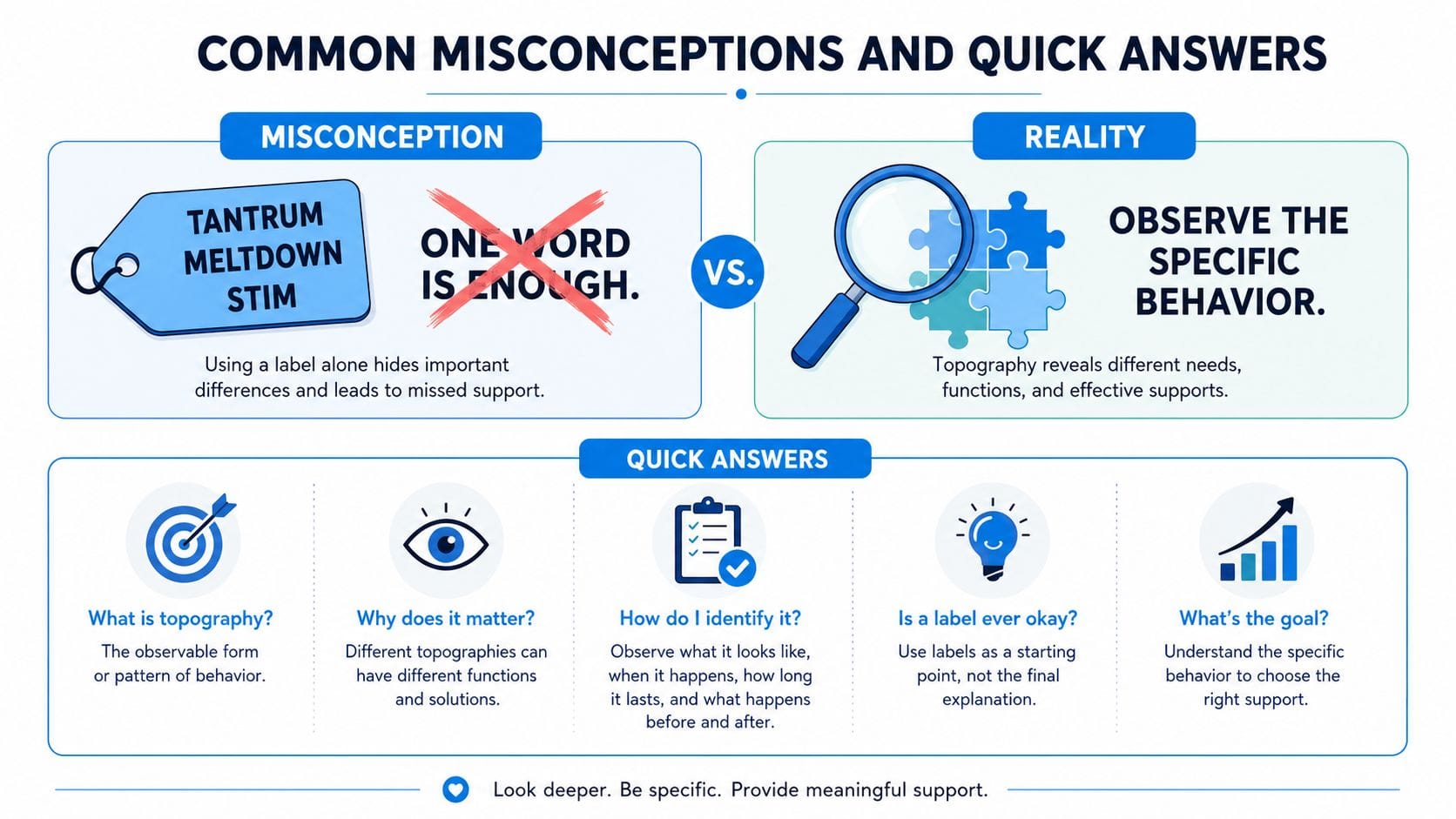
The biggest myth is that one label is enough
A label like tantrum, meltdown, or stim can help in casual conversation. It still leaves out the visible shape of the behavior, and it hides an important point for parents and clinicians, the same function can show up in very different topographies.
Another myth is that only clinicians can do this well
Caregivers can record behavior in a useful way when they write what they see instead of what they guess. That starting point is often the most helpful one. The description should be operational and observable, which means naming exact movements, vocalizations, and posture rather than labels like tantrum or noncompliance (Praxis Notes on observable behavior description).
Quick answers parents ask all the time
- How is topography different from function? Topography is the visible form. Function is the reason or payoff.
- Can one behavior have more than one topography? Yes. The same broader episode can include several visible forms.
- How often should I log? Log the episodes that matter most to your child's support plan, and keep the entry short enough that you will finish it.
- What if two caregivers describe the same event differently? Compare the observable details first, then write one shared version in the same language.
A short summary you can keep on the fridge is simple. Describe what you saw, separate it from why you think it happened, and keep the form in one place so patterns can emerge.
Guiding Growth gives families one place to log behavior, sleep, routines, and therapy notes without juggling scattered scraps of information. If you want a clearer way to track the topography of behaviour and share it with the people helping your child, visit Guiding Growth and see how structured notes can make the next conversation easier.