A visual behavior chart for autism works best when it tracks one clearly defined behavior and connects it to what happened before and after; visual schedules are recognized as an evidence-based practice, with one review identifying 34 studies and input from 101 parents and professionals. It turns a morning meltdown that seemed to come from nowhere into a pattern you can read.
Maybe today it was brushing teeth. Yesterday it was socks. By school pickup, you're replaying the morning while wondering whether you were too strict, too lenient, or missed something important.
A chart can't remove every hard moment, and it shouldn't be used as a weapon to force compliance. Used well, it gives your child a predictable way to understand what comes next and gives you a practical record of triggers, responses, and outcomes. That shared information can replace guesswork with a calmer conversation at home, school, or therapy.
Table of Contents
- Why a Visual Behavior Chart Works for Autistic Kids
- Choosing the Right Chart Format for Your Child
- Building a Chart Your Child Will Actually Use
- Reinforcement Strategies That Pair With the Chart
- Tracking Data So Patterns Actually Show Up
- Troubleshooting When the Chart Stops Working
- Collaborating With Caregivers and Professionals
Why a Visual Behavior Chart Works for Autistic Kids
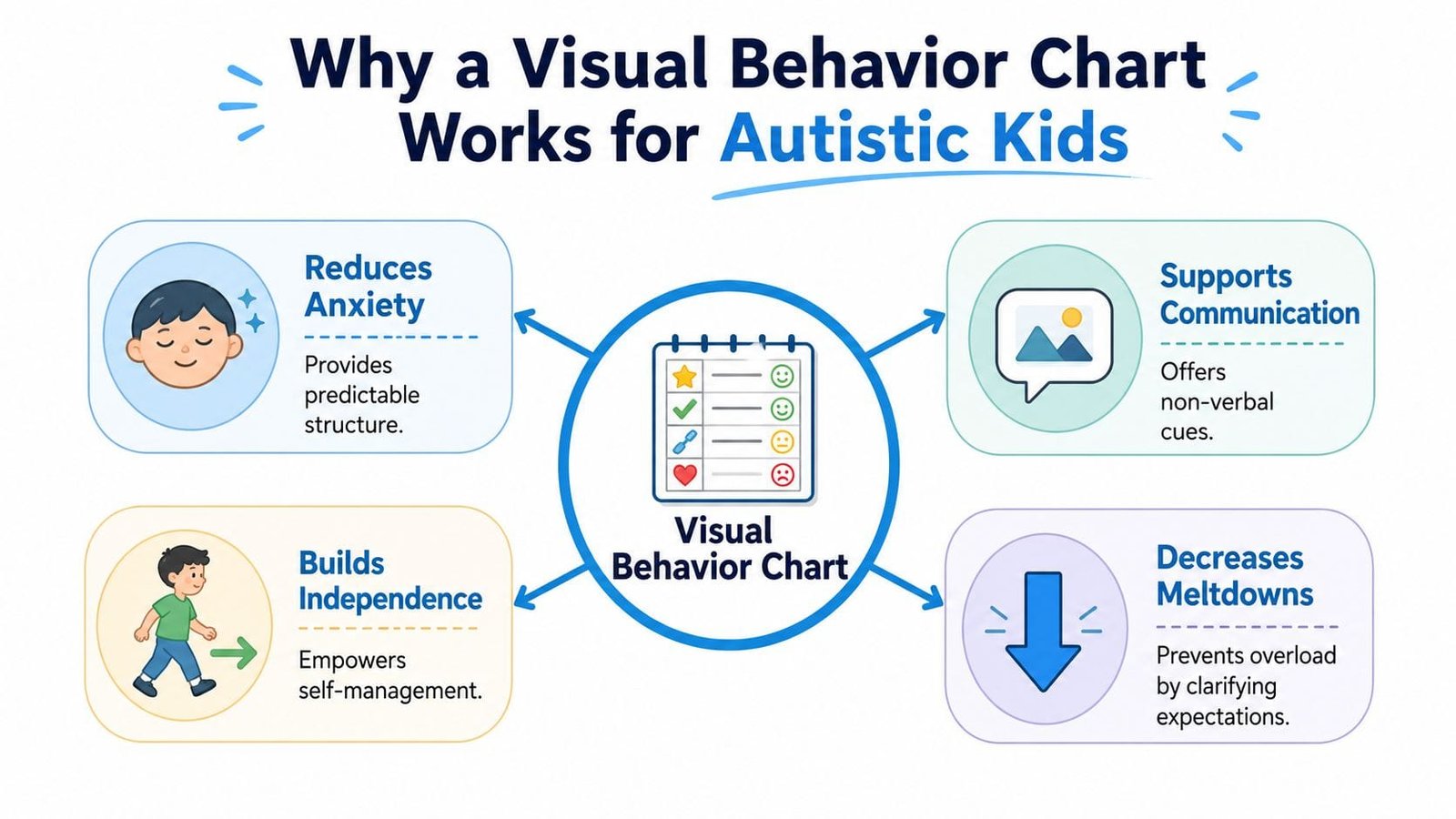
Visual supports make expectations visible. For a child who struggles to process a rapid stream of spoken instructions, a picture of a toothbrush, a “first” card, or a finished symbol can communicate more clearly than repeated reminders. Visual schedules and related supports include pictures, photographs, line drawings, calendars, timers, feelings charts, first-then boards, and social stories, and they can support communication, task completion, and self-regulation. The 2019 scoping review of visual supports in home and community settings identified 34 studies and gathered qualitative input from 101 parents and professionals.
The value isn't that every autistic child responds to pictures in the same way. The value is that the chart can reduce the amount of information your child must hold in working memory, offer a nonverbal prompt, and make progress concrete. A child can point to “finished,” move a card, request a break, or see that a preferred activity follows a less preferred one.
A chart is a shared language
Parents often carry two kinds of anxiety. There's the fear of another public escalation, and there's the fear of being judged for how you respond. A simple visual behavior chart for autism reframes the task. You're not trying to prove that your child is “good.” You're making the routine understandable and observing what support helps.
Visual schedules have a long history in autism intervention, and later evidence-base briefs have identified them as meeting evidence-based-practice criteria for early childhood, elementary, and middle school age groups, as described in the review above. They're most useful when paired with teaching, prompting, reinforcement, and consistent review rather than left on the wall as decoration.
Practical rule: Use the chart to clarify, teach, and observe. Don't use it to shame, threaten, or demand eye contact.
Research on transition-related problem behavior illustrates the distinction. In one experimental study, extinction and differential reinforcement reduced responding by 69% for one participant and 83% for another; adding visual schedules produced larger reductions in some conditions, reaching 76% versus 61% for one child and 89% versus 77% for the other. The experimental study on visual schedules and transition behavior supports a practical conclusion: the visual schedule contributed most effectively as part of a broader plan.
Choosing the Right Chart Format for Your Child
Start with the child, not the template. A beautiful chart that uses abstract icons, long sentences, or too many steps may look organized to an adult while being unusable for the child.
Choose one target first. “Morning routine” is usually too broad for behavior tracking, while “hands hit another person during toothbrushing” gives you something observable. For a routine support, choose a manageable sequence and add complexity only after your child uses the current version comfortably.
Children who are pre-verbal or minimally verbal often benefit from real photos of the actual bathroom, cup, shoes, or tablet. A child with emerging language may use picture symbols, a feelings scale, or a first-then board. A fluent communicator may prefer a written checklist with a space to mark completion.
The visual learner strategies guide can help you think about whether your child responds more readily to photographs, symbols, written words, or a combination.
Matching Chart Type to Child Profile
| Chart Type | Best For | Communication Level | Example Use |
|---|---|---|---|
| First-then board | Immediate transitions and one nonpreferred task | Pre-verbal through fluent communicators | First brush teeth, then tablet |
| Token chart | Repeated practice toward a preferred activity | Emerging language through fluent communicators | Earn tokens for each completed transition |
| ABC tracker | Identifying triggers and consequences | Parent or caregiver data collection | Record what happened before and after hitting |
| Feeling thermometer | Recognizing rising distress and requesting support | Emerging language through fluent communicators | Point to calm, worried, overloaded, or break |
A first-then board is usually the quickest starting point because it answers two questions, “What do I do now?” and “What happens next?” A token chart takes more teaching but can support repeated transitions. An ABC tracker is primarily for the adult, not a child-facing reward system. A feeling thermometer supports self-awareness, but it shouldn't replace an immediate safety plan during intense distress.
Keep the format practical. Paper works when it stays visible and caregivers remember to update it. A dry-erase board works when the child likes moving marks or pictures. A digital option can help when the routine changes often or several caregivers need the same information.
Building a Chart Your Child Will Actually Use
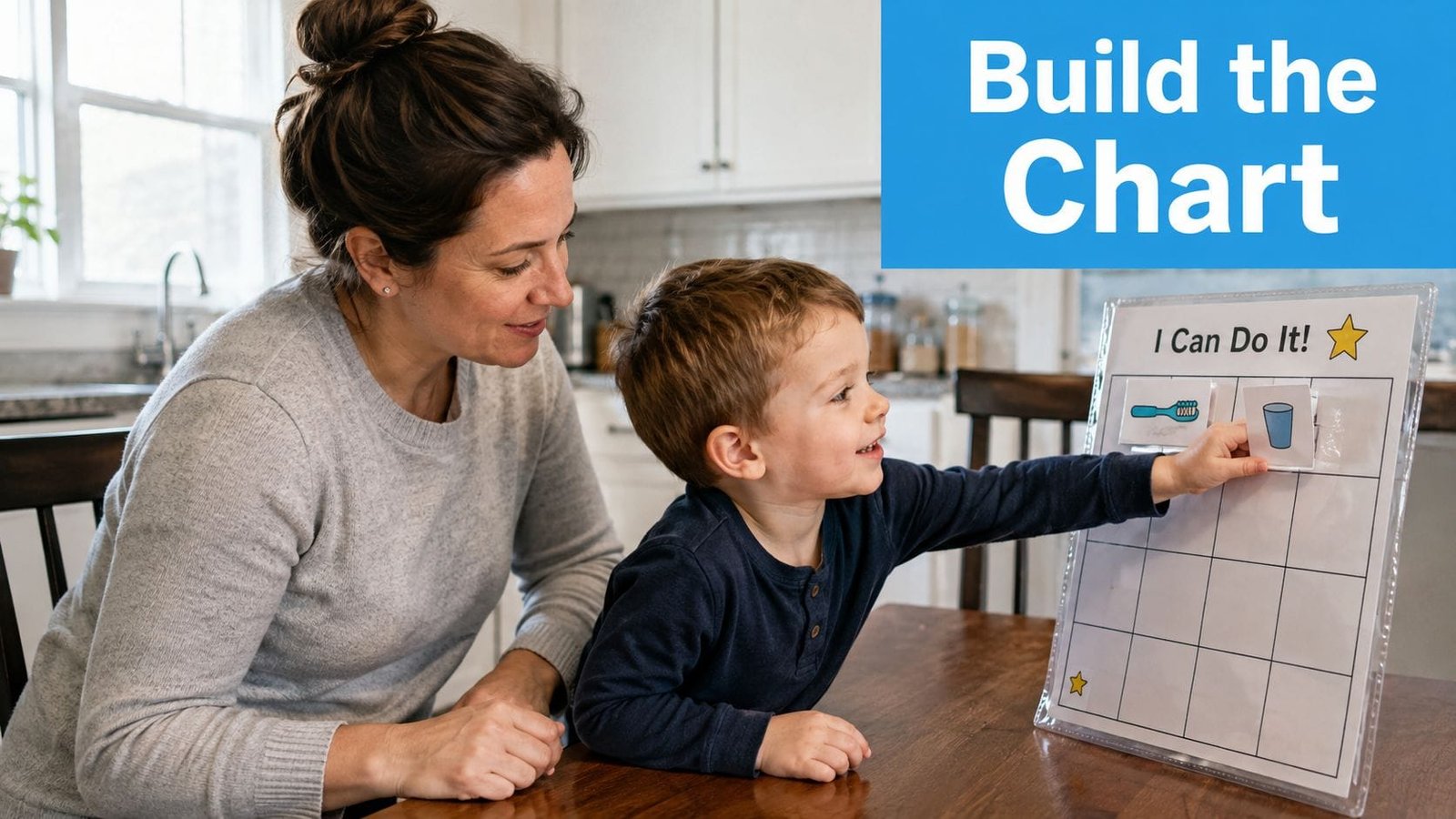
Build the chart during a calm moment, not while your child is already overwhelmed. Gather five to ten real photos of objects or locations your child recognizes, then choose one active goal. If you're working on leaving the house, photograph the shoes, coat, bag, door, and car rather than downloading generic cartoon images.
Place the chart where your child can reach it and see it without asking an adult. Laminate paper pieces or use a dry-erase surface if the routine repeats. Watch for sensory details, too. Velcro can be useful, but the ripping sound may bother some children, so magnets, pockets, or a quiet sliding marker may work better.
Build the smallest useful version
For a pre-verbal child, place two cards side by side. The first might show the toothbrush, and the second might show a preferred activity. Point, use a short phrase, and let the child move or remove the first card after the task.
For a child working on transitions, create a token board with a small number of spaces. Let the child choose whether tokens are stars, circles, or photos, and agree on the reward before the routine begins. For a fluent communicator, use written steps such as “put on shoes,” “get bag,” and “walk to car,” with a check box beside each one.
An ABC log looks different. It may be a notebook, a printed sheet, or a phone form with three fields:
- Antecedent: What happened immediately before the behavior?
- Behavior: What did the child do that another observer could identify?
- Consequence: What happened immediately afterward?
The hospital guidance on using an ABC chart recommends focusing on one behavior, such as hitting rather than hitting and spitting together, and writing the entry while the event is fresh. A 31-study review found that 16 studies met acceptable quality criteria, and its authors concluded that visual activity schedules can qualify as an evidence-based practice for individuals with ASD. The practical lesson is to teach the chart, not merely display it.
Introduce the routine when your child is regulated. Model moving the picture, rehearse once without pressure, and offer choices wherever possible. A child who helps select the reward, places the cards, or moves the finished marker often has more ownership than a child handed a finished system.
Here's a short demonstration of how visual supports can be used in practice:
Start with one chart per active goal. Covering the fridge and bedroom wall with overlapping systems creates work for adults and visual clutter for children. Review the first week by asking whether your child understood the chart, used it with less prompting, and experienced less confusion. If not, simplify before adding anything.
Reinforcement Strategies That Pair With the Chart
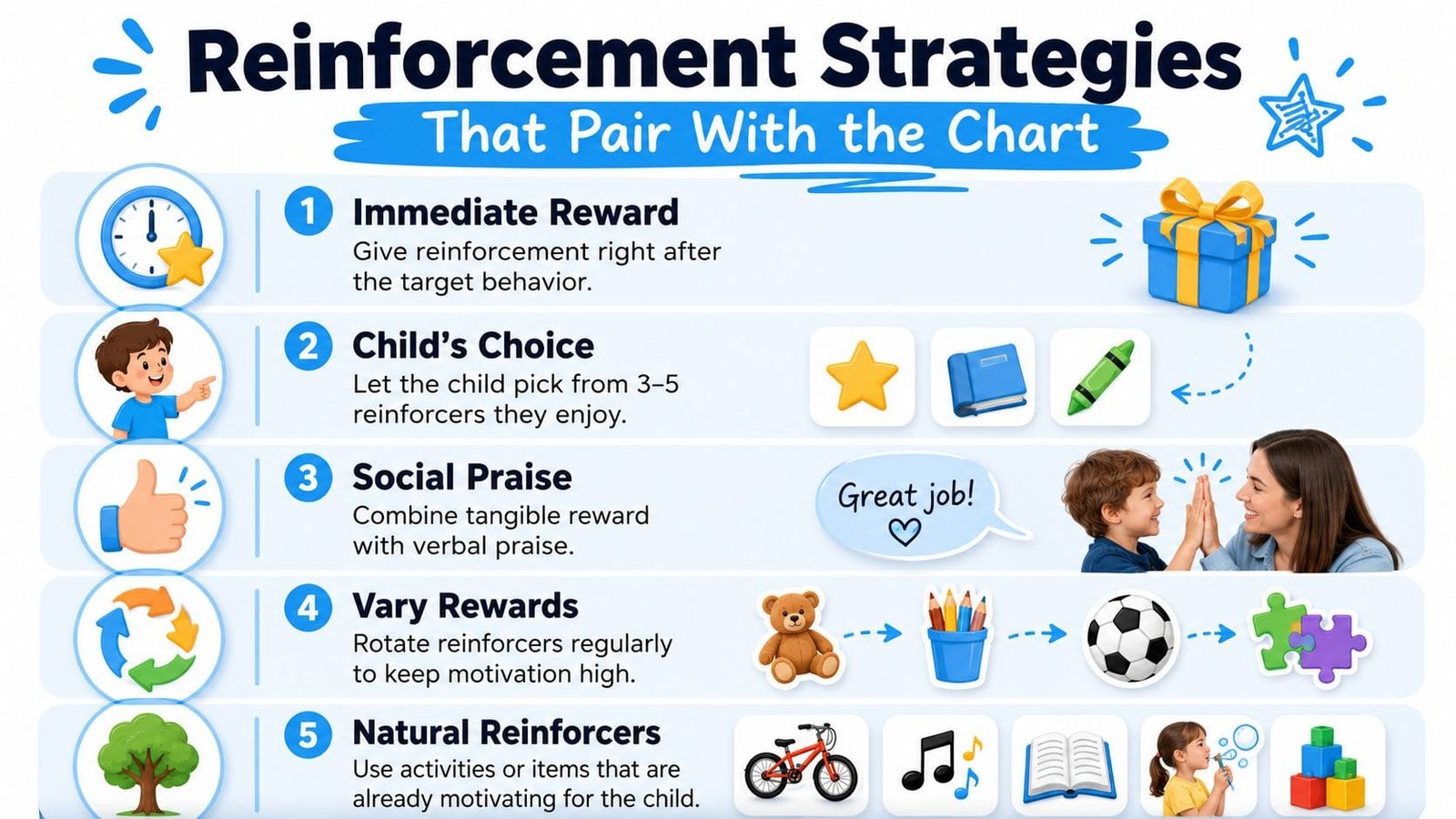
At a tired evening kitchen table, a chart can be perfectly clear and still fail if the reward is delayed, unavailable, or no longer interesting. The reinforcer matters more than the graphic design. Start with what your child already chooses: food, movement, deep pressure, music, water play, a preferred object, proximity, a familiar phrase, help with a favorite activity, or brief control over what happens next. Watch first, then test whether access immediately after the target behavior increases participation.
Make reinforcement specific and immediate
“Good job” may be too vague. Name the action and its payoff: “You waited for the timer. That was hard work.” Keep the words short enough for a busy transition, and pair praise with the selected reinforcer when it fits.
A token economy connects a small effort with a larger reward. The child earns a token for one clearly defined action, watches the tokens accumulate, and exchanges them for the agreed activity. If the exchange is confusing, shorten the path between action and reward instead of repeating the instruction louder. With two siblings nearby or a tablet in one hand, a simple system is easier to use consistently than a detailed one.
Reinforcement should answer one clear question: What happened that made the next attempt worth making?
Rewards lose novelty. Treat that as information, not defiance. Offer a choice among several current reinforcers, vary the order, or shift toward natural outcomes. Completing a bedtime routine may lead to a story, music, or time together. Families seeking ideas beyond autism-specific routines may also find bedtime reward charts for kids useful for visible progress and predictable incentives.
A digital log can keep this choice honest when memory is unreliable. Guiding Growth can record the selected reinforcer alongside behavior and context, so families can notice what still works rather than repeating yesterday's reward by habit.
Do not remove regulation supports as punishment. A sensory break, communication device, or comfort object should remain available. The noncontingent reinforcement guide explains how access to reinforcement can be provided without requiring a target behavior every time.
As the routine becomes easier, fade support gradually. Replace a tangible token with a natural outcome, reduce prompts, or let the child check the chart independently. The goal is understandable, repeatable success while the skill develops, not permanent dependence on rewards.
Tracking Data So Patterns Actually Show Up
The chart is the visible part. The data underneath tells you whether the behavior changes with sleep, food, demands, transitions, noise, pain, or access to a break.
Define the behavior so another caregiver could recognize it. “Bad morning” isn't specific enough. “Hits another person with an open hand during toothbrushing” is observable. Record the entry soon after the event, while details are still available, and capture the antecedent and consequence instead of logging only the behavior.
ABC data is often the most useful single format for families because it preserves context. A one-line note might say, “Meltdown before school.” An ABC entry can show that the child woke early, skipped breakfast, was asked to stop a preferred activity, and then received a quiet space after crying and dropping to the floor. That information doesn't prove a cause, but it gives you a better basis for testing supports.
Use the minimum effective record
Track only what you'll review. Useful fields may include:
- Behavior: What happened, using an observable definition.
- Trigger or antecedent: What demand, change, sensation, or event came first.
- Outcome: What adults and siblings did next, and what the child accessed.
- Context: Sleep, food, illness, medication, setting, or caregiver.
- Response: Whether the support helped, partly helped, or didn't help.
Paper is a valid choice if it stays accessible and several caregivers use the same definitions. The problem isn't paper. The problem is a form that lives in a drawer, gets completed only on unusually difficult days, or records different meanings for the same word.
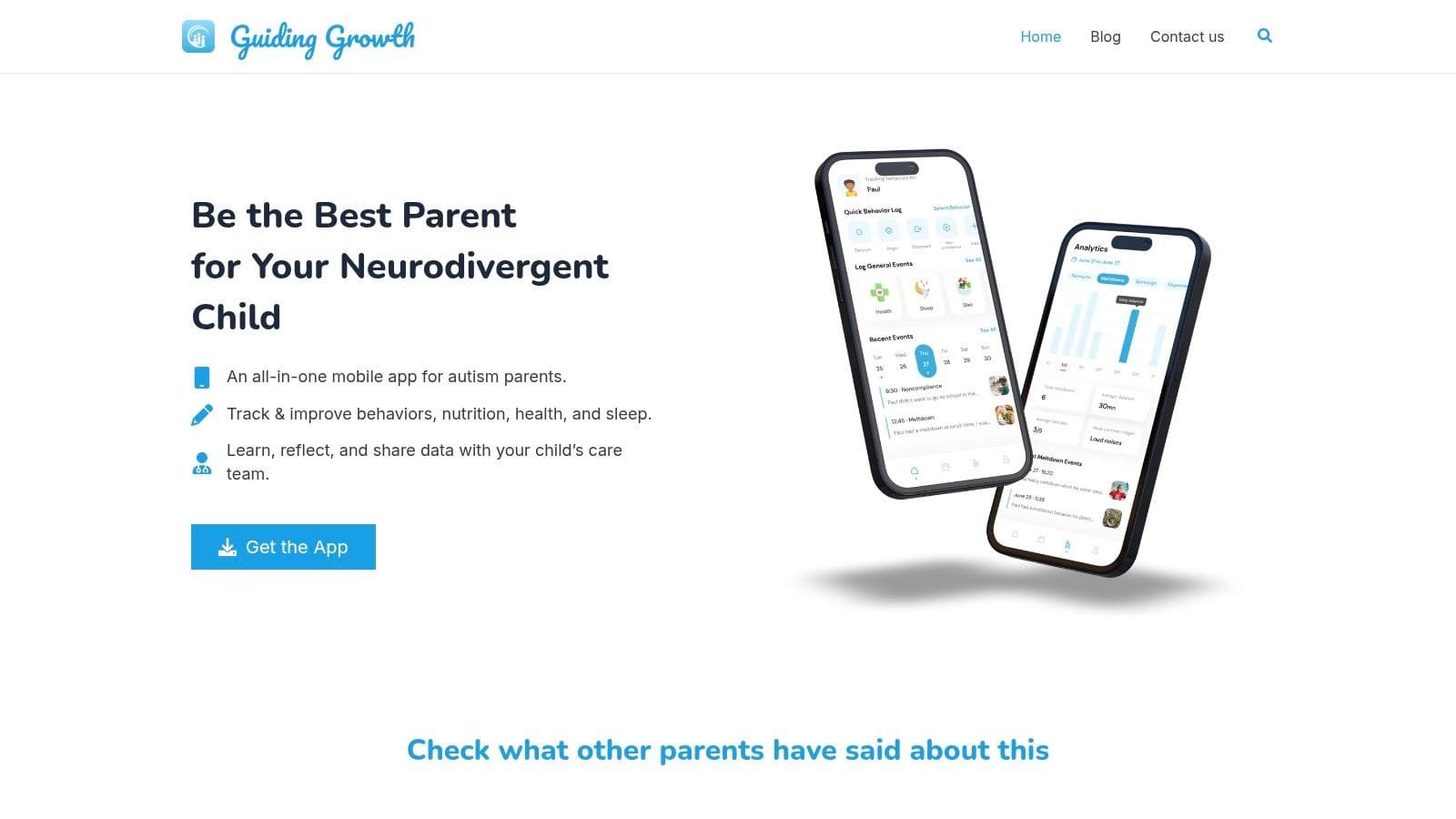
For families who need a phone-based layer, Guiding Growth can centralize behavior logs, triggers, intensity, duration, sleep, diet, routines, appointments, and therapy information. Its voice logging is designed for moments when a parent has a tablet in one hand and is helping a child with the other, while its shared caregiver view can keep a co-parent, grandparent, or aide aligned. Families can also use data visualization guidance for behavior tracking to decide which patterns are worth reviewing.
Review the record when you're calm. Look for repeated combinations rather than a single difficult morning. If the pattern remains unclear, bring the raw entries to a qualified professional instead of forcing a conclusion.
Troubleshooting When the Chart Stops Working
Every chart loses momentum. The first week may feel promising, then your child stops looking at it, asks for the reward without completing the step, or becomes upset when you bring it out. That doesn't mean the entire approach failed.
If your child ignores the chart, check whether it's too long, too abstract, or disconnected from a meaningful outcome. Return to a first-then board, use a photo of the preferred activity, or place a “now” marker directly beside the current step. You can fade the chart partially, keeping support only at the transition that still causes difficulty.
If stickers create a sensory or fine-motor problem, switch to a token, magnet, stamp, or simple check mark. If your child understands the sequence but begins asking for the reward before starting, shift toward a feeling scale or completion checklist and teach the difference between “available later” and “available now.”
When the data seems contradictory
A chart can show fewer logged incidents because everyone was exhausted and stopped recording. It can also show more incidents because caregivers became more accurate observers. Compare the quality and consistency of entries before deciding that behavior changed.
Bring the raw data to a therapist, BCBA, pediatrician, occupational therapist, or another qualified professional when safety concerns persist, the pattern is unclear, or your response seems to make things worse. A professional can help examine function without treating the chart as a diagnosis.
Some goals should be retired. If the goal measures adult convenience rather than a meaningful skill, or if the chart increases distress without improving communication or safety, change the goal. A revised target might be requesting a break, tolerating a transition with support, or completing one step independently.
A discontinued chart isn't a parenting failure. Sometimes it's accurate information about a poor match.
Collaborating With Caregivers and Professionals
A chart that only one parent understands is a memory aid, not a shared support. Write down the target behavior, the exact prompt, the available reinforcer, and what caregivers should do if distress escalates. Keep the wording neutral so a grandparent or babysitter can follow it without interpreting every event from scratch.
A printed handoff can work for a short routine. A shared digital view is more practical when the child moves between homes, school, respite care, and therapy. Ask each caregiver to record the same essential fields, even if they use different devices.
Use a short review rhythm. Look at entries after several consistent days, identify one possible pattern, and change one support at a time. When you meet with a professional, bring a concise summary, the operational definition, and two questions you want answered. Raw examples are more useful than a general statement that “mornings are bad.”
Keep the first experiment small: one chart, one behavior, one week. Choose a goal that matters to your child's comfort, communication, independence, or safety, then adjust based on what the record shows. A paper board may be enough, while a shared app can reduce the chance that tracking disappears when the household gets busy.
Guiding Growth brings behavior, trigger, sleep, food, routine, and caregiver notes into one mobile workspace, with voice logging for fast entries and shared access for the people supporting your child. Visit Guiding Growth to start building a visual behavior chart that remains useful after the first busy weekend.