Your child is halfway through a transition when their body suddenly says no. The shoes are on, the schedule has changed, and a simple request turns into shouting, dropping, hitting, or frantic escape. In another moment, the reaction may look completely different: your child goes quiet, stops responding, hides, or seems unable to move. You lower your voice, remove the demand, and offer comfort, but the same response that helps during one crisis can make another worse.
That's why effective co regulation techniques begin with observation. Co-regulation isn't a universal calming trick. It's a responsive process in which an adult adjusts connection, language, sensory input, problem solving, and support to match a child's state, then gradually helps the child use more independent regulation skills.
Table of Contents
- Why Co Regulation Is More Than Just Staying Calm
- Core Co Regulation Techniques You Can Use Today
- Matching Your Response to the Distress Pattern
- Fading Support to Build Self Regulation Skills
- Tracking What Works and Sharing with Your Care Team
- Building Your Family Co Regulation Practice
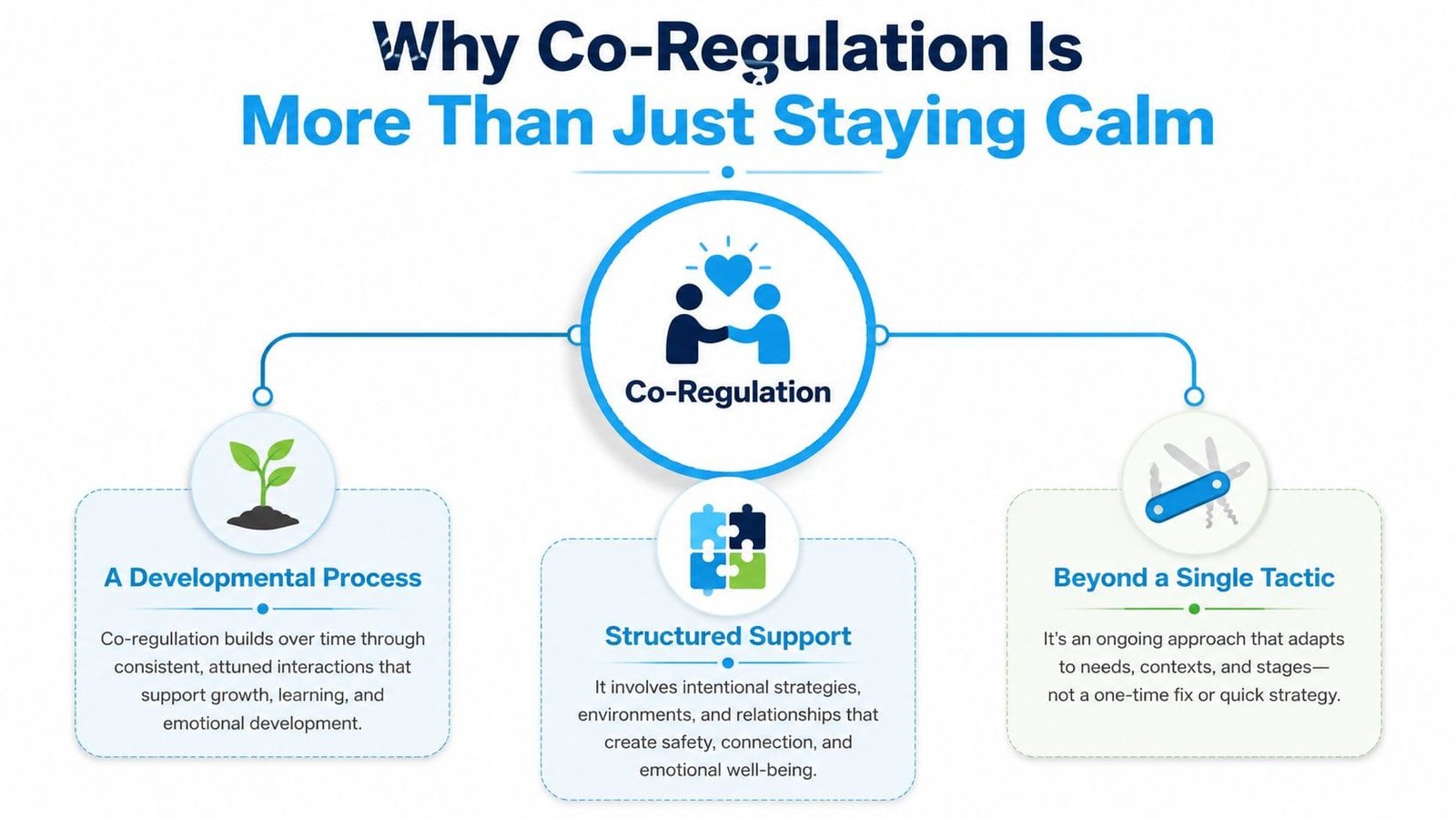
Why Co Regulation Is More Than Just Staying Calm
A transition meltdown often starts before the visible behavior. Your child may already be carrying sensory strain, uncertainty, fatigue, or the effort of processing several instructions at once. By the time you see yelling or pushing, their ability to understand a long explanation may already be gone.
Staying calm still matters, but it's only the adult's starting point. Current autism-focused literature describes co-regulation as a dyadic system, meaning the child's state and the adult's response influence each other in real time. The adult may provide sensitive responding, comfort, problem solving, scaffolding, or redirection, depending on what the child can access in that moment. The UNC FPG Center practice brief on co-regulation organizes this support into warm responsive relationships, supportive environments, and coaching or modeling self-regulation skills.
That framework changes how I interpret a crisis. I'm not asking, “Which calming trick should I try?” I'm asking, “What is my child's nervous system communicating, and what kind of support is least likely to add another demand?”
The evidence is still developing
The research base is newer than many parents realize. One review of autism-focused co-regulation studies identified only seven international articles published between 2010 and 2019 (review of co-regulation studies for autistic students). That doesn't mean co-regulation lacks value. It means families should avoid confident promises and focus on observable responses, careful adaptation, and honest tracking.
A 2024 study of 18-month-olds at increased likelihood for autism found that parental co-regulation reduced the likelihood of continued negative emotion, although the effect was somewhat weaker for autistic toddlers (2024 study of parental co-regulation). Timing and developmental stage matter. A strategy offered early may prevent escalation, while the same words delivered during peak distress may feel like pressure.
Interoception also affects how a child notices internal states such as thirst, tension, heat, or a racing heart. Understanding how interoception affects emotional regulation can help you interpret behavior as communication rather than deliberate defiance.
Practical rule: Calm is the container. The actual intervention still has to fit the child's distress pattern.
Core Co Regulation Techniques You Can Use Today
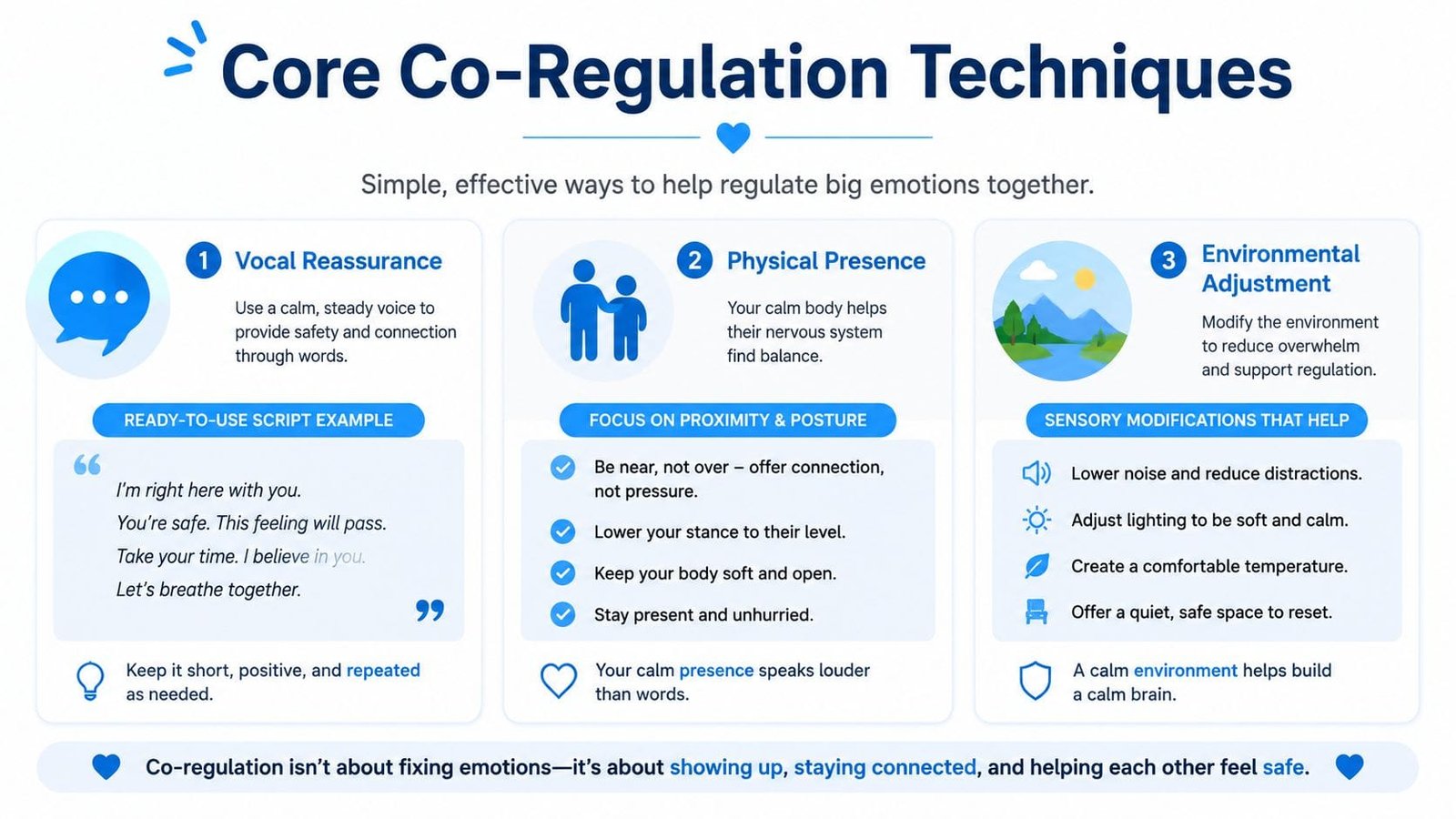
During a meltdown, a long explanation can make the situation worse. Keep a small response menu you can use under pressure. Useful categories include vocal reassurance, active prompting, redirection, physical comfort, and following the child's emotional lead. A 2009 study by Adamson et al. found that an 8-week joint-engagement program was associated with less child negativity and more maternal emotional and motivational scaffolding (joint engagement and co-regulation intervention). The result supports practicing shared regulation before a crisis, not expecting one technique to work every time.
Vocal reassurance
Use fewer words than you think you need. Keep your voice even, slow, and predictable.
Try:
- Name the immediate experience: “The room is loud. I'm here.”
- Offer safety without demanding a reply: “You're safe. You don't need to talk.”
- Give one clear choice: “Quiet room or headphones?”
- Preview the next step: “First quiet. Then shoes.”
At peak distress, avoid questions that require an explanation. “Why are you doing this?” and “What's wrong?” add language demands when processing is already difficult. A short statement may help more than reassurance repeated several times.
Active prompting and shared regulation
Prompt one action at a time. Instead of saying, “Take deep breaths and calm down,” model a short exhale. Your child can watch, copy, or ignore you. Blowing a pinwheel, pushing hands against a wall, humming, or squeezing a familiar object may suit the child better than formal breathing.
Match grounding to the child's communication style. Place a preferred object nearby, point to a visual emotion chart, or demonstrate “Feet on floor.” Do not require eye contact, verbal labeling, or imitation as proof that regulation is occurring.
Sensory support may involve reducing noise, dimming lights, leaving a crowded area, or offering a trusted fidget. Deep pressure can help some children and feel intrusive to others, so use it only when the child has shown that it is welcome. Guidance on sensory tools that can help calm meltdowns is most useful when tools are tested individually and recorded by response.
Physical presence and environmental adjustment
Physical comfort is an invitation, not a requirement. Sit nearby with your body angled slightly to the side, keep your hands visible, and leave an exit route. If your child reaches for you, offer a hug, firm hand pressure, or a blanket. If they pull away, stop immediately.
Set up a regulation space that reduces noise, light, movement, and demands. A corner might contain a tent, pillows, headphones, visual supports, and familiar sensory items. It must not become a punishment area. Offer it during calm periods as well, so the space remains predictable rather than associated only with crisis.
Record what happened before the response, which technique you used, and what changed afterward. Over time, that log can show whether vocal reassurance, space, pressure, or sensory tools work best for this child's meltdown, shutdown, or demand-avoidant moments. Consistent routines and relationships in class can also reduce surprises before overload begins.
Matching Your Response to the Distress Pattern
A child may scream, hit, or run because of sensory overload, fear, frustration, pain, escape, or a need for connection. Another child may go silent because they are recovering, shutting down, exhausted, or unable to respond. The same outward behavior can require very different support, so choose your response from the pattern around it, not from volume or appearance alone.
The categories below function as working hypotheses rather than clinical diagnoses. Watch what happens before the behavior, during the episode, and after your response. A structured view of topography of behaviour helps separate what the behavior looks like from the conditions that may be maintaining it.
Distress Pattern to Co-Regulation Response Matrix
| Distress Pattern | Best Response Category | Specific Techniques | Avoid |
|---|---|---|---|
| Meltdown | Vocal comfort, environmental adjustment, physical presence | Use fewer words, reduce demands, create space, speak quietly, move unsafe objects, stay nearby without crowding | Reasoning, punishment, repeated questions, forced eye contact |
| Shutdown | Following, gentle vocal reassurance, solution-focused help | Pause, offer a visual choice, sit quietly, acknowledge the state without demanding speech, provide water or a familiar sensory item | Rapid prompting, touch without consent, treating silence as compliance |
| Demand avoidance | Redirection, collaborative problem solving, reduced verbal pressure | Offer choices, change the sequence, use a neutral first-then visual, connect the task with a preferred activity, pause and return later | Repeating the demand louder, arguing about refusal, creating a power struggle |
| Sensory overload | Environmental adjustment, physical comfort only if preferred | Reduce sound and light, leave the crowded space, remove uncomfortable clothing or equipment when safe, offer headphones or trusted pressure input | Adding music, bright visuals, unexpected touch, insisting on participation |
| Recovery after distress | Coaching and modeling | Practice labeling body signals, rehearse a break request, review what helped, update the visual plan | Debriefing immediately, demanding an apology, teaching while the child is exhausted |
Redirection works when a child remains able to process a choice or alternate activity, especially during an escalating demand cycle. It can backfire during sensory overload because changing the activity does not remove painful input. Physical comfort has the same trade-off. A firm hug may help one child organize their body, while another may feel trapped and escalate further.
Timing matters as much as the technique. During a meltdown, prioritize safety and reduced language. During shutdown, allow longer pauses and avoid treating a lack of response as agreement. With demand avoidance, collaboration often preserves access to the task better than repeated instructions.
A 2025 systematic review of group-based emotion-regulation interventions for autistic children included 17 studies and found that more effective programs combined CBT-style skill teaching with parent or teacher psychoeducation and homework reinforcement. The practical lesson is to teach and rehearse skills outside a crisis, then use the least demanding version during distress. Record the pattern, response, and recovery so your next choice reflects this child's actual history.
Fading Support to Build Self Regulation Skills
Co-regulation should be a bridge, not a permanent replacement for the child's own skills. Yet fading too quickly can feel like abandonment, especially when the child is still overwhelmed. The right question isn't, “How do I stop helping?” It's, “What is the smallest amount of help that lets my child succeed safely?”
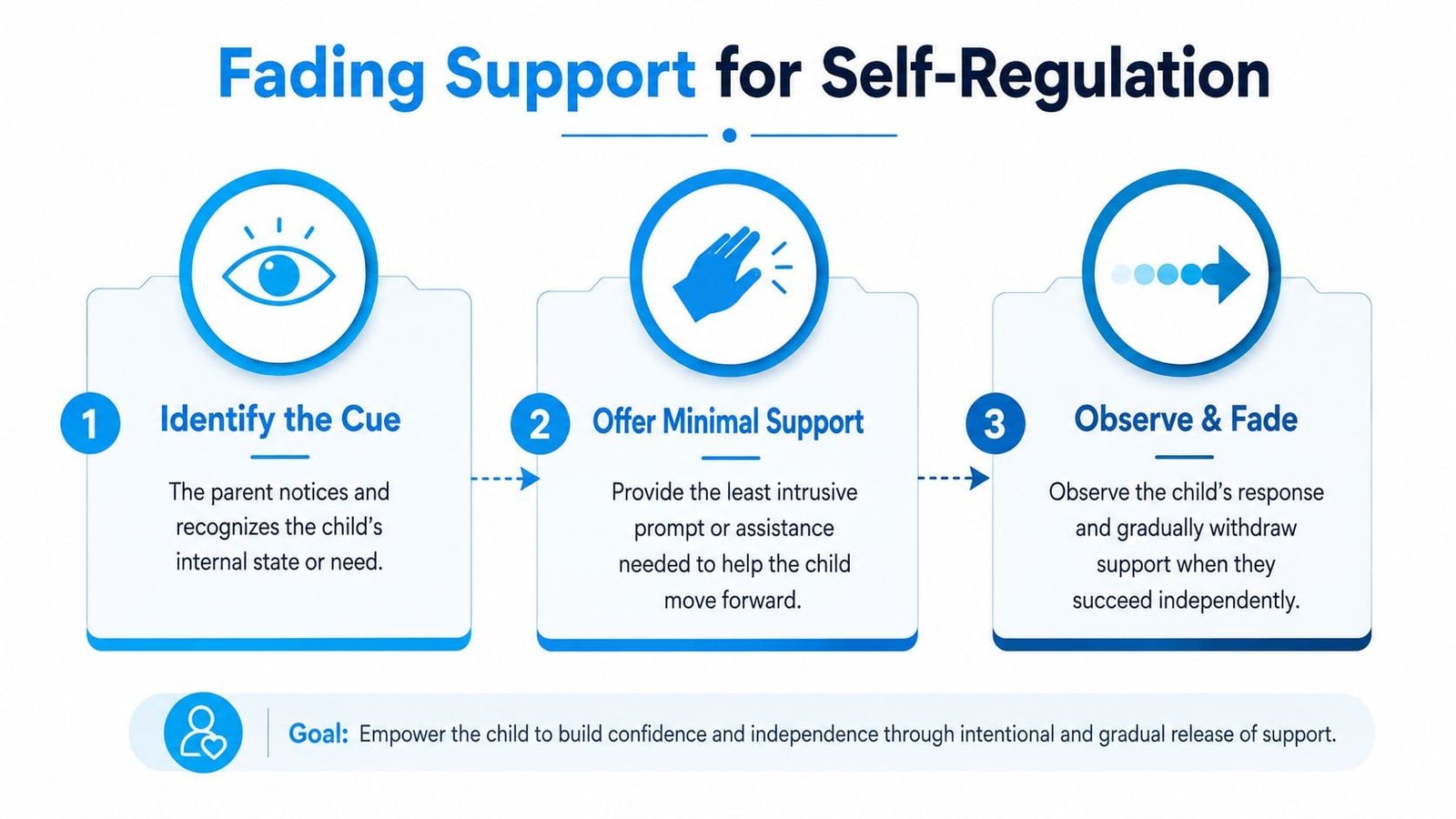
A useful fading sequence has three stages:
- Identify the cue. Notice early signs such as covering ears, pacing, pushing materials away, becoming still, or repeating a phrase more intensely.
- Offer minimal assistance. Start with environmental adjustment or a visual choice before adding verbal prompts or touch.
- Observe and fade. If your child begins using the tool, moving to the quiet space, or accepting a break, stop adding prompts. Let the successful action continue without commentary.
Fade support only after regulation is visible, not while the child is still unsafe or escalating. If a child needs your presence to remain settled, moving away abruptly may remove the very condition that made independent action possible. Try reducing one element at a time, such as fewer words, more physical distance, or a longer pause before prompting.
The tradeoff is real. Over-support can limit opportunities to initiate, but under-support can turn every practice opportunity into another failure. Current autism literature describes co-regulation as a proactive bridge to self-regulation, while also acknowledging that strong, widely adopted guidance for fading support and measuring long-term autonomy remains limited (discussion of co-regulation and self-regulation).
A fading plan should make your child feel more capable, not less supported.
Practice during calm routines. A child might choose a sensory tool before bath time, point to a break card before leaving the house, or identify “too loud” after a mild sound. These small rehearsals create a pathway that's easier to access when distress rises.
The same logic appears in other responsive caregiving routines. For example, Bornbir's paced feeding advice emphasizes watching the child's cues and adjusting adult support rather than forcing a fixed pace. Co-regulation works through the same respect for timing, signals, and gradual autonomy.
Tracking What Works and Sharing with Your Care Team
Memory becomes unreliable after a difficult meltdown. You may remember the shouting, but forget whether the trigger was a fluorescent light, an unexpected delay, hunger, poor sleep, a crowded room, or three demands delivered without a pause. Structured logging turns those impressions into information you can compare.
Record each incident using the same basic fields:
- Context: Location, time of day, people present, activity, and recent transition.
- Possible trigger: Noise, touch, denied access, waiting, communication breakdown, fatigue, pain, or a demand.
- Distress pattern: Meltdown, shutdown, demand avoidance, sensory overload, or another observed pattern.
- Response category: Vocal reassurance, redirection, solution-focused help, active prompting, physical comfort, or environmental adjustment.
- Outcome: What changed, how long recovery seemed to take qualitatively, and whether the child returned to the activity or needed the rest of the routine changed.
- Child preference: Accepted, tolerated, rejected, or independently selected the support.
Don't record only the strategy you want to work. Log the strategy that backfired, too. “Asked for a hug, pushed away, lights reduced, child moved to quiet space” is more useful than “hug didn't help,” because it preserves the sequence and shows what changed the environment.
Make the record useful to other adults
Share patterns with the people who support your child. A therapist may notice that the same response works during home routines but not in a noisy clinic. A teacher may be able to adjust transitions when you provide a clear description of early cues and effective supports. A pediatrician can also use organized observations when considering sleep, nutrition, medication, pain, or other health factors.
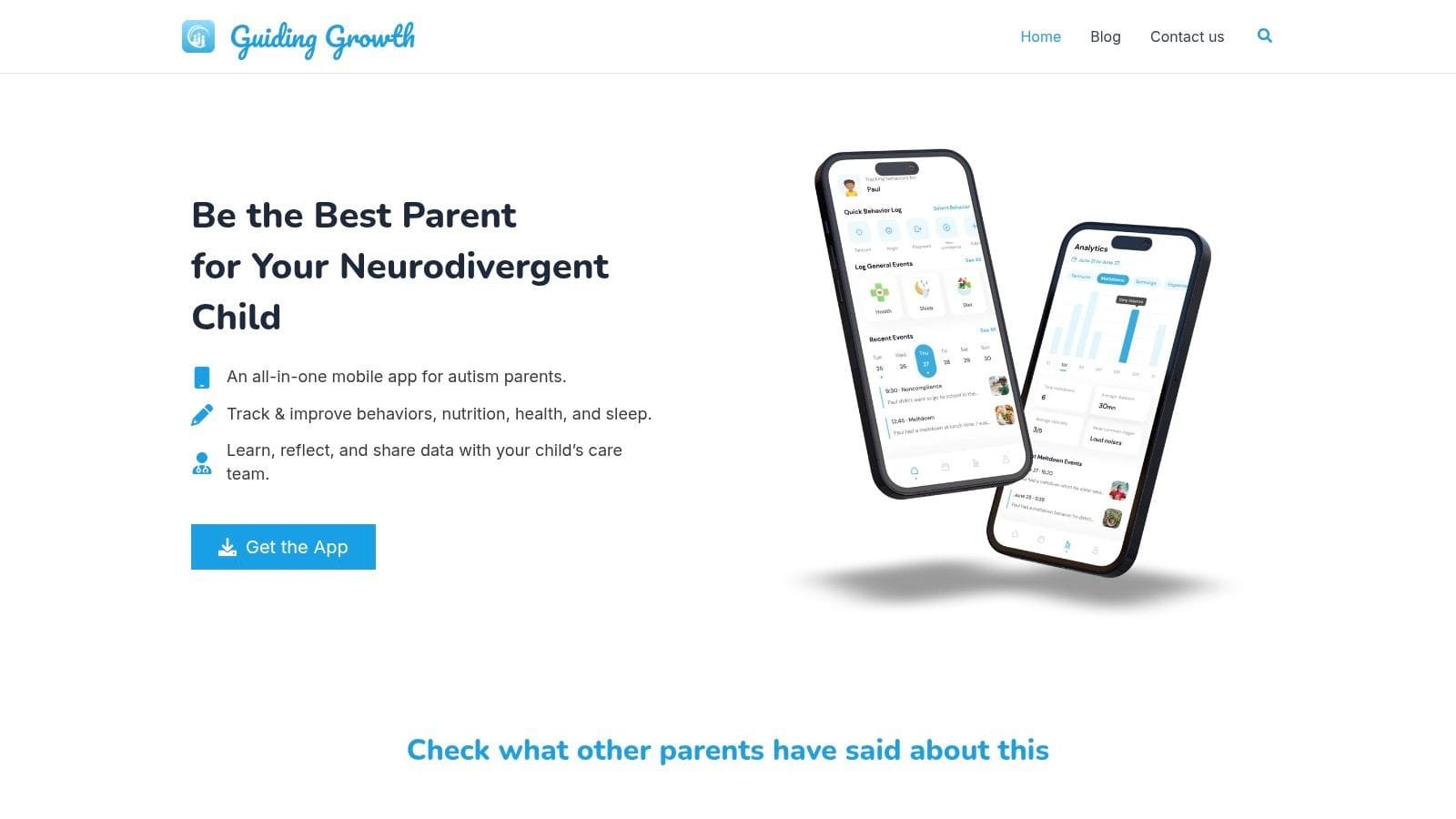
Guiding Growth can centralize logs for meltdowns, shutdowns, demand avoidance, triggers, intensity, sleep, diet, appointments, and therapy details. Its visualizations and sharing features are designed to help families, caregivers, and professionals work from the same record rather than scattered notes.
Review entries when everyone is calm. Look for repeated combinations, such as a particular transition plus high sensory load, or a demand that succeeds when presented visually but escalates when repeated verbally. The aim isn't to rank your child's behavior. It's to identify conditions that make regulation more accessible.
Sensory factors deserve careful attention because they can shape the entire interaction. One psychometric study reported sensory and self-regulatory findings in the autism group at 96% and 98%, respectively, on the checklist used, while a systematic review of sensory integration therapy found positive effects in two randomized controlled trials, with Goal Attainment Scaling effect sizes ranging from 0.72 to 1.62 (sensory processing and self-regulation findings). Those findings don't justify prescribing one sensory tool to every child. They support tracking sensory context and checking whether an intervention follows an appropriate protocol.
Building Your Family Co Regulation Practice
A workable family practice has four parts. Match the response to the pattern, because a quiet voice and a quiet room may help sensory overload while redirection may help a demand cycle. Use a varied toolkit, including vocal reassurance, environmental changes, visual choices, active prompting, and physical comfort only when your child welcomes it.
Fade support after success, not before it. Give your child enough help to access regulation, then reduce words, prompts, or proximity gradually while watching for signs that the change is too much. Co-regulation isn't a performance you either pass or fail. It's a skill built through repeated, responsive interactions.
Finally, track what happened. The strongest plan is rarely the one that sounds most impressive. It's the one that your child can tolerate, use, and eventually begin to initiate across real routines.
Guiding Growth gives you one place to log meltdowns, shutdowns, demand avoidance, sensory triggers, sleep, routines, and the responses that followed, with sharing tools for caregivers and care teams. Visit Guiding Growth to turn scattered observations into a practical record of your child's path from co-regulation toward self-regulation.