At 2 a.m., you're scrolling through your phone trying to remember whether your child swallowed the evening medication or only held it in their mouth before spitting it into a sleeve. The bottle is on the counter, the school note is somewhere in a group chat, and tomorrow's appointment is close enough that “I think so” doesn't feel like an acceptable answer.
Medication adherence monitoring should make that moment easier, not add another chore. For autistic children, a useful system must account for sensory preferences, communication differences, disrupted routines, refusal, vomiting, sleep changes, and the fact that several adults may share responsibility for one dose. The aim isn't surveillance or blame. It's a reliable record that helps you notice patterns and have better conversations with the care team.
Table of Contents
- What Medication Adherence Monitoring Really Means
- Why Monitoring Method Changes Everything
- Building a Routine That Actually Sticks
- Smart Reminders, Alerts, and Voice Logging
- Sharing the Load With Caregivers and Clinicians
- Privacy, Consent, and What to Keep Out
- Your First Week With a Better Adherence Setup
What Medication Adherence Monitoring Really Means
The missed dose usually isn't the whole story. One morning, your child may reject a liquid because the flavor changed. Another day, a rushed school transition may push medication out of everyone's mind. Sometimes the dose goes in, but your child gags, vomits, or later becomes unusually sleepy. If your notes only say “taken” or “missed,” you lose the context that could explain what happened.
Medication adherence monitoring means recording whether the medicine was taken, when it was taken, how it was tolerated, and what happened afterward. Adherence asks whether the prescribed dose was taken as intended. Persistence asks whether the routine continued over the following weeks. A child can be adherent on a particular morning and still struggle with persistence when routines change.
That distinction matters because autistic children may experience medication routines differently. A new texture can trigger refusal. A change in caregiver can remove a familiar cue. Interoception differences may make it harder for a child to describe nausea, dizziness, or another side effect. Behavior may change before your child can explain why.
Four questions your record should answer
At the end of a week, you should be able to answer:
- Dose taken: Did the medicine go in, and was the full dose given?
- Dose missed: Was it refused, forgotten, vomited, spilled, or uncertain?
- Tolerance: Did you notice sleepiness, appetite changes, stomach discomfort, or another concern?
- Behavior change: Did anything unusual happen that the prescriber should know about?
A practical system turns those answers into a timeline instead of a memory test. The practical guide for medication tracking from PepFlow is useful for thinking through the basic mechanics of dose records, while organizing medical records can help you keep medication notes beside appointments and other care information.
Practical rule: Log what happened without judging why it happened. “Refused after the flavor changed” gives a clinician something to work with. “Noncompliant” doesn't.
Guessing creates two problems. You may worry about a pattern that isn't there, or you may miss a real pattern because each difficult day felt isolated. A good workflow combines simple logging, carefully chosen alerts, and a shared record that gives caregivers and clinicians the same account.
Why Monitoring Method Changes Everything
The monitoring method shapes the story your clinician sees. A parent's recollection, a pharmacy refill record, a smart cap, and a digital care log don't measure the same thing. Treating them as interchangeable creates false confidence.
The CDC summary of medication adherence describes a persistent problem. About one in five new prescriptions are never filled, and among prescriptions that are filled, around 50% are taken incorrectly with respect to timing, dose, frequency, or duration. The World Health Organization estimated in 2003 that adherence for long-term therapies in developed countries averaged about 50%, and later reviews continued to describe roughly half of people with chronic illness as not taking medicines as prescribed. These figures explain why one data source rarely tells the whole story.
A 2025 state-of-the-art review found that electronic monitoring produced the highest mean adherence estimate, about 70%, compared with 60% for pharmacy refill metrics and 54% for self-reporting, as reported in the review of adherence measurement methods. The difference doesn't prove that one method is always correct. It shows that measurement changes the apparent result.
Adherence Monitoring Methods Compared
| Method | Captures | Misses | Best Use |
|---|---|---|---|
| Caregiver self-report | What adults remember about doses and refusals | Forgotten details, uncertain swallowing, timing drift | Conversation starter at appointments |
| Pharmacy refill data | Whether medication was obtained and roughly used | In-the-moment refusal, vomiting, spilled doses, sharing between bottles | Checking access and refill continuity |
| Electronic monitors | Time-stamped container openings or actuations | Ingestion, spitting out, vomiting, doses moved to pill boxes | Supporting precise timing review |
| Dedicated digital apps | Dose logs, reminders, notes, patterns, and caregiver handoffs | Anything nobody records or configures | Creating a shared routine record |
Electronic monitoring deserves careful interpretation. A container opening isn't proof that a child swallowed the dose, and a closed container isn't proof that the dose was missed. The same limitation applies to a refill record. It can show that a bottle was obtained, but not what happened during a difficult Tuesday morning.
Self-report remains valuable, especially when it includes context. The problem is relying on memory alone. A combined approach usually works better: use pharmacy data to identify access problems, a caregiver log to capture refusals and tolerance, and electronic data only where its narrow measurement answers a specific clinical question.
Building a Routine That Actually Sticks
The most reliable medication routine is usually the one that asks your child's nervous system to do the least new work. Don't create an isolated medication event if you can attach the dose to something already happening, such as waking, brushing teeth, breakfast, a favorite television cue, or an evening snack.
Start with one or two existing anchors. Keep the medicine in one dedicated location, but follow safe storage instructions and keep it out of reach when needed. A picture schedule strip on the refrigerator, a colored dot on the bottle, or a simple “medicine next” card can move the reminder from your memory into the environment.
Build the cue before you build the record
Use the least demanding visual signal that your child understands. Some children respond to photographs, others to icons, written words, a color, or a physical object placed beside the routine item. A picture of the syringe beside the toothbrush may work better than a phone alarm because it appears at the moment the routine begins.
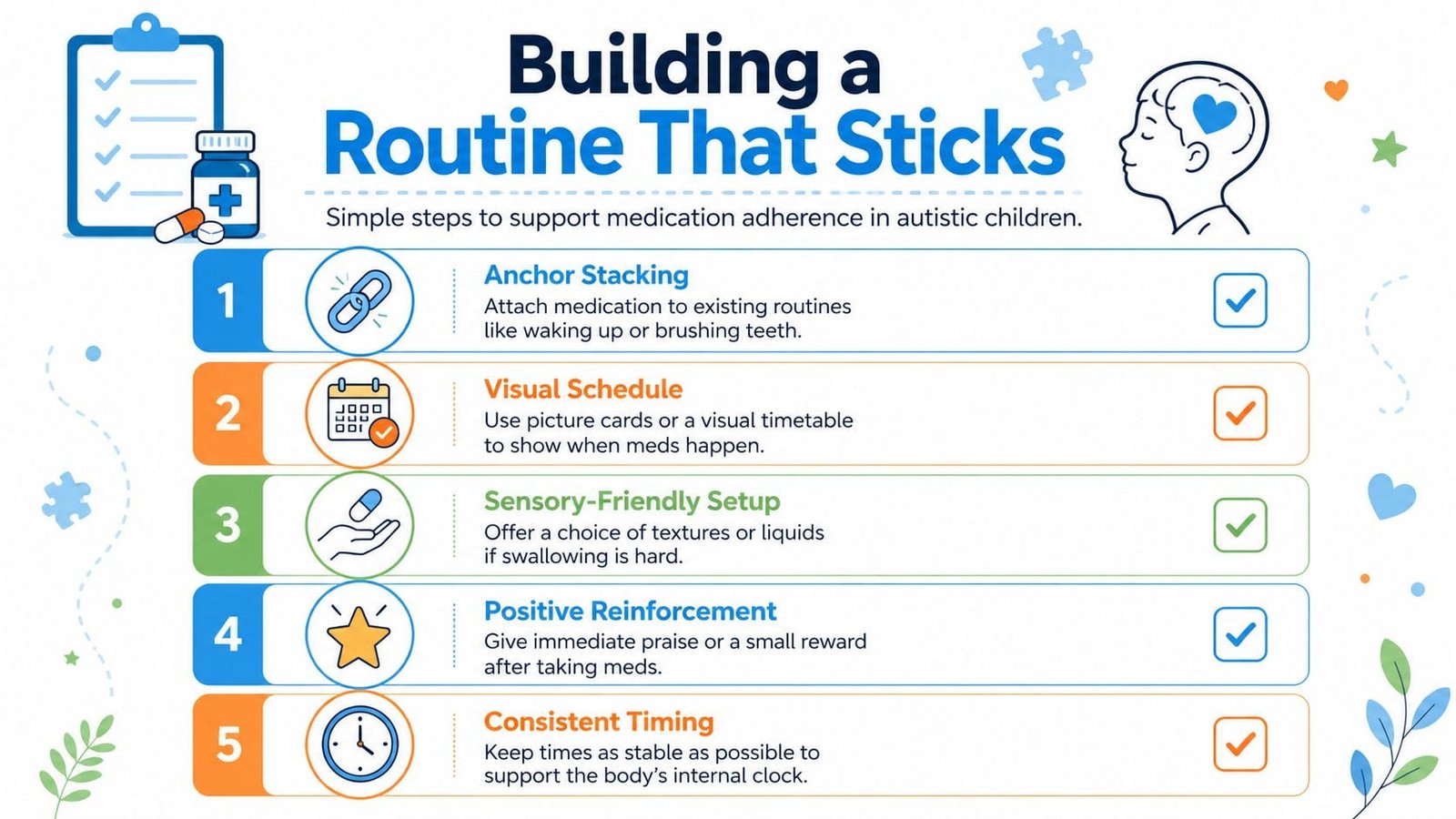
Choose a logging method that you'll still use on a hard day:
- Sticker chart: A tangible chart suits children who like visible progress and gives the routine a concrete finish.
- Notebook column: Record the date, time, dose status, and a short note if you dislike apps.
- Digital timestamp: Use a log that records the time automatically, then add a brief note for refusal, vomiting, or a suspected side effect.
Refusal needs a calm protocol, not a lecture. Offer the sensory accommodation that has a chance of helping, such as a juice chase if medically appropriate, a smaller syringe, a different delivery texture, or a clinician-approved flavoring option. Don't force a dose in a way that creates a larger struggle or risks choking. Record what happened, follow the prescriber or pharmacist's instructions about missed doses, and don't automatically double the next dose.
What worked in our house: We stopped treating refusal as a character issue. Once the log included flavor, texture, timing, and context, the problem became solvable.
Consistency doesn't mean every day looks identical. It means the same cue, location, recording habit, and response plan are available often enough that everyone knows what to do.
Smart Reminders, Alerts, and Voice Logging
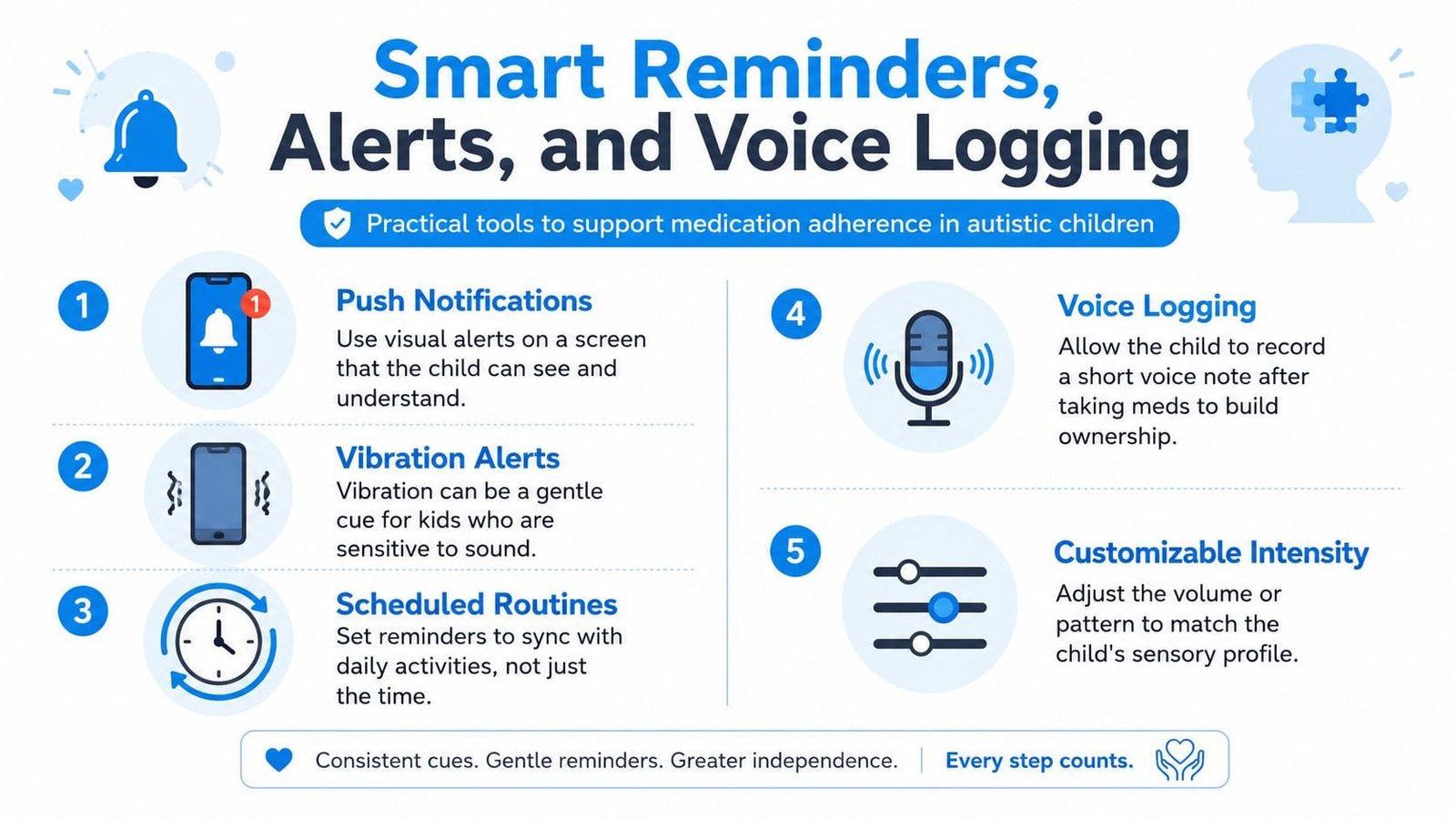
A reminder should fit the child, not punish the child for ignoring it. Some children tolerate a quiet vibration but become distressed by an alarm. Others notice a bright visual notification and ignore sound completely. Start with the least intrusive cue that reliably reaches the responsible caregiver.
One-off alarms are useful when a dose has a fixed time and one adult owns the task. Context-aware reminders are better when medication belongs beside an activity, such as brushing teeth or leaving for school. The point is to connect the prompt to a behavior your child already recognizes instead of making the clock carry the whole burden.
Configure alerts for real life
Use a short snooze window when the routine is predictable but not exact. If the dose still isn't logged, an escalation chain can notify the second parent or another designated caregiver. Quiet hours matter because repeated overnight alerts create alarm fatigue, and an exhausted parent is less likely to trust the system.
A useful smart log can include:
- Timestamped check-in: Record when the caregiver marked the dose as given.
- Missed-dose flag: Separate refusal, forgotten dose, vomiting, spill, and uncertainty when the app allows it.
- Side-effect note: Add a short observation rather than a long narrative.
- Bottle photo: Use only when it helps confirm the medication or label, and avoid capturing unnecessary personal information.
- Caregiver identity: Make clear who gave or observed the dose.
Voice logging can reduce friction for a parent carrying a child, managing a transition, or driving between appointments. It may also give a child a way to participate without typing. But voice features can add noise for children sensitive to sound, and AI processing raises privacy questions. Turn them off if they increase distress or store more information than you need.
Guiding Growth is one option for combining medication reminders with broader child-care notes. Whatever tool you choose, configure it around the sensory profile and communication style in your home rather than activating every feature at once.
Sharing the Load With Caregivers and Clinicians
Medication adherence is a team task whenever school nurses, grandparents, respite caregivers, and co-parents rotate through the day. The dangerous gaps appear during handoffs. One adult assumes the other gave the medicine, a paper chart stays in a backpack, or a group message gets buried beneath unrelated updates.
A single source of truth reduces those gaps. Every authorized caregiver should record the dose in the same place, with the time and any relevant context. The next person can check the record before giving medication, and the prescribing clinician can review a longitudinal pattern rather than reconstructing the month from scattered texts.
Make the shared record practical
Use role-based access where possible. A caregiver may need to log a dose and add a brief observation, while a clinician may need a summary of timing, refusals, and possible side effects. School staff should receive only the information necessary for their responsibility, not the child's complete health history.
Shared notes become especially useful when they connect medication events with behavior, sleep, appetite, or transitions. A short entry such as “refused after poor sleep” can be more useful than a long description written days later. For an IEP meeting or psychiatry visit, prepare a concise summary that highlights patterns and questions, not every individual tap.
Reducing coordination stress is a clinical support in its own right. When adults don't have to search several systems, they're less likely to skip documentation or duplicate a dose. Emotional support resources, including DocuCraft emotional support AI, can also help parents find language for difficult conversations, but they shouldn't replace a prescriber's guidance about medication changes.
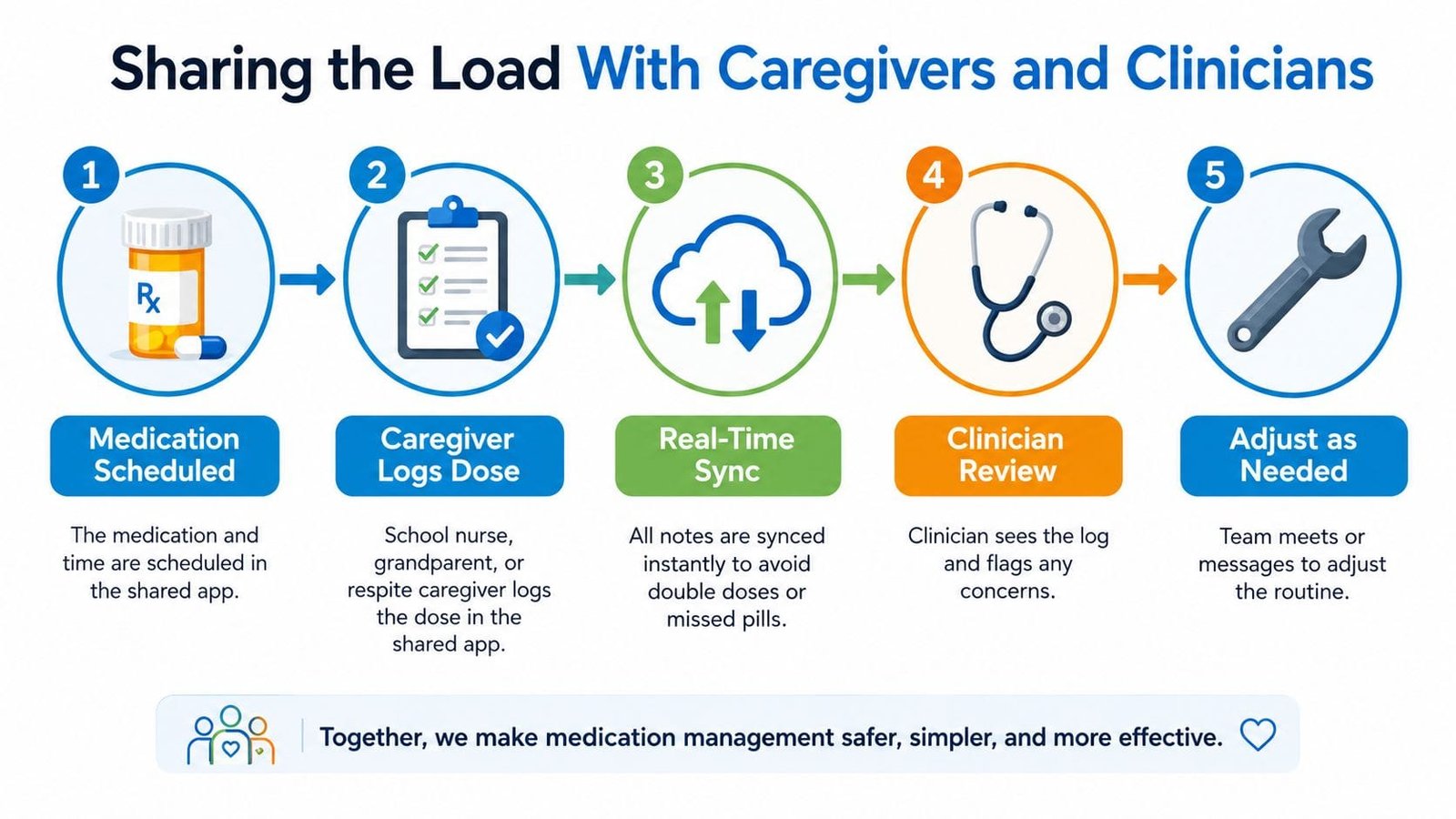
Before an appointment, export or summarize the questions that require medical judgment. Ask the clinician how to handle missed, vomited, or refused doses, which side effects need a call, and what pattern would justify changing the routine. The app should organize observations. The care team should interpret them.
Privacy, Consent, and What to Keep Out
Convenience doesn't justify collecting everything. A parenting app should hold the minimum information needed to support safe routines, clear handoffs, and useful conversations. It shouldn't become an unfiltered archive of your child's identity, diagnosis, location, and family life.
Medication names, dosages, adherence timestamps, and reminder preferences may be appropriate for routine tracking. Diagnosis details, the complete medical history, and lab results belong in clinical records where professionals can interpret them. Legal guardian identification numbers, your home address, and unrelated family information don't belong in a medication app.
Set boundaries before sharing
For minors, get written consent from guardians who have the authority to approve access. Explain data storage and sharing expectations to every caregiver, including what they can view, what they can add, and what they must not copy elsewhere. School staff may need to know that a dose was administered and whether an urgent response is required. They usually don't need the child's full medication history.
Screenshots can expose names, timestamps, labels, or other children in the background. Location data attached to reminders may reveal routines that don't need to be recorded. AI-processed voice notes can contain much more personal information than a short text entry, so disable transcription or voice storage when it creates unnecessary risk.
Use this screening framework before adding medication information:
- Need: Does the feature support a real medication task?
- Access: Can you control who sees and edits the record?
- Retention: Can you delete information you no longer need?
- Processing: Does the tool use voice, images, or AI in ways you understand?
- Clinical boundary: Will the record supplement, rather than replace, the child's medical chart?
A privacy-focused setup isn't less helpful. It's more deliberate. Guidance on HIPAA-compliant apps can help you form questions for a vendor, but ask the app provider directly how your data is stored, shared, and removed.
Your First Week With a Better Adherence Setup
Don't rebuild the entire care system in one evening. The child should barely notice the change, and you should be able to tell which part of the setup is helping.
A calm seven-day rollout
Day 1 and Day 2: Choose two anchor times that already happen, such as breakfast and bath or an evening snack. Add logging only. Don't change every reminder, label, and caregiver permission at once.
Day 3: Turn on one reminder mode that matches your household. Assign one parent to verify the record, not to carry every medication task forever, but to prevent uncertainty while the routine settles.
Day 4: Add one caregiver, teacher, or school nurse if they're responsible for a dose. Explain exactly what counts as “given,” what to record after refusal, and when to contact you.
Day 5: Review the week. Look for refusal patterns around time of day, texture, transitions, sleep, or a particular caregiver. Keep the observations factual.
Day 6: Have one short conversation with the prescribing clinician. Ask what information they want shared and what to do after a missed, vomited, or uncertain dose.
Day 7: Turn on shared tracking in Guiding Growth, then apply the privacy boundaries you chose. Keep only the access, reminders, and notes the team requires.
Keep this checklist somewhere visible:
- Pick two existing anchor times.
- Log doses without changing everything else.
- Add one well-matched reminder.
- Assign one person to verify.
- Invite one additional caregiver.
- Review patterns and prepare clinician questions.
- Set shared access and privacy limits.
The point isn't a perfect record. The point is a dependable record that makes the next decision clearer. If a system creates more distress than clarity, simplify it.
Guiding Growth brings medication and supplement reminders, dose logging, appointments, behavioral observations, and caregiver collaboration into one place, with voice logging available when typing is impractical. Visit Guiding Growth to create a calmer medication adherence monitoring routine for your family and care team.