The reminder arrives while your child is still in pajamas. You're holding a toothbrush, checking the appointment time, and mentally rehearsing the visit: drive, waiting room, chair, cleaning, leaving. Your child may be listening, covering their ears, asking the same question, or not responding at all. That moment explains why dental appointment reminders for autistic kids need to do more than announce a date.
A useful reminder helps a child remember, anticipate a transition, and understand what they can do next. It also gives caregivers and the dental team the same information, so nobody has to guess which sounds, textures, words, or changes might make the visit harder.
Table of Contents
- What a Good Dental Reminder Actually Does
- Building the Right Reminder Cadence
- Choosing Channels That Fit Your Child
- Writing a Social Story and Visual Checklist
- The Day of the Visit End to End
- When Reminders Aren't Enough
What a Good Dental Reminder Actually Does
A calendar notification says, “Dentist tomorrow.” A preparation reminder says, “Tomorrow I will go to the dental clinic. I will meet the receptionist, wait, sit in the chair, clean my teeth, and leave. I can bring my headphones.” Those messages serve different purposes.
A strong reminder has three jobs:
- Cue memory: It brings the appointment back into focus without relying on one adult to remember every detail.
- Reduce surprise: It names the sequence, people, sounds, and changes your child may encounter.
- Give the child a role: It offers a simple action, such as choosing headphones, carrying a visual schedule, or replying with a confirmation.
Timing matters because a message can arrive too late to prepare or so early that the appointment feels endless. A randomized pediatric dental clinic study described SMS reminders sent 48 hours before the visit, with one message for each scheduled appointment. That gives a practical starting point, but your child's response should guide adjustments.
Make the language concrete
Use literal words and short sentences. “The dentist may look at my teeth with a small mirror” gives more usable information than “It'll be easy.” Avoid promises you can't guarantee. If the hygienist might use a buzzing tool, say so gently and explain what choice your child has.
A reminder can include:
- The day and time.
- The order of the visit.
- What your child can bring.
- Who will help.
- What happens if the plan changes.
Practical rule: If your child asks, “What happens next?” the reminder should answer that question before the car ride.
Tonight, draft tomorrow's message with the visit steps inside it: “Tomorrow we drive to the dentist, check in, wait, sit in the chair, and clean teeth. You can bring headphones and choose your comfort item.” Read it aloud once, then save it where every caregiver can find it.
Building the Right Reminder Cadence
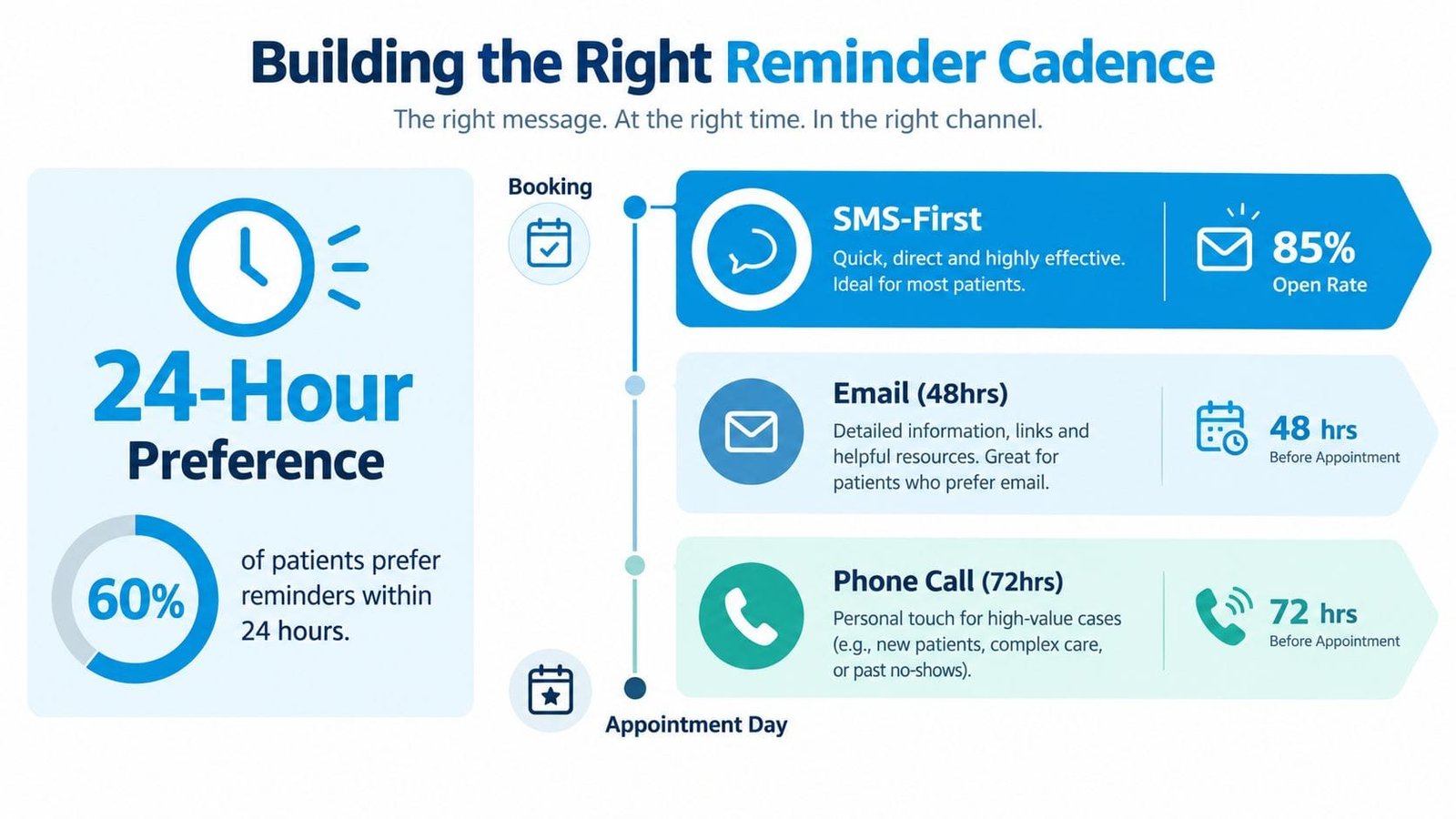
One reminder can disappear under school messages, work alerts, and family logistics. A layered cadence gives your child several calm chances to prepare, while each message does a different job.
A 2026 primary-care study found that 69.6% of participants preferred reminders 24 hours before an appointment, 30.4% preferred one week ahead, and 80.6% preferred SMS delivery (Karger study). Those preferences support an SMS-first plan, but an autistic child may also need visual and spoken preparation.
Give every message one purpose
One week before: Preview the visit. Name the appointment type, clinic, expected sequence, and who's taking your child. Link the social story or place the visual schedule somewhere visible.
48 hours before: Focus on sensory preparation. Ask your child to choose headphones, sunglasses, a quiet toy, or another agreed comfort item. If toothpaste flavor or the dental chair is a concern, write down the preference and send it to the clinic.
24 hours before: Confirm the practical details. Include the exact time, address, transportation plan, and a simple response option. This is the point many people prefer, so keep the message easy to notice and answer.
The morning of the visit: Support the transition rather than adding new information. “First breakfast, then clothes, then car, then dentist” may work better than another long explanation.
After the visit: Record what happened while it's fresh. Note which step went smoothly, which sound or texture caused distress, and what helped your child return to calm.
A shared family calendar can prevent one caregiver from preparing for a different version of the appointment. Guiding Growth can keep doctor appointments, therapy sessions, daily notes, and shared care information together, so parents, grandparents, and clinicians can work from the same plan rather than scattered texts.
Tonight, add the appointment to a shared calendar and attach one preparation item to each reminder. The one-week entry can hold the social story, the 48-hour entry can hold the sensory checklist, and the 24-hour entry can hold the confirmation message.
Choosing Channels That Fit Your Child
SMS is convenient, but convenience isn't the same as accessibility. In a study of 1,193 dental appointments, the average no-show rate was 2.43%, with phone calls at 3.49%, email at 2.68%, and SMS at 1.90%, with no statistically significant difference between the channels (randomized orthodontic study). Patient preference, reliable delivery, and the child's communication style may matter more than choosing a supposedly perfect channel.
| Channel | Best For | Watch Out For | Override Option |
|---|---|---|---|
| SMS | A caregiver who checks a phone quickly and wants a short confirmation task | The message can be missed, misunderstood, or shared without sensory context | Add a visual schedule or ask another caregiver to confirm |
| Longer preparation notes, clinic instructions, or a social story link | It may be too slow for a busy day or too detailed for a child | Print the key steps or copy them into a phone note | |
| Phone call | A caregiver who needs clarification or a child who responds better to spoken language | Unexpected ringing can be stressful, and calls can add pressure | Schedule the call or use a familiar person's voice |
| Voice reminder | A child who understands a familiar spoken routine | Voice alone doesn't show the sequence or offer a visual anchor | Pair it with pictures, gestures, or a wall chart |
A Cochrane review of mobile text-message reminders found that text reminders increased attendance compared with no reminder and performed similarly to telephone reminders, while offering better cost-effectiveness than calls. That supports SMS as a reasonable default for many families, not as a rule for every child.
Try this decision rule tonight:
- If your child reads or recognizes short messages, use SMS plus pictures.
- If spoken language works better, add a familiar voice reminder.
- If transitions are the hardest part, use a printed first-then schedule.
- If two households share care, send the same visual plan to both caregivers.
You can also pair your reminder system with a visual schedule app for autism support so the appointment appears as a sequence rather than an isolated alert.
Writing a Social Story and Visual Checklist
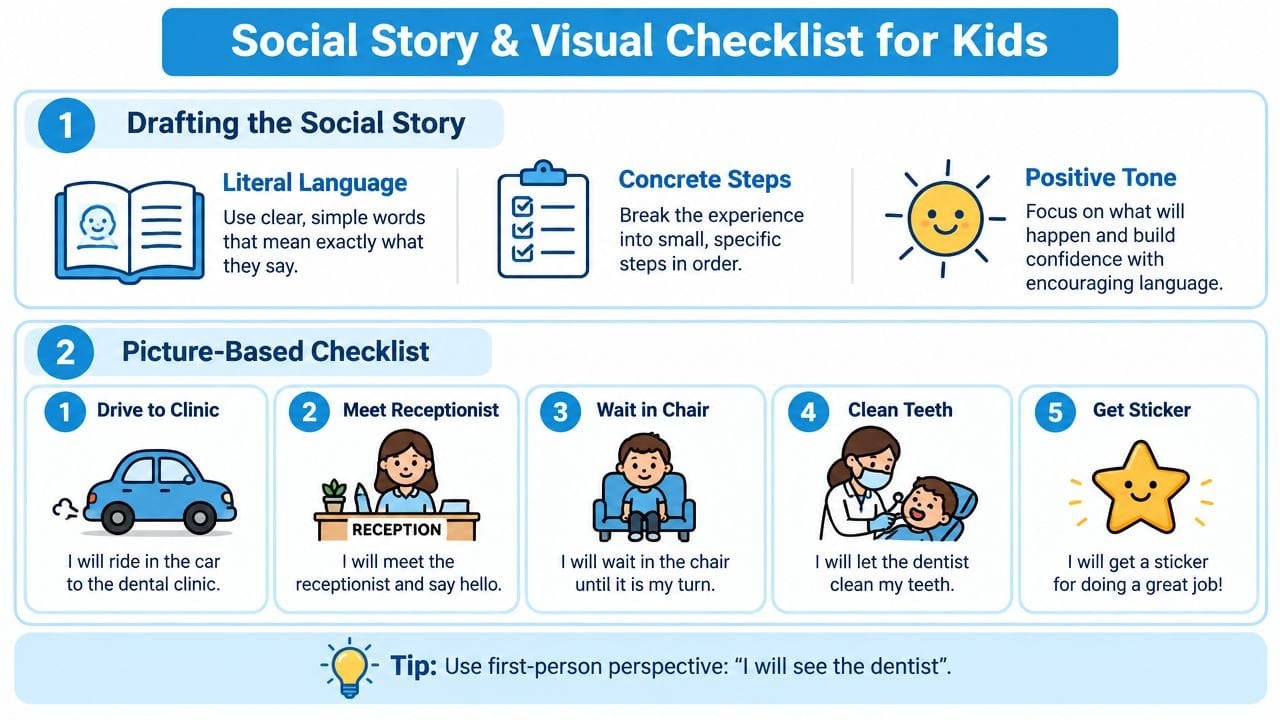
A social story works best when it answers the questions your child can't easily ask in the moment. Keep it short, literal, and honest. Write from your child's point of view, use “I” statements, and describe what adults will do without promising that nothing uncomfortable will happen.
Start with the basic sequence:
- I will drive to the dental clinic.
- I will meet the receptionist.
- I will wait for my turn.
- I will sit in the dental chair.
- The dental team will clean or check my teeth.
- I will leave and return home.
The sequence can become a picture-based checklist. Use one photograph, symbol, or simple drawing for each step. The picture doesn't need to be beautiful. It needs to be recognizable and placed in the same order every time.
Add the sensory plan inside the story
A sensory plan belongs beside the step where it helps. Put headphones next to “wait,” a weighted lap pad next to “sit in the chair,” and flavor-free toothpaste next to “clean my teeth,” if the dental team approves those choices. The goal isn't to remove every sensation. It's to make support available before distress peaks.
You can paste language like this into a social story template:
“I will see the dentist. The room may have bright lights and new sounds. I can wear my headphones. I can ask for a break. The dentist will tell me what happens next. When the visit is finished, I will leave with my caregiver.”
Avoid phrases such as “It won't hurt” or “You'll be fine.” Those statements can feel confusing if the visit includes pressure, vibration, an unfamiliar taste, or a long wait. Say what you know, name the available support, and leave room for the dental team to explain the rest.
A resource on how to write social stories for autism can help you shape the wording. If you need help turning rough notes into clear caregiver-facing copy, LunaBloom AI for marketing teams can also be useful for organizing and polishing text, while you remain responsible for checking that every sentence matches your child's actual visit.
Share the finished story with grandparents, babysitters, the other parent, and the dental team. Afterward, log what worked and remove steps your child already understands. Tonight, paste this six-step story into your chosen app or document, add one picture per step, and print a copy for the car.
The Day of the Visit End to End
The morning starts badly. The reminder arrives before your child is ready for it, the toothbrush gets thrown into the sink, and the usual clothing routine stalls. You don't cancel immediately. You shorten the plan, offer sunglasses and the familiar playlist, and show the first picture: car.
The waiting room wobbles too. The lights are bright, another child is crying, and the chair takes longer than expected. Instead of repeating the whole appointment, you open the social story on your phone and show the next two steps. The hygienist receives a short sensory preferences card: headphones, fewer spoken instructions, warning before touch, and a break signal.
Use the pause as information
Your child refuses the chair. You step back, lower your voice, and give the same two choices you practiced: headphones on or headphones beside the chair. After 90 seconds, your child moves closer. The cleaning still isn't perfect, but the team gets a workable starting point because the adults respond to the plan rather than improvising five different demands.
The evidence supports treating reminders as part of a wider attendance and adherence process. A systematic review in orthodontics covering 14 randomized controlled trials and 2,078 participants found a pooled relative risk of 0.39 for missed appointments among patients receiving reminders, and also reported a lower white-spot lesion risk with reminders (European Journal of Orthodontics review). That doesn't mean one text solves every difficult visit. It means preparation and follow-through can connect with clinical outcomes.
After the appointment, you enter a brief note in Guiding Growth, or capture a voice note in the parking lot and type it later. Record the trigger, the support, the child's response, and the request for next time. Send the useful part to the dentist and the other parent, not every private detail.
For more ideas on managing sensory overload, keep the focus on prevention, choice, and recovery. Tonight, open your tracking tool and create one line called “next visit notes.” Write the first thing you already know, such as “Headphones and advance warning helped during the cleaning.”
When Reminders Aren't Enough
Sometimes the reminder works exactly as designed and the appointment still doesn't happen. Your child may refuse at the door, you may cancel because transportation collapses, or everyone may stop talking about the visit until the slot is gone. Those signals look similar in a scheduling system, but they need different responses.
Separate logistical misses from sensory or anxiety-driven misses. A transportation problem calls for a different pickup plan. A child who becomes distressed at the sound of the suction tool may need gradual exposure, a quieter appointment period, or a conversation with the dental team before the next cleaning.
A missed appointment is information about the plan, not a verdict on the child or the caregiver.
A single missed visit may have many explanations. Two missed visits in six months are a pattern worth flagging, not automatically bad luck. If the problem continues, note lead time, whether the confirmation message was answered, the day of the week, who was caregiving, and what happened immediately before the refusal. Recent evidence identifies lead time, missed confirmations, prior no-show history, and day-of-week effects as predictors of dental no-shows, while also warning that SMS doesn't work equally well across populations (recent review).
Choose an escalation step
| Signal You See | Likely Cause | Next Step |
|---|---|---|
| The family never receives or answers reminders | Wrong number, inaccessible channel, or caregiver overload | Confirm contact details by phone and choose one accountable caregiver |
| The child refuses during the car ride | Anxiety, unclear sequence, or transition difficulty | Schedule a short desensitization visit and use the visual story beforehand |
| The child struggles in the waiting room | Noise, lights, crowding, or unpredictable delay | Request a sensory-friendly slot, waiting-room alternative, or direct room entry |
| The visit fails after an unexpected procedure change | Loss of predictability | Ask the dentist to explain changes before touch and record the preferred script |
| The same pattern appears across visits | The cadence or support plan isn't addressing the cause | Share the documented pattern with the dentist's behavior support contact |
A phone conversation may clarify what an SMS cannot. For broader scheduling ideas, this appointment no-show guide from Voicedial.ai offers another perspective on confirmation and escalation workflows, but your child's sensory and communication needs should remain central.
If reminders haven't changed the outcome across three visits, change the plan, not just the wording. Tonight, log the last missed visit with its likely cause and one escalation request for the dental office.
Guiding Growth brings appointment tracking, visual preparation, behavior and sensory notes, voice logging, and caregiver collaboration into one place. Use it to build a dental visit plan, share the same social story with your care team, and record what to change next time. Visit Guiding Growth and turn the next dental appointment reminder into preparation your child and caregivers can use.