Individual therapy sessions typically last 30 to 60 minutes, while intensive autism interventions may require 10 to 40 hours per week across multiple sessions. But are you measuring the time your child spends in one appointment, or the total treatment exposure delivered across the entire week?
That distinction matters on a busy therapy morning. A parent may drop a child at speech therapy, drive to occupational therapy, coordinate ABA, answer school messages, and still be unable to say how many minutes of planned care actually happened. The calendar shows appointments, but it doesn't always show late starts, early finishes, breaks, cancellations, or the difference between a scheduled block and face-to-face treatment.
The answer to how long do therapy sessions last depends first on the therapy type, then on the child's goals, capacity, setting, and care plan. A conventional psychotherapy visit may follow a 45-to-60-minute scheduling pattern, while autism-focused behavioral treatment is often planned as cumulative weekly exposure. The practical task is to understand both clocks: the clock inside each appointment and the running total across providers.
Table of Contents
- What You Need to Know About Therapy Session Lengths
- Typical Durations Across Common Therapy Types
- Factors That Influence How Long Sessions Last
- Understanding Billing Codes and Actual Face-to-Face Time
- Deciding When to Continue, Shorten, or Intensify Therapy
- How Parents Can Prepare for Sessions and Track Progress
- Key Takeaways for Managing Therapy Scheduling
What You Need to Know About Therapy Session Lengths
At 8:00 in the morning, Maya's parent checks the family calendar. Speech therapy is listed first, occupational therapy follows after school, and ABA appears as a block later in the week. Each appointment has a start time and an end time, yet the parent still can't answer a basic question: How much therapy did Maya receive?
That uncertainty is common because “therapy session” can describe very different services. Individual psychotherapy commonly uses appointments around 45 to 60 minutes, while autism intervention programs may involve approximately 18 to 40 hours of therapist-delivered intervention per week, depending on the treatment model and the child's needs (New York State's autism intervention review). Those figures aren't interchangeable. One describes a visit, and the other describes weekly treatment intensity.

Start with the therapy category
For a rough orientation, parents may encounter:
- Individual psychotherapy: Often scheduled for 45 to 60 minutes, although the therapeutic conversation may occupy a different amount of time than the calendar slot.
- Speech-language therapy: Commonly arranged in shorter or moderate blocks, adjusted for communication goals, age, attention, and tolerance.
- Occupational therapy: Often scheduled as a focused appointment, with activities and breaks shaped by the child's sensory and motor needs.
- ABA and other intensive behavioral programs: Planned by cumulative weekly exposure, sometimes through multiple blocks rather than one appointment.
The shorter appointment isn't automatically less meaningful, and the longer program isn't automatically better. The child's response, the goal being addressed, and the amount of useful treatment delivered matter more than a familiar number on the schedule.
Parents new to individual counseling may also benefit from getting started with individual therapy, especially when they want to understand what happens before, during, and after a standard appointment. For care coordination, write down the scheduled duration and the actual start and end times. That simple distinction gives you a more reliable picture than the appointment label alone.
Typical Durations Across Common Therapy Types
A side-by-side comparison helps, but it also reveals why a single answer can mislead. Individual psychotherapy usually follows a visit-based model. ABA often follows a weekly-intensity model. Speech and occupational therapy sit between those approaches, with session blocks adapted to the child's goals and participation.
Individual, speech, occupational, and ABA care
Individual psychotherapy is commonly associated with a 45-to-55-minute appointment, a convention shaped partly by scheduling history rather than proof that one duration works for everyone. Historical evidence summarized by the British Association for Counselling and Psychotherapy notes that Freud commonly conducted sessions of about 55 minutes, while the shorter convention allowed clinicians time for documentation, preparation, or transition.
Speech-language sessions may be planned for 30 to 60 minutes, depending on the child's age, communication goals, and ability to participate. Occupational therapy often uses a similar practical range, with the therapist adjusting activities, transitions, and breaks to match the child's regulation and motor needs.
ABA changes the math. Professional guidance describes full-spectrum treatment as approximately 26 to 40 hours of direct treatment per week, while focused treatment generally ranges from 10 to 25 hours weekly (ABA practice guidelines). Individual ABA sessions can range from 30 to 120 minutes, so one appointment on a calendar says little about total exposure.
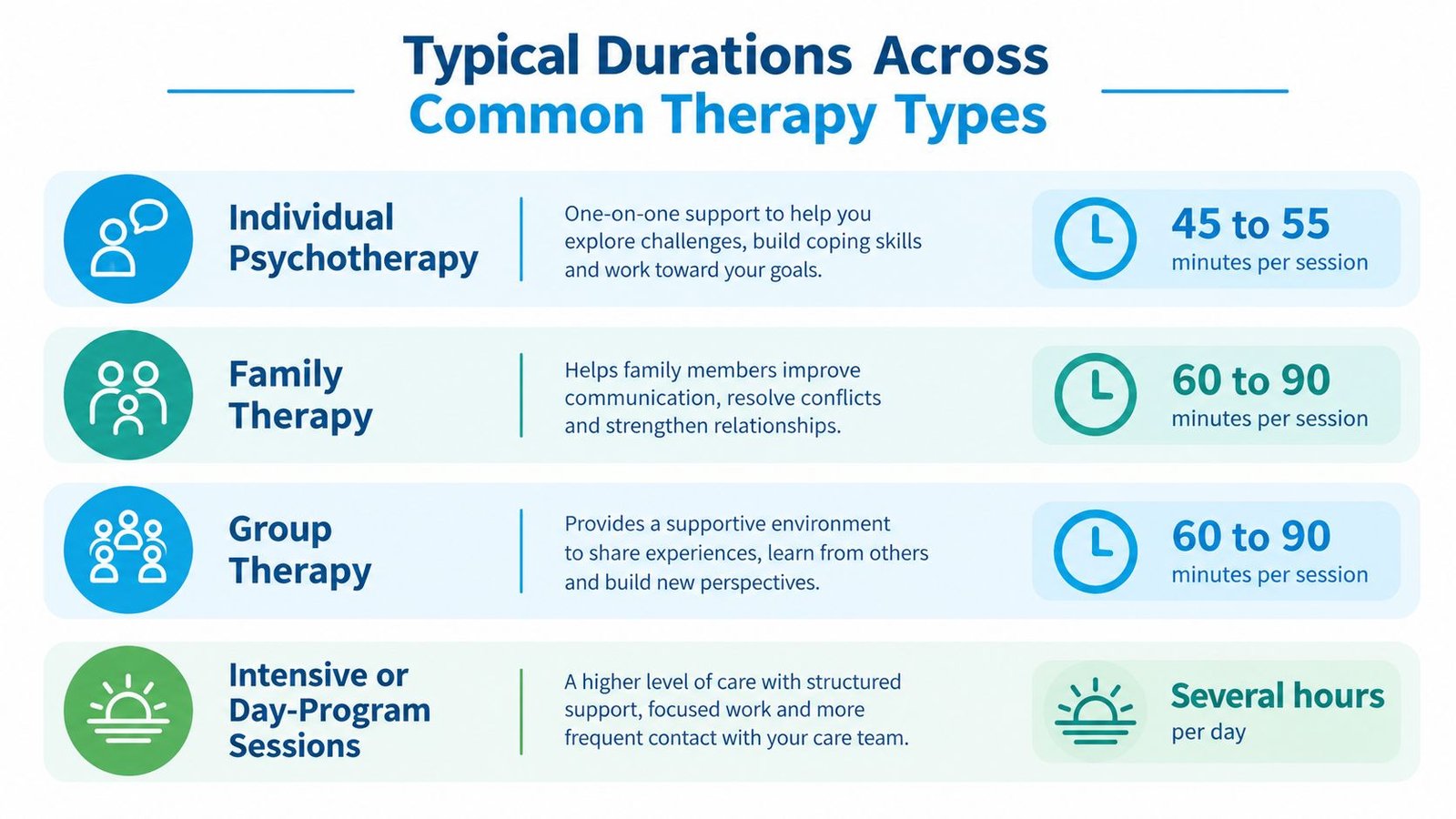
The following table keeps the comparison practical. Ranges are planning references, not prescriptions for a particular child.
| Therapy Type | Typical Session Length | Weekly Exposure Range | Key Consideration |
|---|---|---|---|
| Individual psychotherapy | 45 to 60 minutes | Varies by plan | Actual face-to-face time may differ from the calendar slot |
| Speech-language therapy | 30 to 60 minutes | Varies by goals and schedule | Attention, communication targets, and breaks shape the visit |
| Occupational therapy | 45 to 60 minutes | Varies by plan | Sensory, motor, and daily-living goals affect pacing |
| ABA, focused treatment | 30 to 120 minutes per session | 10 to 25 hours | Count all blocks across the week |
| ABA, comprehensive treatment | Multiple blocks | 26 to 40 hours | Weekly exposure is more informative than one appointment |
For a parent comparing center-based, home-based, and hybrid care, how long ABA therapy typically lasts offers additional context about how providers describe treatment schedules. Families considering home-based services can also review ABA home therapy while asking how planned hours translate into actual minutes delivered.
The essential comparison is not “Which therapy has the longest appointment?” It's “What does this plan deliver across a week, and how much of that time is active, appropriate treatment?”
Factors That Influence How Long Sessions Last
Therapists don't choose session length at random. They balance clinical goals, the child's capacity, the service setting, documentation requirements, provider availability, and the family's ability to sustain the schedule.
The child's current capacity
Age can affect attention, stamina, communication, and the need for movement or sensory breaks. A younger child may participate more productively in a shorter block, while another child may tolerate a longer appointment when activities are varied and familiar. A child who is tired, dysregulated, hungry, or recovering from a difficult transition may not benefit from using every scheduled minute.
Goals also change the timetable. A program focused on acquiring a new communication or daily-living skill may need repeated practice. A maintenance or generalization visit may use a shorter check-in to see whether the skill appears at home, school, or in the community.
The service and the setting
A therapist may structure time differently in a clinic, school, home, or community setting. Home-based work can embed practice in meals, dressing, play, or transitions, while a clinic visit may use a more defined treatment block. Breaks are part of the plan, not necessarily lost time, when they help a child return to a learning activity.
Insurance authorization and provider availability can shape what a family is offered, but those constraints shouldn't replace individualized clinical reasoning. Ask the provider what the scheduled duration includes, how breaks are handled, and how the team decides whether to shorten or extend a visit.
Practical rule: A planned duration is a target for organizing care, not proof that every minute was clinically useful.
Record the reason for an early finish or missed block, along with participation and post-session effects. Over time, those notes can show whether the schedule matches the child's real capacity instead of forcing the family to judge each appointment in isolation.
Understanding Billing Codes and Actual Face-to-Face Time
The number on a calendar invitation isn't always the number used for psychotherapy billing. In the United States, CPT guidance uses 45 minutes and 60 minutes as principal psychotherapy benchmarks, while reportable face-to-face ranges are approximately 38 to 52 minutes for code 90834 and 53 minutes or longer for code 90837 (APA psychotherapy services guidance).
That means a 60-minute calendar slot doesn't necessarily represent 60 minutes of conversation with the patient or family. Transition, intake, preparation, and documentation may occur around the patient-facing service. The clinician should document the actual time delivered and choose the code closest to that service, rather than treating the appointment label as exact.
How Medicare time ranges work
Medicare places common psychotherapy codes into three broad time categories:
- Shorter psychotherapy services: 16 to 37 minutes, associated with CPT 90832 and 90833.
- Standard psychotherapy services: 38 to 52 minutes, associated with CPT 90834 and 90836.
- Longer psychotherapy services: 53 minutes or more, associated with CPT 90837 and 90838.
Sessions under 16 minutes shouldn't be reported using these psychotherapy codes. CMS also explains that the patient must be present for all or part of the service, and that a psychotherapy encounter lasting 90 minutes or longer may qualify for prolonged-service billing when the relevant conditions are met (CMS billing guidance).
Parents don't need to memorize every code. They should ask two direct questions: “What was the actual face-to-face time?” and “What did the scheduled block include?” A current overview of CPT updates for behavioral health can help families understand terminology, but the treating provider and insurer should answer questions about a specific claim.
For behavioral services, a time-stamped note can be more useful than a billing label. An ABA session notes workflow can help caregivers record planned duration, actual start and end times, goals, breaks, and observations in one place.
Deciding When to Continue, Shorten, or Intensify Therapy
The harder question isn't “Was the appointment long enough?” It's “Did the time support meaningful progress without creating an unsustainable burden?”
A large review found no scientifically established consensus on treatment duration or session frequency. The evidence supports brief, intensive, concentrated, and non-weekly approaches for different conditions and populations (review of treatment duration and frequency). A separate analysis of routine outpatient psychotherapy found treatment lengths ranging from three to 86 sessions, with a median of five and a mean of eight, and concluded that no single prespecified number of sessions fits every client.
Look for change beyond the therapy room
Before adding hours, ask what the current schedule is accomplishing. Useful questions include:
- Observable change: Is the target skill appearing more often or with less assistance?
- Carryover: Does the child use the skill at home, school, or in another setting?
- Participation: Is the child engaged enough for the planned activities?
- Recovery: Are fatigue, distress, sleep changes, or difficult transitions manageable afterward?
- Sustainability: Can the family maintain travel, school coordination, caregiver work, and home practice?
A longer appointment may be appropriate when assessment, caregiver consultation, or complex planning requires it. A shorter visit may be wiser when the child is fatigued or unable to participate productively. CMS guidance also states that psychotherapy duration should be individualized and that coding should reflect the actual service delivered (CMS individualized duration guidance).
Bring the whole burden to the care meeting
Families coordinate more than minutes in a therapy room. They also manage travel, transitions, school absence, caregiver work, meals, sibling needs, and recovery time. A schedule can look clinically ambitious on paper while leaving the child and family too depleted to use the skills between appointments.
Bring a simple record showing planned time, actual time, the goal addressed, the child's response, and what happened afterward. The care team can then discuss whether to continue, shorten, space out, or intensify treatment based on patterns rather than appointment count alone.
How Parents Can Prepare for Sessions and Track Progress
Tracking works best when it starts before the appointment. Review recent sleep, behavior, meals, mood, triggers, and school concerns, then choose the observations most relevant to that day's therapy goal. You don't need a perfect diary. You need consistent information that helps the clinician connect the session with everyday functioning.
Capture the minutes that actually happened
For each appointment, record:
- The planned block, including the provider, therapy type, and location.
- The actual start and end times, including meaningful delays or early finishes.
- The goal addressed, such as requesting, dressing, transitions, feeding, or emotional regulation.
- Breaks and participation, including what helped the child re-engage.
- The post-session pattern, such as calm engagement, fatigue, sleep changes, or increased distress.
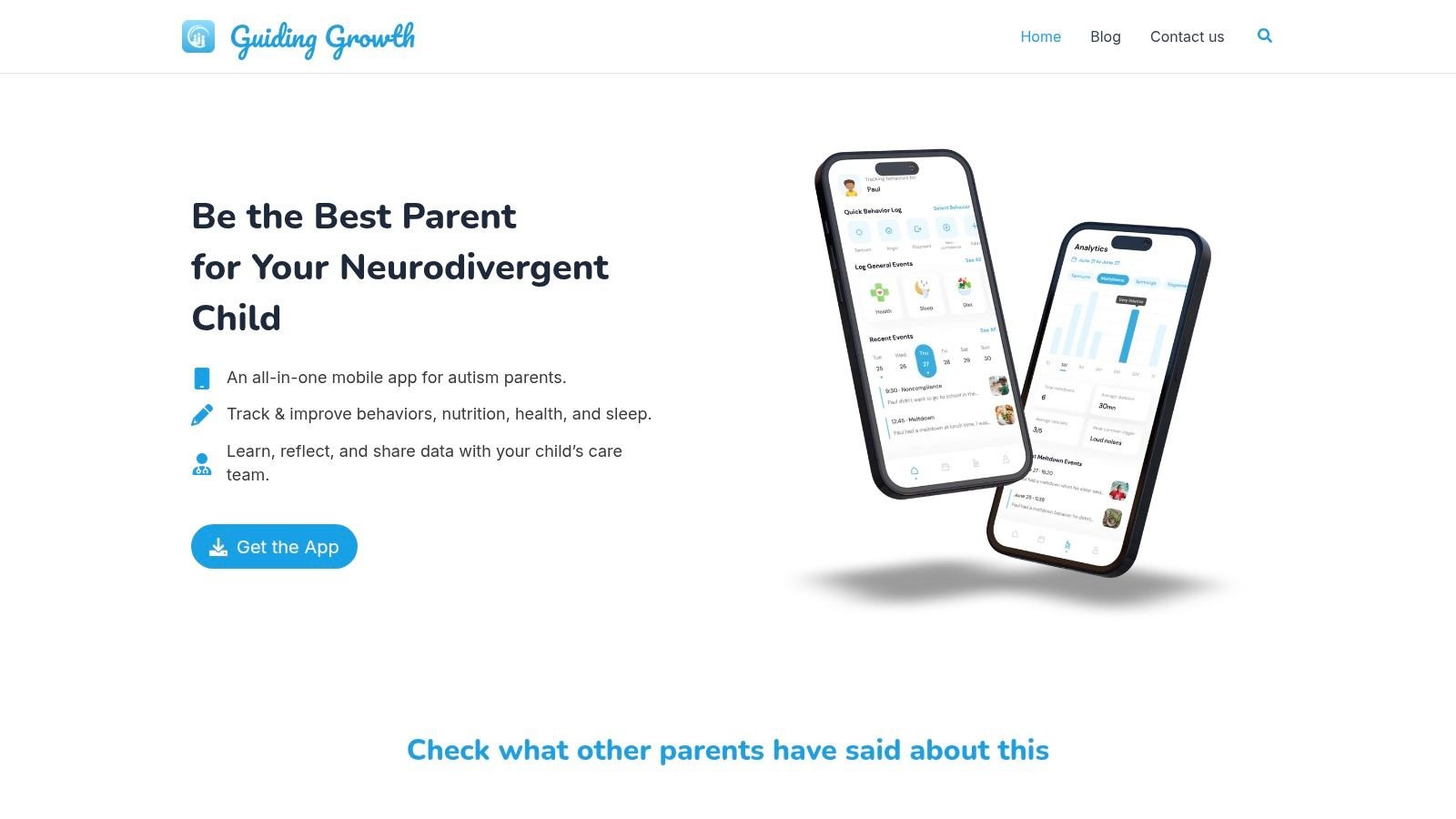
A voice-first approach can reduce the burden of typing after a long day. With Guiding Growth, parents can describe daily events naturally, review structured entries for behavior, sleep, meals, mood, and attendance, and consolidate information from multiple providers. Its records can include therapy sessions, specialist visits, medications, supplements, and other parts of a child's routine.
Turn scattered notes into a care-team record
A weekly view can reveal details that memory hides. You may notice that one therapy regularly starts late, that cancellations cluster around a particular school day, or that sleep and behavior change after a dense schedule. Those patterns don't prove cause and effect, but they give you precise questions to discuss with clinicians.
A practical therapy progress tracking workflow can also help organize the information needed for an IEP meeting, specialist visit, or treatment review. Bring a short summary rather than a pile of disconnected notes: planned exposure, delivered exposure, target skills, observed changes, and concerns about fatigue or carryover.
“What happened between appointments?” is often as important as “How long was the appointment?”
The aim isn't to turn parents into billing specialists or therapists. It's to replace vague impressions with a shared record that helps the care team make better scheduling decisions.
Key Takeaways for Managing Therapy Scheduling
The answer to how long do therapy sessions last changes with the service. Speech, occupational, and individual psychotherapy appointments are usually organized as discrete visits, while intensive behavioral programs are better understood through cumulative weekly treatment exposure. A 30-minute appointment may be exactly right for one goal and one child, while another care plan may use repeated blocks across the week.
Keep these principles visible when you review the schedule:
- Separate scheduled time from delivered time. Record actual start and end times, not only the calendar invitation.
- Measure the full week. Add minutes across speech, occupational, behavioral, mental-health, and other services instead of judging intensity from one visit.
- Treat billing categories as administrative tools. A CPT range helps describe a reportable service, but it doesn't replace the clinician's record of what occurred.
- Match duration to capacity. Breaks, fatigue, regulation, communication, and attention affect how much useful work a child can do.
- Connect time to outcomes. Track the goal, participation, generalization, recovery, and carryover at home or school.
- Review the plan regularly. Continue, shorten, space out, or intensify services when the evidence supports that change.
A useful family dashboard should show minutes delivered, therapy type, goals addressed, breaks, setting, cancellations, attendance, and child response. That view turns scheduling anxiety into a concrete conversation: what was planned, what happened, what changed, and what should happen next.
Guiding Growth gives parents one place to log therapy times, daily patterns, behavior, sleep, meals, and observations across providers, then prepare structured information for care meetings. Visit Guiding Growth to start building a clearer record of the treatment your child receives.