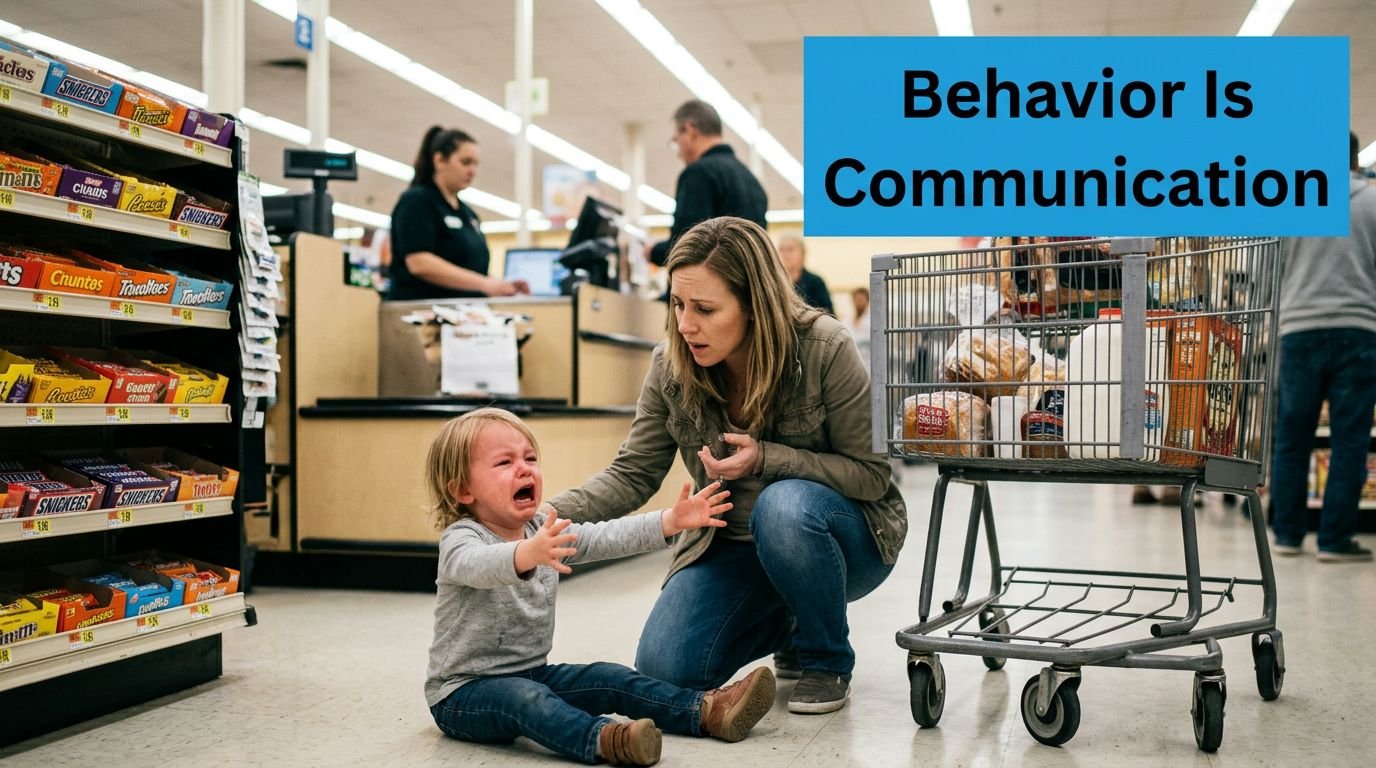
You're at the supermarket checkout when your child drops to the floor crying. The groceries are halfway through the scanner, someone's waiting behind you, and you're trying to comfort your child while wondering whether they need to leave, want something, or can't manage another moment in the store.
Table of Contents
- When Behavior Is a Message You Haven't Decoded Yet
- What Functional Communication Training Actually Is
- The Four Functions Behaviors Usually Serve
- How a Team Figures Out What the Behavior Means
- Choosing How the Child Will Communicate
- Why Early Gains Can Stall and What Schedule Thinning Does
- Turning Home Observations Into Data a Team Can Use
- What FCT Can and Cannot Do and How to Start This Week
When Behavior Is a Message You Haven't Decoded Yet
In that moment, you don't need another person telling you to be firmer. You need a clearer picture of what happened and a way for your child to get help before everyone reaches breaking point.
Functional communication training, usually shortened to FCT, starts with a practical question: what does this behavior help the child obtain or get away from? The aim is to understand that need, teach an accessible way to express it, and respond reliably when the child uses it.
That doesn't mean every difficult moment has a simple explanation. At the checkout, leaving the store, receiving your attention, or getting a preferred item might each be possibilities. A single incident can't tell you which explanation fits.
The scene below is familiar to many families, but the child's message isn't visible in the photograph.
Start with what you noticed
Once everyone is safe, record what happened immediately before the crying and what happened afterward. Perhaps the cashier began speaking, you put a preferred snack back, or the queue stopped moving. Write those observations separately from your interpretation.
A useful starting question: What changed just before this happened, and what changed because it happened?
Your everyday observations can become a clinical record rather than a collection of stressful memories. Guiding Growth offers a place to capture triggers, duration, intensity, people present, and outcomes between appointments.
You don't have to decode the message alone. Your job is to bring usable observations to the team, not to prove that your child was seeking a particular outcome.
What Functional Communication Training Actually Is
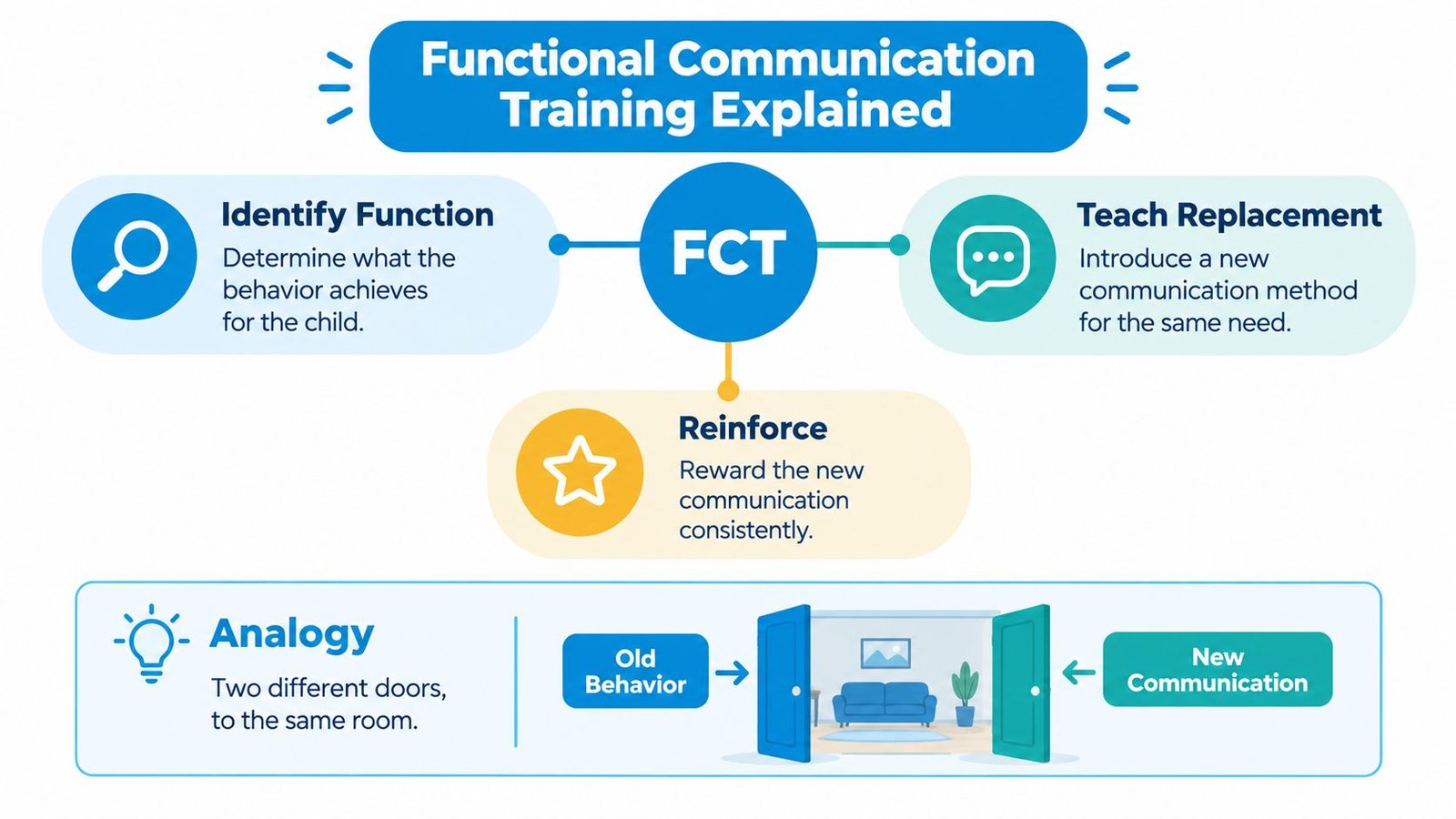
Think of FCT as teaching a different door into the same room. If a child's behavior reliably leads to help, the new communication must also lead to help. Teaching them to name a color wouldn't address that need, even if naming colors is a worthwhile language goal.
Edward G. Carr and V. Mark Durand formally introduced FCT in 1985 in the Journal of Applied Behavior Analysis. Their foundational study involving four children with developmental disabilities assessed situations associated with behavior problems, taught meaningful requests such as attention or assistance, and reported reductions across all participants.
Functional communication training teaches an accessible request that achieves the same outcome as the challenging behavior.
The working parts
- Functional assessment: The clinician investigates what consequence is maintaining the behavior. This is more specific than identifying what happened beforehand.
- Replacement-response training: The team teaches a recognizable communication response matched to that consequence.
- Differential reinforcement: The new response produces the desired outcome, while challenging behavior no longer provides the same effective route when that can be implemented safely.
The relationship between those parts matters more than the wording of the request. In an illustrative example, a child who pushes a worksheet away to obtain a break might learn to hand over a break card. The meaningful outcome is the break, not praise for touching the card.
The infographic shows how those pieces connect.
FCT isn't a generic speech curriculum. Speech therapy, picture exchange, and fitting an AAC device address communication in other ways; those tools can support FCT without being the procedure itself.
For the home record, keep the response, intended outcome, actual outcome, and setting together. That lets the clinician examine whether the new door really opens.
The Four Functions Behaviors Usually Serve
The function of behavior means what the behavior accomplishes, not what it looks like. Crying doesn't automatically mean escape, and hitting doesn't automatically mean attention. Treat the following scenarios as possibilities to investigate, not diagnoses.
An attention-related example might occur while a parent answers a phone call. A child shouts, and the parent immediately turns toward them. If assessment supports attention as the function, the team might teach a gesture meaning “come here.”
For escape or avoidance, consider a child who throws materials when an activity begins and then has the activity removed. A break request or help signal might fit, depending on what the assessment identifies.
Access and sensory experiences
Access to an item or activity, sometimes called a tangible function, could involve crying after a tablet is put away. An appropriate replacement might request the tablet, although the team must also plan what happens when access isn't available.
Automatic sensory reinforcement is different: the behavior itself may provide a sensory experience, rather than depending on another person's response. FCT shouldn't be assumed to address that directly. A clinician may explore whether requesting a sensory support is useful, alongside changes to the environment.
Functions of behavior at a glance
| Function | Typical behavior | Example replacement response | Log field |
|---|---|---|---|
| Attention | Shouting during a parent's call | Gesture for “come here” | Who responded and how |
| Escape or avoidance | Throwing task materials | Break card or help signal | Demand and what happened afterward |
| Access to an item or activity | Crying when an activity ends | Picture request for the activity | Requested item and access provided |
| Automatic sensory reinforcement | Repetitive movement providing a sensory experience | Request for a support, if appropriate | Sensory context and supports available |
“Typical” here means illustrative, not definitive. Record the presumed purpose separately from the observed trigger, intensity, duration, and people present so your team can revise its hypothesis.
How a Team Figures Out What the Behavior Means
A clinician can't choose a well-matched request from the behavior's appearance alone. Choosing the response before assessing the function is like prescribing glasses without checking vision.
Assessment may include caregiver interviews, structured observation, and ABC records. ABC means antecedent, behavior, consequence: what happened before, what the child did, and what followed. When appropriate, qualified clinicians may use a functional analysis to test possibilities under carefully arranged conditions; families shouldn't recreate those tests independently.
Make the home record specific
Use the app's structured behavior fields for context and add details in the attached notes where needed.
- Antecedent: Describe the immediate event, such as a request to put shoes on, rather than writing only “transition.”
- Behavior: Record observable actions. “Hit the door with an open hand” is more useful than “became difficult.”
- Consequence: Note what adults did and what changed, including whether a task stopped or an item became available.
- Context: Capture setting, time of day, and people present.
- Intensity and duration: Use definitions agreed with the clinician so different caregivers record comparable events.
Record what you saw first. Put your best guess about why it happened in a separate field.
You can use this functional behavior analysis example to become familiar with the distinction between the event before a behavior and the outcome after it.
The value of assessment before treatment is also reflected in an ASHA-indexed review of FCT and communication outcomes, which describes teaching a response that produces the same outcome as the behavior.
Bring examples that don't fit your initial theory, too. Those entries help the clinician avoid building a plan around only the incidents everyone remembers most clearly.
Choosing How the Child Will Communicate
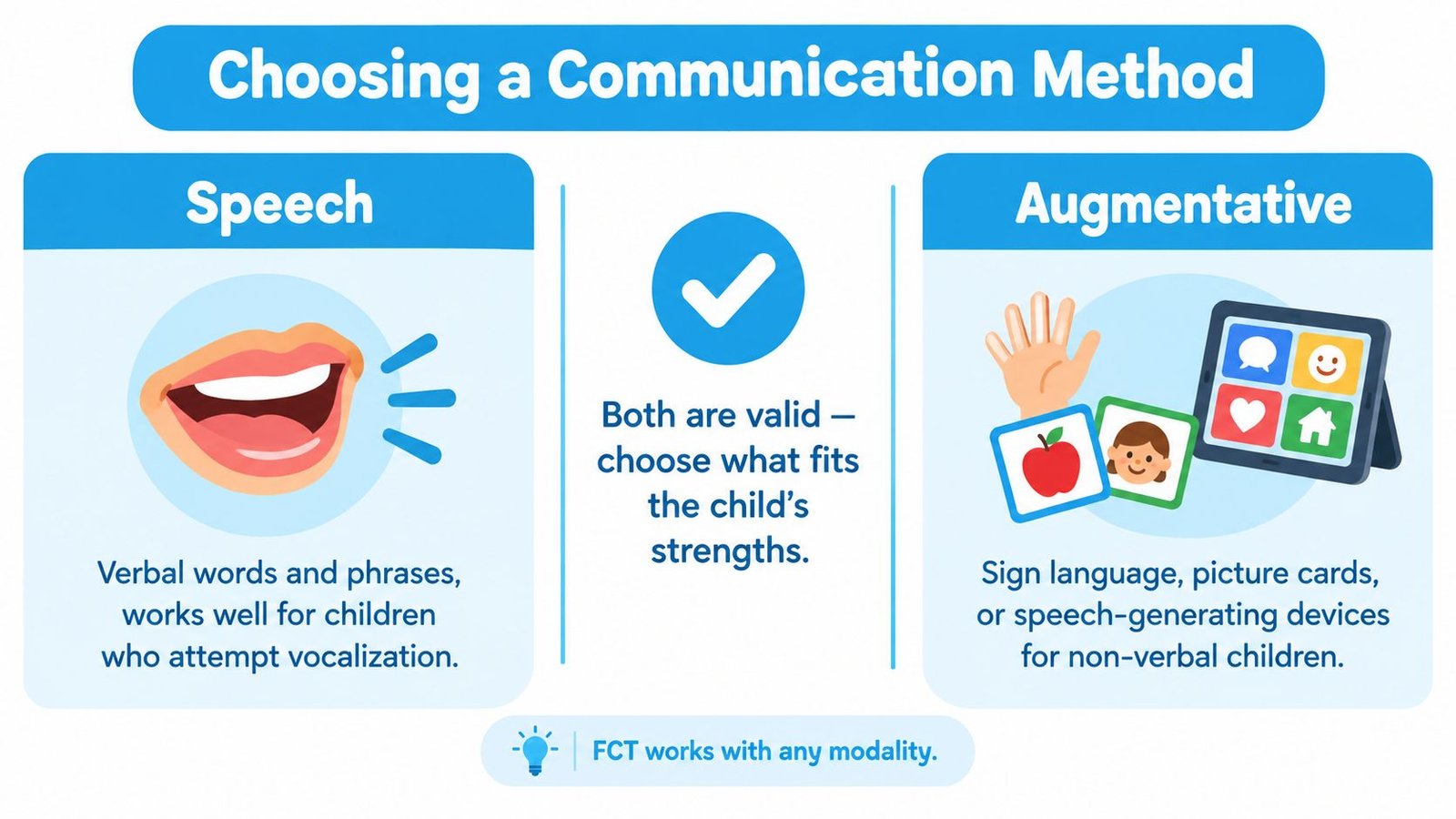
Your child doesn't have to speak to participate in FCT. The response might be speech, a sign, a gesture, a picture exchange, or augmentative and alternative communication, known as AAC. The practical question is which response your child can use and their communication partners can recognize.
The visual below compares communication options, though children don't have to stay in a single category.
Choose for access, not appearance
- Speech or signs: Consider whether the child can produce the response reliably and whether partners understand it.
- Gestures or pictures: Check that the signal is recognizable and the materials remain within reach. This guide to a PECS communication book offers context for families exploring picture-based communication.
- AAC: Consider motor access, sensory preferences, device availability, and how easily the child can reach the message.
Judge the response by effectiveness, independence, accessibility, dignity, and use across settings. Don't count only spoken requests or interpret non-speaking communication as lack of understanding.
For a multilingual family, discuss which words and signals make sense with each communication partner. A review addressing AAC integration and limitations in the FCT literature highlights fragmented AAC integration and demographic reporting concerns, including male overrepresentation and insufficient culturally responsive reporting.
The following video can be a discussion prompt with your child's team.
In your log, note the mode used, prompting, refusals, communication breakdowns, and whether the partner responded. Keep spontaneous gestures visible alongside device use.
If you're also seeking support for parent-child interactions, you can browse parent-child therapy options from Wald Behavioral Health and discuss their fit with your clinician. That's a separate conversation from selecting an FCT response.
Why Early Gains Can Stall and What Schedule Thinning Does
An illustrative home problem is easy to recognize: your child learns to request an activity, and you respond immediately during practice. Later, you're cooking or helping another child, and immediate access isn't possible.
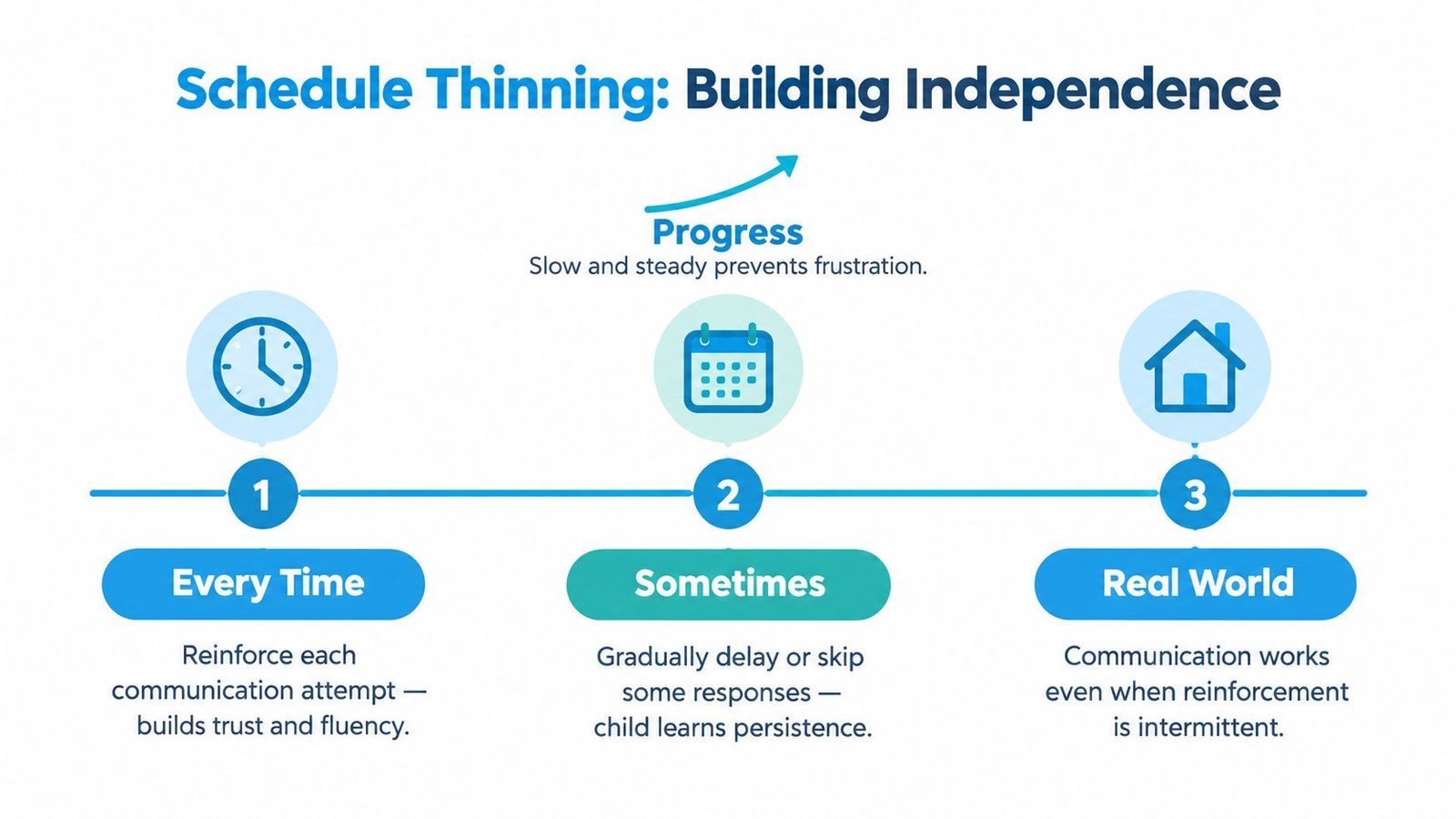
Schedule thinning is the planned transition from frequent, immediate reinforcement toward a schedule the family can sustain. A practical review of FCT implementation explains the role of initial dense reinforcement, prompting, and carefully programmed changes, including signaled delays and alternative activities.
The infographic shows the broad progression, not a schedule to follow independently.
A plan, not random refusals
“Sometimes” shouldn't mean adults unpredictably ignore requests. Ask the clinician what signal indicates availability, what the child can do while waiting, and what data would show that the change is too demanding.
A systematic review of schedule thinning identified 82 articles, 296 participants, and 401 applications published from 1985 through 2022, with nine distinct procedures. There isn't one universal waiting plan.
Many FCT protocols also use extinction, meaning the consequence that maintained challenging behavior no longer follows that behavior. An analysis of FCT treatment applications describes its role and additional procedures that can support treatment during thinning.
Safety comes first: Extinction can produce temporary escalation. It requires qualified clinical planning, not a parent deciding to ignore distress or withhold needed care.
Log request latency, meaning how long the child takes to request after an opportunity; waiting duration, meaning the time from request to outcome; and behavior intensity. Keep the protocol-change date visible.
Date- and setting-based summaries can help the team compare phases. If requests become less independent or unsafe behavior increases, contact the clinician rather than pushing through the next step.
Turning Home Observations Into Data a Team Can Use
A home logbook becomes a clinical instrument when it captures the relationship the clinician is trying to evaluate. Knowing that behavior happens in the kitchen is useful context. Knowing that a break request was prompted there but didn't produce a break is much more actionable.
In a randomized trial involving 38 young autistic children aged 21–84 months, parent-implemented FCT delivered through telehealth produced a mean 98% reduction in problem behavior over 12 weeks, compared with limited improvement under treatment as usual, as reported in the ASHA evidence summary of the trial. That finding supports coached parent implementation; it doesn't establish that logging alone causes improvement.
Map the plan to the record
| Clinical decision | What the caregiver captures |
|---|---|
| Hypothesized function | Purpose field, antecedent, and actual consequence |
| Replacement response | Communication mode and message in the behavior entry or notes |
| Prompting | What help was given and whether the response was independent |
| Reinforcement schedule | Delay, availability signal, and outcome in notes |
| Safety and progress | Frequency, intensity, duration, and people present |
Keep functional requests separate from challenging-behavior counts. A reduction in behavior and an increase in independent communication are related goals, but they aren't interchangeable measurements.
Time and location tell the team where to look. The response and consequence tell them whether communication is working.
Use this guide to ABA data collection training to discuss consistent definitions with caregivers. If you use voice logging, review the captured entries and add missing prompt or consequence details before saving.
For the next IEP, 504 review, or specialist visit, choose the relevant date range and event types, then generate an exportable Smart Summary. Include protocol-change dates and representative notes alongside the summary so the clinician can interpret the pattern rather than only the totals.
What FCT Can and Cannot Do and How to Start This Week
FCT can teach a meaningful alternative to behavior that serves a communicative function. It isn't a cure, a promise of spoken language, or a substitute for investigating discomfort and other support needs.
The research is encouraging but needs careful interpretation. A meta-analysis of young autistic children synthesized 34 single-case studies involving 79 children aged 2–8 years and reported Tau-BC effects of 0.97 for reducing challenging behavior and 0.78 for increasing replacement behavior. These are effect-size measures, not percentages of children who improved.
Transfer beyond treatment deserves explicit planning. A systematic quality review of maintenance and generalization identified 37 studies, but only six met all its standards for both. A request demonstrated with a therapist shouldn't be assumed to work with a grandparent or teacher.
A safe start this week
- Choose one target behavior: Ask the team for an observable definition, especially if several caregivers will record it.
- Log for seven days: Capture antecedent, behavior, and consequence without deliberately provoking episodes or changing the treatment plan.
- Share the record: Ask what function the clinician is hypothesizing and what evidence might challenge that explanation.
- Request clear coaching: Look for assessment, communication-access planning, demonstrations, prompt guidance, safety procedures, and criteria for changing the schedule.
- Plan for other partners: Ask how the skill will be checked with different caregivers and in relevant settings.
The observation week is a starting routine, not a clinically established assessment duration. Your clinician may need a different observation period.
Contact the team promptly if self-injury increases, new behaviors emerge, or aggression risks harm. Follow the child's safety plan and seek urgent help when there's immediate danger.
You don't need a perfect spreadsheet. You need a consistent record that helps the team decide what to teach, what to change, and what your child is communicating.
Guiding Growth offers structured behavior logs, shared caregiver records, and exportable meeting summaries to keep FCT observations together between sessions. Visit Guiding Growth to start recording the behavior, communication attempts, and outcomes you want to discuss with your child's qualified care team.