You say five more minutes, then dinner. Your child nods, or seems to. When you take the iPad, he's on the floor screaming, and you're wondering what you did wrong. You didn't lie about the time. He just couldn't see it passing, so the end arrived like a theft. That's the problem timers for autism are meant to solve, and most guides stop at telling you which one to buy. Don't start there.
Table of Contents
- Why Timers Change the Hard Transitions
- The Four Timer Formats and What Each One Does
- A Step by Step Transition Protocol
- Matching the Timer to Your Child
- Building Consistency Across Caregivers and Settings
- When Timers Backfire and How to Tell
- Putting It All Together
Why Timers Change the Hard Transitions
That iPad scene isn't defiance. For many autistic children, an invisible interval is hard to track, so "soon" carries no useful information. A 2019 systematic review of time perception in autism reported that, among children, 11 studies found reduced time sensitivity, 3 reported mixed results, and 3 found no group differences. In experiments using intervals from 4 to 20 seconds, autistic participants showed poorer accuracy and consistency than comparison participants, and consistency was associated with working memory.
Read that carefully. The evidence doesn't say every autistic child can't judge time. It says results vary by age, task, and individual, which is exactly why you test a timer with your child instead of assuming it'll work.
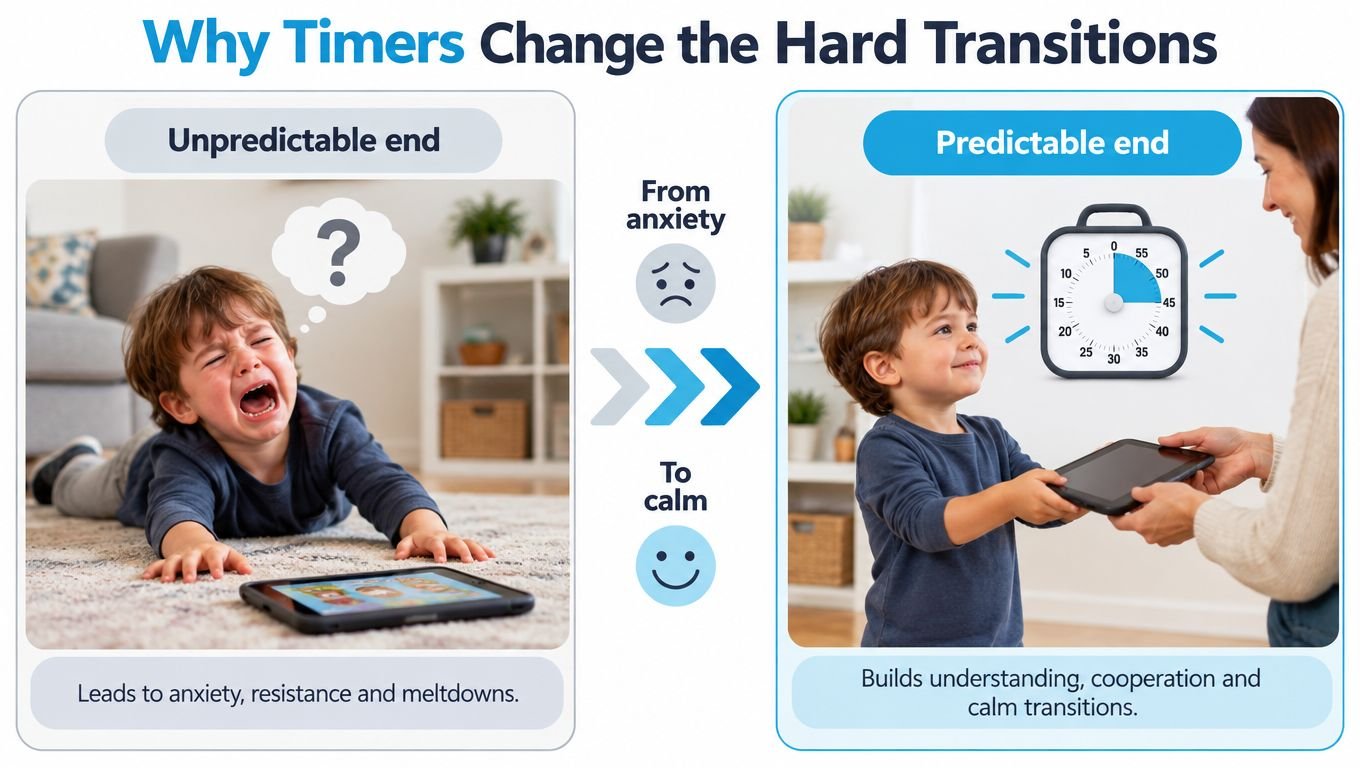
What Changes When Time Becomes Visible
An NHS clinical resource on visual supports for autistic children puts the mechanic plainly. A visual timer lets a child see how much time remains before moving to the next activity, and pairing visual information with verbal information supports structure, predictability, and independence. Your child stops relying on your voice as the only warning and can watch the end approach himself.
| Without a Timer | With a Timer |
|---|---|
| "Soon" means nothing concrete | Remaining time is visible |
| Parent announces a surprise ending | Child watches the ending approach |
| Argument is with the parent | Timer, not parent, signals the end |
My rule: If the timer isn't paired with a visible next step, you've bought a countdown to an unknown. That rarely calms anyone.
Our companion guide on autism and time management strategies for daily routines covers the broader scheduling picture. Here, keep one question in mind. Not which timer is best, but which cue helps your child predict what happens next.
The Four Timer Formats and What Each One Does
Stop shopping for the best timer. Build a small toolkit instead, because different formats do different jobs.
Visual Countdowns and Auditory Cues
Visual countdown devices, like disappearing-disk timers, answer one question well. How much is left? A case study of two autistic boys aged 5 and 7 found that when a visual timer was introduced, the child engaged in activities more frequently while looking at the timer, with less time between activities. That's two children, not proof for yours. Treat it as a reason to trial, then measure.
Auditory and music timers suit longer intervals and waiting. A small report described a music timer tested for 3 weeks with three children aged 8, 11, and 12, using intervals of 10 to 30 minutes, where familiar songs paired with visual feedback helped children monitor time and anticipate completion. Three siblings can't establish a population-wide effect. The design principle still holds. Pair a concrete visual with a consistent, meaningful sound.
Apps and Paper Countdowns
App-based timers win on portability. They travel to restaurants, therapy waiting rooms, and grandma's house, and settings stay consistent. The risk is that the phone itself becomes the distraction, or the alarm is too harsh.
Paper countdowns are my default for low-sensory needs. A Northern Ireland guide describes a five-step countdown placing numbers 5 down to 1 and removing them gradually until the activity is finished. No ticking, no flashing, no beep. Teachers setting up similar classroom routines can browse teaching timer options to see what formats schools use.
| Timer Format | Best For | Watch Out For |
|---|---|---|
| Visual countdown | Short transitions, task endings | Fixation on the shrinking display |
| Music timer | Waiting, longer intervals | Song preference changing over time |
| App-based | Outings, multiple settings | Phone becoming a reward itself |
| Paper 5-to-1 strip | Low-sensory spaces, classrooms | Adult must remove numbers reliably |
Watch the sensory load in every format. Flashing displays, ticking, and sudden alarms can overload a child faster than the transition would have.
A Step by Step Transition Protocol
A timer alone changes very little. A timer inside a predictable sequence changes behavior. A single-case home study of a 7-year-old autistic child found problem behavior in 85% of interruption test trials versus 0% of control trials, and a 2-minute warning plus timer reduced problem behavior and increased compliance. One child, one home. Useful as a protocol, useless as a promise.
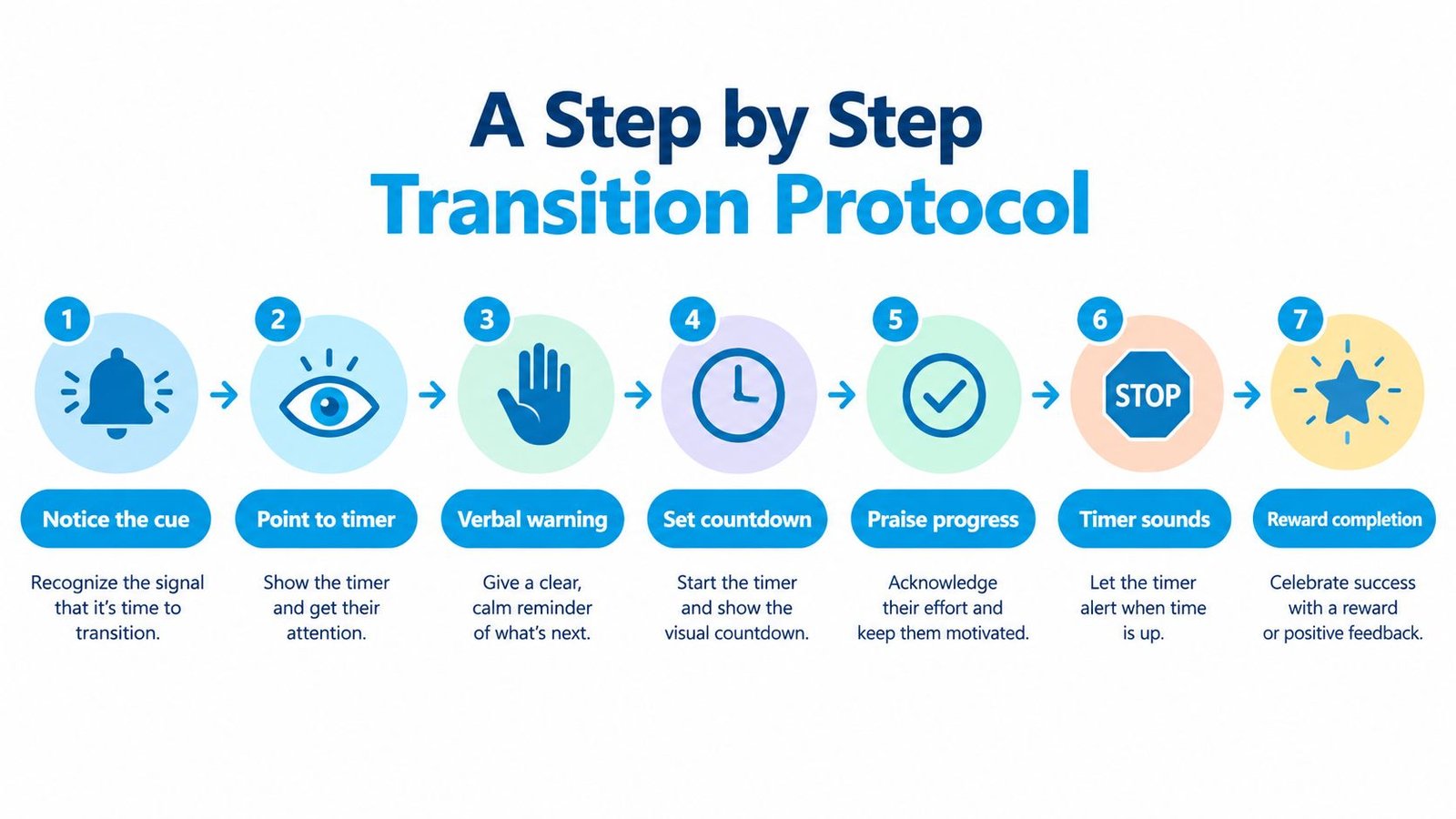
The Seven Steps
- Check the trigger: Is the conflict about interrupting a preferred activity?
- Warn early: Give an advance warning about 2 minutes before the transition.
- Show what's next: Make the upcoming activity visible, not just spoken.
- Start the countdown: Use the format your child tolerates best.
- State the rule: When the timer ends, say what happens, once.
- Reinforce immediately: Deliver descriptive praise or the agreed reinforcer for starting.
- Prompt consistently: If he doesn't move, prompt the same way every time.
Minnesota autism guidance gives the same pairing in plain words, such as "in five minutes we will line up to go to lunch" or "in two minutes we will clean up the blocks". The countdown always names the next action. Pairing this with picture schedules for autistic children makes step three almost automatic.
Watch how a visual countdown is introduced in practice before you try it at home.
Here's the iPad script. "First five minutes of tablet, then dinner. Timer's on. When it's done, tablet goes on the counter and you pick your cup." Then log the trial. Warning length, prompts needed, whether he moved independently. Don't restore the iPad when he protests, or you've just reinforced refusing.
Matching the Timer to Your Child
At 6:10 p.m., tablet time ends, bath starts, and your son freezes because a glowing “5” tells him nothing about what happens after the last beep. A mixed-methods study of 113 parents of autistic children aged 7 to 12 found that visual aids were widely used yet effectiveness was mixed, and children often needed structured support to remember to use them. So I choose the cue like a coach choosing a play: define the transition, test one timer, log the result.
Four Variables That Matter
| Variable | What I ask first | Starter choice |
|---|---|---|
| Language level | Can he read numbers, or does he need the next activity shown? | Visual countdown plus picture |
| Sensory profile | Will a beep end the routine before it starts? | Silent strip or dimmed screen |
| The goal | Ending fun, waiting, sharing, or finishing work? | A different cue for each job |
| The setting | Kitchen quiet or clinic noise? | The format adults can repeat there |
A countdown answers “how much is left” only. Match the representation to the question your child is asking.
My defaults are opinionated: minimally verbal, start visual; waiting rooms, try music; school days, use the timer his team already models; sound-sensitive spaces, go paper. Then judge the trial in Guiding Growth by three outcomes: did he follow the cue, transition with less protest, start the next step alone. Shared records matter when tutors and aides enter the routine, the same way families look at how to manage tutoring students and parents to keep one plan visible. Keep the winner until the data says change.
Building Consistency Across Caregivers and Settings
A timer survives exactly as long as the weakest adult in the routine. Your child learns the rule from whoever enforces it least: if grandma grants four extra minutes on Thursday, the countdown becomes a suggestion by Friday, and every trial you ran on Monday stops meaning anything.
A caregiver-implemented visual-support review reported clinically significant changes for 97% of participants across outcomes including transitions, with maintenance or generalization for 78%. Those figures cover varied visual supports beyond timers alone, so treat them as direction rather than a guarantee. The direction is clear, though. Results come from adults running the same play in every setting.
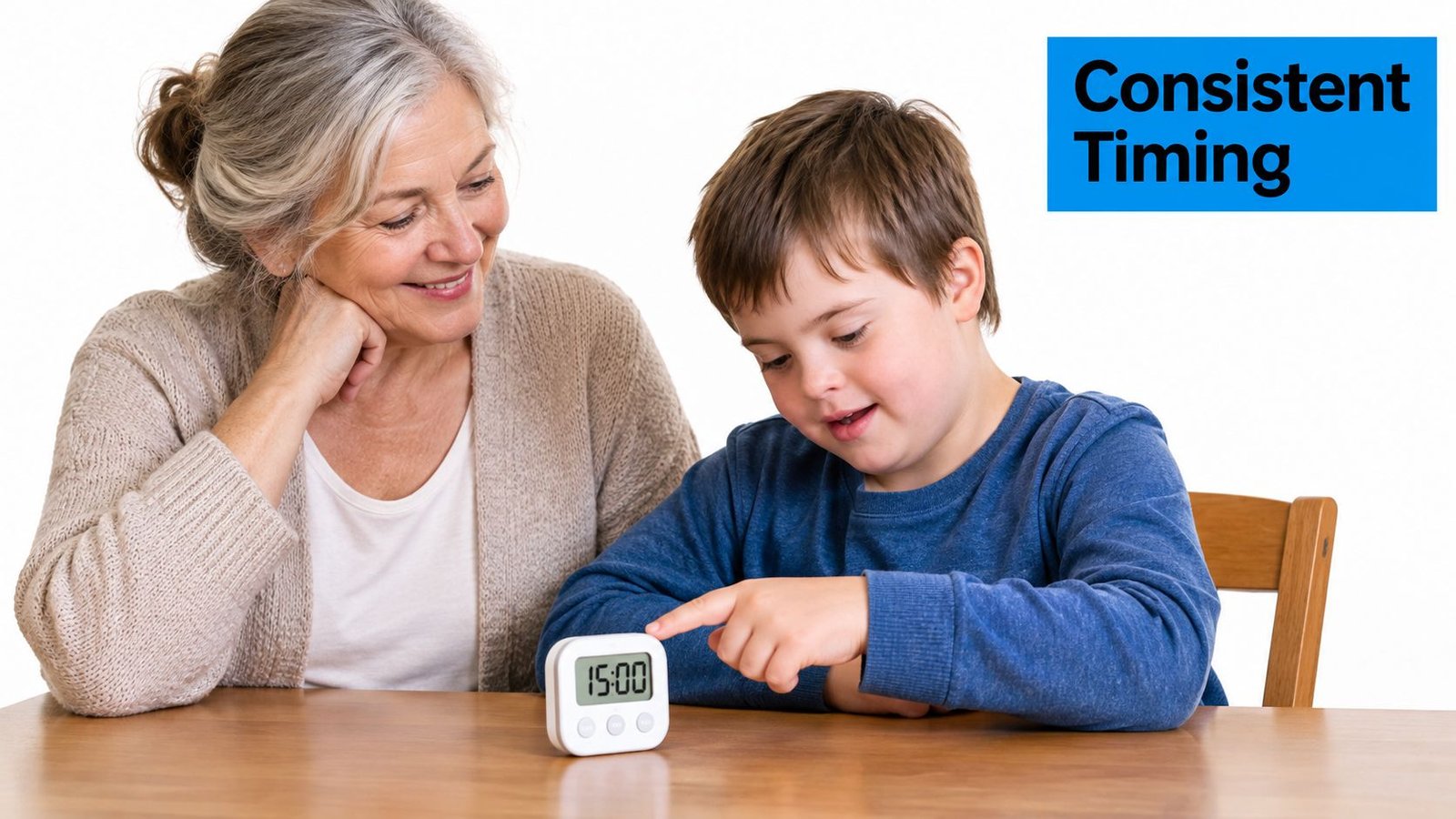
Give Every Adult the Same Script
Consistency fails on wording before it fails on anything else. Write the routine down in your child's exact hearing, then hand that script to everyone who runs it:
"Timer on. When the red is gone, the iPad goes on the shelf."
Two sentences. Same warning length, same end action, same words at home, at the clinic, and at grandma's house. Once every adult matches, teach your child to check the timer himself and fade your pointing prompt. A child who checks the cue owns the transition. An adult who narrates it owns the problem.
Guiding Growth is where I keep that shared record. Families can invite co-parents, grandparents, and caregivers as collaborators, log each transition with context and outcome, and read the analytics dashboard for patterns by person, time of day, and routine instead of arguing from memory. That shared log is the practical backbone behind how consistency improves outcomes for autistic children.
Run a one-week audit before you change anything. Pick one transition, say iPad to dinner, and have both parents and grandma log warning length, prompts used, and how clean the switch was. The records will show whose trials go smoothly and what that person does differently. Copy it verbatim. When independence improves, fade the adult prompt first and leave the timer in place.
When Timers Backfire and How to Tell
A boy I coached could handle a ten-minute cleanup timer at school and fell apart the moment one appeared at home. The timer was identical. The routine around it was not.
That matches what a component analysis with two autistic children found: visual schedules alone were ineffective for preferred to nonpreferred transitions, while adding extinction and differential reinforcement reduced problem behavior by 69% for one participant and 83% for the other. The reinforcement plan around the visual did the work. When a timer fails, assume the surrounding protocol is failing first.
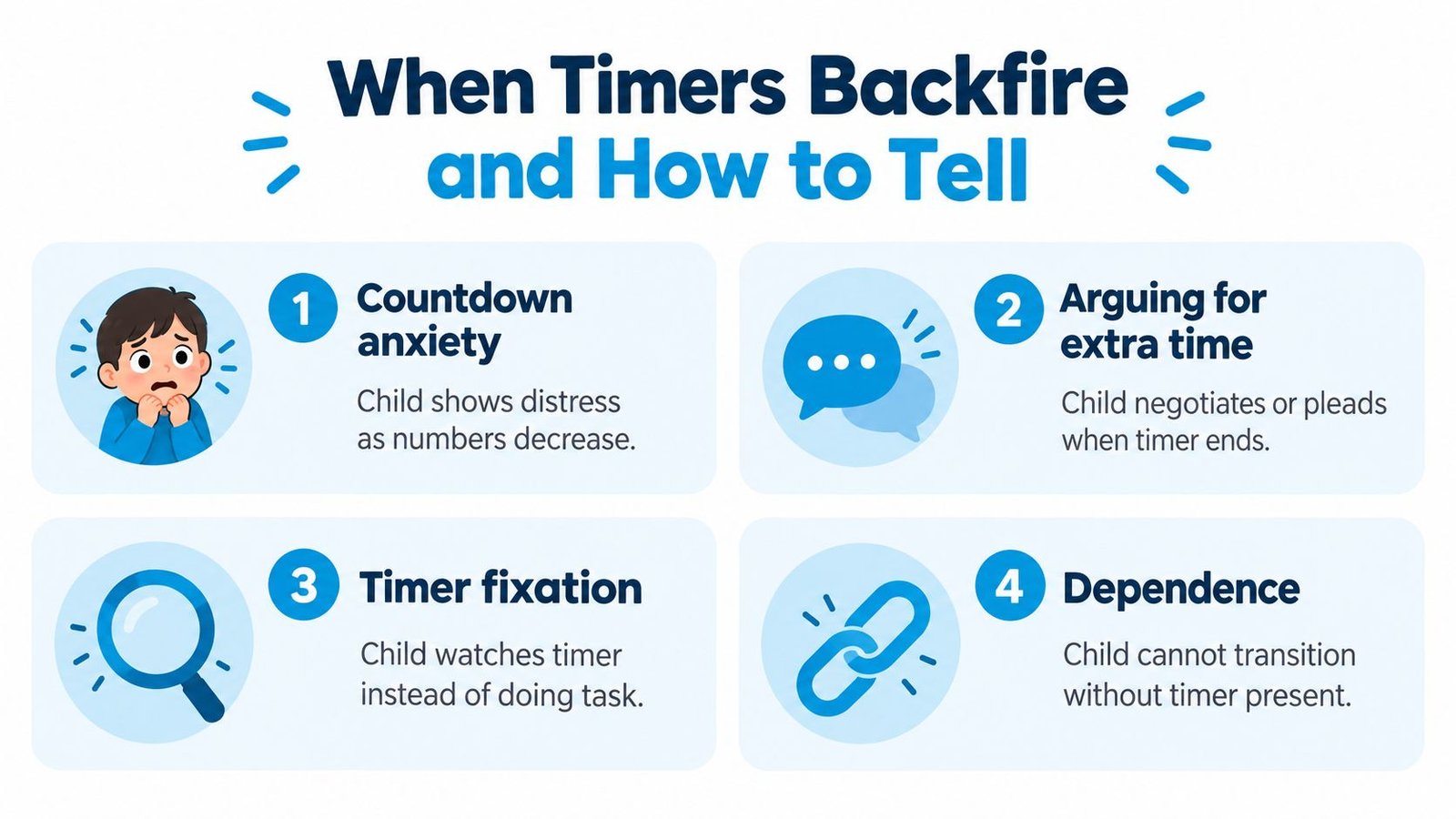
The backfire shows up four ways in a log. Distress climbs as the countdown shrinks instead of easing. Every ending turns into a negotiation for extra minutes. He watches the timer and stops doing the actual task. Or transitions collapse whenever the timer is absent, which means the tool replaced the skill it was supposed to teach.
Record the failures, not just the wins. A parent who only logs smooth transitions will keep a tool that is making things worse. Tag each trial in Guiding Growth with distress, negotiation, and fixation, then compare proportions across a week of trials instead of trusting impressions. Bring in a qualified clinician before running any procedure that blocks a child from regaining a preferred activity after problem behavior.
Match the fix to the pattern your log shows. Countdown anxiety usually responds to a longer interval or a silent, low-sensory format. Dependence calls for gradual fading toward a clock cue. Some routines do better with no timer at all. The same low-pressure logic applies after the transition lands at the dinner table, where getting children to eat better tends to beat pressure once a child is already dysregulated.
A timer is an intervention. Interventions need data.
Putting It All Together
Run this checklist and stop guessing.
- Pick one goal: One transition, not the whole day.
- Pick one format: Matched to language, sensory profile, and setting.
- Run the protocol: Warning, visible next step, countdown, rule, reinforcement, consistent prompt.
- Log every trial: Warning length, prompts, outcome, and any distress or negotiation.
- Review weekly: Keep what the data supports, change what it doesn't.
The insight I'd leave you with is simple. The timer is the smallest part of this. What lowers anxiety over time is a family system where the same cue, same words, and same next step show up predictably, and where you can prove which version works because you wrote it down. Bring that record to therapy sessions and school meetings and you're no longer retelling the week from memory. You're showing patterns. That's when a cheap countdown becomes a tool your whole team can build on.
Log each timed transition in Guiding Growth with the warning length, cue type, prompts, and outcome, then review the patterns with your co-parents, therapists, and teachers using data instead of memory. Download the app, set up your first transition routine today, and find out within a week which timer works for your child.