The most popular advice about sensory diets for autism starts with a shopping list: buy a swing, add a weighted item, schedule movement breaks. That's the wrong starting point. Start with a daily activity your child finds difficult, then test whether a carefully chosen sensory support makes that activity more comfortable or accessible.
A child sitting may not necessarily be feeling better. A useful plan should help them participate, communicate, or manage a routine with less distress, while preserving their ability to refuse the activity.
Table of Contents
- Sensory Activities Matched to Each Need
- How to Assess Whether a Sensory Diet Fits
- Tracking Responses to Know What Works
- Build the Sensory Schedule Into Real Routines
- Limits, Feeding Links and When to Get Help
- Run a Two-Week Sensory Trial
Sensory Activities Matched to Each Need
| Sensory need | Signs to notice | Example activity | When to use it |
|---|---|---|---|
| Seeking movement (proprioception) | Crashes into furniture, pushes or carries heavy objects | Wall push-ups, carrying a loaded backpack | Before seated work or homework |
| Vestibular seeking | Constant spinning or rocking, seeks big movement | Supervised swinging or rocking chair | Before circle time or after school |
| Tactile sensitivity | Rejects clothing tags, avoids messy play | Brushing protocol under OT guidance, textured tools | Before dressing or grooming |
| Auditory overload | Covers ears, distress in noisy places | Noise-reducing headphones, quiet corner | Before busy or noisy events |
| Visual input | Squinting, avoids bright lights | Dimmed lighting, tinted lenses only with clinician input | Before visually busy settings |
| Oral seeking | Chews clothing, mouths objects | Chewy tube, crunchy snack | During homework or long seated tasks |
A sensory diet is a personalized schedule of sensory activities or environmental adaptations, not a proven autism treatment. Each activity in this table is a candidate to discuss with an occupational therapist, not a prescription to copy.
The strongest directly relevant evidence concerns structured, therapist-delivered Ayres Sensory Integration, rather than loosely defined home schedules; a randomized occupational-therapy trial found improvements in individualized goals and caregiver assistance. Don't assume that adding the same equipment at home reproduces that intervention.
Match the input without forcing it
Proprioception concerns body position and effort through muscles and joints. Wall push-ups offer a straightforward movement option, but a loaded backpack needs therapist guidance on load, fit, and suitability. More resistance isn't automatically better, and carrying weight shouldn't become a requirement for accessing schoolwork.
Vestibular input involves movement and balance. Offer supervised rocking or swinging with an easy way to stop. Don't interpret constant spinning as a reason to prescribe more spinning, especially if movement leaves your child distressed, unsteady, or unable to join the next activity.
For tactile sensitivity, change the irritating clothing first. Remove tags, offer preferred fabrics, and let your child control contact with textured materials. A brushing protocol requires specific OT assessment and training; it isn't a general-purpose home calming technique.
Reduce input when adding more isn't useful
Headphones and a quiet corner address auditory overload by reducing exposure. Introduce them before entering a noisy setting, and make sure your child can still receive essential communication and safety instructions.
For visual discomfort, begin with manageable environmental changes, such as reducing glare or clearing a cluttered workspace. Persistent squinting deserves clinical attention rather than an assumption that it's purely sensory. Use tinted lenses only with clinician input.
For oral seeking, select an age-appropriate chewing tool with professional advice, inspect it for damage, and supervise its use. Crunchy food must fit the child's feeding and swallowing plan, not just their preference for chewing.
Practical rule: Offer a sensory activity as a choice, not as something a child must endure to earn the next activity.
A small collection of sensory box ideas can make suitable options accessible without filling the house with equipment. The same child may choose different inputs on different days. Pick one need and one routine first, because a focused trial is easier to interpret.
How to Assess Whether a Sensory Diet Fits
Treat a sensory diet as a hypothesis tied to one functional goal: if this input is given at this time, a specific routine should get easier. Sensory-processing difficulties are reported more often in autistic children than in typically developing peers, and estimates shift with the population and assessment method. Common still does not mean universal, and a common difficulty still needs a local explanation in your child's day.
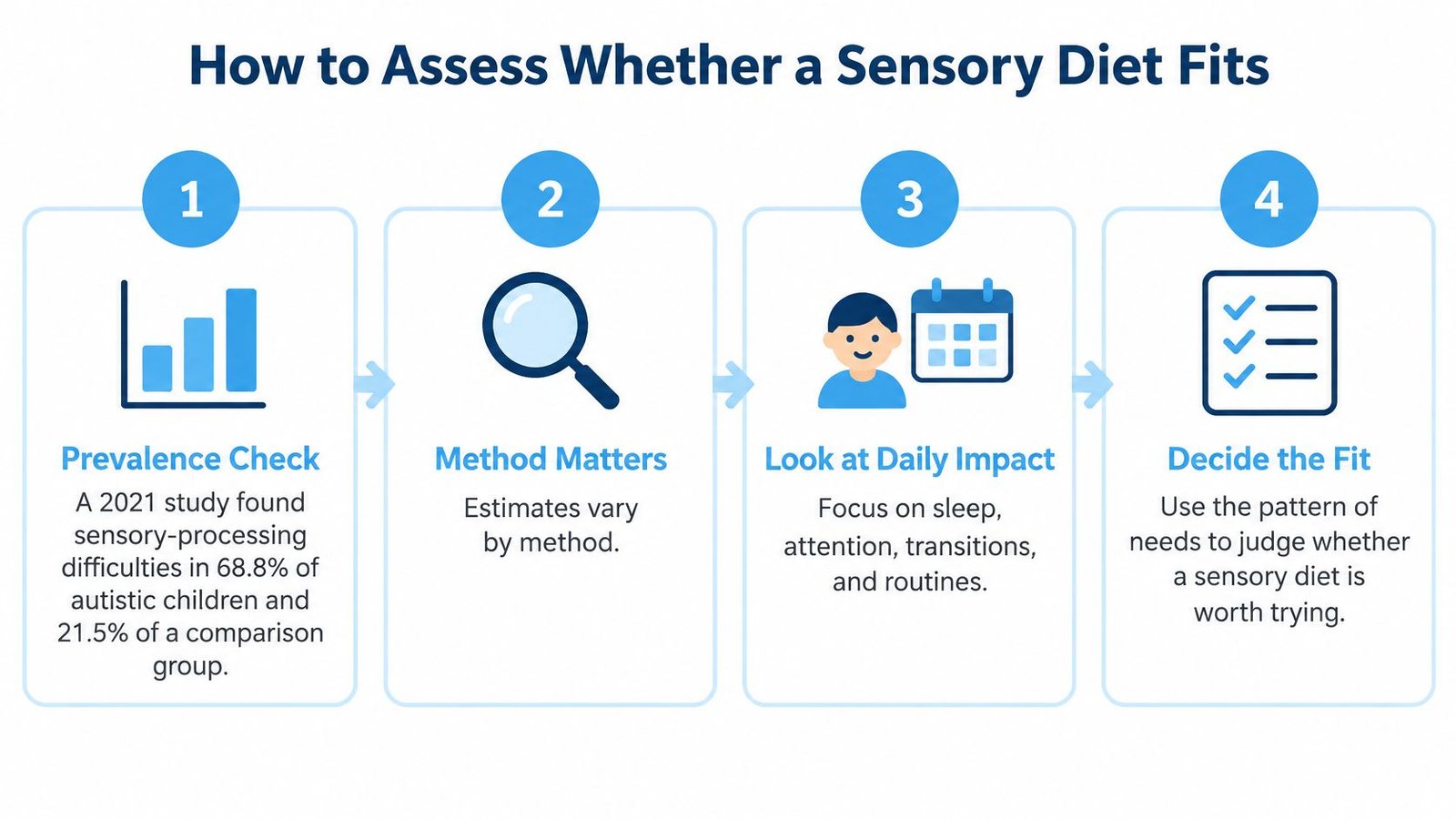
Build an assessment around daily life
Write three concrete examples. Describe where the difficulty happened, when it occurred, and what immediately preceded it. Instead of “hates getting dressed,” record that your child pulled away when a sleeve touched their wrist, accepted a different shirt, and then dressed with help. Include what they communicated through speech, gestures, movement, or withdrawal.
Confirm documented occupational-therapy assessment. Professional guidance advises against sensory-based interventions without assessment findings identifying sensory-processing or integration difficulties. Ask the therapist to explain how the proposed input relates to the observed difficulty: what channel it targets, why the timing matters, and what change should appear in the routine.
Choose one functional target and its measures. A target might be completing toothbrushing with an agreed level of support or moving from play to the doorway without leaving the transition area. Decide whether you will measure time, prompts, task completion, or distress before collecting baseline observations. Your child's sensory profile can help organize observations, but it doesn't replace clinical assessment.
Record a baseline over several days. Observe the routine before adding the proposed strategy. Use the same definitions each time: what counts as a prompt, when timing begins, and what counts as completing the task. Do not withdraw existing necessary accommodations to create a cleaner baseline, because the result will not reflect real life.
Agree on an input, dose, and stop rule. Ask the OT to specify the activity, duration or repetitions, intensity, timing, supervision, and review point. Write down how your child can decline and what signs require stopping, such as rising distress, increased seeking, fatigue, or avoidance that continues after the input ends. If the assessment is only booked, gather observations while waiting rather than beginning a specialized protocol.
Check whether the plan is ready
A sensory explanation should fit the details, not only the behavior's appearance. Leaving a table could reflect uncomfortable noise, an unclear instruction, pain, or a task that is too difficult.
- A recognizable pattern exists. Similar demands produce similar difficulties across settings, or there is a clear explanation for why the problem occurs in one setting.
- The target matters to the child. It improves access, comfort, independence, or communication, not just outward compliance.
- A comparison is possible. You have a usable baseline and a practical way to record the same measures during the trial.
If those pieces are missing, refine the question before buying equipment or expanding the schedule.
Tracking Responses to Know What Works
A calm moment proves very little by itself. Sleep, pain, hunger, communication demands, medication, and changes in adult responses can all affect what happens during a routine.
Research specifically on sensory diets is sparse, with inconsistent activities, doses, and outcome measures, as explained in the Association for Science in Autism Treatment's sensory-diet analysis. A practical A-B comparison means recording the existing routine first, then introducing the selected strategy while keeping other conditions as consistent as reasonably possible.
Decide what improvement would look like
The thresholds below are planning examples to agree with the care team, not validated cutoffs or promises of benefit.
| Metric | What to record | Example threshold |
|---|---|---|
| Transition latency | Seconds from first prompt to leaving the area | 30% reduction from baseline median |
| Adult prompts | Number of prompts needed per routine | One fewer prompt per routine |
| Distress or avoidance | Count and context of each adverse response | Any sustained increase means stop or modify |
| Independent task completion | Tasks finished alone out of total attempted | Sustained gain across two weeks |
| Fatigue or increased seeking | Time of day, duration, what came before | Track the trend; no fixed threshold |
Define each measure precisely. For a transition, leaving the area should mean moving toward the agreed destination, not running away from it. Record whether an adult repeated a verbal instruction, pointed, modeled the action, or physically assisted.
Compare the median, or middle observation, for timing and prompt counts rather than selecting the best day. Keep a note of whether the activity was delivered as planned. An apparent failure after a missed activity isn't the same as a failure despite consistent delivery.
Track participation without policing stimming
A 2025 occupational-therapy evidence review found support for Ayres Sensory Integration in individualized occupational-performance goals but no demonstrated benefit for irritability or resistance to change. That distinction matters: looking quieter isn't an adequate outcome.
Our Guiding Growth Behavior Tracking keeps logs of echolalia, hand flapping, and other stimming behaviors with their triggers and outcomes. Parents can also record meltdowns, shutdowns, demand avoidance, and other challenging behaviors, including intensity, duration, and location. Record harmless stimming as context when useful, not as something that automatically needs reducing.
Better participation with visible movement can be a better outcome than stillness with withdrawal.
Log distress, avoidance, dysregulation, fatigue, or increased seeking alongside successful task completion. Stop immediately for pain or an unsafe response; don't wait for a trend. A single successful episode is encouraging, but it doesn't establish that the sensory input caused the improvement.
Build the Sensory Schedule Into Real Routines
Attach the selected input to an existing routine rather than creating an additional program to manage. The American Occupational Therapy Association's sensory-processing guidance places assessment and individualized intervention at the center of sensory support.
A visible routine can help adults present the same sequence without repeated verbal prompting.
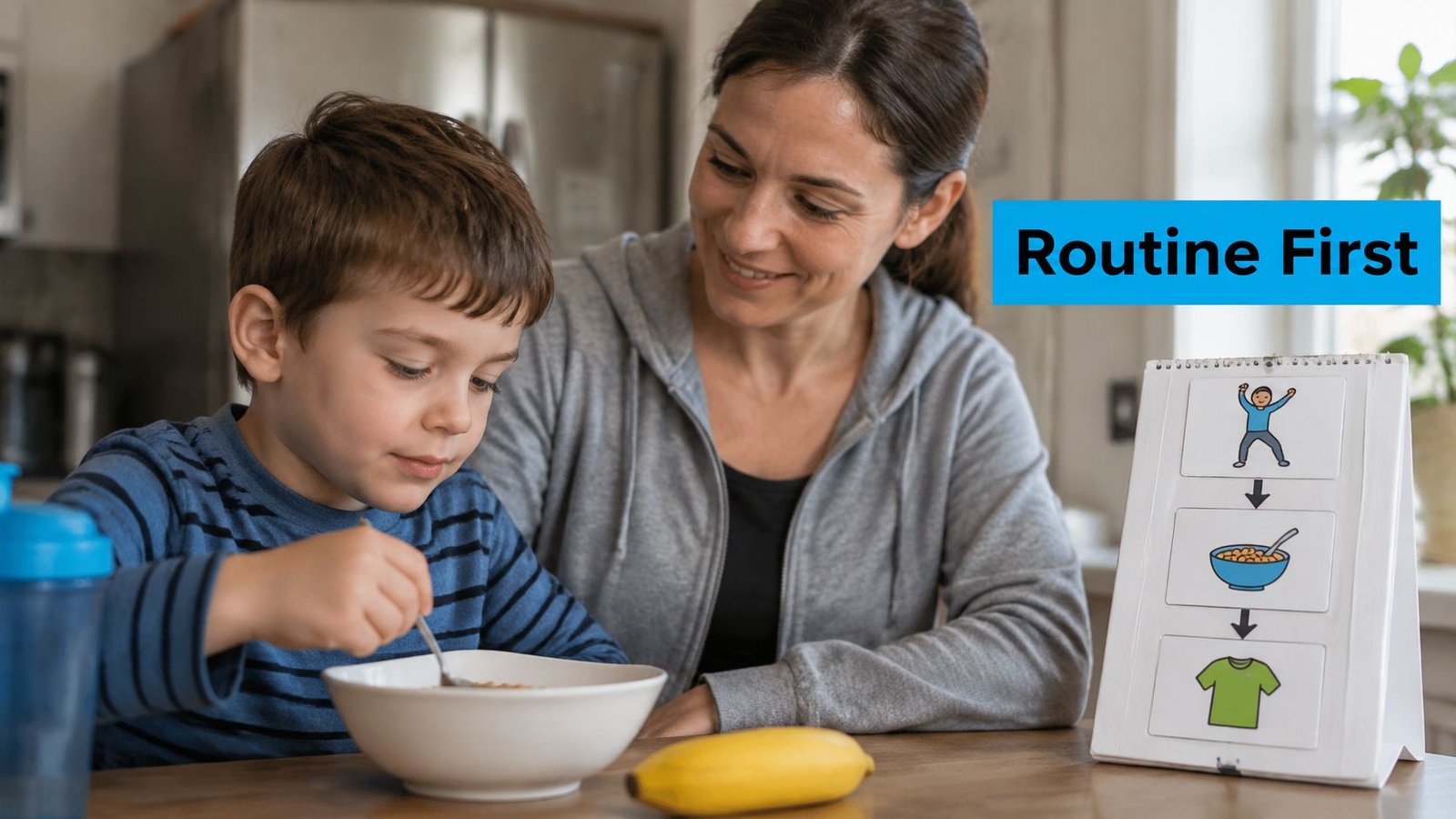
Use a sample day as a planning template
The timings below form a hypothetical schedule, not recommended therapeutic doses. Introduce only the input selected for the trial; don't start the whole day at once. Joint compression, weighted equipment, and deep pressure require individual professional guidance and the child's assent.
| Routine | Sensory need | Input | Timing |
|---|---|---|---|
| Morning dressing | Tactile sensitivity | Light joint compression, soft preferred clothing | 5 minutes before dressing |
| Breakfast | Oral seeking or food selectivity | Chewy or crunchy food offered as an option | During the meal, per feeding plan |
| School drop-off | Auditory overload | Headphones and quiet entry | 10 minutes before arrival |
| Homework | Seeking movement | Weighted lap pad, wall push-ups | 5 to 10 minutes before seated work |
| After-school transition | Vestibular seeking | Supervised swinging or rocking | About 10 minutes after school |
| Bedtime wind-down | Arousal or tactile overload | Dim lights, deep pressure if tolerated | 30 minutes before lights out |
Use picture schedules for autism to show where an optional support belongs. Don't turn the picture into a demand to complete an unwanted activity.
Give each adult a usable handoff
Write an instruction for each participating adult that names the routine, timing, therapist-set intensity, and stop rule.
- Parent at dressing: Offer preferred clothing; use joint compression only if specifically taught and prescribed. Stop for pulling away, guarding, pain, or refusal.
- Breakfast caregiver: Offer the feeding-plan option without pressure to taste. Record accepted and refused foods, texture, and whether input occurred before or during eating.
- Drop-off adult and teacher: Offer headphones before arrival and use the agreed quiet entrance. Check fit and stop if they cause discomfort or interfere with safety.
- Homework caregiver: Follow the OT's written movement dose and lap-pad instructions. The child must remain able to remove equipment and move freely.
- After-school adult: Offer the agreed supervised movement intensity. Stop for dizziness, distress, or a request to finish.
- Bedtime caregiver: Reduce lighting; offer only approved, tolerated pressure. Never restrain the child or continue after refusal.
For another visual reference, this video can support discussion with the adults implementing the routine.
Our Diet and Nutrition feature records eating habits and helps identify sensitivities or preferences that may affect well-being and daily routines. Keep meal observations beside routine notes so the next caregiver can understand what was offered and what happened.
If an input helps at home but overwhelms your child at school, don't insist on identical delivery. Record the difference in noise, space, demands, and timing, then ask the therapist to adapt the plan.
Limits, Feeding Links and When to Get Help
Association is not proof of cause. Systematic reviews have found a consistent association between sensory processing and eating in autistic children, but most of the included studies were cross-sectional, which limits conclusions about cause.
That evidence does not establish that gluten-free, casein-free, ketogenic, or other restrictive diets improve core autistic traits. A sensory diet is not a food-elimination diet, and the shared word should not blur that distinction.
Look beyond texture alone
Food selectivity can involve sensory preferences alongside medical discomfort, oral-motor difficulty, anxiety, or learned responses to meals. A child rejecting crunchy food might dislike its sound, struggle to chew it, anticipate pain, or have several overlapping reasons at once.
Record useful details without turning meals into repeated tests: foods accepted, preparation, texture, temperature, smell, and any signs of discomfort. Protect access to accepted foods while the feeding team evaluates concerns. If a pattern in the log tempts you to cut a whole food group, bring that pattern to a clinician and dietitian first.
For families also exploring attention or activity-level concerns, Vancouver Counselling Clinic's ADHD guide offers a separate starting point for that conversation. Restlessness alone should not be treated as confirmation of a sensory need or another diagnosis.
Know when observation isn't enough
A sensory trial is a hypothesis, and some findings end the experiment rather than refine it. Seek clinical assessment instead of adding another activity when you notice:
- Weight loss or poor growth: Bring the eating record and information about changes in food variety or intake.
- Choking or gagging during meals: Request a feeding and swallowing assessment. Active choking or breathing difficulty requires emergency help.
- Pain or physical discomfort: Describe when it occurs and whether it relates to eating, movement, toileting, or touch.
- Persistent sleep problems: Discuss the sleep pattern and associated symptoms with the child's medical team.
- Self-injury or safety concerns: A safety plan and prompt professional assessment take priority over continuing the trial.
Bring the trial log to the pediatrician or occupational therapist, including unsuccessful attempts and adverse responses. Two questions keep the review honest: What is the functional goal? What result would mean we stop? If the sensory hypothesis produces no movement toward that goal, report it plainly. A negative result is still a result.
A sensory explanation should never prevent a child from receiving assessment for pain, feeding difficulty, or another health concern.
Our meal records can preserve accepted foods, refusals, and suspected sensitivities for these conversations. They support clinical decision-making; they do not diagnose an allergy, intolerance, or feeding disorder.
The practical boundary stays simple: sensory support may improve participation, but it does not replace diagnosis, nutritional assessment, medical care, or an accessible environment. A sensory diet earns its place only while it moves one measured goal.
Run a Two-Week Sensory Trial
Start this week by putting the observation period and review date on a calendar. This two-week template is an organizational tool, not a validated treatment duration, and your therapist may recommend a different review period.
Keep the plan visible so everyone knows when to record observations and when to make a decision.

Put the trial on the calendar
Days 1 to 3, prepare and record the baseline. Confirm that the occupational-therapy assessment is completed or booked. Choose a functional target, identify the proposed input, and agree on measures and review criteria. If assessment or activity-specific safety guidance is still pending, continue observation rather than starting the intervention.
Days 4 to 13, introduce the approved input. Offer it at the agreed point in the same routine, using the written dose and prompting plan. Log transition latency, adult prompts, participation, and adverse responses. Mark missed sessions and unusual circumstances instead of filling gaps from memory.
Day 14, compare the records. Review the trial observations against the baseline and the thresholds agreed beforehand. Look for a repeatable improvement without increased distress, fatigue, or loss of choice. If observations are too inconsistent to interpret, call the result uncertain rather than successful.
Decide with the therapist. Choose whether to keep, change, or stop the input, then bring the record to the next therapy or medical appointment. Change a specific element deliberately rather than adding several activities at once.
Make the decision explicit
Keep the input when the child accepts it, the functional outcome improves meaningfully, and the effort required is sustainable. Continuing should still include a review date, especially when school demands or health conditions change.
Change the plan when there's a plausible implementation problem or the goal needs refining. A strategy that requires equipment unavailable at school may be impractical even if it seems useful at home.
Stop when the input causes adverse responses, the child declines it, or consistent delivery doesn't produce a worthwhile benefit. Don't increase intensity just because the first attempt didn't work.
Our all-in-one Guiding Growth mobile app helps autism parents track and improve behaviors, nutrition, health, and sleep. It also keeps medications, doctor appointments, and therapy sessions together, so the trial record can accompany the wider picture at each meeting.
A sensory diet is a test of a specific support in a specific situation. Stopping a failed test is a useful result, not a parenting failure.
Guiding Growth helps you keep sensory-trial observations alongside behavior, meals, sleep, and health records, then prepare a clear summary for your child's care team. Visit Guiding Growth to start recording a functional goal, establish your baseline, and bring better information to the next occupational-therapy appointment.