You're probably here because the same thing keeps happening. A pediatrician, BCBA, teacher, or therapist asks, “What did the last week look like?” and suddenly you're digging through texts, paper scraps, half-finished notes in your phone, and your own tired memory.
By the time you piece it together, the details that matter most are fuzzy. Was the hard day after poor sleep, a schedule change, a medication shift, or sensory overload at school? When notes live in five places, pattern spotting turns into guesswork.
A daily communication log for autism fixes that problem. Not by adding busywork, but by giving daily life one place to land.
Table of Contents
- Why a Daily Communication Log Is a Game Changer
- What to Track for Actionable Insights
- How to Create Your Daily Communication Log
- Making Your Log a Powerful Collaboration Tool
- Essential Tips for Consistent and Effective Logging
- From Data to Decisions Your Next Steps With Guiding Growth
Why a Daily Communication Log Is a Game Changer
The biggest benefit of a log isn't neatness. It's relief.
A parent walks into an appointment knowing the week isn't trapped in memory anymore. A teacher doesn't have to reconstruct the day from fragments. A therapist can look at what happened before, during, and after a tough moment instead of relying on broad summaries like “he had a hard day.”
That shift matters because autism support often depends on patterns, not isolated events. One rough afternoon may mean very little. The same rough afternoon appearing after poor sleep, a disrupted routine, or a noisy transition tells you something useful.
Written records reduce friction
A written log also matches how many autistic people naturally communicate. Objective smartphone data found that adults with ASD spent 2.3 times more time on written communication and 2.6 times less time on verbal communication compared to neurotypical peers in daily life, supporting the value of written records as a communication bridge (objective ASD communication findings).
That doesn't mean every autistic child prefers the same format. It does mean written communication isn't just a backup. For many families, it's the clearest, calmest way to capture what happened and share it without the pressure of remembering everything in the moment.
Practical rule: If a pattern matters enough to discuss at the next meeting, it deserves a place in a log today.
A log turns advocacy into evidence
When parents advocate without records, people sometimes hear emotion first and data second. When parents advocate with a daily log, the conversation changes.
Instead of saying, “School days seem harder lately,” you can say:
- Sleep was off: The hard mornings followed short or disrupted nights.
- Transitions were rough: Problems clustered around schedule changes.
- Support worked: A visual prompt, snack break, or quieter pickup helped.
That kind of detail helps teams adjust supports faster. It also makes appointments less stressful because you're not trying to rebuild the week from memory under pressure.
If you want a broader system for collecting this kind of information over time, this guide on tracking autism therapy progress is a useful next step.
What to Track for Actionable Insights
A log works when it captures information you can use. It stops working when it becomes a scrapbook of random details.
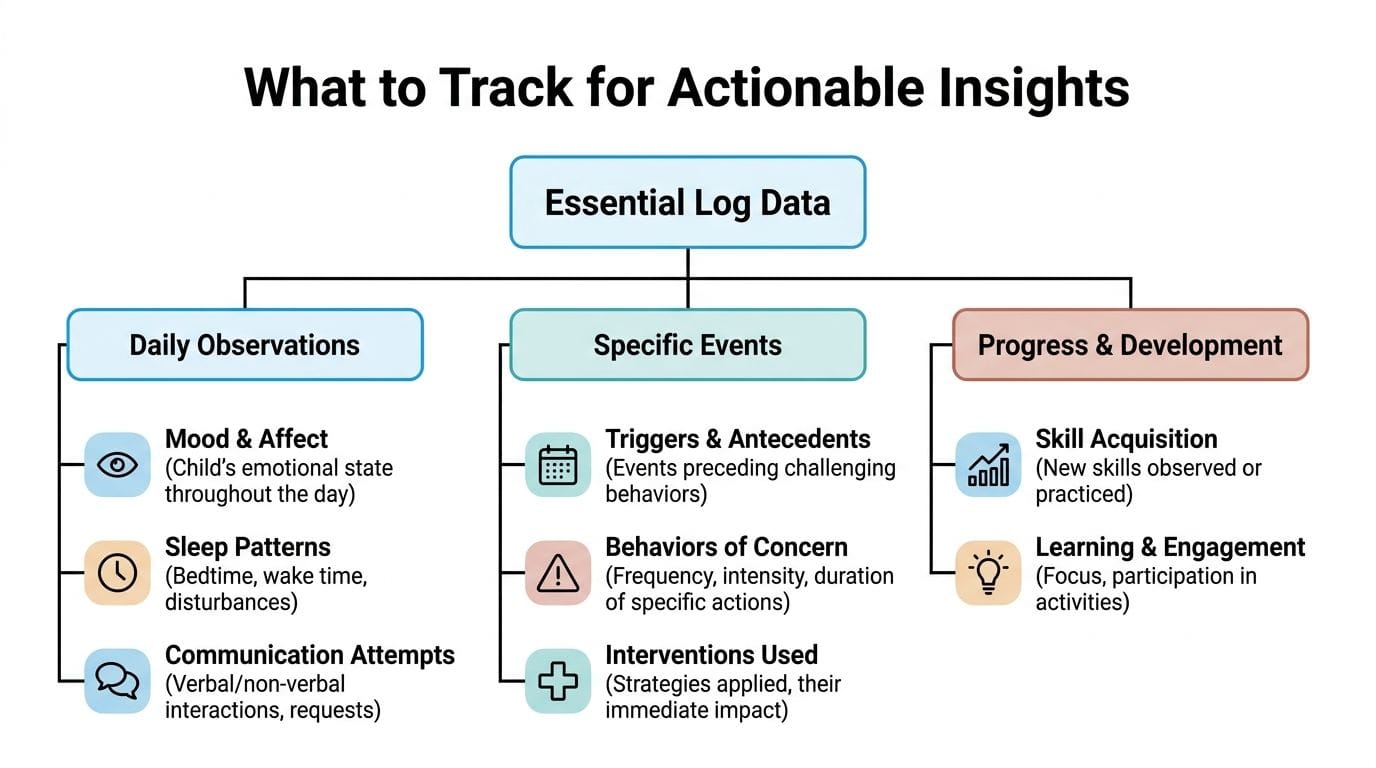
Track the factors that change behavior
Start with the categories that tend to affect regulation, communication, and learning most.
- Sleep and rest: Note bedtime, wake time, night waking, or a visibly tired morning. Sleep changes often explain why a child who usually copes well struggles that day.
- Food and body needs: Track meals, hydration, toileting, constipation concerns, and whether basic physical needs were met. A child who skipped lunch may look dysregulated when they are overwhelmed and hungry.
- Behavior and regulation: Record meltdowns, shutdowns, aggression, elopement, stimming changes, or signs of rising stress. Brief notes on intensity or duration help more than vague labels like “bad day.”
- Triggers and antecedents: Include schedule interruptions, staff changes, sensory overload, long waits, difficult transitions, denied access, and communication breakdowns.
- Communication attempts: Note requests for help, use of AAC, gestures, echolalia, verbal attempts, or times the child withdrew from communication.
- Interventions and outcomes: What did adults try, and what happened next? A sensory break, reduced demands, visual schedule, first-then support, or co-regulation strategy should be logged with the immediate result.
- Progress and strengths: Don't only track hard things. Add skill use, successful transitions, spontaneous communication, flexibility, engagement, and moments that went better than expected.
Skip the clutter
Many families start strong, then burn out because they try to record everything. That's where logs turn into paper clutter or giant phone notes nobody reviews.
One common pitfall is information overload. Data cited by Pathfinders for Autism notes that logging trivial activities instead of key factors like schedule interruptions or sleep quality can contribute to a 60% failure rate in identifying meltdown causes, while focusing on key data points can improve behavioral pattern recognition accuracy by 40% (communication tips on meaningful data points).
What belongs in the log:
- Useful context: “Fire drill before math.”
- Regulation clues: “Slept poorly and woke early.”
- Support data: “Needed noise-canceling headphones after lunch.”
What usually doesn't:
- Craft-by-craft detail: “Glued leaves in science.”
- Long narratives about routine tasks: unless they connect to a behavior, skill, or trigger.
- Repeated filler: “Good day” with no context.
The best log is short enough to complete daily and specific enough to guide a decision.
A simple way to test any entry is to ask, “Would this help me explain a pattern to school, a clinician, or another caregiver?” If the answer is no, leave it out.
How to Create Your Daily Communication Log
Most families choose between two systems. They either build their own log with paper or spreadsheets, or they use an app that handles structure for them.
Both can work. The trade-off is setup time versus convenience, and flexibility versus consistency.
The paper or spreadsheet route
A notebook, printed sheet, or Google Sheet gives you control. You can decide the categories, wording, and level of detail. That's helpful if your child has very specific needs or your school already uses a familiar format.
The downside is that DIY systems often grow messy fast. Parents use one format. School uses another. Therapy notes live elsewhere. Then the log becomes another thing to maintain.
If you build your own, keep the structure tight. A daily communication log autism setup should be based on checkboxes and simple scales, not long narrative writing. Evidence cited in practice guidance shows that converting narratives into checkboxes or simple scales increased daily compliance by busy teachers and caregivers from under 20% to over 85% because entries became much faster to complete (daily log template guidance).
A simple template might include:
| Category | Format |
||—|
| Sleep | Checkbox or short note |
| Meals | Yes/no or partial/full |
| Toileting | Yes/no |
| Major behaviors | Checkbox plus brief note |
| Triggers | Select from short list |
| Supports used | Select from short list |
| Wins | One sentence |
Short forms get filled out. Long forms get postponed.
If you need help thinking through the setup side of habit tracking in general, Pretty Progress has a practical article on setting up a progress app that's useful even if you later adapt those ideas for autism-specific tracking.
The digital route
An app removes the hardest part of logging. You don't have to design the form, remember where you saved it, or transfer notes later.
That matters more than people expect. Parents rarely skip logging because they don't care. They skip it because both hands are full, the day got away from them, or the form feels like homework.
Digital logging works best when it supports:
- Quick-tap entries for common daily items
- Reusable templates so you're not rewriting the same categories
- Centralized records for sleep, behavior, food, medications, and appointments
- Voice capture for the days typing won't happen
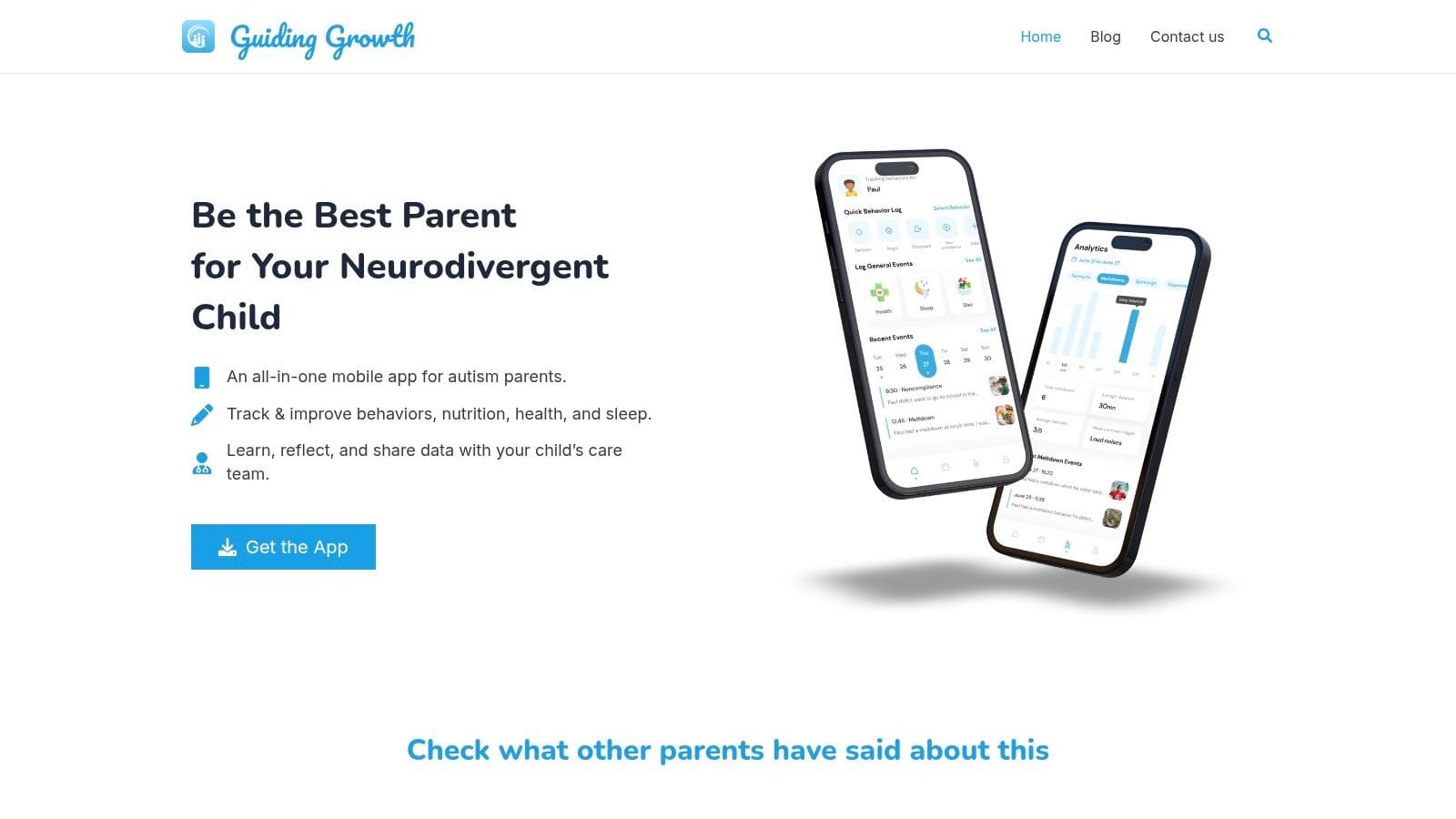
One option is Guiding Growth's ABA session notes tools, which fit naturally into a broader app-based logging workflow. In practice, the biggest advantage of an app-based approach is that it cuts down on duplication. You log once, keep everything in one place, and can review it later without hunting through photos, binders, and text chains.
Voice logging is especially useful for parents. If you can speak a note while walking to pickup or cleaning up after dinner, you're much more likely to keep the habit going.
Making Your Log a Powerful Collaboration Tool
A communication log becomes valuable when everyone uses it the same way. Without that shared agreement, one person writes detailed context, another sends a smiley face, and a third forgets to update anything at all.
That's why collaboration needs structure, not just goodwill.
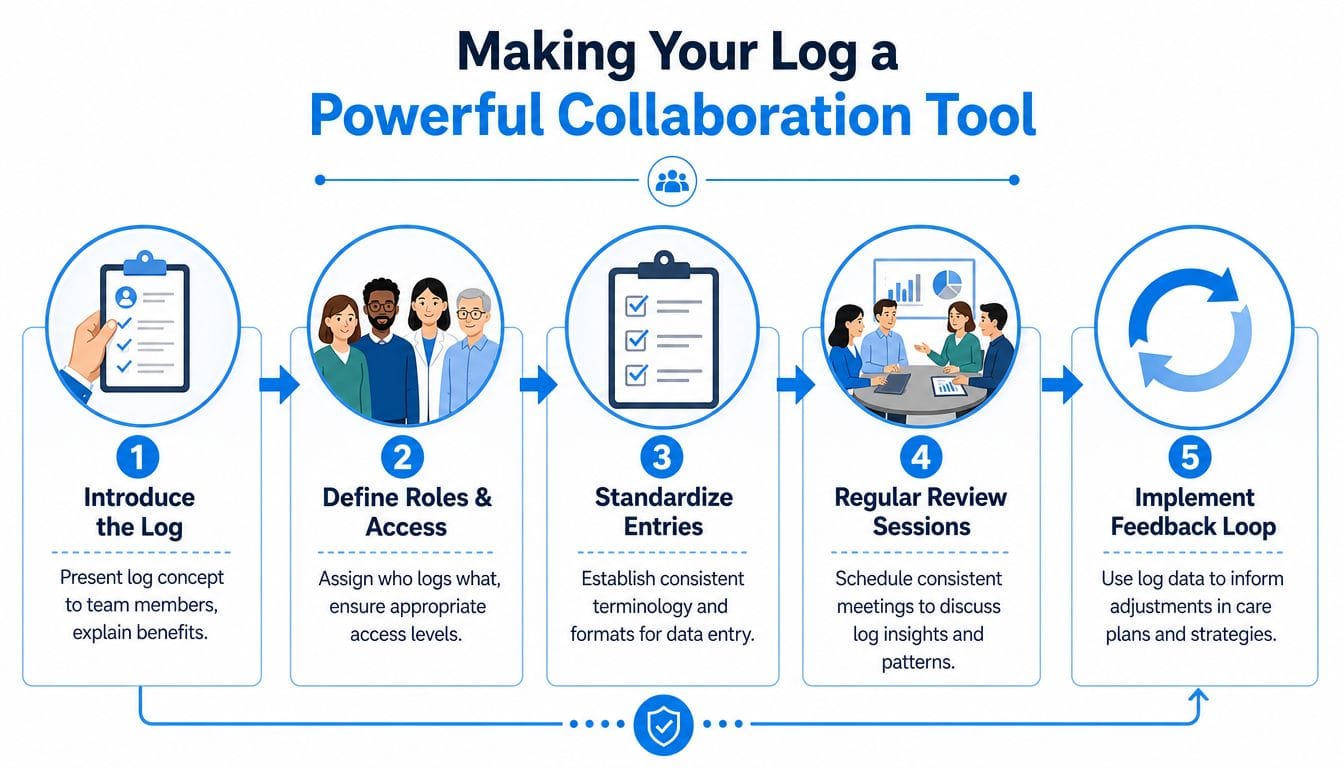
How to get buy-in from school and therapy teams
Start with a small ask. Don't hand a teacher a long custom form and hope for the best. Ask for a few high-value data points recorded consistently.
Useful language sounds like this:
“Could we track sleep-related concerns, major schedule changes, and any significant regulation issues in one shared format so we can compare home and school patterns?”
Or this:
“I'm not looking for a long narrative. A quick checklist and one short note on anything important would help us a lot.”
That approach respects staff time while making it clear that the log has a purpose. It's not paperwork for paperwork's sake. It's a tool to make supports more accurate.
For students who are nonverbal or who struggle with communication, daily communication logs should be explicitly written into the IEP so schools are legally required to provide structured tracking and maintain home-school collaboration (IEP communication log guidance).
That language matters. When the log is informal, it's easier for it to disappear during busy weeks. When it's part of the plan, accountability improves.
Why shared access matters
Paper logs create friction. They get left in backpacks, missed during absences, photographed poorly, or delayed until the detail is less useful.
Shared digital records solve a practical problem. Everyone can work from the same information instead of separate versions of the same day.
A collaboration-friendly system should answer four questions clearly:
- Who logs what: Parent, teacher, therapist, or aide
- When it gets updated: End of day, after key events, or during transitions
- How much detail belongs there: Brief checkboxes plus one meaningful note
- Who reviews it: Parent only, care team, or selected professionals
If you want a model for that kind of shared tracking, an autism-focused behavior tracking app can show what centralized collaboration looks like without relying on printed sheets and back-and-forth attachments.
Essential Tips for Consistent and Effective Logging
A log only helps if it survives real life. That means it has to work on rushed mornings, therapy days, school transition weeks, and evenings when nobody wants one more task.
Daily communication logs are an evidence-based tool in special education, designed to support meaningful home-school exchange and help identify behavioral trends and challenges early (Texas autism toolkit communication form).
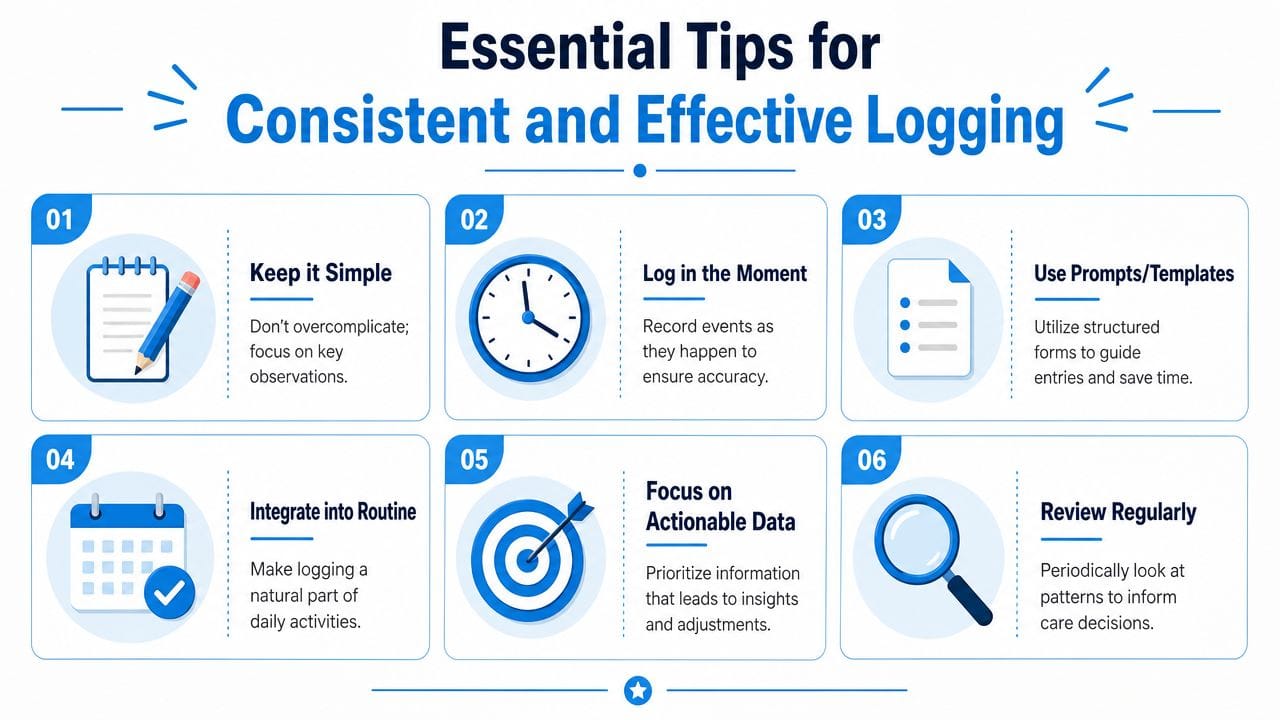
Build a routine you can actually keep
The most sustainable logs are boring in the best way. They're fast, repeatable, and easy to finish.
Try these habits:
- Log in the moment: A short note right after the event is usually more accurate than reconstructing the day at night.
- Use prompts, not blank pages: Blank space invites overthinking. Prompts keep you focused on what matters.
- Anchor logging to existing routines: After school pickup, after dinner, or after bedtime meds are common moments that work.
- Record before and after: Don't only note the behavior. Note what happened right before it and what helped afterward.
- Keep the bar low on hard days: A few useful entries are better than abandoning the system because you missed details.
Review for patterns, not perfection
Many parents collect data but never step back to look at it. The review is where the value appears.
A short weekly review can help you notice:
- When hard moments cluster
- Which supports consistently help
- Whether school and home report the same triggers
- What strengths are growing steadily over time
If your log includes sensitive health information, it's also worth understanding privacy basics for digital notes. This guide for HIPAA compliance from SpeakNotes is a useful reference point when you're deciding how to store and share documentation.
Good logging isn't about documenting everything. It's about preserving enough truth to make the next decision better.
One more practical tip. Use voice notes when your hands are busy and your brain is tired. A spoken note often captures the important context you'd otherwise lose, especially during transitions, car rides, or the few minutes right after a difficult incident.
From Data to Decisions Your Next Steps With Guiding Growth
A communication log matters because it changes the quality of decisions.
When you log consistently, you stop relying on general impressions like “school has been harder lately” or “weekends go better.” You can point to recurring patterns instead. Maybe sleep disruption comes before shutdowns. Maybe demand-heavy mornings lead to refusal. Maybe a small change in transition support improves the whole afternoon.
That kind of clarity helps in every direction. Parents can adjust routines. Teachers can prepare for predictable stress points. Therapists can test supports with better context. Doctors get a more accurate picture of daily life.
It also changes advocacy. Families often know something is off long before they can prove it. A structured log closes that gap. It gives you language, examples, and consistency.
For parents who want to move past scattered notes, Guiding Growth offers a digital way to centralize daily tracking, voice-captured observations, routines, behaviors, and shared records in one place. The practical advantage isn't just convenience. It's being able to look back and effectively use what you recorded.
You don't need a perfect system. You need one that helps you notice more, remember more, and act sooner.
If you're tired of piecing together school notes, therapy updates, and late-night phone reminders, Guiding Growth gives you one place to log daily life, organize what matters, and share it with the people supporting your child. It can turn a daily communication log from one more pile of paper into a working record you'll actually use.