You've just left an appointment with a recommendation for ABA therapy, a provider list, and more questions than answers. You may be wondering whether ABA will help your child communicate, manage daily routines, and feel less overwhelmed, or whether the program will focus mainly on making behavior look more typical. That uncertainty is reasonable.
The pros and cons of ABA therapy can't be reduced to a simple yes or no. The better question is whether a specific program is pursuing goals that improve your child's safety, autonomy, communication, participation, and quality of life, and whether your family can sustain the plan. A program can collect excellent data and still measure the wrong things. Another can use a modest number of hours but produce meaningful changes in sleep, dressing, eating, or expressing needs.
| Decision area | Potential value | What parents should verify |
|---|---|---|
| Communication | Functional ways to request, refuse, comment, and seek help | Whether the program honors all effective communication, including AAC |
| Daily living | Greater independence with routines and self-care | Whether skills generalize beyond therapy sessions |
| Behavior support | Fewer dangerous or distressing episodes | Whether clinicians address triggers and teach alternatives |
| Social participation | More access to play, learning, and relationships | Whether goals involve connection, not forced performance |
| Family capacity | Shared strategies across home and other settings | Whether the schedule, staffing, and cost are sustainable |
| Ethical fit | Support that respects autonomy and sensory needs | Whether the child can assent, pause, refuse, and influence goals |
Table of Contents
- Introduction to Making an Informed ABA Decision
- Understanding What ABA Therapy Is and How It Works Today
- Benefits of ABA Therapy Supported by Research
- Limitations Ethical Concerns and Practical Burdens to Consider
- Comparing ABA Therapy With Alternatives and Complementary Supports
- How to Evaluate Providers and Collaborate for Better Outcomes
- Making the Right Choice for Your Child and Family With Guiding Growth
Introduction to Making an Informed ABA Decision
A parent might agree to an ABA consultation because a child is running toward traffic, unable to communicate pain, or becoming distressed during every transition. Another parent might hear that ABA can improve eye contact, sitting still, or following directions and wonder whether those targets matter to the child. Both families deserve careful guidance, not pressure.
ABA can be useful when it teaches a child a practical skill, makes communication easier, reduces danger, or expands access to enjoyable activities. It becomes harder to justify when the main outcome is obedience, quietness, eye contact, or the suppression of harmless movements without a clear quality-of-life benefit. The treatment label matters less than the goals, methods, measurements, and relationship between the team and your child.
This guide takes a position: parents should judge ABA by functional outcomes and lived experience, not by reputation alone. Research supports measurable gains in some domains, especially intellectual functioning and adaptive behavior, while results remain mixed across other outcomes. Families also face real burdens involving time, money, transportation, staffing, and emotional energy.
The central test: Is the program helping your child do more of what matters to them, with less distress and greater independence?
Keep that question active through every stage. First, understand what the provider means by ABA. Then examine the strongest research-supported benefits and the limits of that evidence. Compare ABA with developmental, speech, occupational, and parent-mediated supports. Finally, evaluate the provider's goals and use consistent daily observations to check whether formal progress is translating into better routines at home.
A structured record can help when memory is affected by exhaustion or a difficult week. Tracking the setting, trigger, behavior, response, and outcome gives you something more useful than a general feeling that therapy is or isn't working. It also gives your clinical team a clearer basis for changing a goal that no longer serves your child.
Understanding What ABA Therapy Is and How It Works Today
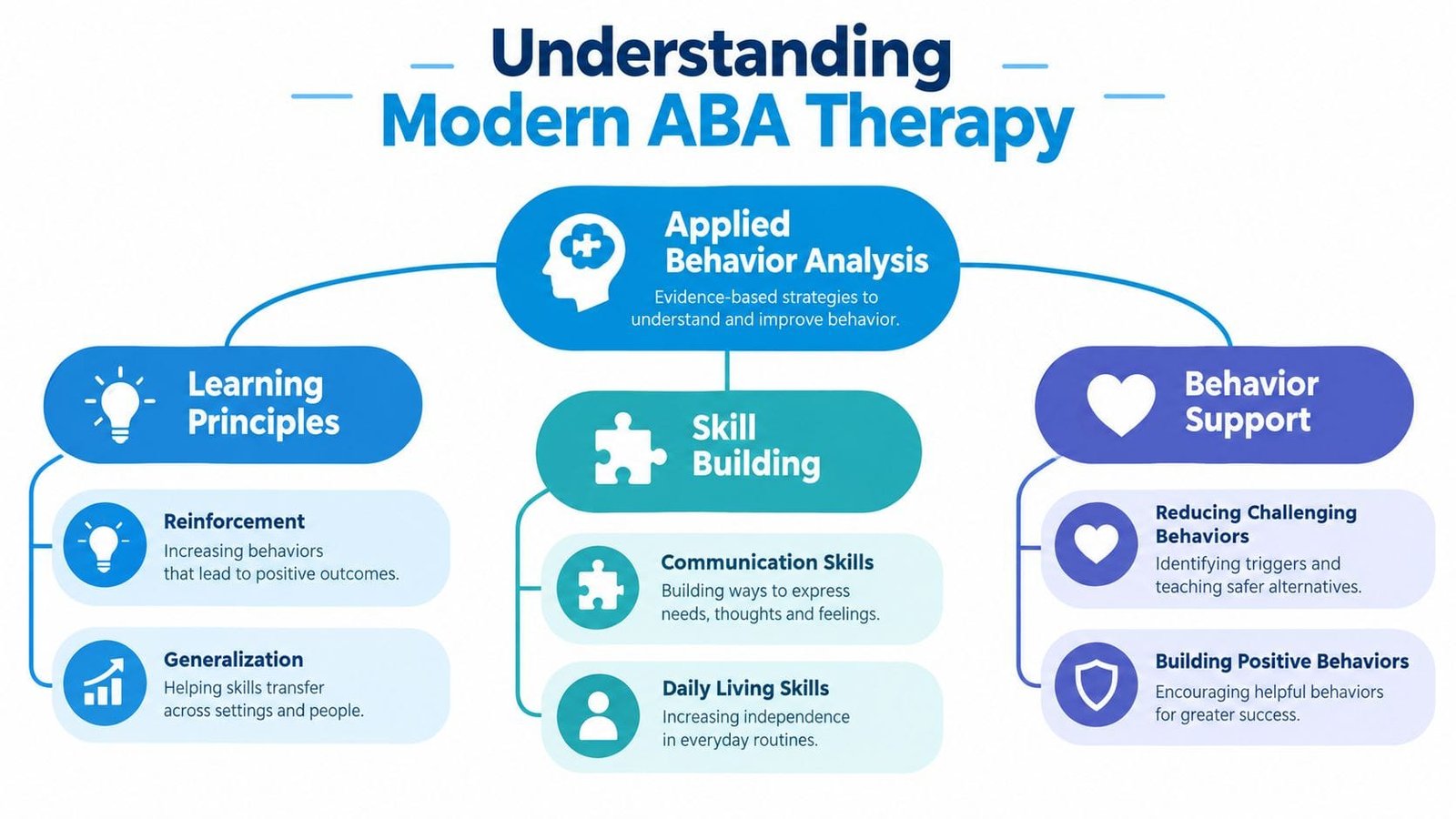
Applied Behavior Analysis, or ABA, applies learning principles to teach skills and support behavior in everyday contexts. A clinician observes what happens before and after a behavior, identifies what a child may be communicating or seeking, and designs teaching opportunities around that information. Reinforcement may make a useful behavior more likely, while prompting and practice can help a child learn a new routine.
Modern ABA programs vary widely. ABA may address several developmental areas across settings. Focused ABA concentrates on a narrower priority, such as functional communication, toilet routines, feeding participation, safety, or transitions. The important distinction isn't the program's name. Ask what your child will learn, why the goal matters, how the team will teach it, and how you'll know the skill is useful outside the session.
What modern programs should prioritize
A strong program might teach a child to request a break, use an AAC device, tolerate a necessary medical routine with support, prepare part of a snack, or move between activities with a visual schedule. It should also consider sensory needs, communication differences, motivation, and the child's ability to assent or refuse.
ABA isn't a cure for autism, and it shouldn't aim to erase autistic identity. A therapist can teach a safer way to communicate during distress without treating every autistic trait as a problem. Stimming, echolalia, movement, and reduced eye contact shouldn't be targeted just because they look different.
Parents who want a plain-language overview can review ABA therapy explained for caregivers, which offers background for families evaluating services. If a provider proposes discrete-trial teaching, ask how the technique will connect to natural routines and your child's own priorities. This guide to discrete-trial teaching in ABA can help you prepare more precise questions.
How measurement should work
A provider should define goals in observable terms, such as independently requesting help during a routine or completing part of a dressing sequence with fewer prompts. Data should include context, not only whether a response occurred. A child who remains quiet because they're frightened hasn't necessarily learned a meaningful skill.
Ask to see progress regularly and ask what happens when a goal stalls. Quality teams adjust teaching, examine environmental barriers, and listen to the child and family. They do not increase demands because a graph failed to improve.
Benefits of ABA Therapy Supported by Research
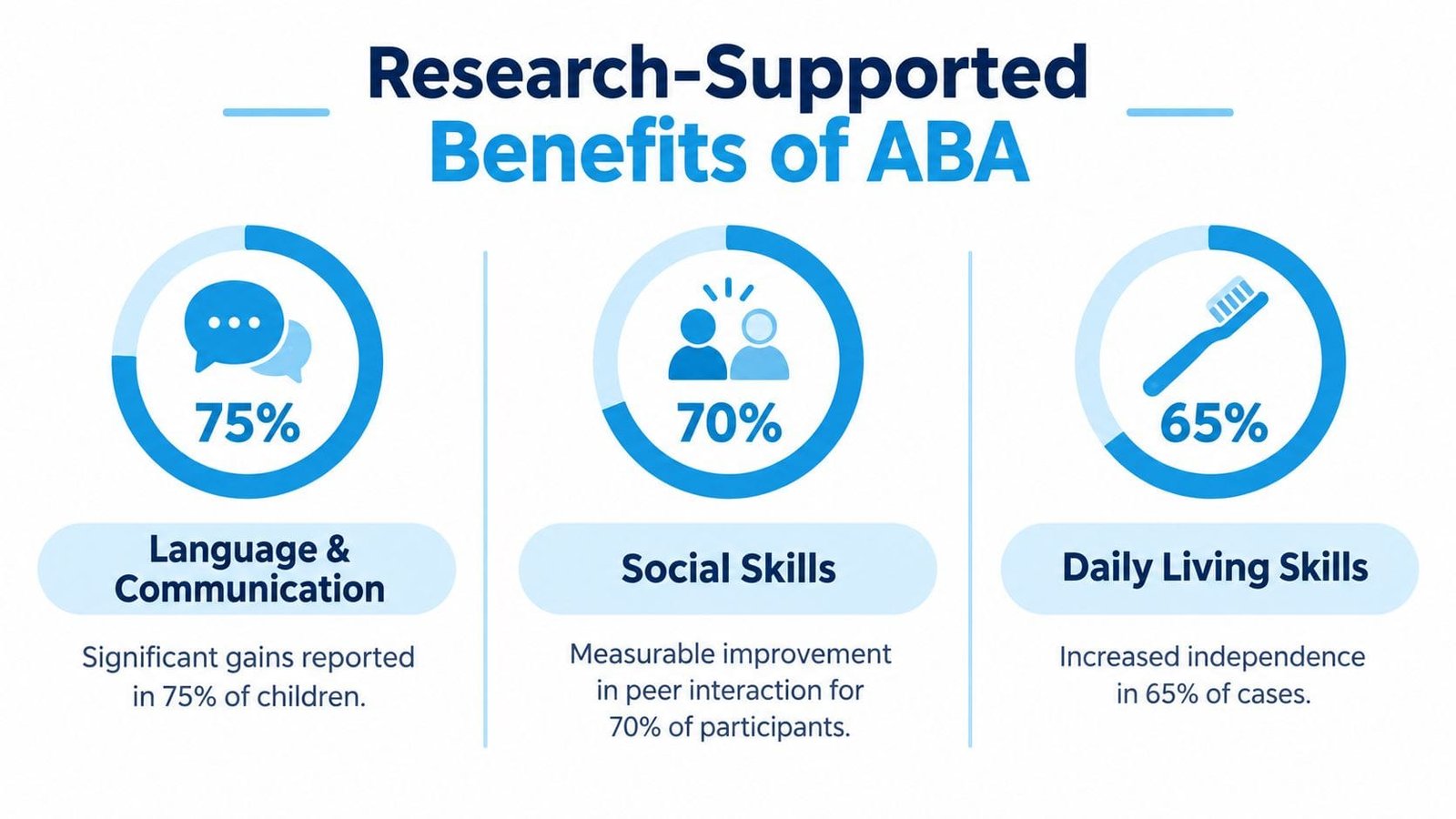
The strongest case for ABA comes from measurable improvements in cognitive ability, adaptive behavior, communication, and selected daily skills. A 2023 meta-analysis of ABA-based interventions found medium effects for intellectual functioning, with SMD = 0.51 and a 95% confidence interval of 0.09 to 0.92, and adaptive behavior, with SMD = 0.37 and a 95% confidence interval of 0.03 to 0.70, compared with treatment as usual, minimal treatment, or no treatment. These findings are reported in the BMC Psychiatry review of comprehensive ABA interventions.
Earlier evidence syntheses reported a significant impact on general IQ, with an effect size of 1.19 across 18 studies, and described medium-to-large improvements in language, daily living skills, and social functioning. A mixed-methods systematic review and meta-analysis also found significant improvement in adaptive behavior, including daily living skills, versus treatment as usual, with SMD = 0.39 and a 95% confidence interval of 0.07 to 0.71.
Why these outcomes matter
Adaptive behavior includes the practical abilities that let a child participate more independently. A gain in communication may mean requesting food, reporting pain, refusing an activity, or asking for assistance. A gain in daily living may mean completing a hygiene step, navigating a routine, or participating in household activities with less adult support.
A 2025 NIH umbrella review found positive effects of ABA on cognitive ability and adaptive behavior, the two most consistently measured outcomes in autism research, with effect sizes described as primarily moderate to large, especially for IQ. The review also noted that research concentrates on a limited set of outcomes, so parents shouldn't assume that progress in one domain guarantees progress in every area. See the NIH overview of the umbrella review evidence.
Higher treatment dose and longer duration may matter for some outcomes, particularly receptive language and adaptive behavior, but intensity alone doesn't make a program good. More hours can't compensate for poor goals, weak supervision, an unsafe therapeutic relationship, or a schedule your family can't maintain.
For a visual explanation of how therapy may support communication, social participation, and daily skills, review the video below. Treat it as background education, not as a promise about your child's likely response.
The practical conclusion is straightforward. ABA has a credible evidence base for selected functional and cognitive outcomes, but parents should approve goals individually. Ask the provider to connect each target to a real activity your child wants, needs, or must access safely.
Limitations Ethical Concerns and Practical Burdens to Consider
ABA results vary by child, goal, provider, and setting. In a California autism-mandate study, about 66% of children referred for ABA remained in services for 12 months, while 46% were still receiving services at 24 months. This attrition means many children leave before longer-term outcomes can be assessed. The figures appear in the review of ABA evidence and service outcomes.
The same review described improvement across 63% to 88% of study records, while 13% to 36% showed mixed results and 0% to 13% showed no change. Another meta-analysis found that language abilities and parental stress did not improve beyond control groups, although intellectual functioning and adaptive behavior did. A separate 2020 meta-analysis reported significant gains in socialization, communication, and expressive language, but no significant effects for general autism symptoms, receptive language, adaptive behavior, daily living skills, IQ, motor skills, cognition, and other outcomes, as described in the meta-analysis of ABA-based interventions.
The ethical question is not optional
Parents should examine what a program rewards, suppresses, and counts as progress. Critics have raised concerns about compliance-focused teaching, efforts to suppress harmless autistic traits, and research that does not adequately include autistic voices. A child who stops moving their hands because movement is punished may look calmer while experiencing greater distress.
Choose goals that build autonomy, self-advocacy, communication, regulation, and access. Ask why eye contact, stillness, quiet hands, or immediate compliance matter and how each target improves daily life. Refusal is communication. The program should respect it, identify the underlying need, and offer sensory-informed support rather than forcing participation.
Ask whether the team measures quality of life, not only therapist-directed behavior. Track useful changes at home, such as requesting help, tolerating necessary routines, recovering from distress, or participating in preferred activities. Daily notes can reveal whether a target transfers beyond therapy or merely produces compliance in the treatment room.
Burden, quality, and continuity
ABA can consume substantial family time and energy. Costs, transportation, scheduling, staffing changes, and poor communication can make a sound plan difficult to maintain. Assess supervision, therapist training, family participation, and coordination with school and other clinicians before committing.
Look for these signals:
- Green flags: Goals connect to daily life, the child's priorities, safety, or communication.
- Green flags: Therapists explain data plainly and revise plans when distress or progress data requires it.
- Green flags: The child can pause, refuse, choose between options, and use breaks.
- Red flags: Compliance is treated as the main measure of success.
- Red flags: Staff dismiss sensory discomfort or punish echolalia, AAC use, or other communication.
- Red flags: The provider cannot explain how a goal will improve independence outside therapy.
Ask what happens when a child escapes or refuses a demand. Learn more about how escape extinction is used in ABA and what safeguards to ask about. A 2021 review found no data showing that any specific number of ABA hours is associated with harmful outcomes, and reported that available research on extinction procedures did not show that extinction causes trauma. That finding does not resolve every ethical concern. Evaluate the actual procedure, safeguards, context, and child response, as explained in the review of concerns about ABA-based interventions.
Comparing ABA Therapy With Alternatives and Complementary Supports
ABA shouldn't automatically be the first or only service. Families should match support to the problem they're trying to solve, the child's learning style, and the capacity available at home. A communication-first plan may rely heavily on speech-language therapy and AAC, while sensory access may require occupational therapy. Developmental and naturalistic approaches may fit children who learn best through shared play and everyday interaction.
A blended plan is often more practical than choosing one therapy as a complete answer.
| Support option | Best fit scenario | Strengths | Limitations to weigh |
|---|---|---|---|
| ABA | Functional skill acquisition, safety, adaptive behavior, or behavior support | Structured teaching and direct measurement | Quality and ethical approach vary; can be demanding |
| Speech-language therapy | Communication, AAC, language access, or feeding communication | Direct expertise in communication systems | May not address broader routines or behavior patterns alone |
| Occupational therapy | Sensory access, motor planning, self-care, and participation | Connects regulation and functional activities | Progress may depend on carryover across settings |
| Developmental or naturalistic support | Learning through play, relationships, and daily routines | Builds motivation and spontaneous participation | Measurement and intensity can differ by provider |
| Parent-mediated support | Families needing practical strategies across the day | Uses ordinary routines and caregiver knowledge | Requires coaching, time, and consistent follow-through |
| School-based services | Educational access and classroom participation | Integrates support into learning environments | School goals may not cover home or community priorities |
Choose by priority, not by label
If your child can't reliably express pain, hunger, or refusal, start with communication access. If transitions trigger shutdowns or meltdowns, examine sensory demands, predictability, and regulation before treating the visible behavior as the primary problem. If dressing, eating, sleep, or hygiene limits independence, occupational therapy and focused behavioral teaching may work together.
A family with limited hours shouldn't accept a plan that assumes unlimited availability. Ask which goals have the greatest practical value and whether the provider can coach caregivers during ordinary routines. A smaller, coordinated plan may be more useful than a larger plan that causes exhaustion and frequent cancellations.
Decision rule: Choose the support that addresses the barrier your child experiences, not the behavior adults find most noticeable.
Speech, occupational, developmental, and behavioral services can complement one another, but coordination matters. Each clinician should understand the shared priorities, communication system, sensory accommodations, and signs of overload. Parents should know who owns each goal and how conflicting recommendations will be resolved.
How to Evaluate Providers and Collaborate for Better Outcomes
A provider's response to your first questions often predicts the quality of care better than its polished sales presentation. Ask which goals they would consider first, what they need to learn about your family, how your child can refuse or request a break, and how they distinguish distress from a skill gap. Choose a team that can explain how treatment will improve daily life, not just increase compliance.
Questions that expose program quality
Use these questions during consultations:
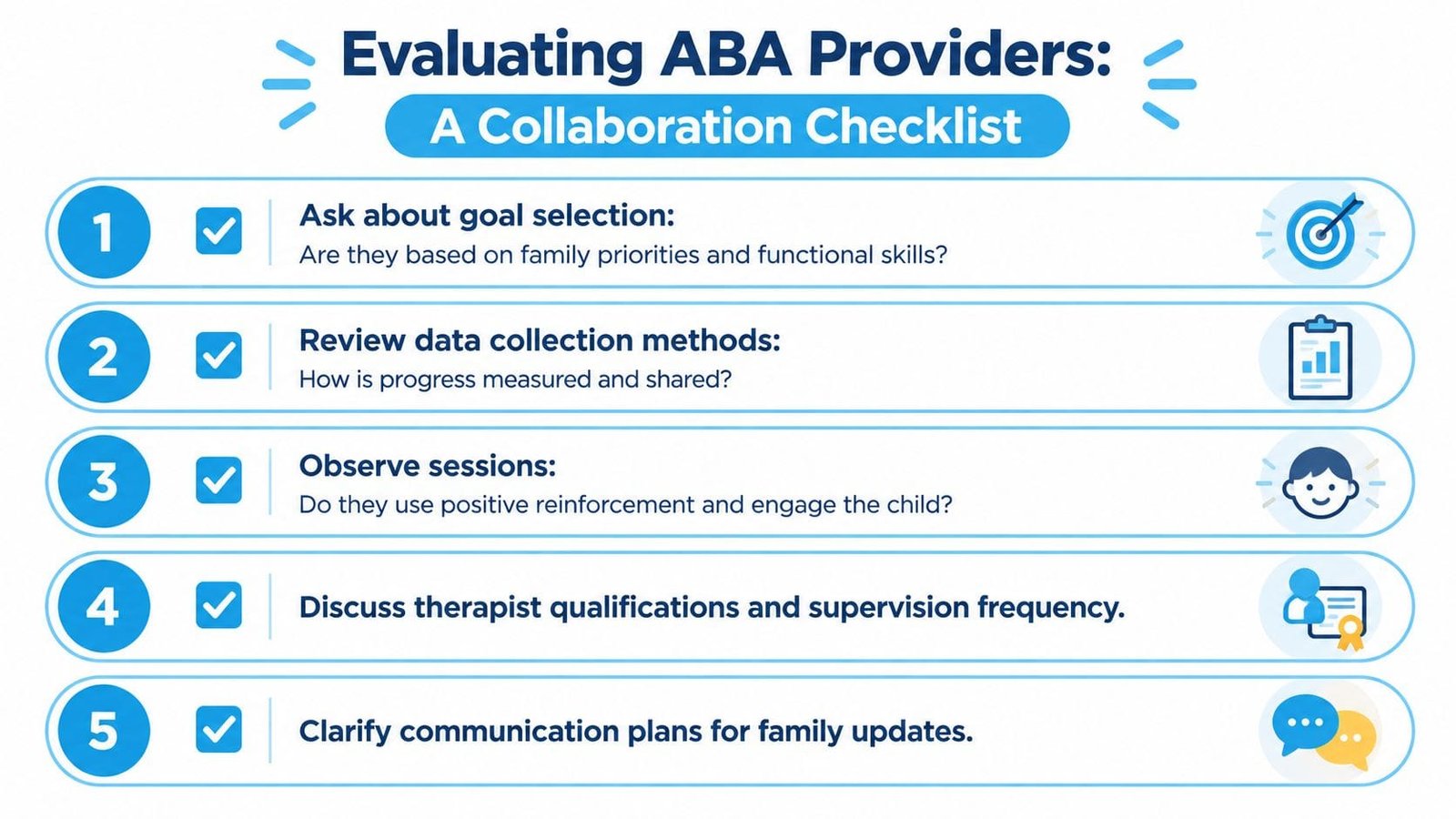
- How are goals selected? Ask whether targets reflect family priorities, the child's preferences, functional needs, and input from other professionals.
- How is progress measured? Request examples of data, context notes, generalization checks, and the schedule for reviewing results.
- What happens during distress? Ask how therapists respond to meltdowns, shutdowns, demand avoidance, or escape behavior. Find out whether they investigate triggers before increasing demands.
- How does the child participate? Clarify assent, choice-making, breaks, refusal, reinforcement, and staff responses when the child communicates “no.”
- Who supervises the plan? Learn the supervising clinician's role, therapist qualifications, observation practices, and caregiver communication process.
A strong provider can explain why each target matters outside the clinic. The team should welcome your observations and include sensory supports, AAC, movement, and preferred activities where appropriate. It should also revise or stop goals that produce little meaningful benefit.
Track what formal data misses
Daily notes should record more than whether a behavior occurred. Log the trigger, setting, demand, communication attempt, adult response, recovery, and later outcome. Add relevant changes in sleep, diet, medication, illness, appointments, or routines.
Record meltdowns, shutdowns, demand avoidance, echolalia, and hand flapping without treating them as automatic problems. Ask whether your child was distressed, unsafe, unable to participate, or communicating a need. A behavior-tracking system such as Guiding Growth can centralize these observations, therapy sessions, routines, sleep, diet, appointments, and care-team sharing, including voice logging and visual patterns.
Bring patterns to treatment meetings. If a goal improves in sessions but not at home, ask how the team will support generalization. If a behavior decreases while sleep worsens or recovery takes longer, investigate the tradeoff instead of judging success by the graph alone.
Use this guide to collaborative autism care teams to prepare for clearer communication among therapists, caregivers, educators, and medical professionals. Ensure everyone is measuring goals that improve participation, communication, safety, or autonomy.
Making the Right Choice for Your Child and Family With Guiding Growth
A program deserves your consideration when it targets functional goals, teaches respectfully, and protects your child's communication, autonomy, and comfort. Choose focused or blended support when priorities such as communication, safety, dressing, or transitions affect daily life. Pause, change providers, or consider alternatives when goals mainly demand conformity, distress is dismissed, or improvement appears only in session records.
Measure quality of life, not compliance alone. Is your child communicating more effectively, joining routines more easily, and recovering from stress with better support? Check whether sleep, eating, participation, and family relationships remain stable or improve. A new skill is meaningful only when it helps your child function, connect, or make choices beyond therapy.
Guiding Growth lets families organize behavior logs, triggers, outcomes, sleep, diet, medications, appointments, therapy sessions, and developmental observations in one place. Shared records and visual summaries give parents concrete patterns to discuss with providers instead of scattered notes or memory.
Make one decision at a time. Define the functional goal, agree on daily measures, observe your child's experience, and review whether the change improves life outside the therapy room. If progress requires greater distress or reduced autonomy, revise the goal rather than rewarding the graph.
Use Guiding Growth to record ABA-related behaviors, routines, appointments, and therapy progress, with voice logging and shareable care-team insights. Guiding Growth can help you track what matters while keeping your child's autonomy and quality of life in view.