You notice it in small moments first. Your child flaps their hands when they're excited. They hum in the grocery store. They tap a pencil through homework, pace during conversations, or rock when the room gets loud. You wonder what it means. Is it ADHD? Autism? Both? Something else entirely?
That confusion is common, especially because the same behavior can look very different from the inside. A child who bounces, taps, or repeats sounds isn't necessarily trying to misbehave. Often, they're trying to regulate their nervous system.
Stimming is one of the ways children do that. The behavior itself matters, but the bigger clue is usually why it happens, when it happens, and what happens next. That matters even more because many families aren't looking at a simple either-or picture. Up to 70% of autistic people may also have ADHD, which means stimming can be shaped by both conditions at once, not just one (CDC autism data and research).
Table of Contents
- Understanding Stimming in Your Child's World
- What Is Stimming and Why Does It Happen
- Stimming in ADHD vs Autism A Detailed Comparison
- Real-World Examples of Stimming Scenarios
- When to Seek a Professional Assessment
- How to Support Your Child's Regulatory Needs
- Using Patterns to Guide Care with Guiding Growth
Understanding Stimming in Your Child's World
Parents usually aren't confused by the movement itself. They're confused by the meaning. Hand flapping, chewing sleeves, pacing, rocking, finger flicking, tapping a foot, or repeating sounds can all fall under the broad idea of stimming, which means repetitive behavior that helps with regulation.
Some children stim when they're overloaded. Others stim when they're under-stimulated and need more input to stay alert. Some do it when they're anxious. Some do it when they're thrilled. The outside behavior may look similar while the inside experience is completely different.
That difference is where many parents get stuck with the question of stimming ADHD vs autism. They want a clean rule. They want one behavior to point to one answer. Real life usually doesn't work that way.
The most useful question isn't “What does this look like?” It's “What job is this behavior doing for my child right now?”
A child with ADHD may fidget through dinner because their body is trying to stay engaged. An autistic child may rock in a bright, noisy room because their body is trying to cope with too much input. Another child may do both in different settings.
What parents often miss
The same stim can serve different functions on different days.
- Hand movements: These may show up during excitement, stress, or sensory overload.
- Pacing: This can help organize thoughts, release tension, or manage restless energy.
- Humming or repeating sounds: This may soothe, block out other noise, or express big feelings.
That's why labels alone don't tell the whole story. Observation does. When parents start noticing patterns around sleep, noise, transitions, demands, hunger, excitement, and fatigue, the behavior becomes easier to understand and support.
What Is Stimming and Why Does It Happen
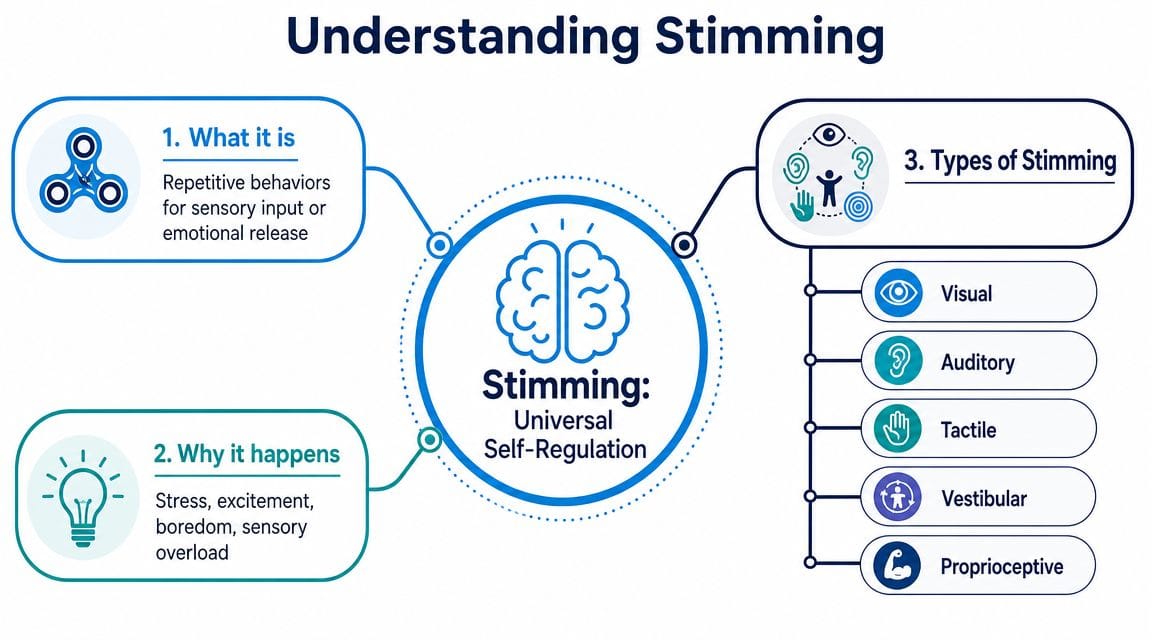
Stimming is self-stimulatory behavior, but in everyday language, it's best understood as a self-regulation tool. Children use it to help their brains and bodies find a more manageable state. That's true whether a child is autistic, has ADHD, has both, or has no diagnosis at all.
A helpful comparison is this. Adults do milder versions of the same thing all the time. We tap our fingers during a meeting, pace while thinking, twirl hair when stressed, or bounce a leg while concentrating. Children often do it more visibly because they have fewer subtle ways to regulate.
Regulation can mean different things
Stimming doesn't happen for one reason. It can help with several kinds of regulation at once.
- Sensory regulation: A child may seek more input through movement, pressure, sound, or touch. Or they may use a repetitive action to block out overwhelming input.
- Emotional regulation: Repetitive movement can help discharge anxiety, frustration, anticipation, or excitement.
- Attention and arousal regulation: Some children move to wake up their brains enough to stay focused on a task.
Stimming is communication
When you see stimming as communication, your response changes. Instead of asking, “How do I stop this?” you start asking better questions.
- What happened right before it started?
- Does it help the child recover, focus, or stay calm?
- Does it happen more in loud places, boring tasks, hard transitions, or exciting moments?
- Does the child seem better after doing it?
Practical rule: If a stim is safe and helping a child regulate, the first response usually shouldn't be to remove it.
That doesn't mean every stim should be ignored. Some behaviors are unsafe, painful, or so disruptive that a child needs alternatives. But many repetitive actions are not signs of defiance. They're signs that a child is trying to meet a need with the tools they currently have.
When parents understand that, shame tends to drop. Curiosity goes up. And support gets much more effective.
Stimming in ADHD vs Autism A Detailed Comparison
The clearest way to understand stimming in ADHD vs autism is to compare the function, form, and context. There is overlap, but there are also patterns that can guide what you notice at home and at school.
Stimming in ADHD vs Autism at a Glance
| Aspect | Stimming in ADHD | Stimming in Autism |
|---|---|---|
| Main purpose | Often helps increase stimulation and support focus | Often helps manage sensory overload, anxiety, or strong emotions |
| Typical feel | More restless, fidget-based, quick motor activity | Often more rhythmic, immersive, or whole-body |
| Common forms | Tapping, bouncing, fidgeting, pen clicking, shifting positions | Hand flapping, rocking, humming, repeating sounds, pacing, sensory-focused repetitive actions |
| When it may appear | During tasks that require concentration, waiting, or low stimulation | During overwhelm, transitions, sensory stress, or intense emotion |
| Pattern quality | Often less elaborate | Often more varied and elaborate |
The driving force
Clinical guidance highlights an important difference. In ADHD, repetitive movement is commonly used to increase stimulation and support focus. In autism, it more often functions as a response to sensory overload, anxiety, or emotional intensity (Healthline guide on ADHD stimming vs autism stimming).
That means the same child may tap a foot during homework because movement helps attention. Another child may flap or rock after a fire alarm because their body is trying to recover from too much sensory input.
The common forms
Research comparing the two conditions found that stimming appears in both, but it was far more prevalent in autism. In that comparison, participants with ASD showed a significantly higher prevalence of self-stimulatory behaviors, with motor stimming most common, followed by vocal and sensory forms. Participants with ADHD showed a lower frequency and intensity, with stimming mainly in the motor domain and described as less elaborate (comparative analysis of self-stimulatory behaviors).
In plain language, ADHD stimming often looks more like fidgeting. Autism-related stimming is often broader in form and may involve body movement, sound, rhythm, or sensory repetition.
If a behavior looks obvious, that doesn't automatically make it autism. If it looks subtle, that doesn't automatically make it ADHD. Pattern matters more than appearance alone.
For parents trying to sort through overlapping traits, this guide to ADHD and autism differences can help frame the bigger picture beyond one behavior.
The context around the behavior
Context is often the deciding clue.
A child with ADHD may start tapping, chair-rocking, or pencil-fidgeting during a slow lesson, a long car ride, or a multi-step homework task. The movement may help them stay mentally present.
An autistic child may start rocking, flapping, humming, or pacing when the environment gets noisy, bright, crowded, unpredictable, or emotionally intense. The stim may reduce distress or help restore a sense of control.
A few practical cues can help:
- ADHD leaning pattern: more likely during low-interest tasks, sitting still, waiting, or trying to focus.
- Autism leaning pattern: more likely during sensory overload, abrupt transitions, social stress, or emotional flooding.
- Mixed profile: the child uses some movements for focus and others for sensory recovery, depending on the setting.
That last pattern is common enough that parents shouldn't force a false choice. Sometimes the right answer is that the behavior belongs to a larger neurodevelopmental picture, not a single neat category.
Real-World Examples of Stimming Scenarios
Parents usually understand this best when they can see it in everyday life.
During schoolwork
Eli sits at the kitchen table doing math. His foot bounces the whole time. He taps the eraser, shifts in his chair, and grabs a small fidget every few minutes. If his parent tells him to sit completely still, he gets slower, more frustrated, and loses his place.
That pattern points toward a child using movement to stay engaged. The motion isn't random. It's helping him keep his attention online.
In a crowded public space
Maya walks into a busy mall. The lights are bright. Music is playing. People move past her from every direction. She starts humming, then rocks slightly while holding her caregiver's hand. When the environment gets louder, her movements become more intense.
This is a very different picture. The behavior is tied to overload. Her body is trying to reduce the impact of too much sensory and emotional input at once.
A useful question in public is, “Is my child moving to wake up their system or to calm it down?”
In moments of joy
Then there's Noah at a birthday party. He jumps, flaps, and squeals when he sees his favorite game set up. He isn't distressed. He isn't dysregulated in a negative way. He's expressing joy through his body.
Many adults find this confusing. Not all stimming means a child is struggling. Sometimes it means they're excited, immersed, relieved, or delighted.
A parent who only looks at the movement may misread all three children. A parent who looks at the trigger, setting, and outcome sees something much clearer:
- Eli moves to focus.
- Maya moves to cope.
- Noah moves to express joy.
The behavior category may be similar. The function isn't.
When to Seek a Professional Assessment
Stimming can tell you something important about your child, but it doesn't diagnose anything on its own. In fact, diagnostic ambiguity is common, and pattern recognition is more useful than labels alone. Clinical discussion aimed at families notes that ADHD stimming is typically less frequent and elaborate than in autism, but behavior pattern by itself is still a weak screener for diagnosis. It also points out that sleep loss, anxiety, and sensory overload can all change how stimming looks across settings (Rula discussion of ADHD stimming and pattern recognition).
That's why assessment should focus on the whole child. Not just the hand flapping, not just the fidgeting, and not just one hard day at school.
Signs that it's time to ask for help
Consider a professional assessment if any of these are true:
- Safety is a concern: Your child's stimming causes injury, pain, or ongoing physical harm.
- Learning is being affected: They can't participate in school tasks without significant distress or disruption.
- Daily life is shrinking: Public outings, family routines, sleep, or social participation are regularly derailed.
- Other concerns are showing up: You're also noticing language differences, sensory struggles, rigid routines, attention challenges, developmental delays, or intense emotional reactions.
- The pattern feels hard to read: You can't tell what the behavior means, and guessing isn't helping.
Who can help assess the bigger picture
Families often start with a pediatrician, then move to a developmental pediatrician, child psychologist, psychiatrist, neurologist, or another clinician experienced in neurodevelopment. If you're sorting through the evaluation process, this overview of who can diagnose autism can help you understand where to start.
Sometimes a parent notices similar traits in themselves during this process. If that's happening, a resource on how clinicians evaluate adult ADHD can give useful context for the adult side of the picture.
Assessment isn't about chasing a label for its own sake. It's about understanding the child's needs well enough to choose the right supports.
How to Support Your Child's Regulatory Needs
Support works best when it matches the function of the stim. If a child is moving to focus, they need something different from a child who is moving to recover from sensory overload.
Start with what your child is telling you through behavior. Then respond in a way that protects regulation, safety, and dignity.
Accommodate the need
Sometimes the best support is changing the environment, not the child.
A child who gets overwhelmed in noisy spaces may need noise-reducing headphones, dimmer lighting, a quieter corner, shorter outings, or a warning before transitions. A child who needs movement to focus may do better with movement breaks, a wobble cushion, a resistance band on a chair, or permission to stand during homework.
If your child also struggles with sensory overload and meltdowns, these ideas for sensory tools that help calm meltdowns can help you think in practical terms.
Redirect when safety or participation matters
Redirection is different from suppression. The goal isn't “stop moving.” The goal is “meet the same need in a safer or more workable way.”
Examples help:
- Shirt chewing: offer a chewable necklace or another safe oral tool.
- Desk banging: try a silent fidget, therapy putty, or a hand-squeeze tool.
- Running in tight indoor spaces: create a planned movement break before the demand becomes too hard.
- Loud vocal stims in a quiet classroom: try a humming break outside, a breathing routine, or a quieter sensory substitute.
The question isn't whether your child should regulate. The question is how to help them regulate in a way that protects them and the people around them.
For older children, especially those with attention challenges, practical routines matter too. Parents supporting teens or adults may also appreciate strategies for managing time with adult ADHD, since regulation, pacing, and daily demands often interact.
Understand before you correct
Children usually don't respond well to shame around regulation. If a child hears “stop that” all day, they may learn to hide their needs rather than manage them.
Try replacing correction-first language with curiosity-first language:
- “Is the room too loud?”
- “Do you need to move your body?”
- “Do you need a break?”
- “Would squeezing this help?”
- “Are you excited or overwhelmed?”
A short explanation can also help teachers, relatives, and siblings. “This helps their body regulate” is often more useful than a long debate about whether the behavior looks typical.
Later, if you want a deeper visual explanation to share with caregivers, this video gives a helpful overview:
Using Patterns to Guide Care with Guiding Growth
Parents usually don't need more random advice. They need a way to see patterns clearly enough to act on them.
That's where tracking becomes powerful. If you log when stimming happens, what came before it, how your child slept, what the environment was like, and what helped afterward, you stop guessing. You start seeing whether the behavior clusters around fatigue, sensory overload, difficult transitions, school demands, excitement, or hunger.
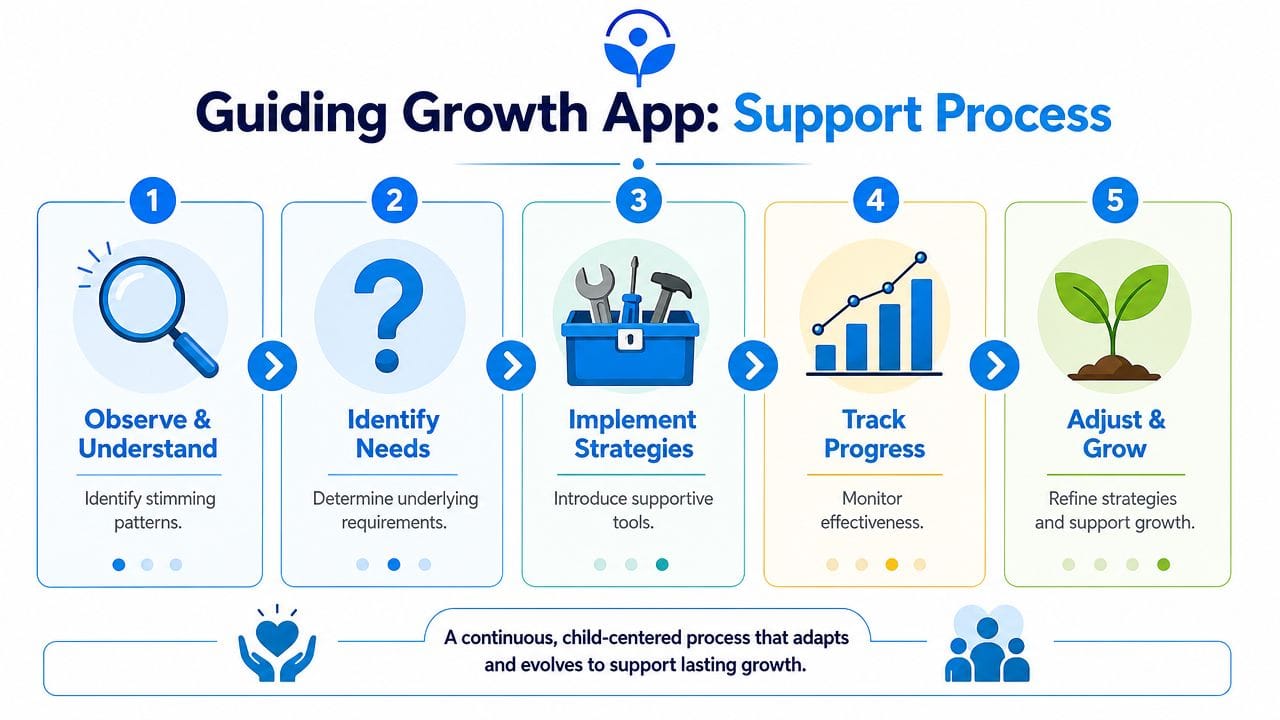
That's the practical value of Guiding Growth. It gives parents one place to track behaviors such as hand flapping, pacing, humming, meltdowns, shutdowns, and other daily patterns alongside sleep, diet, routines, appointments, and care notes. The app also supports quick voice logging, which matters when you're trying to capture what happened in the middle of real family life, not after you've forgotten the details.
The bigger benefit is what happens next. Clear logs and visual patterns can make conversations with therapists, doctors, teachers, and caregivers much more specific. Instead of saying, “He does this a lot,” you can show when it happens, what tends to trigger it, and which supports work.
For a parent trying to understand stimming ADHD vs autism, that shift matters. Behavior becomes less mysterious. Your response becomes more targeted. And your child gets support based on their real needs, not assumptions.
If you're tired of scattered notes and second-guessing, Guiding Growth can help you track stimming, triggers, sleep, routines, and outcomes in one place so you can spot patterns faster and support your child with more confidence.