You're sitting at a conference table with a draft IEP in front of you. The pages are full of phrases like “will improve social skills” and “will make progress in communication.” You read them, nod because everyone else is nodding, and still feel that sinking thought: This doesn't sound like my child.
That feeling is common. It doesn't mean you're unprepared. It means the process is often written for systems, not for families.
Good IEP targets for autism should do something very simple. They should describe who your child is now, what support would make daily life easier, and how the team will know whether that support is helping. When the goals are clear, the meeting changes. You stop reacting to school jargon and start shaping the plan.
Table of Contents
- From Overwhelmed to Empowered in Your IEP Meeting
- Start with Your Child's Strengths and Needs
- How to Write Meaningful and Measurable IEP Goals
- Sample IEP Goals for Key Development Areas
- Turn Goals into Progress with Smart Data Tracking
- Navigating the IEP Meeting with Confidence
From Overwhelmed to Empowered in Your IEP Meeting
A parent once described her IEP meeting to me like this: “Everyone was kind, but I still felt outnumbered.” That's the experience many families have. The team may be warm and professional, yet the process still feels lopsided when the school brings reports, acronyms, and draft goals that were written before you even sat down.

If that's where you are, start with this truth. You do not need to become a lawyer, a therapist, and a teacher overnight. You need a workable way to describe your child clearly and respond to vague goals with better ones.
Some of the hardest meetings happen when the document focuses on compliance instead of support. A child who avoids group work may get a goal about “participating appropriately” when the underlying issue is sensory overload, unclear expectations, or a lack of communication support. A child who scripts, flaps, or looks away may be treated like the priority is making them appear more typical. That approach usually creates stress, not growth.
What changes the meeting
The shift happens when you walk in with observations that are concrete and goals that are functional. Instead of saying, “I'm worried about recess,” you can say, “Transitions into recess are smooth, but coming back to class is hard when the room is loud and the routine changes.” That opens a real problem-solving conversation.
Practical rule: If a goal sounds polished but you still can't picture what your child will actually do, the goal isn't clear enough.
Parents often feel calmer when they've already sorted their concerns before the meeting. A short parent note, behavior patterns, examples from home, and a few draft targets can change the whole tone. If overwhelm is a big part of your experience, this guide on handling autism parenting overwhelm can help you steady yourself before you advocate.
What empowered advocacy actually looks like
Being prepared doesn't mean combative. It means you can do things like:
- Ask for plain language: “Can you tell me what this goal would look like during a normal school day?”
- Push for function: “How will this skill help my child communicate, regulate, or participate more independently?”
- Request a rewrite: “This feels too broad. Can we narrow it to one observable skill?”
- Bring the focus back to dignity: “I want goals that support self-advocacy, not masking.”
That's the heart of effective IEP targets for autism. They should help your child access school as themselves, with support that fits who they are.
Start with Your Child's Strengths and Needs
The strongest IEP goals don't begin with the annual goal page. They begin with a full, honest picture of your child. Schools call this the present levels section. Parents usually understand it better when we call it what it really is: your child's current story.
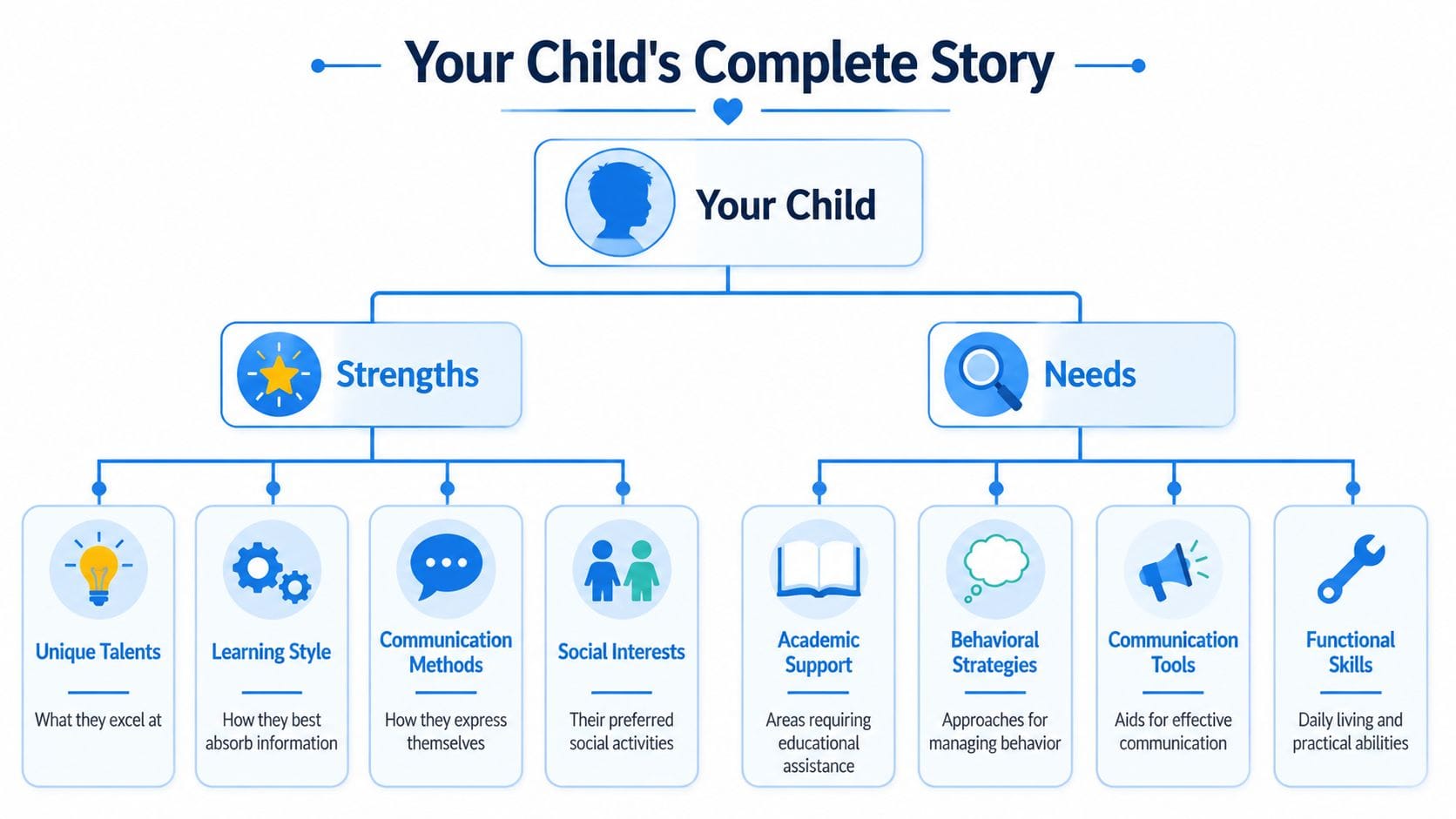
A weak profile sounds like a checklist of deficits. A useful profile tells the team what helps, what gets in the way, and what matters to your child. If your child is strongly motivated by trains, Minecraft, animals, letters, movement, or routines, that belongs in the discussion. If they communicate more clearly with visuals, AAC, gestures, or written choices, that belongs there too.
Tell the whole story, not just the hard parts
When families leave out strengths, schools often build bland goals that miss the child entirely. A child's strengths aren't “nice extras.” They're a powerful tool.
Try organizing your notes into two columns before the meeting.
| Strengths to highlight | Needs to describe clearly |
|---|---|
| Interests and motivators | Communication breakdowns |
| Sensory preferences | Triggers and stressors |
| Ways they learn best | Areas where support is needed |
| Social interests, even if unconventional | Daily situations that lead to stuck moments |
That fuller picture matters because the wrong target can waste a school year. For example, if a child already connects with peers through shared play but struggles to enter noisy groups, a generic “social skills” goal won't help much. A goal about joining a preferred activity with support might.
The best starting point is not “What looks behind?” It's “What would make school feel safer, easier, and more accessible for this child?”
What to document before the meeting
You don't need a polished binder. You need patterns.
For a few weeks before the meeting, notice what happens in daily life. Keep it simple and concrete.
- Communication: When does your child get their needs across easily, and when do they get stuck?
- Regulation: What tends to lead to shutdowns, meltdowns, refusal, or withdrawal?
- Learning: What kind of instruction helps most, such as visuals, repetition, movement, modeling, or reduced language?
- Independence: Which routines can they do with ease, and where do they still need prompts?
- Connection: What kinds of peer or adult interactions seem genuine and enjoyable for them?
Write short observations, not essays. “Asked for a break with gesture when noise increased.” “Refused worksheet but completed same task on whiteboard.” “Talked at length about favorite topic with cousin, but not during open-ended class discussion.” Those kinds of notes are gold in an IEP meeting because they're specific.
A lot of parents intend to track this and then life happens. That's normal. The problem with scattered notes in your phone, papers in the kitchen, and memory-based reporting is that important context gets lost. If you want a practical system, a tool that lets you log patterns as they happen can make the present levels section much stronger without creating more paperwork.
Build a baseline you can actually use
When you bring observations, the team can write better IEP targets for autism because the baseline is real. You move from “He struggles with transitions” to “He transitions well with visual warning and has more difficulty when the next activity is nonpreferred or the room is loud.” That difference matters.
A useful parent input summary often includes:
- What your child does well
- What is hard right now
- What supports seem to help
- What daily-life skills would make the biggest difference
- What you want the team to prioritize
That's the foundation. Without it, goals tend to drift toward whatever is easiest for adults to measure.
How to Write Meaningful and Measurable IEP Goals
Many school teams use SMART goal language, but not all SMART goals are meaningful. A goal can be technically measurable and still be a poor fit if it pushes compliance, ignores communication differences, or targets appearance over access.
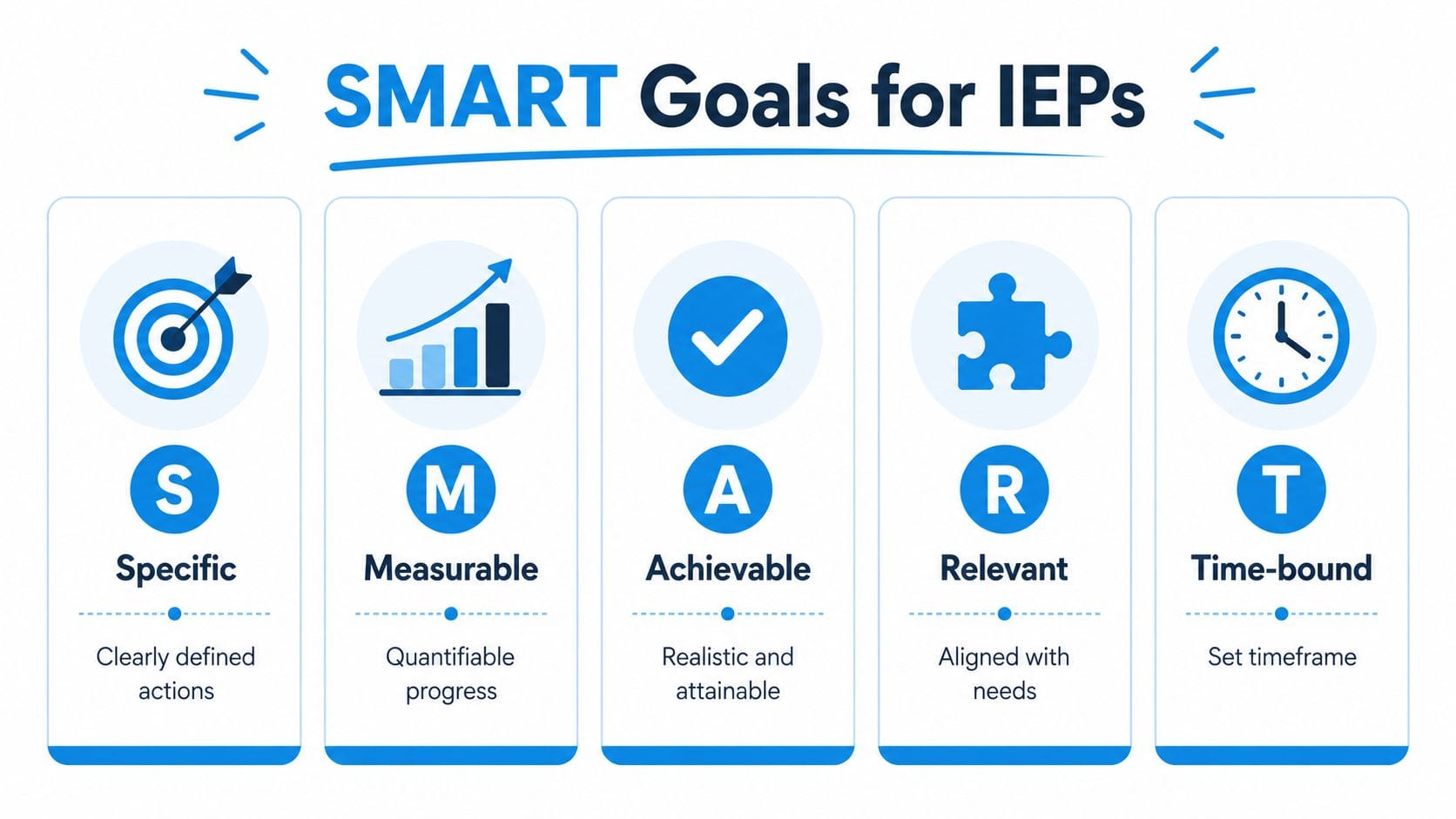
The test is simple. A good goal should tell you exactly what skill is being taught, how progress will be observed, and why the skill matters in your child's real life.
What SMART should look like in real life
Specific means one skill at a time.
“Will improve social skills” is too vague. “Will use a preferred communication method to greet a familiar peer during structured arrival routines” is specific enough to teach and observe.
Measurable means the team names what counts as success.
That may be frequency, independence, consistency across settings, or a clear performance pattern. If the goal doesn't tell you what data will be collected, ask for a rewrite.
Achievable means the target fits the child you have now, not the child someone wishes they were.
Goals should stretch, not set your child up to fail. A child who is just beginning to use AAC for requesting doesn't need a broad conversational goal first.
Relevant means the skill improves access, autonomy, communication, regulation, or participation.
Here, neurodiversity-affirming practice is most critical. Goals should help your child manage school as themselves, not train away harmless autistic traits.
Time-bound means there's a review point.
A goal without a timeline tends to drift. A timeline creates accountability and gives the team a natural point to review whether the strategy is working.
Here's the difference in practice:
| Weak goal | Stronger goal |
|---|---|
| Will improve behavior | Will request a break using speech, gesture, or AAC when overwhelmed during class routines |
| Will improve social skills | Will join a shared activity with a peer around a common interest using a taught entry phrase or support card |
| Will stay on task | Will begin assigned work after the teacher provides the agreed visual cue and materials support |
What does not belong in a neurodiversity-affirming goal
Some goals look polished but send the wrong message.
Avoid targets that focus on:
- Forced eye contact
- Quiet hands or still body requirements when movement is not harmful
- “Appropriate” behavior without defining the support need
- Reducing stimming that helps regulation
- Making a child sound or look less autistic
Those goals often teach masking. They may make adults more comfortable, but they don't usually increase safety, learning, or communication.
If a goal would make your child seem easier to manage but not actually more supported, it needs a second look.
A stronger replacement asks, “What function is missing here?” If a child leaves their seat, do they need movement, a break request, a more accessible task, or clearer expectations? If a child scripts during stress, do they need regulation support rather than correction? Functional thinking leads to better IEP targets for autism every time.
One more practical point. Keep annual goals focused. When a goal tries to capture too many steps at once, the school can report vague progress without showing meaningful change. Narrow goals are easier to teach and easier to monitor.
Sample IEP Goals for Key Development Areas
Parents often ask for examples because it's easier to react to real language than to abstract advice. That makes sense. The caution is that sample goals should be adapted, not copied wholesale. The right goal depends on your child's baseline, communication style, and school day.
Sample Neurodiversity-Affirming IEP Goals and Objectives
| Domain | Sample Goal | Sample Measurable Objective |
|---|---|---|
| Communication | During classroom routines, the student will use their preferred communication method, including speech, AAC, sign, gesture, or visual support, to express a need, choice, or request for help. | Given natural opportunities across the school day, the student will independently communicate a need or request in documented observation periods using the agreed support system. |
| Social Engagement | During structured or interest-based activities, the student will engage in shared interaction with peers in a way that is comfortable and authentic for them. | With visual or verbal support as needed, the student will enter a shared activity, respond to a peer, or sustain a brief reciprocal exchange during scheduled peer opportunities. |
| Emotional Regulation | When experiencing frustration, overload, or uncertainty, the student will use an identified regulation strategy or request support before escalation. | In observed moments of dysregulation, the student will access a break, sensory tool, calming routine, or adult support with decreasing prompt dependence across review periods. |
| Daily Living Skills | During school routines, the student will complete age- and context-appropriate self-help tasks with supports matched to their needs. | Using visuals, modeling, or environmental supports, the student will complete targeted routines such as unpacking, toileting steps, lunch cleanup, or materials organization with increasing independence. |
| Academics | During academic instruction, the student will demonstrate understanding using accessible response formats and supports that match their learning profile. | Given adapted materials, visual supports, or assistive technology, the student will complete targeted academic tasks and show skill growth through work samples and teacher data. |
| Executive Function | The student will use a support system to start, continue, and finish classroom tasks with less adult prompting. | With a checklist, visual schedule, first-then board, or teacher cue, the student will begin and complete identified classroom routines with documented reduction in support over time. |
| Self-Advocacy | The student will communicate when they need clarification, help, more time, reduced sensory input, or a break. | During naturally occurring challenges, the student will use a taught phrase, card, gesture, or AAC message to advocate for support in school settings. |
| Transitions | The student will move between activities using supports that reduce uncertainty and overload. | With advance notice, visual schedule access, or transition routine, the student will complete identified transitions with reduced distress and improved recovery when routines change. |
A few things make these stronger than old-style goals. They don't assume speech is the only valid communication. They don't treat autistic body language as a problem to erase. They focus on access, not appearances.
If you're brainstorming social or communication goals, joint attention and autism support ideas can also help you think about how connection develops in real daily moments, not just in contrived drills.
When you bring sample language to a meeting, use it as a starting point. Ask the team to personalize the setting, support level, and data method so the goal becomes usable.
Turn Goals into Progress with Smart Data Tracking
A goal can look excellent on paper and still go nowhere if nobody tracks it in a consistent way. That's where many IEPs break down. The team writes a measurable target, but the actual progress monitoring becomes scattered notes, memory, or broad comments on a report card.
Parents run into the same problem at home. You mean to track break requests, tough transitions, sensory overload, or after-school recovery, but by bedtime you can barely remember the sequence of the day. Paper logs sound simple until you're trying to use them during real life.
Why paper tracking breaks down
Manual tracking usually fails for practical reasons, not because families or educators don't care.
- It takes too long: Writing full notes in the middle of a hard moment isn't realistic.
- It loses context: A tally mark doesn't tell you what happened before or after.
- It stays siloed: Home notes, teacher notes, and therapy notes rarely live in one place.
- It's hard to review: Even when you collect pages of data, it can be difficult to spot patterns quickly.
That's why digital tracking has become so useful across education and support settings. Even outside special education, teams use systems to track enrollments and student progress because centralized records make follow-up and review far easier than disconnected spreadsheets or paper files.
The same logic applies to IEP implementation. If a student has a goal about requesting help, the useful data isn't only whether they did it. It's also the setting, prompt level, likely trigger, and what support made the attempt successful.
Good data should answer two questions. Is the skill growing, and under what conditions does the child use it best?
What useful progress data actually looks like
Useful data is simple enough to capture and rich enough to interpret.
For example, if your child has a regulation goal, a strong log might include:
- the situation
- the early signs of stress
- the strategy offered or chosen
- whether the child accepted support
- how the moment ended
If your child has a communication goal, you might track:
- what they wanted or needed
- how they communicated
- whether support was needed
- whether the communication worked
That kind of tracking makes meetings more productive because you can stop debating impressions. You can say, “Requests for breaks are happening more during writing than during reading,” or “They communicate more independently when visual choices are offered first.” Those observations lead directly to better supports.
Here's a useful midyear check-in to consider:
| If the data shows this | The team should ask this |
|---|---|
| Little or no progress | Is the goal too hard, too vague, or being taught inconsistently? |
| Progress in one setting only | What support is helping there, and how can it carry over? |
| High prompting with low independence | Are we measuring the right thing, or fading support too slowly? |
| Progress followed by regression | Did the routine, environment, demands, or staffing change? |
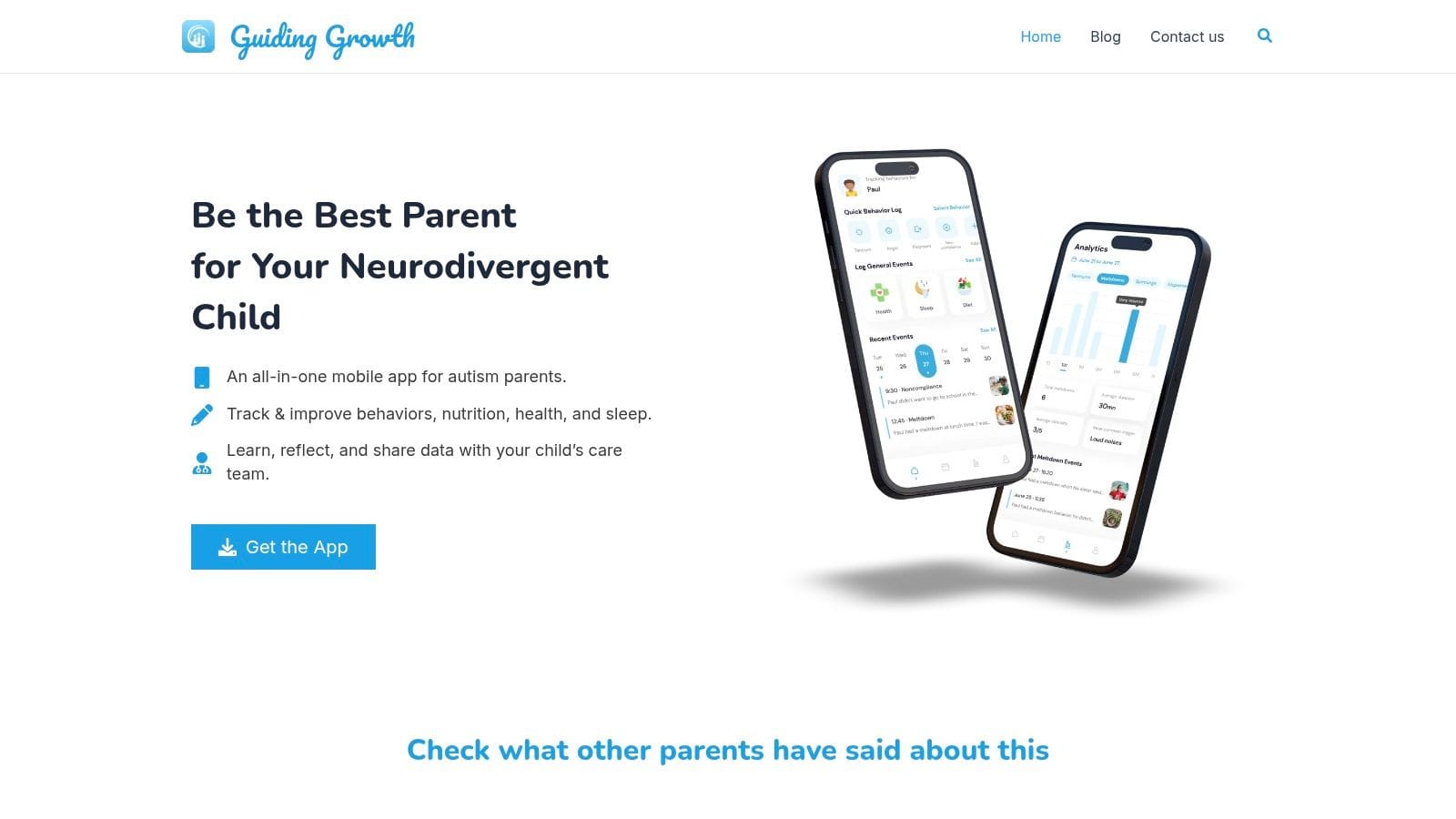
For parents who want a more realistic way to keep track of behavior, regulation, routines, and context without drowning in paperwork, a dedicated behavior tracking app for autism families can make the data collection piece far more manageable.
A quick walkthrough can help you picture what that looks like in daily life:
The biggest win isn't the chart itself. It's that the chart gives you a shared reference point. Instead of hearing “He's doing fine” or “She's struggling lately,” you can ask to look at the actual pattern and decide what to adjust.
Navigating the IEP Meeting with Confidence
By the time the meeting arrives, your job isn't to remember every concern on the spot. Your job is to bring the clearest version of your child's needs and respond calmly when the draft misses the mark.
That starts before you walk in. Review the proposed goals and highlight anything vague, compliance-based, or disconnected from daily function. Bring your parent input summary. If you've tracked patterns over time, condense them into a short format the team can scan easily.
Bring a plan, not just concerns
A simple meeting packet can include:
- A one-page child profile: strengths, interests, communication style, triggers, and supports that help
- A short priority list: the few areas that would make school more accessible right now
- Draft goal language: not perfect legal wording, just clear ideas
- Examples from daily life: brief notes that show where support is needed
This changes the tone. You're no longer saying, “I don't like these goals.” You're saying, “Here is what I think would better match my child's actual school experience.”
If the team proposes something broad like “improve peer interaction,” ask practical follow-up questions.
- Where would this happen most naturally?
- What support will be provided?
- How will progress be measured in a way that reflects real participation?
- How will we know if the goal is helping quality of life, not just outward compliance?
Phrases that keep the meeting collaborative
You don't have to choose between being agreeable and being effective. You can be warm, clear, and firm at the same time.
Some phrases that work well:
“I want to make sure this goal reflects my child's actual communication style.”
“Can we narrow this so we're measuring one meaningful skill instead of a broad area?”
“What baseline are we using for this target?”
“I'd like the team to consider a replacement skill here, not just reduction of the behavior.”
“Can we try this approach for a short review period and look at the data together?”
That last one matters when there's disagreement. You don't always need to win the whole argument in the room. Sometimes the best move is to turn a debate into a shared experiment with a scheduled review.
If you leave with one mindset, let it be this: your child does not need an IEP that sounds impressive. Your child needs one that people can implement, monitor, and adjust. Strong IEP targets for autism are clear, humane, and functional. They help adults support the child in front of them, not the child they expect them to imitate.
If you want one place to organize observations, routines, behavior patterns, and progress notes before your next IEP meeting, Guiding Growth gives parents a practical way to turn daily life into usable insight. It's built for busy autism families who need less paper, less guesswork, and clearer information they can bring to the table.