Your child is on the floor, intently focused on lining up toy cars by color. Ten minutes later, they're crashing into couch cushions, chewing a shirt collar, or refusing to touch finger paint. If you're a parent of a 4-year-old, that mix of fascination, avoidance, energy, and overwhelm can feel confusing fast.
Most parents I talk with aren't looking for “more toys.” They want to know what their child is trying to tell them through behavior. They want fewer meltdowns, smoother transitions, and play that is helpful. That's where sensory toys can be useful, but only when you choose them with your child's nervous system in mind.
Sensory play isn't fluff or a trend. Sensory play activities build specific nerve connections in the brain's pathways that enable children to complete complex tasks, directly supporting the development of language, motor skills, cognitive growth, and social interactions from birth through early childhood, as explained by Cleveland Clinic's overview of sensory play. For a 4-year-old, that means the right play experiences can support both learning and regulation at the same time.
Table of Contents
- Understanding Your 4-Year-Old's Sensory World
- The Six Key Sensory Systems Your Child Uses
- How to Choose Safe and Effective Sensory Toys
- Top Sensory Toy Ideas for Your 4-Year-Old
- Integrating Sensory Play into Your Daily Routine
- How to Track What Works with Guiding Growth
- Conclusion Empowering Your Child's Sensory Journey
Understanding Your 4-Year-Old's Sensory World
At age 4, many children are moving between pretend play, hands-on exploration, and more structured tasks. That's why you may see big swings. A child can love building a tower but hate sticky fingers. They may seem calm while kneading dough, then fall apart during a loud birthday party.
That doesn't automatically mean something is wrong. It usually means your child's brain is sorting, filtering, and reacting to sensory input in a very individual way.
Some children seek sensation. They jump, crash, spin, squeeze, hum, chew, and touch everything. Others avoid certain input. They pull away from wet textures, cover their ears, resist bright lights, or refuse certain clothing. Many children do both, depending on the situation. A child might crave movement but dislike messy hands. That mix is common.
What sensory needs really mean
A helpful way to think about sensory needs is this. Your child's nervous system has preferences, just like it has food preferences. Some kinds of input help them feel organized and ready. Other kinds make them feel flooded, irritated, or tired.
When parents understand that difference, behavior starts making more sense. Refusing glue isn't always defiance. Constant climbing isn't always “bad behavior.” Sometimes a child is solving a body problem the best way they know how.
Practical rule: Before asking, “How do I stop this behavior?” ask, “What sensory input might my child be seeking or avoiding right now?”
Why families are paying closer attention
More families, educators, and clinicians are looking for developmentally appropriate sensory tools. The broader market reflects that shift. The global sensory toys market is valued at USD 2.46 billion in 2026 and is projected to reach USD 6.16 billion by 2035, according to Business Research Insights on the sensory toys market. That projection points to growing awareness of neurodevelopmental needs, especially in early childhood.
Still, more products don't automatically mean better choices.
For parents shopping for sensory toys for 4 year olds, the key question isn't “What's popular?” It's “What helps my child feel safe, focused, and capable?” That's the lens that makes toy choices more useful and less overwhelming.
The Six Key Sensory Systems Your Child Uses
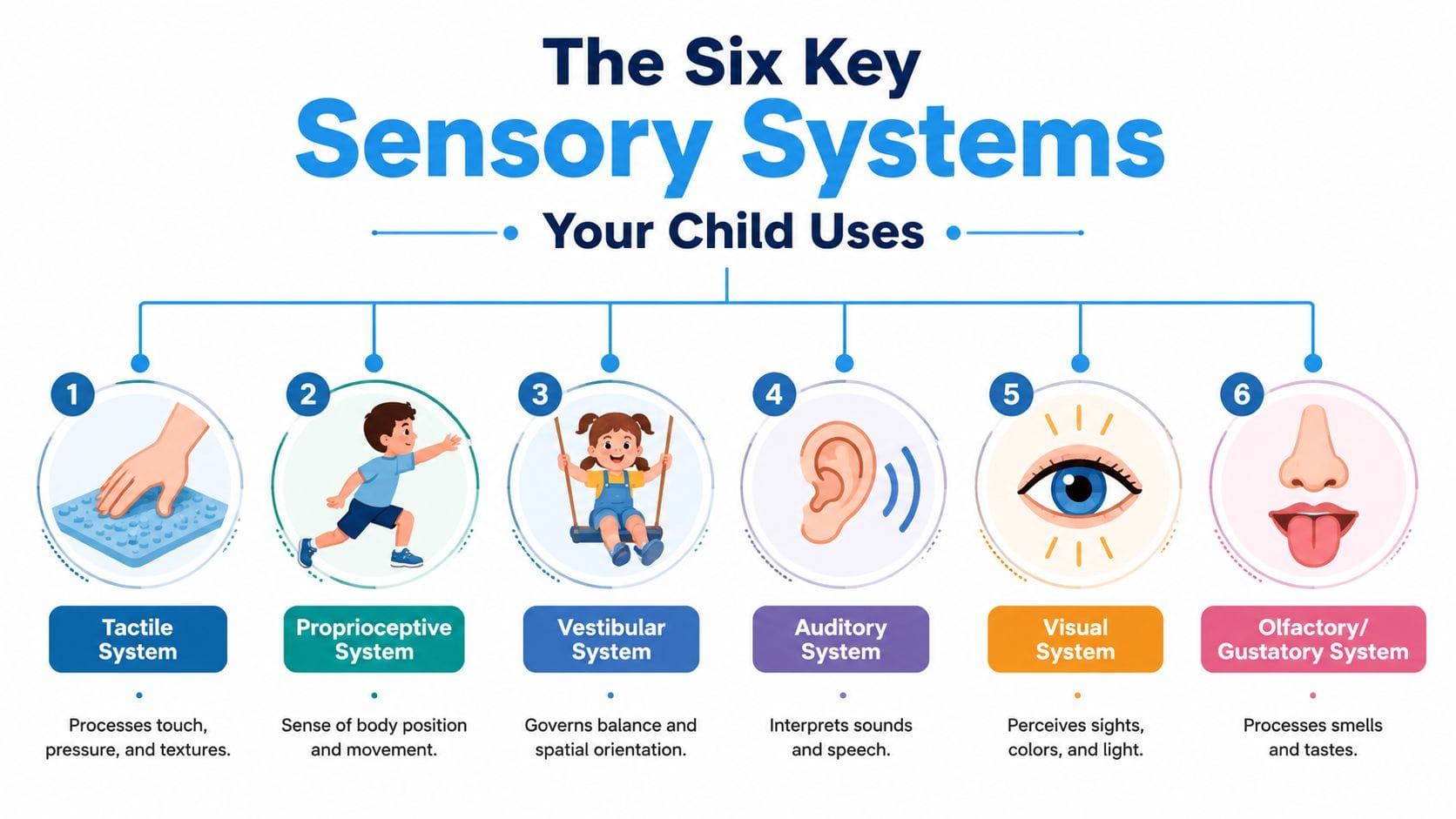
Why this matters now
Parents often hear about the “five senses,” but daily life is shaped by more than sight, sound, smell, taste, and touch. For many 4-year-olds, especially those with sensory differences, body awareness and movement are just as important.
If you know which sensory system a toy supports, you can make better choices. You stop buying random items and start picking tools with a job to do.
A simple way to understand each system
Here's a plain-language guide you can use at home.
| Sensory System | What It Governs | Example Toy Category |
|---|---|---|
| Tactile | Touch, pressure, texture | Kinetic sand or playdough |
| Proprioceptive | Body position and muscle effort | Weighted item or push-pull toy |
| Vestibular | Balance and movement | Mini trampoline or balance beam |
| Auditory | Sound and rhythm | Shaker or rain stick |
| Visual | Light, color, movement | Glitter tube or light-up ball |
| Olfactory/Gustatory | Smell and taste, including oral input | Scented markers or safe oral sensory tool |
Tactile is the touch system. It helps your child notice whether something feels squishy, bumpy, sticky, soft, or rough. A child who loves burying hands in rice or squeezing clay is often looking for tactile input. Good examples include kinetic sand, textured puzzles, and sensory bins.
Proprioceptive is your child's internal GPS. It tells the body where it is and how much force to use. Pushing a laundry basket, carrying books, or squeezing playdough all wake up this system. This is one reason tactile materials can do double duty. For preschoolers, NAPA Centre's occupational therapy guide to sensory toys explains that kinetic sand gives medium-intensity resistance, which can support fine motor strength and bilateral hand coordination.
Vestibular is the movement and balance system. It lives in the inner ear and responds when your child spins, swings, bounces, or climbs. This system often shows up in the child who never stops moving, or the child who gets carsick easily and avoids motion.
Auditory helps your child process sound. Some children seek sound through humming, banging, or repeating phrases. Others get overwhelmed by background noise and need quieter input. Toys like shakers and rain sticks can offer controlled sound instead of chaotic sound.
Visual involves more than seeing clearly. It includes how a child handles brightness, patterns, movement, and visual complexity. Light-up balls, glitter tubes, and colour-changing mats can be calming for some children and overstimulating for others.
Olfactory and gustatory, the smell and taste systems, often connect to oral sensory needs. A child who chews sleeves, mouths toys, or strongly reacts to smells may be using this system to regulate.
Some of the most useful sensory toys don't “look therapeutic.” They simply give the child the kind of input their body has been asking for.
How to Choose Safe and Effective Sensory Toys
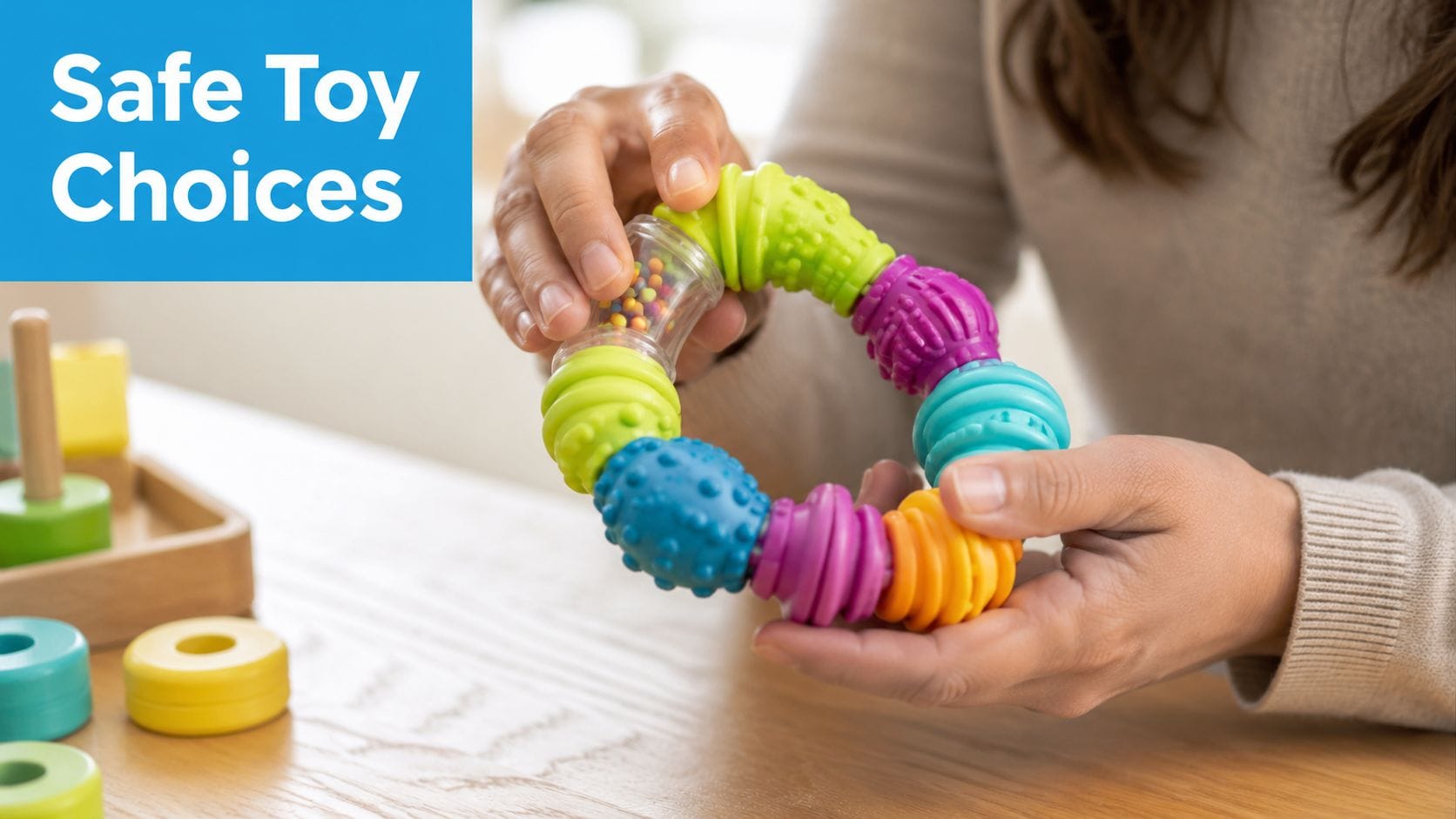
Buying sensory toys can get expensive quickly, especially if you're choosing by trial and error. A better approach is to use a short decision filter before you buy anything.
Start with your child's pattern
Watch your child for a few days and write down what they naturally do.
- Movement-seeking behavior: jumping off furniture, spinning, crashing into cushions, hanging upside down
- Touch-seeking behavior: touching walls, rubbing fabrics, digging into bins, smearing paint
- Avoiding behavior: refusing hair brushing, backing away from noise, resisting glue or messy play
- Oral sensory signs: chewing sleeves, biting straws, mouthing toys
You're not trying to label your child. You're trying to spot patterns.
A child who constantly chews may need different support than a child who avoids all wet textures. If oral input is a frequent need, this guide to sensory chew toys for autism can help you compare practical options.
Use a safety filter first
Safety comes before sensory benefit. The U.S. Consumer Product Safety Commission age determination guidelines for toys state that sensory toys for 4-year-olds should have soft, sturdy materials, rounded edges, and bright contrasting colors. That fits both safety and development, since many children this age are still learning through cause and effect.
Check for these features before you buy:
- Rounded edges: hard corners can turn active play into accidental injury
- Sturdy construction: weak seams, peeling parts, or easily broken plastic won't hold up to preschool use
- Washable surfaces: many sensory toys get used with hands, mouths, floors, and food nearby
- Simple supervision needs: if a toy requires constant panic-level monitoring, it may not be the best daily fit
Match the toy to the goal
Parents often get stuck, knowing their child likes a toy but not understanding its developmental benefits.
Try this simple pairing:
- For fine motor strength, choose playdough, kinetic sand, tongs, or textured puzzles.
- If your child needs calming body input, think weighted lap pads, pushing activities, or deep-pressure play.
- For movement regulation, use a mini trampoline, scooter board, or balance path.
- During transitions, visual timers and predictable sensory tools often work better than verbal reminders alone.
If a toy is fun but leaves your child more scattered, it may not be the right fit for that moment of the day. Effective sensory toys for 4 year olds should support regulation, not just excitement.
Top Sensory Toy Ideas for Your 4-Year-Old
Lists can get shallow fast, so instead of giving you random product names, I want to show you how these toys function in real life.
Hands-on options for touch and hand strength
For many 4-year-olds, tactile play is the easiest starting point because it can happen at a table and doesn't require much setup.
Kinetic sand works well for children who like resistance but don't enjoy loose mess. Scoop it, hide little objects in it, or press toy animals in to make tracks. It gives the hands something to push against.
Playdough or puffy clay is widely recommended for ages 3 to 5. Parents.com's age-by-age sensory toy guide specifically names Play-Doh or puffy clay as a strong option for this age group. Roll snakes, pinch “cupcakes,” or hide beads inside for a treasure hunt.
Textured puzzles are useful for the child who wants a task, not just open-ended play. They combine touch with problem-solving. Some children stay with them longer because there's a clear finish line.
A nice option if you want something more gift-like is this curated Smartmax activity set from NINI and LOLI. It offers a mix of sound and sensory exploration without being overly busy.
Movement toys that help the body organize
Some children don't need more tabletop play. They need movement first.
According to New York Magazine's Strategist guide to sensory toys, vestibular-input toys such as mini trampolines, balance beams, and Pikler triangles can support gross motor regulation, and a short burst of vestibular play before a demanding activity can act like a reset for the nervous system. In practice, that can look like bouncing before meals or walking a balance path before sitting for therapy.
Try these:
- Mini trampoline: use short jumping rounds, then pause for a calm activity
- Wooden balance beam: set it up as a “river crossing” game with stuffed animals
- Scooter board: have your child lie on their tummy and “deliver mail” across the room
- Yoga ball: gentle bouncing while singing a simple rhythm can help some children settle
A movement toy isn't always for “burning energy.” Often it helps a child feel where their body is, which makes the next task easier.
There's one important nuance here. Some children are extreme sensory seekers. Standard suggestions like a basic fidget or casual swinging may not be enough. NAPA Center's discussion of sensory toys and OT needs notes that families often need help calibrating sensory intensity for these children. If your child seems wilder after light sensory input, they may need stronger proprioceptive or movement input, not more tiny hand fidgets.
Visual, sound, and oral tools that fill common gaps
Visual toys can help when a child needs something mesmerizing and predictable. Good examples include glitter tubes, light-up balls, and colour-changing mats. Talking Turtle's overview of sensory toys also highlights textures such as squishy, bumpy, soft, and rough, along with instruments like shakers, bean bags, and rain sticks.
For sound-sensitive children, the most helpful “toy” may be a support tool. If noise is causing distress in stores, birthday parties, or the car, this guide to the best noise-cancelling headphones for autism is worth reviewing.
Oral sensory needs often show up as chewing, licking, or constantly wanting snacks. In those cases, safe oral tools can make a big difference, especially during car rides, waiting rooms, or transitions.
Integrating Sensory Play into Your Daily Routine
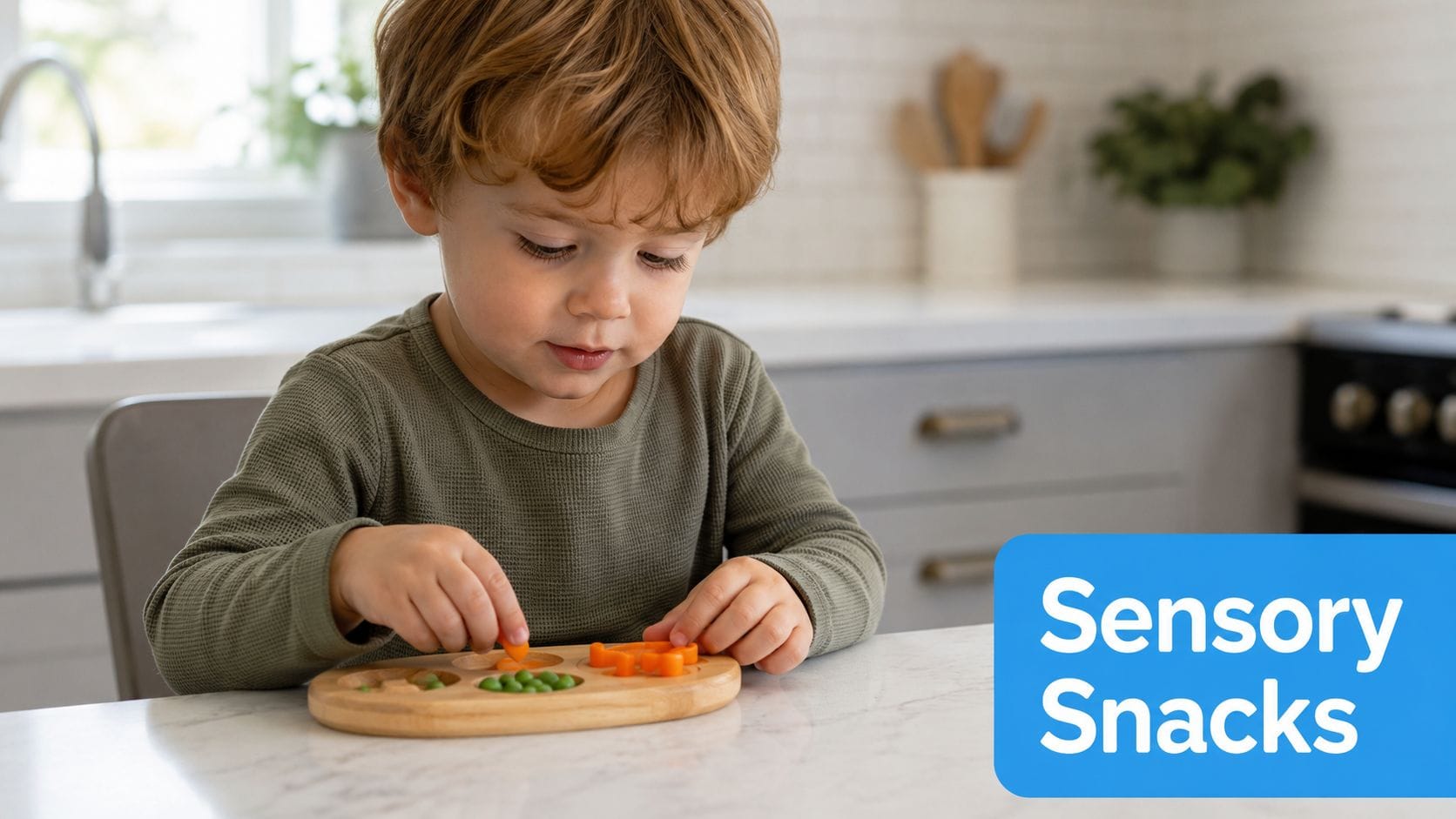
The biggest mistake I see is saving sensory play for when things are already falling apart. By then, your child's nervous system may be too overloaded to use the toy well.
A better approach is to offer small sensory supports across the day. I call these sensory snacks. They're brief, practical, and built into routines you already have.
Use sensory snacks instead of waiting for overload
Think in short bursts, not long therapy-style sessions.
- Before getting dressed: let your child push against the wall, carry pajamas to the hamper, or squeeze playdough for a minute
- Before meals: offer a few jumps, animal walks, or chair pushes if your child struggles to sit
- After preschool: use a sensory bin, bean bag toss, or quiet visual toy before asking questions
- During car rides: provide a safe oral sensory tool, a fidget, or calming music if transitions are hard
Children with sensory differences often do better when input is predictable. Repeating the same small routine can help the body feel safer.
Build support into transitions
Transitions are hard because they require the brain and body to shift gears quickly. Movement, pressure, and structure can soften that shift.
Helpful sensory tools for children with special needs can include weighted blankets or lap pads, noise-canceling headphones, vibrating toys, swings, balance boards, wobble cushions, and visual timers, as outlined in BBM Academy's age-by-age sensory toy guide.
If you'd like a quick demonstration of sensory-based play ideas in action, this video is a useful starting point:
Try attaching one sensory support to one predictable part of the day. For example, use a wobble cushion during tabletop play, a visual timer before cleanup, or a swing before bath time. Keep it simple enough that you can repeat it.
The best routine isn't the most creative one. It's the one your family can keep using on an ordinary Tuesday.
How to Track What Works with Guiding Growth
Parents often tell me, “I think the trampoline helps,” or “I'm pretty sure the headphones prevented a meltdown last week.” That kind of observation matters, but memory is slippery. After a hard day, most details blur together.
Why memory alone usually fails
Sensory support works best when you can notice patterns over time. Maybe your child does well with playdough in the morning but avoids it after preschool. Maybe a weighted lap pad helps during reading but not during meals. Those details are hard to hold in your head, especially if you're also managing appointments, sleep issues, and daily routines.
Helpful sensory tools can include weighted blankets, noise-canceling headphones, and swings, and parents can use a behavior tracking app built for autism and daily care to log when those tools helped prevent a meltdown and share that information with ABA therapists and pediatricians. That kind of record turns “I think it helped” into something more concrete.
What to log so patterns become visible
You don't need a perfect spreadsheet. You just need a repeatable way to notice what happened before, during, and after sensory play.
Log simple details like:
- The toy or activity: mini trampoline, kinetic sand, weighted lap pad, scooter board
- Timing: before preschool, after dinner, during a transition, before therapy
- Behavior change: calmer body, less chewing, more focus, quicker recovery, no change
- Context: poor sleep, skipped snack, noisy room, sibling conflict
Sensory needs are not standalone issues; sleep, food, transitions, and environment all affect how a child responds.
A useful system should also help you share patterns with other adults. If your occupational therapist, ABA provider, teacher, or pediatrician can see the same notes you're seeing, everyone can make better decisions from the same information. That lowers guesswork and helps the care team stay consistent.
Conclusion Empowering Your Child's Sensory Journey
Supporting a 4-year-old's sensory needs doesn't require you to become a therapist overnight. It starts with noticing. What does your child seek? What do they avoid? Which kinds of input help them feel more settled, more focused, or more able to play?
The best sensory toys for 4 year olds aren't the flashiest ones. They're the ones that fit your child's sensory profile, meet basic safety needs, and make daily life easier. Sometimes that's kinetic sand at the kitchen table. Sometimes it's a balance beam in the hallway. Sometimes it's headphones, a visual timer, or a weighted lap pad during a hard transition.
When you combine thoughtful toy choices with simple routines and clear tracking, you stop guessing and start learning what helps your child.
If you want one place to organize sensory observations, behavior patterns, routines, and care-team communication, Guiding Growth makes that process much easier. It helps you turn everyday moments into useful insight so you can support your child with more confidence and less guesswork.