You know the moment. Your child has been bouncing off the couch, climbing the back of a chair, pressing their face into a pillow, or chewing the corner of a shirt, and you're left wondering whether this is misbehavior, energy, or something deeper. For many families, that repeating pattern is sensory seeking, a real sensory regulation difference, not a parenting failure or a child trying to be difficult.
The hard part is that it can look messy from the outside. The good part is that once you know what you're seeing, you can respond with more confidence, fewer power struggles, and better notes for the people helping your child.
Table of Contents
- When Your Child Cannot Stop Crashing Into Everything
- What Sensory Seeking Means
- How Seeking Differs from Other Sensory Patterns
- Everyday Examples Across Ages and Settings
- Common Triggers and What Sets Seeking Off
- Evidence-Informed Strategies for Home, School, and Therapy
- Behavior Management, Safety, and Tracking Progress
- Building a Long-Term Support Routine With Your Team
When Your Child Cannot Stop Crashing Into Everything
A parent once told me, “The minute we get home, he turns into a wrecking ball.” That might mean launching into the cushions, spinning in the hallway, or throwing his whole body onto the floor just to feel something intense. If that sounds familiar, you're probably looking at sensory seeking behaviors, and you're not alone.
This pattern shows up in plenty of autistic children, and it's not a rare side note. In a large U.S. population-based study of 25,627 autistic children, 74.0% had documented sensory features, with 70.1% at age 4 and 74.5% at age 8, which tells us sensory differences are part of everyday autistic development across childhood, not an unusual add-on (study). The same study also places these findings within an earlier research range of 53% to 94% for autistic samples (study).
What parents usually notice first
It often starts with movement. Your child may crash into furniture, jump from the last stair, press hard into a couch cushion, or mouth objects that don't belong in their mouth. Sometimes the behavior looks silly or wild, but the child is usually trying to get the nervous system the input it's asking for.
Practical rule: if the behavior seems intense, repetitive, and oddly satisfying to your child, don't jump straight to “won't.” Start with “needs.”
A helpful reframe is this, your child may not be trying to escape your rules. They may be trying to organize their body. That shift matters because it changes what you do next, from punishment to observation, support, and safer alternatives.
What Sensory Seeking Means
A child who keeps throwing themselves into cushions, pressing hard against your body, or seeking out noisy, fast, rough play is often telling you something through behavior. Sensory seeking means a child is drawn to intense, unusual, or prolonged sensory input because their nervous system seems to need more of it to feel settled.
The basic idea behind the behavior
Every child's brain is taking in information from the world all day long. Some children seem to notice enough input quickly, while others keep looking for more. That is why a child may spin, bounce, chew, squeeze, or crash into things. They are not being random. They are trying to reach a sensory level that feels right to them.
A familiar way to explain it is this. The nervous system is like a car radio turned too low. The signal is there, and the system is working, but the child seems to turn the volume up through movement, touch, pressure, sound, or oral input. The goal is not misbehavior. The goal is regulation.
The pattern can show up alongside other sensory responses too. In a study of 100 toddlers with developmental delay, 66.2% showed sensory seeking behaviors, making seeking the most frequent sensory pattern in that cohort, while 61.8% showed over-responsiveness and 54.4% showed under-responsiveness (study). That matters because a child can seek movement and still dislike certain sounds, or crave deep pressure while avoiding light touch.
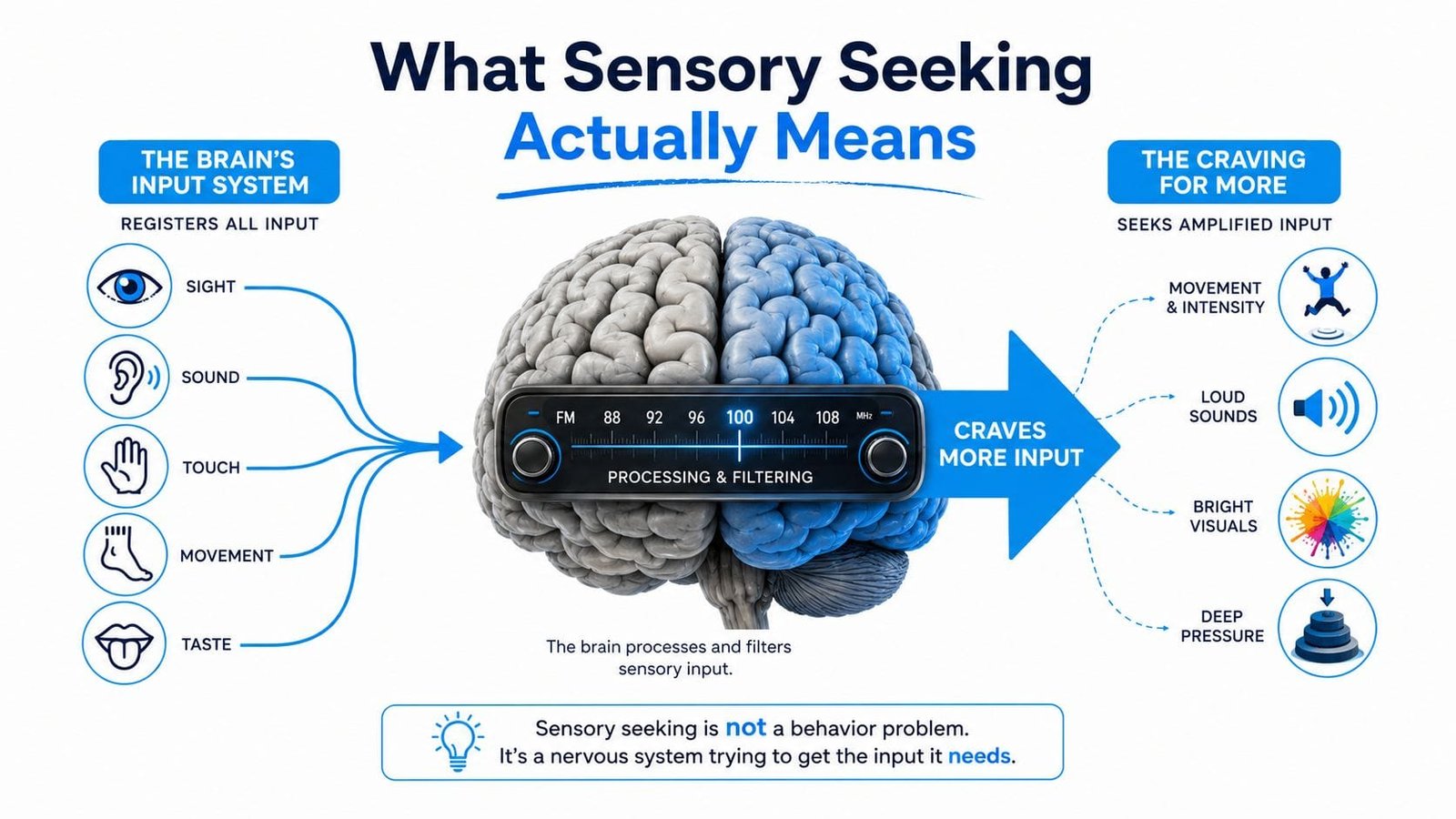
For a parent, the most useful lens is the one you already use at home. You notice what your child reaches for, what calms them, what ramps them up, and what leaves them looking for more. That pattern gives you clues to track, share with teachers or therapists, and use when you decide which activities to offer before the day gets hard.
The simplest way to explain it to a grandparent is, “My child's body seems to need more input than other kids do.” That usually gets the idea across without turning dinner conversation into a clinical lecture.
Children don't always ask for regulation in calm ways. Sometimes they ask with their whole body.
How Seeking Differs from Other Sensory Patterns
At home, the difference often shows up in small moments. One child runs toward the couch and crashes into it with a grin, another covers their ears and backs away from the vacuum, and a third seems to miss the bump into the table until it happens a second time. Those patterns can all happen in the same child on different days, which is why parents usually need to watch the whole picture, not just one behavior.
The clearest way to sort them
A child who seeks input usually goes looking for more sensation. They may spin, jump, press into pillows, mouth a toy, or keep asking for rough play because their body wants stronger feedback. A child who avoids sensory input tends to protect themselves from too much noise, touch, or movement, so they may cover their ears, refuse certain textures, or pull away from a crowded room. A child who under-registers may miss a cue until it becomes obvious, so cold hands, a bumped shoulder, or a change in direction may barely register at first.
A clinical review describes sensory craving or seeking as children who constantly touch, move, and crash into objects, often with little awareness of personal space or boundaries, and notes they can also be clumsy and show decreased safety awareness (review). Parents often see this in everyday routines first, like a child who leans hard into the side of a sibling, throws themselves onto cushions, or keeps seeking movement even after the room has gone quiet.
Why the distinction matters
The same behavior can mean something different depending on the pattern around it. Repetitive behavior research found that the link between sensory seeking and repetitive behaviors was mostly non-significant, except for a significant association with ritualistic or sameness behaviors (study). So a child who spins when excited is giving you one kind of clue, while a child who lines up toys and becomes distressed when the routine changes is showing a different kind of need.
This is why parent observations matter so much. A simple tracking question helps, “What does my child run toward, and what seems to set them off or calm them down?” That answer is often clearer than the label alone, especially when you are trying to share useful details with a teacher, therapist, or another caregiver.
One child may keep asking for the swing, the trampoline, or the crash pad, while another may look for the same kind of input in calmer ways, like chewing, squeezing, or pressing into furniture. A child who gets repeated movement input may also do better with predictable outlets, such as durable spinner play units, because the body is getting the kind of feedback it keeps requesting.
Everyday Examples Across Ages and Settings
A toddler who runs the hallway after lunch, a school-age child who throws themselves into the couch after school, and a teen who chews the hoodie string during homework may all be showing the same basic need in different forms. The age changes, but the sensory pattern often stays familiar, so what you see at home is worth noticing across different settings, not just in the moment.
The range is broader than many people expect. In observational research, examples included jumping on stairs, bouncing on a large ball, trampoline jumping, headstands, throwing the body into furniture or the floor, rough-housing, intense visual or tactile inspection, rubbing objects on the face or body, rolling on carpet, placing objects in the mouth, and pressing objects firmly into the body (study). That's a whole-body way of asking for input, and parents often spot it first because the child keeps reaching for the same kind of feedback again and again.
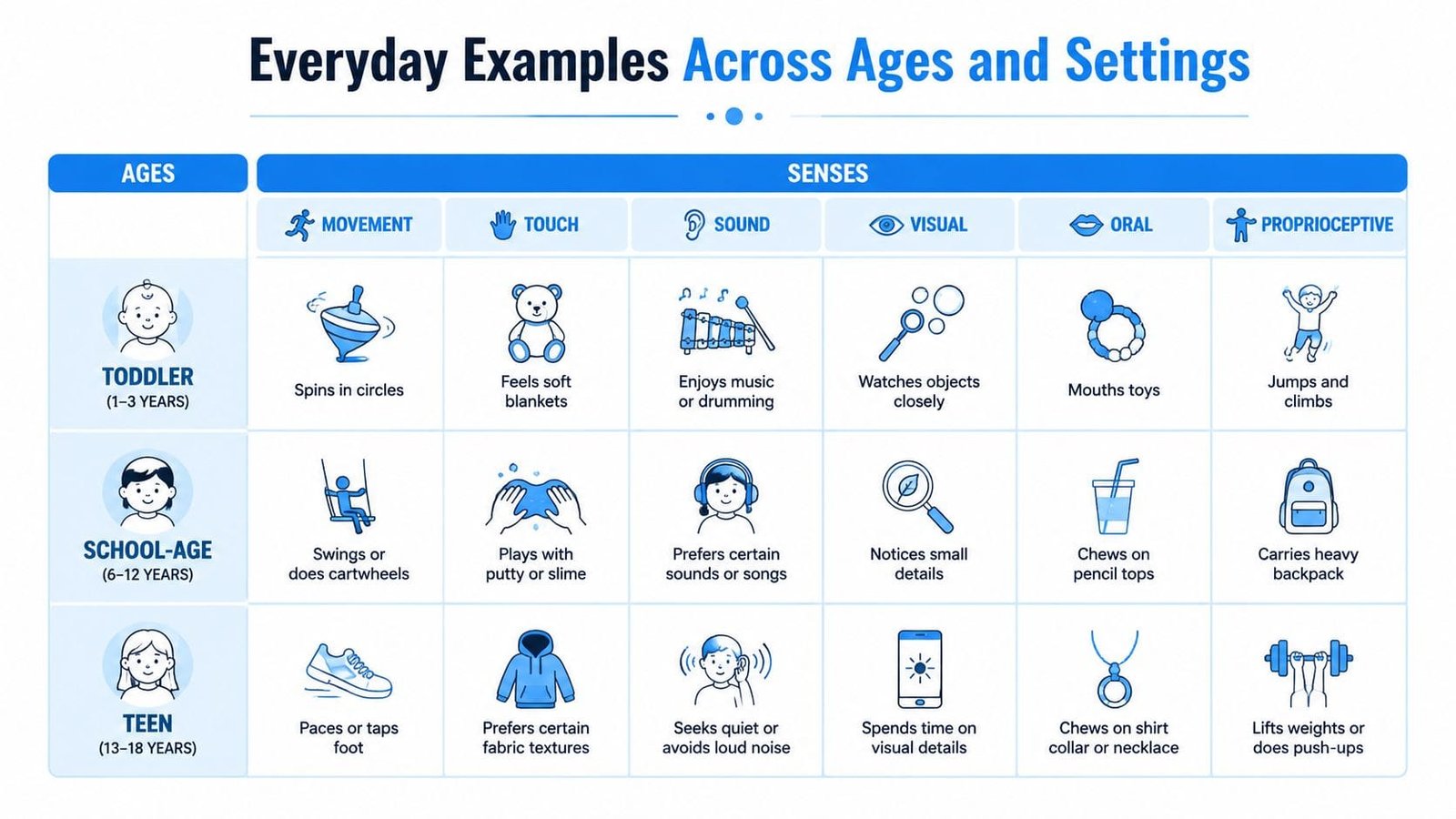
A teen may not crash the same way a preschooler does. They might pace while talking, slam into the bed during a meltdown, chew on shirt collars, or seek rough play with siblings. A school-age child might ask for wrestling, bounce on stairs, or keep touching every object at the store aisle endcap because their body wants more feedback. The outer behavior shifts with age, but the underlying message can look familiar if you start comparing what happens at home, at school, and during busy outings.
One clinical review also notes that children with craving or seeking patterns may be clumsy, have little awareness of personal space, and show decreased safety awareness (review). That is why the goal is not to shame the behavior. It is to keep the child safe while giving the nervous system a better outlet, and that often means writing down the situations where the behavior shows up most clearly.
For families looking at home equipment, durable spinner play units can be one way to think about safe movement input, especially when a child keeps chasing spinning or vestibular play in less controlled ways. If you are trying to sort out patterns, a practical guide like this sensory trigger checklist for parents can help you record what your child seeks, where it happens, and which settings seem to leave them needing more movement or pressure. The key is matching the equipment to the child, not the other way around.
Common Triggers and What Sets Seeking Off
A lot of parents notice the same thing. Their child holds it together during a long outing, a school assembly, or a quiet appointment, then comes home and explodes into movement, crashing, jumping, or nonstop touching. That doesn't mean the child was “fine” and suddenly became defiant. It often means the body is finally safe enough to ask for input.
Patterns that often come before seeking
Under-stimulation is a big one. Transitions can be another, especially when a child goes from sitting still to needing to move without warning. Unpredictable environments, long waits, and stretches where the child's sensory needs aren't being met can all set the stage.
A study of infant siblings of children with autism found that sensory seeking at 18 months predicted later social symptomatology at 36 months, suggesting sensory seeking may serve as an early marker rather than just a general behavior quirk (study). That doesn't mean every seeker has the same developmental path. It does mean parents' observations about timing, context, and change over time are worth writing down carefully.
What to log in real life
A simple note can be enough to start spotting patterns.
- Time of day, because some children seek most after school or before bed.
- What came right before, such as a transition, boredom, or a crowded space.
- What the child did, like crashing, chewing, spinning, or pressing.
- What happened after, including whether the child calmed, escalated, or stayed regulated.
If you track the situation around the behavior, the behavior starts to make sense.
If you want a structured place to start identifying those patterns, this parent-friendly guide on identifying sensory triggers in autism can help you translate daily observations into clearer notes. The point isn't to become a detective overnight. It's to make your own observations easier to trust.
Evidence-Informed Strategies for Home, School, and Therapy
The best support plans don't scatter random tricks around the house. They line up the child's needs, the adults' observations, and the same goal across settings. That's where occupational therapy, home routines, and school supports can work together instead of pulling in different directions.
What a good support plan tends to include
An occupational therapist may look at what kinds of input calm your child, what kinds rev them up, and what situations make the pattern stronger. From there, families often build a sensory diet, which is just a regular plan for offering the right kind of sensory input before the child is flooded or desperate for it. That might include heavy work, movement breaks, deep pressure, or other body-based activities.
The evidence base supports the idea that sensory differences are common across autistic development. In the large U.S. study of 25,627 autistic children, 74.0% had documented sensory features, with 70.1% at age 4 and 74.5% at age 8 (study). That's one reason individualized planning matters. There isn't one universal fix.
Teachers can help with movement passes, wiggle cushions, safe break options, or a planned movement job between seated tasks. At home, parents can schedule short bursts of input before the hardest times of day instead of waiting for dysregulation to build.
If you're sorting through attention and regulation together, a practical resource like manage attention with Pretty Progress can be useful for thinking about routines that support focus without turning every struggle into a discipline issue. And for families who want a simpler overview of sensory regulation basics, this guide on sensory regulation in autism can pair well with therapy conversations.
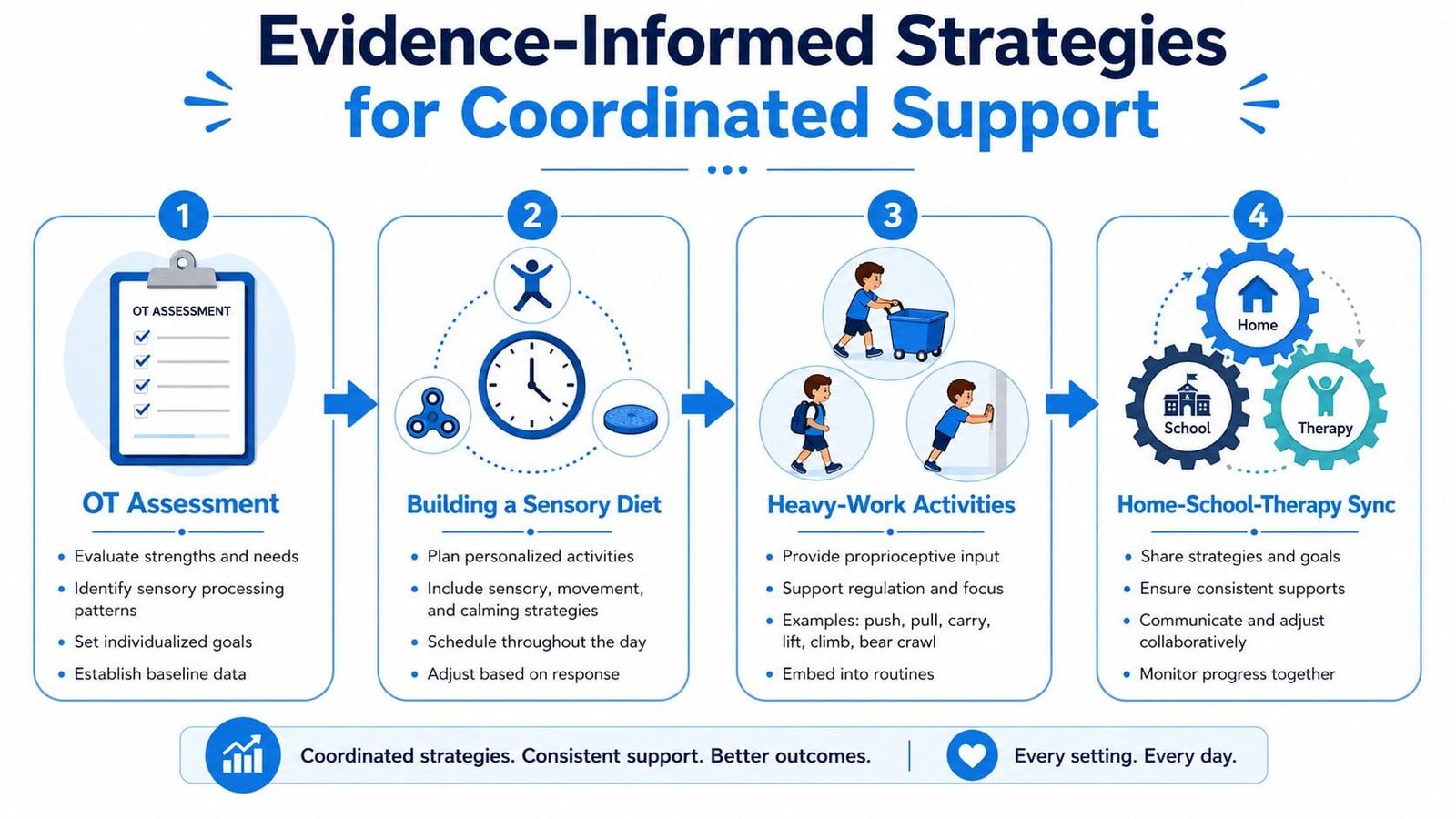
Best practice: don't copy someone else's sensory plan and hope it fits. Build one around your child's actual triggers, routines, and recovery patterns.
Behavior Management, Safety, and Tracking Progress
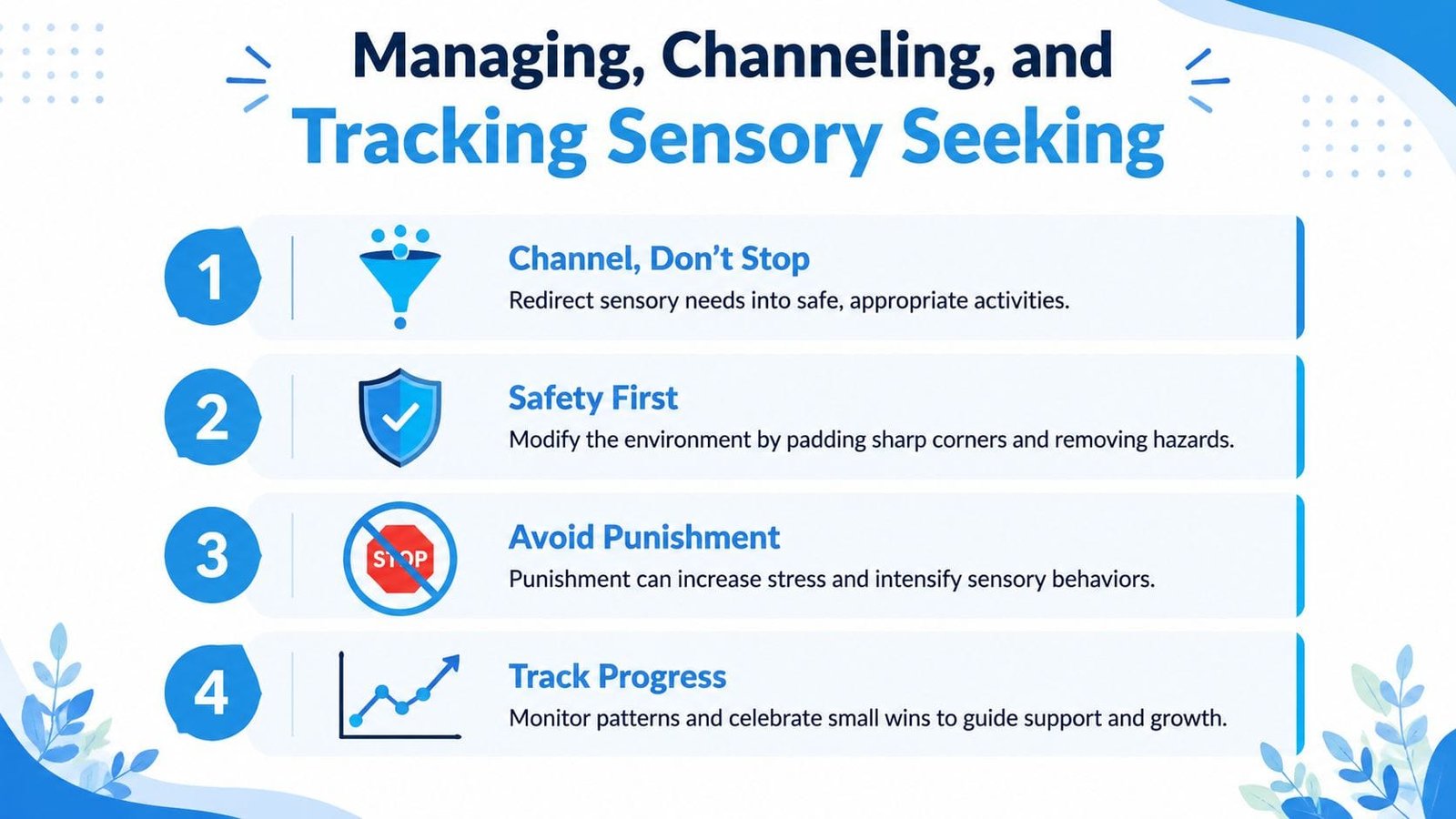
Trying to stop sensory seeking outright usually backfires, because the child still has the same body need underneath the behavior. A better approach is to channel that need in a safer direction, protect the space around the child, and give a more acceptable way to get the same kind of input.
What helps more than punishment
If a child is crashing into the sofa, redirect them to a crash pad, a wall push, a carry job, or supervised rough play instead of only saying no. If oral seeking shows up often, offer a safe chew option rather than fighting every shirt collar. If proprioceptive input seems to settle their body, build in pushing, carrying, or squeezing activities on purpose.
Safety matters here. Children who are clumsy or less aware of personal space need adults to supervise risky movement, pad sharp corners, and teach safer ways to get the input they are after. This is practical supervision, not overprotectiveness.
How to track what's actually working
A good log turns a fuzzy memory into useful information. Write down the behavior, the time, the trigger, the response you offered, and the outcome. If the child calmed after heavy work but escalated after a loud transition, that gives you something concrete to try the next day.
Research on sensory features and repetitive behavior found that sensory seeking should be tracked separately, because it does not line up neatly with all repetitive behaviors. So do not lump everything into one bucket. Note whether the child was seeking movement, pressure, oral input, or something else.
For families who want a visual way to spot patterns, a simple chart or graph can make the notes easier to read. A guide like best ways to visualize data can help you decide whether a tally, timeline, or color-coded log will make your child's patterns clearer at a glance. For a structured example of how a routine tool can support follow-through, Browse Daily Powers Focus may be helpful. The main win is still the habit of recording what happened in the moment, not trying to reconstruct it later.
Building a Long-Term Support Routine With Your Team
The simplest long-term routine is also the most useful. Observe, log, share, adjust, repeat. A few minutes a day is enough to build a record that helps you, your child's occupational therapist, and your pediatrician see what's changing and what isn't.
Monthly check-ins work better than waiting for a crisis. You can bring the same notes to school meetings, therapy visits, or medical appointments and show patterns instead of trying to summarize everything from memory. That turns “I think I see something” into “Here's what happens, here's what helps, and here's what still needs work.”
If your family is trying to keep sleep, behavior, meals, and therapy notes in one place, an organized system can make that much easier. You don't need to solve sensory seeking alone, and you don't need to keep carrying it all in your head. A consistent record gives your child's whole support team a clearer way to help.
If you want a calmer way to track sensory seeking behaviors, triggers, sleep, routines, and notes for your child's care team, visit Guiding Growth. It's built to help parents turn scattered observations into clear patterns they can use.