By the end of a difficult afternoon, many parents have a phone note that says “rough transition,” a school message about a shutdown, and a therapy summary describing a successful communication attempt. Each note is true, but together they don't yet answer the question that matters: what helped, what made things harder, and what should we try next?
Progress documentation can turn those scattered observations into a useful shared record. It isn't a diary that asks you to describe every moment, and it shouldn't reduce a child to scores or compliance. Done well, it captures a small set of consistent details, preserves the child's everyday context, and helps families, educators, and clinicians make thoughtful decisions over time.
Table of Contents
- Why Progress Documentation Should Support Decisions
- Define Goals and Measures Before Logging
- Build a Sustainable Daily and Weekly Logging Routine
- Capture Events With a Complete Context Template
- Choose the Logging Method That Lowers Family Burden
- Connect Settings and Turn Trends Into Reports
- Protect Privacy and Keep Documentation Sustainable
Why Progress Documentation Should Support Decisions
A parent notices a pattern after several challenging afternoons. The child comes home from school tired, has difficulty moving from the car to the house, and later struggles with a routine change. One note mentions poor sleep. Another mentions a missed snack. A third records that visual support helped, but none includes the time, setting, or sequence of events. The family is left trying to reconstruct the week from memory.
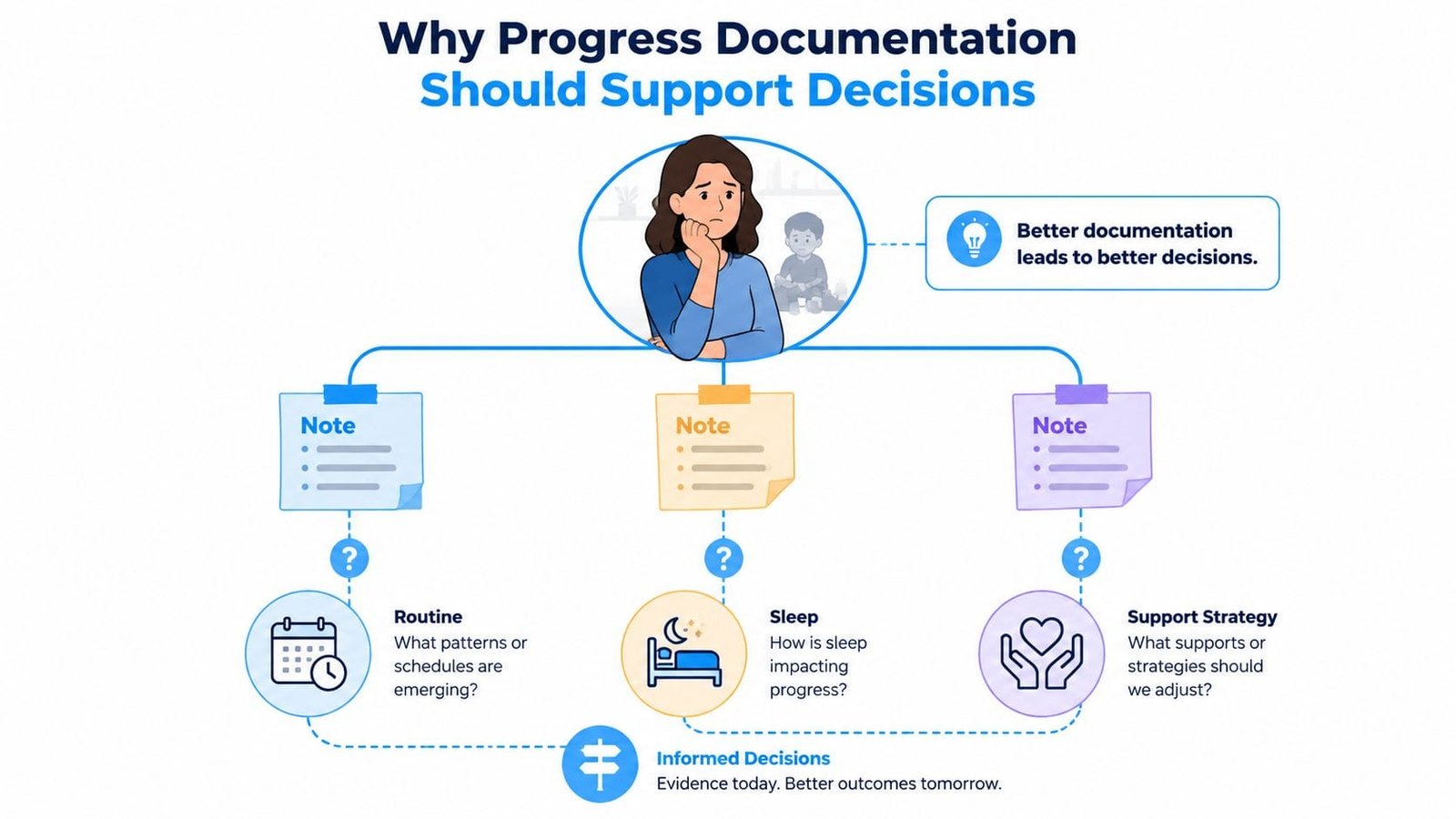
Progress documentation is an organized, longitudinal record of goals, relevant events, context, and outcomes. The word “longitudinal” matters because one event rarely explains a pattern. A useful record lets the team compare what happened at home, school, and therapy without pretending that every setting works the same way.
Start with a question
The strongest entry usually begins with a decision the family or care team needs to make:
- Routine question: Does a visual countdown make leaving the playground easier?
- Sleep question: Does a disrupted night change regulation or communication the next day?
- Communication question: Is the child using a replacement response outside therapy?
- Support question: Does a quieter transition reduce recovery time?
This approach keeps documentation focused. The record can include routine fields, such as time and duration, alongside context-rich details about triggers, sensory conditions, sleep, nutrition, and the support offered.
Healthcare documentation has long shown why both kinds of information matter. A PubMed study found that routine items were recorded frequently, while nuanced history was less consistent. Smoking history, for example, appeared in only 37.8% of internist charts and 20.4% of pediatrician charts, even though immunizations were documented in 96.2% of internist charts and 100% of pediatrician charts (PubMed research on documentation quality). The lesson isn't that families should create longer notes. It's that structured fields capture consistency, while context often explains meaning.
Practical rule: Record enough to support the next decision, not enough to recreate the entire day.
That might mean documenting a challenging transition and a successful request in the same entry. It also means recording gains, plateaus, generalization, sleep, routines, and quality-of-life changes. A child who still finds a transition difficult but now uses a communication tool before becoming overwhelmed is showing meaningful progress that a single behavior count could miss.
Families seeking a broader framework can review this guide to special education progress monitoring. For caregivers who find typing difficult during an active routine, a Verbex ELN voice capture tool offers another way to preserve observations while the details are fresh.
Define Goals and Measures Before Logging
A broad concern is a useful starting point, but it isn't yet a measure. “Transitions are hard” tells the team what the family notices. It doesn't identify what to count, what improvement could look like, or how different adults should record the same event.
Turn the concern into an observable goal:
During a transition from a preferred activity, the child will use an agreed communication response or visual support, with the level of adult assistance recorded, and will return to the next activity after the transition.
The goal can then be connected to a baseline, a target direction, a review period, and a review date. The baseline describes what currently happens. The target direction might be more independent communication, shorter recovery, fewer interruptions, or greater success across settings. A review date creates a reason to look at the record instead of logging indefinitely.
Define what an observer can see
Avoid labels such as “bad,” “defiant,” or “noncompliant” as the primary record. Those words can hide several different experiences. A more useful entry might say that the child covered their ears, moved under the table, did not respond to spoken directions, and accepted a break card after an adult reduced verbal language.
Choose the measure that matches the question:
- Frequency: How often did an event or response occur?
- Duration: How long did it continue?
- Intensity: What observable level did the event reach, using a family-defined scale?
- Latency: How long passed before the child began the requested activity?
- Independence: Did the child use the skill without a prompt, with a prompt, or after repeated assistance?
- Recovery time: How long did it take to return to a preferred or planned activity?
- Replacement response: Did the child request help, a break, more time, or a different communication option?
A functional communication response needs a precise definition. Guidance on autism therapy documentation recommends tracking replacement and problem behaviors with graphs, defining functional communication responses measurably, and linking documentation to functional assessment data (functional communication documentation guidance).
Keep the goal small enough to maintain
Families often choose too many priorities at once. A better plan starts with the few goals that affect safety, communication, participation, sleep, or family routines most directly. One week might focus on transitions and sleep, while diet or appointment details remain optional unless they relate to the question being reviewed.
Use the same definition at home, school, and therapy. If “independent request” means touching a communication icon at home but pointing only after a prompt at school, the records won't be comparable. A plateau also deserves careful attention. It may show that a skill is stable, that the support isn't generalizing, or that the goal needs refinement. It isn't proof that the child has failed.
Build a Sustainable Daily and Weekly Logging Routine
A logging routine has to fit inside real family life. Caregivers may be helping with dressing, preparing food, managing siblings, answering school messages, or supporting a child through a difficult transition. A system that requires a long narrative after every event won't remain accurate for long.
Use three flexible moments instead of expecting constant recording. During a busy day, capture a short event entry as soon as practical. During evening wind-down, add only missing context. During a weekly review, look for patterns and decide whether any field is no longer useful.
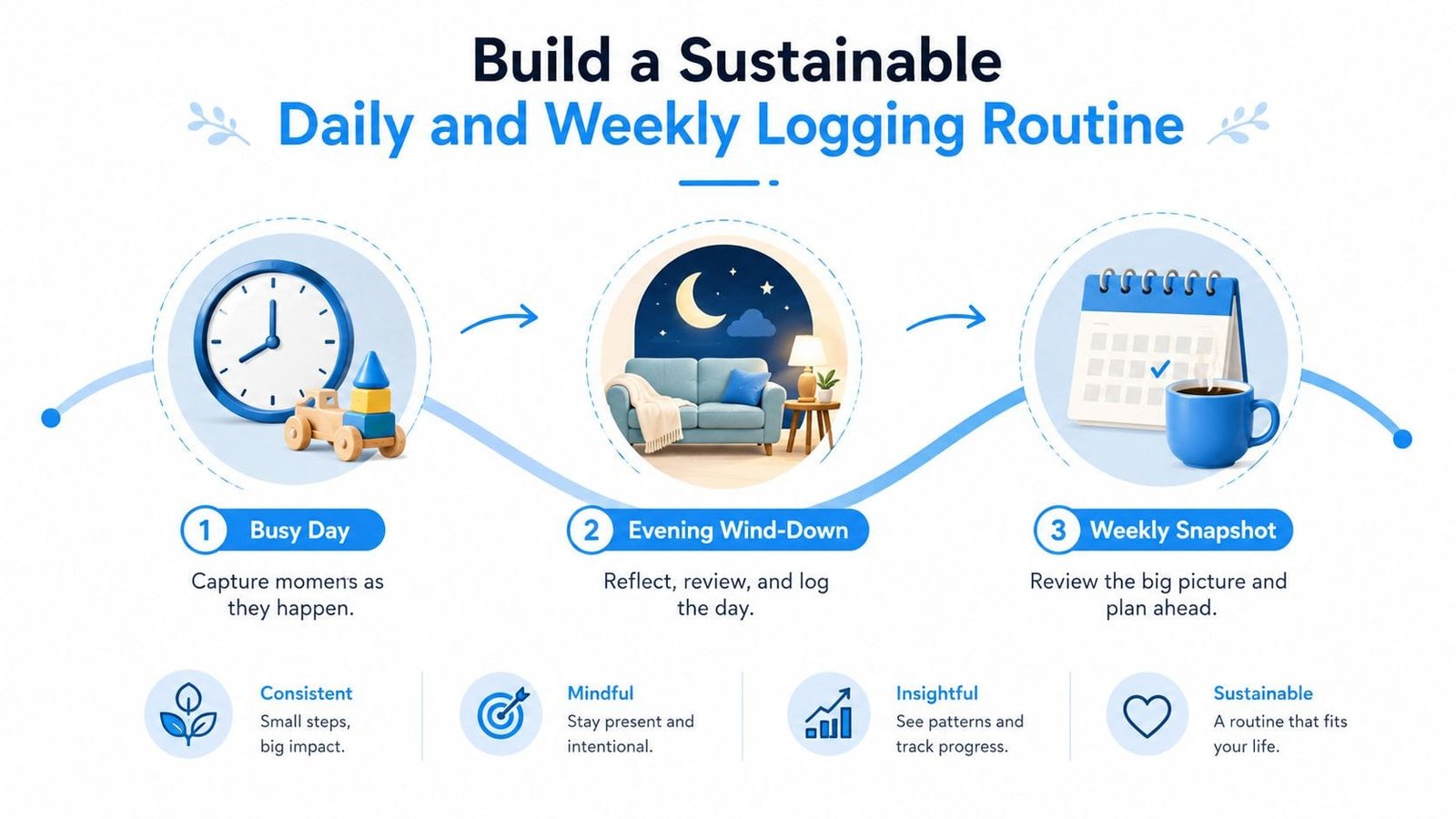
Capture events, not memories of the whole day
A timestamped entry is usually more dependable than a summary written much later. Record the meaningful event, the support offered, and the outcome. For example:
- Event: Leaving the playground became difficult.
- Context: The transition followed a change in the usual route.
- Support: The adult showed a visual countdown and offered a break card.
- Outcome: The child used the break card and moved to the car with assistance.
- Follow-up: Note whether recovery continued in the car or at home.
The record should include wins as well as challenges. A successful request, a shorter recovery, a tolerated change, or a skill used with less prompting can help the team see development that a problem-only log will miss.
Daily summaries have a place, but they shouldn't replace event-level information when the goal depends on sequence and timing. Structured ABC recording is especially useful for behavior analysis because it captures the antecedent, behavior, and consequence, along with details such as place, duration, intensity, and triggers (structured ABC recording guidance).
Make incomplete weeks usable
An irregular week isn't a failed record. Mark missing entries directly rather than filling gaps from assumptions. You can write “not recorded,” “school information unavailable,” or “routine changed,” then preserve what is known.
Decide who owns each part of the workflow. A parent might record sleep and home transitions, a teacher might contribute school observations, and a therapist might add session data. Keep those observations separate until review time so the team can see setting-specific differences instead of blending them into an unclear average.
Capture Events With a Complete Context Template
A good event entry lets another caregiver understand what happened without a long phone call. It also separates observation from interpretation. “He was overwhelmed” may be a reasonable interpretation, but the record becomes more useful when it also describes what the child did, what happened immediately before, and what support followed.
Use the template selectively. Not every meal needs an intensity rating, and not every bedtime needs an ABC sequence. The family's current question should determine which fields are essential.
Event Context Template
| Field Group | Fields to Record |
|---|---|
| Time and setting | Date, time, location, people present, home, school, therapy, or community |
| Activity | What was happening immediately before the event |
| Observable behavior | What the child said or did, without judgmental labels |
| Antecedent or trigger | Change, demand, noise, waiting, denied access, fatigue, discomfort, or another relevant context |
| Support offered | Visual aid, communication tool, break, reduced language, sensory support, choice, or routine adjustment |
| Consequence or response | What happened immediately afterward |
| Measurement | Duration, intensity, latency, frequency, or level of independence |
| Replacement skill | Request, gesture, device use, coping action, or other functional response |
| Next outcome | Recovery, return to activity, change of plan, or continued support needed |
| Optional health context | Sleep, diet, medication, appointment, illness, or other factor connected to the question |
Consider a shutdown after school. The entry might state that the child arrived home at the usual time, went directly to a quiet room, covered their ears, and didn't answer spoken questions. The caregiver noted that sleep had been unsettled, offered a visual choice between a snack and quiet time, and observed that the child selected quiet time after a prompt. Later, the child used a communication device to request food.
That entry documents both the challenge and the skill. It doesn't claim that poor sleep caused the shutdown. It preserves a possible relationship for the family and care team to examine alongside other entries.
Match detail to the decision
Sleep records may need bedtime, sleep onset time, night awakenings and their frequency, morning wake time, and daytime naps. Those fields come directly from a peer-reviewed review of sleep assessment in autistic children (sleep assessment and parent sleep logs). Sleep logs can reveal whether a routine adjustment changes latency, fragmentation, or daytime rest.
Diet, medication, appointments, and therapy can be added when they relate to the goal. A food tracker guide such as this resource for parents tracking children's food may help families decide whether they need broad meal notes or more specific information about preferences and sensitivities. Exact portions or medication details should remain optional unless they answer the current question and can be recorded accurately.
Choose the Logging Method That Lowers Family Burden
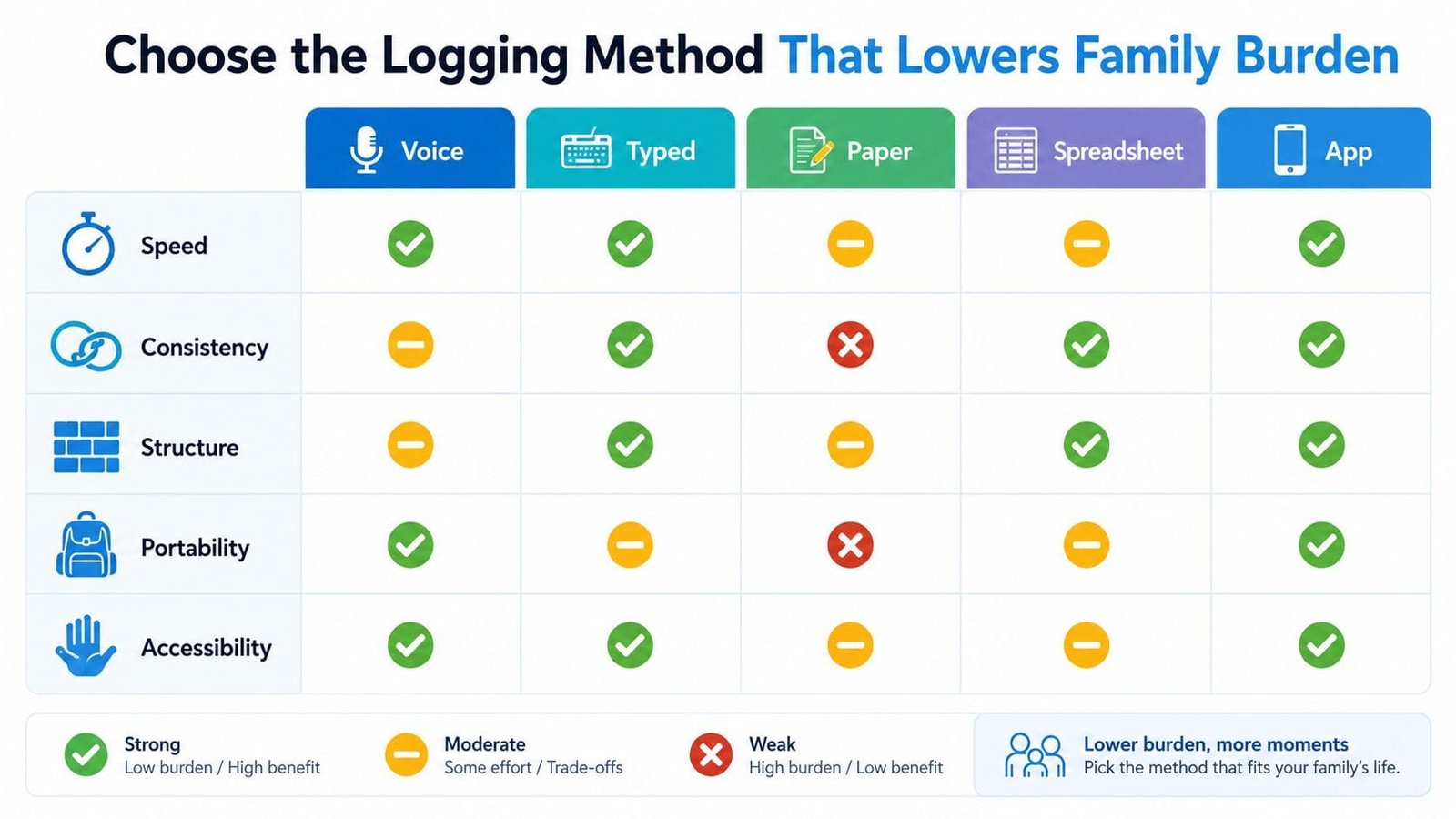
The right method is the one a caregiver can use during an ordinary day. A paper sheet may work well on a refrigerator. A spreadsheet can help a team customize columns. Typed notes are searchable, but they may be slow when a child needs immediate support.
| Method | Strengths | Common limitation |
|---|---|---|
| Voice | Fast, hands-free, preserves immediate observations | Requires later organization and accuracy review |
| Typed note | Searchable and familiar | Can be difficult during active caregiving |
| Paper | Simple, visible, and usable without a device | Can be misplaced or hard to share |
| Spreadsheet | Flexible fields and easy sorting | May feel administrative and require maintenance |
| Mobile app | Portable structure, summaries, and collaboration | Privacy settings and access need careful review |
Voice logging can be practical when a caregiver is helping with a transition. A short note might capture the time, setting, trigger, support, and outcome. If software later organizes that note into fields, the caregiver should still check names, times, behaviors, and interpretations. Automated summaries shouldn't determine what a child felt, diagnose a cause, or replace a professional review.
Paper and spreadsheets remain valid choices. The goal isn't to move every family into an app. The goal is to avoid a system that creates so much work that entries become delayed, copied, or incomplete.
A dedicated mobile workflow becomes useful when a family wants behavior, sleep, diet, medication, appointments, therapy, and sharing in one place. Guiding Growth is designed around quick voice logging, structured tracking, visual summaries, and collaboration with caregivers and professionals. Families considering that approach can review its behavior tracking app and compare the fields with their own priorities.
The least burdensome system often combines methods. A caregiver records by voice during the event, checks the structured entry later, and shares only the relevant summary with the school or clinician. That preserves speed without surrendering accuracy.
Connect Settings and Turn Trends Into Reports
A behavior can look different at home, school, therapy, and medical appointments because the people, demands, routines, and supports differ. Combining all observations into one score can hide those differences. Keep the settings visible, then compare the same goal using consistent definitions and time markers.
A simple review might examine frequency by setting, average duration, recovery time, and successful replacement responses. It might show that a child uses a break request at home but needs prompts at school. That difference isn't a contradiction. It tells the team where generalization needs support.
Observation is evidence. Interpretation is a hypothesis. Keep both visible.
A documented support can be followed by a change in behavior, but that timing alone doesn't prove the support caused the change. Sleep, illness, schedule changes, sensory conditions, hunger, and unfamiliar adults may also matter. A clear report separates what the record shows from what the team thinks it might mean.
Use a concise report structure
A family report can include:
- Review period: The dates covered and any missing records.
- Goal and baseline: The observable skill or behavior and the starting pattern.
- Changes: Frequency, duration, independence, latency, recovery, or replacement responses.
- Setting examples: Separate home, school, therapy, and medical observations.
- Strategies used: The support, prompt, communication option, or environmental change.
- Barriers: Sleep disruption, routine changes, access problems, illness, or inconsistent implementation.
- Wins: New skills, easier recovery, improved participation, or quality-of-life changes.
- Next steps: A proposed adjustment, question, or goal refinement for the care team.
For slow or uneven progress, describe the shape of change accurately. “The child used the request independently in familiar home routines, needed prompts during school transitions, and had limited opportunities during therapy” is more informative than “progress is inconsistent.”
Visual summaries can make this comparison easier when the underlying entries remain available for review. Families can explore approaches to visualizing progress data while keeping the care team responsible for interpretation and decisions. A graph should support conversation, not make a clinical judgment by itself.
Protect Privacy and Keep Documentation Sustainable
Privacy belongs inside the system from the beginning. Decide which caregivers may view or add records, obtain appropriate consent before sharing with schools or professionals, and update access when a child's support arrangement changes. Before sending a report, remove details that aren't needed for the specific decision.
Keep raw entries separate from concise shared summaries. Use observable language, correct mistakes promptly, and preserve an edit history when the tool allows it. Secure account settings matter, but no app should be assumed appropriate without reviewing its privacy practices, access controls, and fit with local requirements. Families interested in privacy-first data collection can also examine this overview of self-hosted survey software as a broader example of questions to ask about data ownership and handling.
The documentation routine should protect emotional energy as well as accuracy. One study of autism behavior logging described emotional strain around recording intensely negative experiences, while other work has highlighted the difficulty of maintaining paper collection amid competing responsibilities (research on caregiver and clinician experiences with behavior logging). More detail isn't automatically better if the burden causes caregivers to stop recording.
A sustainable maintenance plan might include:
- Daily capture: Record only meaningful events and relevant wins.
- Weekly review: Remove low-value fields and identify patterns worth discussing.
- Monthly cross-setting review: Compare home, school, therapy, and medical observations.
- Privacy check: Confirm that each person still needs the access they have.
- Accuracy check: Correct copied, stale, or misunderstood entries.
A useful record should make care clearer, not make family life feel like paperwork.
If you want one mobile workflow for behavior, sleep, diet, medication, appointments, therapy, and shared progress records, explore Guiding Growth. It can help you capture brief observations, organize them into meaningful patterns, and prepare clearer information for the people supporting your child.