You ask your child to put on their shoes. They know where the shoes are, and they may even want to go out, but the request sparks panic, bargaining, anger, or a sudden retreat under the table. A few minutes later, the whole family is distressed, and you're wondering why an ordinary morning task became such a painful confrontation.
Families often use the phrase demand avoidance autism to describe this pattern. The words can help explain what's happening, but they don't settle the diagnostic question. Demand avoidance may relate to anxiety, autistic differences, sensory overload, executive functioning, or several factors at once. The most useful starting point is to understand the child's experience, observe what happens before and after the behavior, and reduce unnecessary pressure while keeping safety and essential care in view.
Table of Contents
- What Demand Avoidance Looks Like in Daily Life
- The Clinical Picture and Why Experts Disagree
- Recognizing Signs and Common Triggers
- How Demand Avoidance Differs from Related Profiles
- Practical Strategies for Prevention and Response
- Tracking Patterns to Reveal What Actually Works
- When to Seek Professional Help and How to Prepare
What Demand Avoidance Looks Like in Daily Life
A child can resist a demand even when the activity itself is enjoyable. “Get ready for the playground” may lead to refusal, while independently choosing to play outside goes smoothly. “Time for homework” may produce tears or a long conversation about an unrelated topic, even though the child usually likes the subject once they begin.
That apparent contradiction leaves parents feeling confused. It can look like the child is choosing when to cooperate, but the behavior may reflect the pressure attached to the expectation rather than dislike of the task. The demand can come from another person, a timetable, a classroom routine, or even an internal expectation such as “I should start this now.”
Demand avoidance describes a strong urge to escape or resist perceived expectations. In autism, families and professionals often discuss it as a possible profile associated with anxiety and a need for control. A child might refuse directly, negotiate every detail, become silly and distracting, ask repeated questions, withdraw, or move into a shutdown or meltdown.
A useful reframe: The behavior may be communicating, “This feels unsafe or impossible right now,” rather than, “I want to make life difficult.”
The response is still real and disruptive. Parents may need to get to school, administer medication, leave an unsafe place, or maintain a predictable family routine. Compassion doesn't mean ignoring those responsibilities. It means responding to the nervous system underneath the behavior instead of treating distress as deliberate misbehavior.
What parents may notice
Demand avoidance often changes with context. A child may manage a task when they initiate it, complete it through play, or share control with an adult. The same task may become overwhelming when delivered as a direct instruction, especially during fatigue, transition, uncertainty, or sensory strain.
Look for the pattern across situations rather than judging one difficult moment. A single refusal doesn't establish a profile. Repeated reactions to expectations, especially when paired with visible anxiety or a rapid loss of regulation, deserve careful observation and discussion with a qualified professional.
The Clinical Picture and Why Experts Disagree
The concept has a relatively short formal research history. UK psychologist Elizabeth Newson first identified the profile in the 1980s, and the first peer-reviewed paper appeared in 2003, according to Autism Australia's history of pathological demand avoidance. Newson and colleagues described children with an “obsessional avoidance of the ordinary demands of everyday life” and proposed the profile as part of the autism spectrum, not as a separate disorder.
PDA still isn't listed as a standalone diagnosis in DSM-5 or ICD-11. NICE guidance has treated it as a possible subgroup or profile within autism guidance, while advising clinicians to consider overlapping presentations, including oppositional defiant disorder, during assessment. NICE's surveillance information helps explain why one clinician may use “demand avoidance,” while another documents anxiety, autistic inflexibility, distress intolerance, or another formulation.
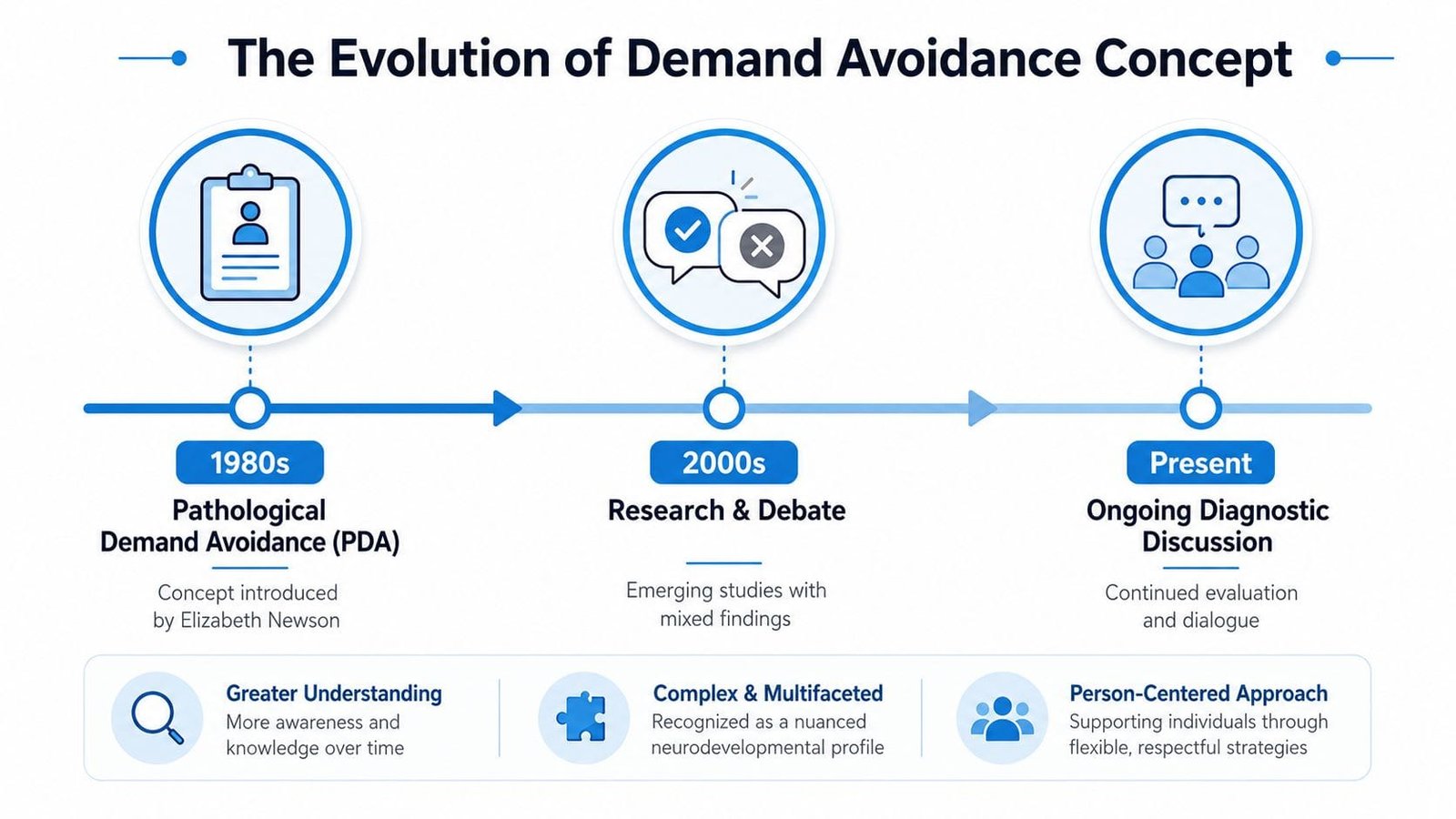
What the prevalence evidence can and can't tell us
The most frequently cited population-level figures come from a 2015 Faroe Islands study of people aged 15 to 24. Researchers screened the entire population and identified 67 people meeting autism diagnostic criteria, corresponding to an autism prevalence of almost 1%. Within that group, 9 people met criteria for possible clinical PDA, which represented about 1 in 5 of the autistic participants with PDA-like childhood features. The combined autism plus PDA estimate was 0.18% of the total population, while a later review summarized the estimate as 0.13% for autism with extreme demand avoidance compared with 0.94% autism prevalence in that population. These figures come from the Faroe Islands study indexed by PubMed.
Those numbers shouldn't be treated as a universal rate. Autism Australia notes that reliable population data aren't available because there's no standardized assessment, and the research methods have varied. A 2021 systematic review found only 13 relevant studies involving children and adolescents and described the evidence base as small and methodologically weak, as reported in the review's PubMed record. A 2026 systematic review identified only 12 empirical studies, with heavy reliance on self-report questionnaires or surveys, inconsistent use of tools such as EDA-Q and DISCO, and a high risk of methodological bias. Its conclusion was that current evidence can't firmly support PDA as a distinct diagnosis, according to the published systematic review.
The uncertainty matters clinically, but it shouldn't erase what families observe. A label may remain contested while a child still needs fewer verbal demands, more autonomy, sensory adjustments, and anxiety-informed support.
Recognizing Signs and Common Triggers
Start with observable behavior, not a conclusion. Ask what the child did, what happened immediately beforehand, and what changed after the demand was removed or softened.
Common signs can include:
- Direct refusal: “No,” running away, pushing materials aside, or refusing to move.
- Negotiation: Repeatedly changing the terms, asking for more time, or debating every part of the request.
- Distraction and humor: Suddenly becoming extremely conversational, inventing a game, or asking unrelated questions when homework begins.
- Delay behaviors: Needing a snack, a bathroom visit, a particular object, or a long explanation before starting.
- Meltdowns: Crying, yelling, aggression, or dropping to the floor when pressure rises.
- Shutdown: Becoming quiet, still, withdrawn, or unable to answer.
- Social withdrawal: Leaving the room, hiding, or avoiding eye contact when expectations feel intense.
- Rapid shifts: Moving quickly from relaxed engagement to panic, anger, or apparent disconnection.
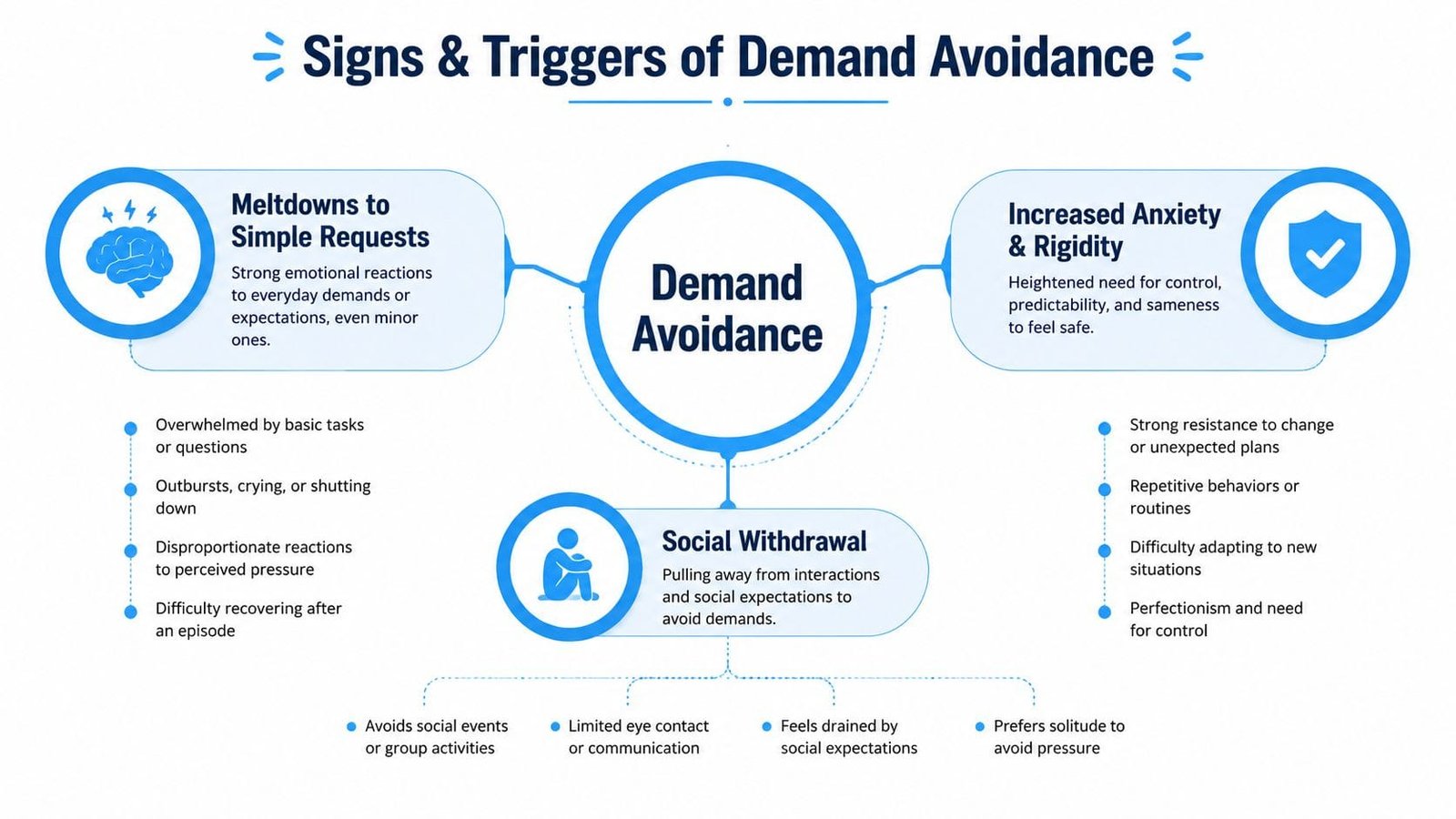
Common triggers
A direct command is only one type of demand. Time pressure can turn dressing into a crisis, especially when the child doesn't know what will happen after leaving home. Transitions create a second layer of expectation because the child must stop one activity, shift attention, and begin another.
Sensory conditions can amplify the reaction. A noisy classroom, scratchy uniform, bright bathroom, crowded hallway, hunger, poor sleep, or medication change may reduce the child's capacity before anyone asks them to do anything. The demand then becomes the final stressor rather than the only cause.
Perceived loss of control is another important clue. A child may cope when offered two acceptable options, but resist when an adult dictates the order, timing, or method. That doesn't prove a PDA profile, yet it gives you a practical place to begin.
You can use this antecedent and consequent tracking guide to record what came before the behavior and what followed. For broader support around coping with frustration and recovering from overload, frustration tolerance and burnout recovery offers useful context.
How Demand Avoidance Differs from Related Profiles
The same outward behavior can have different causes. A child who refuses a classroom activity may be anxious about expectations, overwhelmed by noise, unsure how to begin, worried about failure, or reacting to a conflict with an adult. The behavior alone can't identify the underlying profile.
This comparison can guide better questions, but it isn't a diagnostic tool:
| Profile | Core Driver | Context Dependent | Response to Control |
|---|---|---|---|
| Demand avoidance | Anxiety linked to expectations, pressure, or loss of autonomy | Often changes depending on who asks, how the request is phrased, and whether the child can influence the task | Shared control and flexible choices may reduce distress |
| Oppositional defiant disorder | A persistent pattern of angry, irritable, argumentative, or defiant behavior toward authority and rules | Clinicians assess the pattern across relationships and settings | Accommodation alone may not explain the behavior, so a full assessment matters |
| Anxiety-driven refusal | Fear, worry, uncertainty, or anticipated failure connected to a specific situation | Often strongest around feared tasks, places, people, or outcomes | Reassurance, gradual support, and anxiety treatment may help |
| Sensory overload | Excessive or distressing sensory input, such as noise, light, touch, or crowds | Closely follows the sensory environment | Reducing input and providing recovery space may help |
| Autistic rigidity or inflexibility | Difficulty shifting plans, tolerating uncertainty, or processing a change in expectations | Often linked to transitions, routines, or unexpected changes | Predictability, preparation, and flexible support can reduce strain |
PDA-related traits aren't unique to PDA. A feature-identification study found that several traditionally labeled PDA features are common across autism, while later reviews have found insufficient evidence to establish PDA as a separate disorder or stable subtype.
The distinction between autism and ADHD can also become relevant because executive functioning, impulsivity, emotional regulation, and task initiation may overlap. This guide to ADHD and autism differences can help families prepare more precise questions for a clinician.
Ask, “What changed when we reduced noise, offered control, clarified the task, or removed time pressure?” That answer often helps more than arguing over the label.
Practical Strategies for Prevention and Response
The most effective support usually lowers threat before asking for performance. A 2022 adult study found that autistic traits and anxiety were unique, equally important predictors of demand avoidance, supporting an anxiety-driven model in which reducing uncertainty, perceived pressure, and performance threat may lower avoidance behavior. The findings are summarized in the adult demand avoidance study.
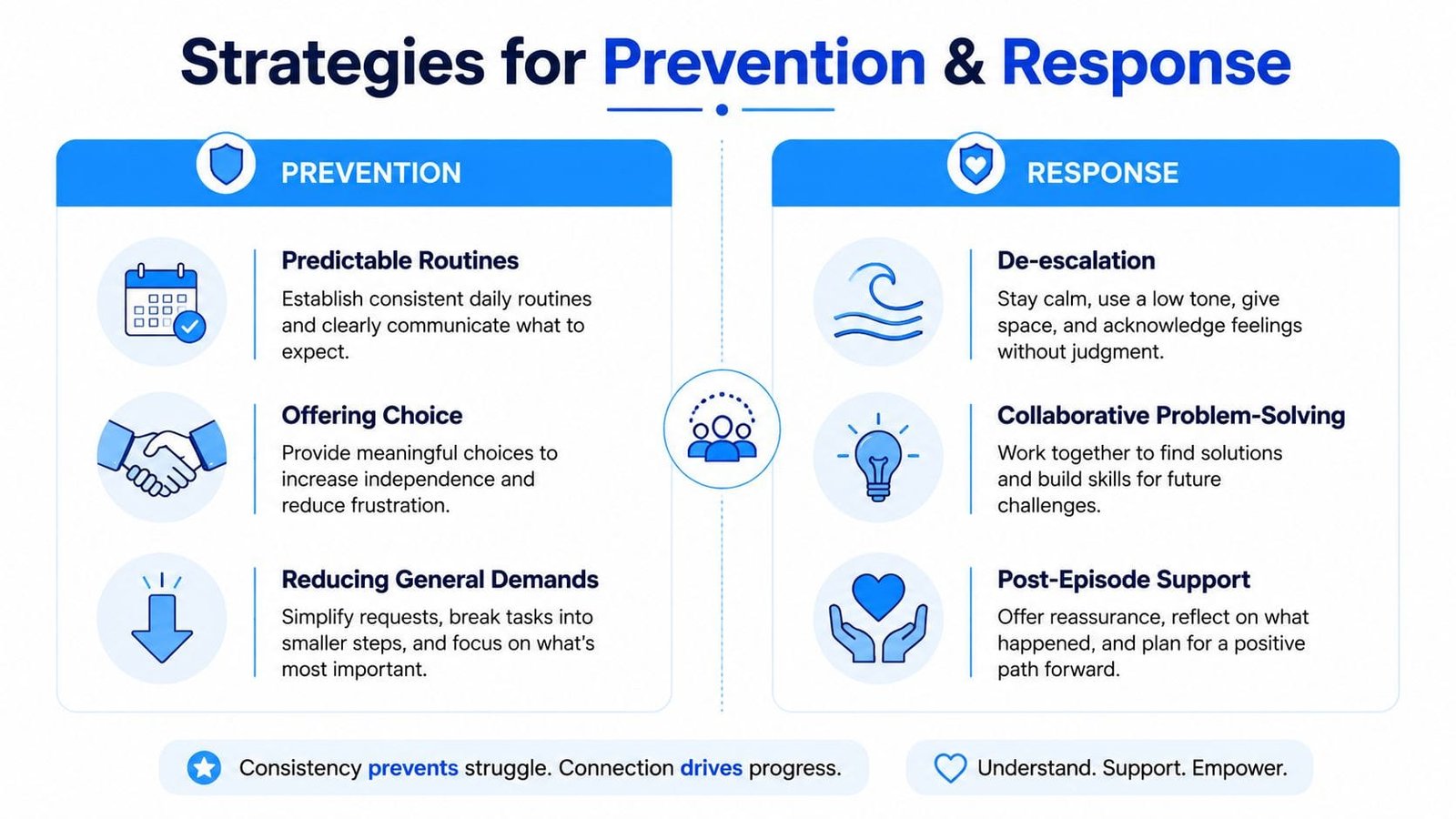
Prevent the pressure spiral
Use declarative language. Replace “Put your shoes on now” with “The shoes are by the door, and we're leaving after breakfast.” You're still communicating the expectation, but you're reducing the sharpness of a direct command.
Offer bounded choice. “Do you want the blue shoes or the trainers?” gives control without making the child responsible for the entire routine. If both options are acceptable, follow through without adding extra negotiation.
Make the sequence visible. A visual schedule can show breakfast, dressing, shoes, and leaving. The schedule externalizes the plan, so the parent doesn't have to repeat the demand and the child doesn't have to hold every step in working memory.
Front-load transitions. Give information before the last minute. “The tablet will finish after this episode. Then we'll choose clothes.” A warning won't remove every difficult transition, but it can reduce surprise.
Reduce unnecessary demands. If the child is already exhausted, skip nonessential tasks and preserve energy for safety, school attendance, food, hygiene, or medical care. Support should be flexible, not permissive in ways that create danger.
Respond during escalation
Lower your voice, shorten your sentences, and stop explaining. During a meltdown or shutdown, a long lecture adds more processing and social demand.
- Instead of arguing: “You said no. I'm giving you space.”
- Instead of repeating the instruction: “The door is safe. We can leave when your body is ready.”
- Instead of threatening consequences: “The plan has changed. We'll solve the next step together.”
- Instead of demanding eye contact or an apology: Offer quiet, distance, water, headphones, or a preferred calming activity.
Reward charts may backfire when the chart itself feels like another performance demand. That doesn't mean every reinforcement strategy is harmful, but it does mean you should watch whether the system reduces anxiety or adds pressure. Safety boundaries remain firm, while the route toward them can stay collaborative.
A calming object, movement break, music, or sensory activity may help some children recover. Families looking for tools for focus and calm can browse this resource from Playz. Introduce any tool when the child is regulated, not for the first time in the middle of a crisis.
Here's a short video you can use as another practical starting point:
Tracking Patterns to Reveal What Actually Works
Memory becomes unreliable after a difficult day. Parents remember the loudest meltdown, the school call, or the moment everyone cried, but they may miss the quieter variables that shaped the outcome. Structured tracking turns those impressions into a sequence you can examine.
Record the demand, the setting, the time of day, sleep quality, food, medication, sensory conditions, transition, and the child's response. Add what you tried and what happened afterward. “Homework refusal” is a starting point. “Refusal followed a noisy school day, began after a direct instruction, and eased when the child chose between writing and dictation” is actionable information.
Keep the record usable
You don't need to document every minute. Choose a small set of behaviors, such as meltdowns, shutdowns, school refusal, or demand avoidance, and log them consistently enough to compare similar situations.
Voice logging can help when your hands are occupied or emotions are high. The Guiding Growth app lets parents record behaviors including demand avoidance, meltdowns, shutdowns, echolalia, and hand flapping, while adding contextual triggers and outcomes. It also brings sleep, diet and nutrition, medications, appointments, and therapy information into one place, with visualizations and sharing features for caregivers and professionals. You can read more about behavioral data analysis before choosing a tracking method.
Track the experiment, not just the crisis: Write down what you changed, what you expected, and what actually happened.
After several entries, look for repeated relationships. Does refusal appear after poor sleep? Does a visual schedule help only when it's introduced early? Does offering choices work for dressing but not leaving a preferred activity? Patterns won't prove a diagnosis, but they can reveal which environmental changes deserve more attention.
Bring those observations to school meetings and clinical appointments. A shared record helps adults compare contexts, avoid blaming the child, and select one change to test at a time.
When to Seek Professional Help and How to Prepare
A family may seek professional input when demand avoidance contributes to persistent school refusal, unsafe behavior, severe stress, difficulty completing essential care, or significant anxiety, depression, sleep disruption, or other mental health concerns. A pediatrician, psychologist, psychiatrist, occupational therapist, speech-language therapist, or school team may each clarify different parts of the assessment.
Assessment may consider autism, anxiety, sensory processing, executive functioning, learning needs, trauma, sleep, medication effects, and overlapping behavioral diagnoses. PDA is not a standalone diagnosis in major diagnostic systems, so ask clinicians to describe observed functional needs and recommended supports, even if they do not use the PDA label.
Bring concrete examples and tracking notes. Record what came before the behavior, the child's response, the adult response, and the outcome. If you are considering in-home behavioral support, this reVIBE Mental Health ABA resource offers questions about service setting and fit.
You do not need a perfect label to provide good support. Careful observation, respect for autonomy, clear safety limits, and professionals who see the whole child can guide daily decisions.
Guiding Growth lets families log demand avoidance, meltdowns, shutdowns, sleep, diet, medication, appointments, triggers, and outcomes in one mobile space, with voice logging for busy moments. Visit Guiding Growth to organize observations for family and care-team discussions.