The worksheet is on the desk, the lesson has started, and one student is staring through the window while another is tapping a pencil, calling out, or asking what to do again. By the time the class moves on, the teacher feels ignored, the parent hears about “poor effort,” and the student may be carrying a very different experience: I tried to keep up, but the instructions disappeared before I could use them.
ADHD in a classroom rarely looks the same from one child to another. The most useful support begins when adults look past the visible behavior and ask what task the student's brain is struggling to manage at that moment.
Table of Contents
- Understanding the Classroom Reality of ADHD
- The Cognitive Mechanics Behind ADHD Behaviors
- Evidence-Based Strategies for Academic Success
- Navigating IEPs, 504 Plans, and Legal Rights
- The Critical Gap Beyond Basic Accommodations
- Bridging Home and School with Guiding Growth
- Real-World Case Scenarios and Outcomes
- Building a Sustainable Support Ecosystem
Understanding the Classroom Reality of ADHD
A teacher gives the class three directions: take out the reading book, turn to the assigned page, and underline the evidence in the second paragraph. Most students begin. A student with ADHD opens the desk, notices a missing pencil, asks a classmate for one, hears someone whisper, and loses the sequence before reaching the book.
From across the room, that can look like refusal or carelessness. Up close, it may be an executive-function breakdown. The student hasn't necessarily decided to ignore the teacher. The student may have lost the instruction while trying to hold it, organize it, and act on it.
A common classroom presence
ADHD is one of the most common conditions seen in classrooms. A 2024 review estimates that about 1 to 2 students per classroom meet ADHD diagnostic criteria, so a class of 25 to 30 pupils is likely to include at least one student with ADHD and often two, according to the review of ADHD prevalence and classroom implications. The same source cites CDC reporting that about 5.4 million U.S. children ages 3 to 17, roughly 8.9%, currently meet criteria for ADHD.
That scale matters. Supporting ADHD in a classroom isn't a special favor made for one unusually difficult child. It's part of designing instruction for the range of attention, activity, impulse-control, and organizational needs already present in ordinary classrooms.
Defiance and dysfunction aren't the same
Defiance usually involves a student understanding a reasonable expectation and actively refusing it. Executive dysfunction can look similar, but the barrier lies in starting, sequencing, remembering, shifting, or stopping. A child may want to complete the work and still fail to begin because the first step isn't visible.
Useful questions include:
- What happened immediately before the behavior? Was the student given several directions, asked to transition, or handed a long independent task?
- What part of the task broke down? Starting, remembering, writing, waiting, or finishing?
- When does the student succeed? Look for differences in time of day, task length, adult proximity, movement, noise, and feedback.
Practical rule: Treat behavior as information before treating it as misconduct.
That shift doesn't remove expectations. It helps adults teach the missing skill instead of repeating a demand the student can't yet execute reliably.
The Cognitive Mechanics Behind ADHD Behaviors
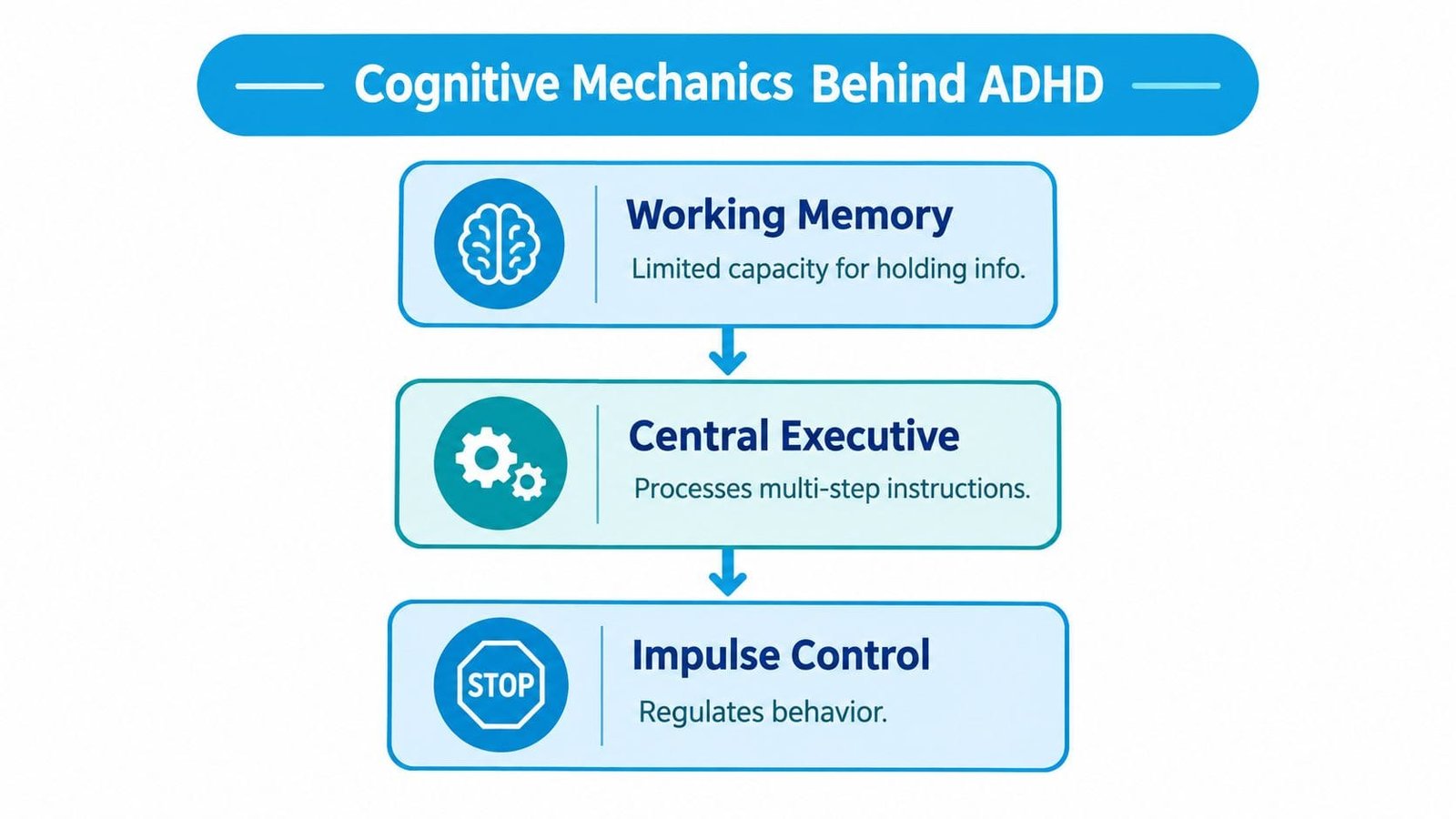
A student can understand a lesson and still fail to complete the assignment because understanding and execution rely on different systems. Working memory holds information briefly while the brain uses it. Executive function helps the student prioritize, sequence, initiate, monitor, and adjust an action. In a busy classroom, those systems must work while the student filters noise, manages movement, interprets social cues, and resists impulses.
Consider the instruction, “Write a paragraph explaining the character's motivation, include two examples, and check your punctuation.” A student must remember the topic, retrieve evidence, organize sentences, monitor the requirements, and sustain effort. If the teacher adds a time limit or the room becomes noisy, the task can exceed the student's available processing capacity.
Why working memory changes what teachers see
A classroom study found that 59% of the between-group difference in inattentive behavior was explained by ADHD-related impairment in central executive working memory, with 41% of that effect direct and 15% indirect through coordination of phonological short-term memory, as reported in the study of inattention and working memory in ADHD.
These figures don't mean every lapse has one cause. They do show why “try harder” is a weak intervention when the student is losing track of information. A better response externalizes the sequence:
- Give one step.
- Ask the student to show or repeat that step.
- Provide the next step in writing or with a visual.
- Check the work before adding another demand.
This reduces the need to hold several instructions in mind at once. It also gives the teacher a clearer observation point. Instead of marking the student as inattentive, the adult can identify whether the difficulty occurred during listening, recall, initiation, or completion.
Impulse control is part of the same system
Blurting out, leaving a seat, or touching nearby materials may reflect difficulty pausing between an urge and an action. A quiet cue, planned movement, or private redirection can protect dignity while preserving the lesson.
For a broader explanation of how ADHD traits can differ from autistic traits, see this guide to ADHD and autism differences.
The following video offers another visual explanation of classroom-related ADHD concepts:
Evidence-Based Strategies for Academic Success
A student may understand a lesson and still lose the thread halfway through an assignment. The missing support is often not more explanation, but a visible path from the first action to the finished product. Start with the task, identify what must be remembered, organized, regulated, and produced, then reduce unnecessary mental load while preserving the learning goal.
Make the work visible
Use an example before asking for independent work. For a writing assignment, show the sequence:
- Choose evidence: Find two details in the text.
- Plan: State what each detail shows.
- Draft: Write the explanation.
- Review: Check the required features.
Pause at natural stopping points. Ask the student to point to the current step, show a completed part, or explain what comes next. One successful step creates a firmer bridge to the next than a long verbal explanation delivered all at once.
The same assignment may need different supports for different students. One may use a checklist, another a model, and another a brief verbal rehearsal. Personalization should be based on observed barriers, with the goal of gradually increasing independent performance.
Build a feedback loop, not a punishment system
A systematic review of school-based ADHD interventions found stronger academic effects when interventions combined self-regulation, one-to-one delivery, and personalization. It reported median effect sizes of g = 0.37 for multi-component school interventions and g = 0.62 for daily report card interventions.
A daily report card works best when it measures a few actions adults can see. Targets might include “begins within two minutes” or “records the homework step.” Review the target with the student and teacher, then adjust support when the pattern changes. “Behaved well” provides no useful information about which skill succeeded.
| Intervention Type | Median Effect Size (g) |
|---|---|
| Multi-component school interventions | 0.37 |
| Daily report card interventions | 0.62 |
Pair the record with visual schedules, planned movement, private cues, or short work periods. Tracking patterns helps staff distinguish working-memory overload from task initiation, sustained attention, or regulation difficulties. Families can use the same observable language at home, creating a shared system rather than separate expectations.
For classroom sensory demands, see these sensory strategies for the classroom. Use the observations to test one change at a time and keep the support that improves access to learning.
Navigating IEPs, 504 Plans, and Legal Rights
A student may understand a lesson during discussion, then lose the thread when a worksheet presents several directions at once. That gap can reflect working-memory overload or executive dysfunction, not a lack of effort. Informal classroom strategies may help, while some students need formal protection and documented support.
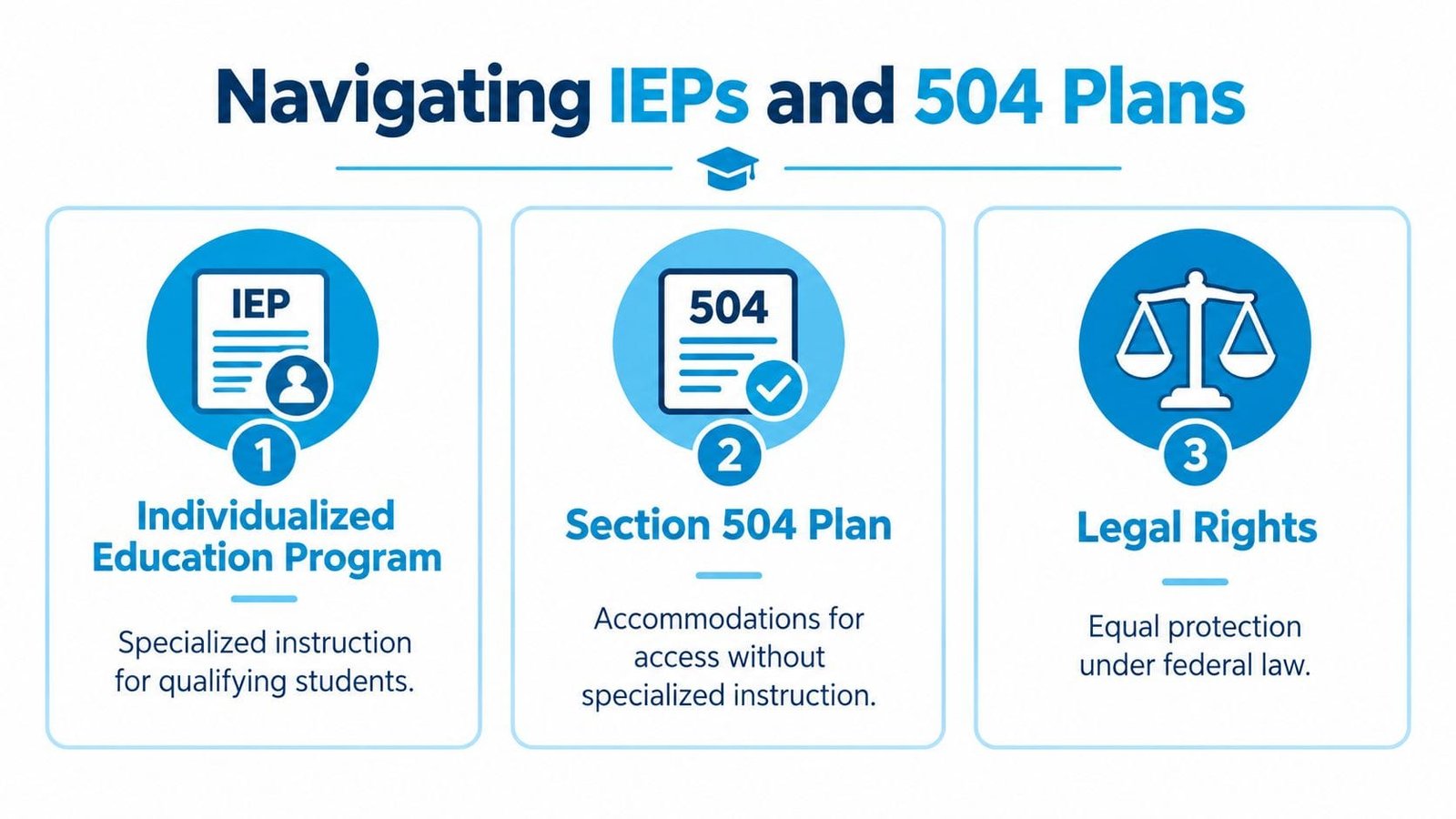
In the United States, an IEP generally provides specialized instruction for a qualifying student. A Section 504 plan provides modifications or accommodations that give a student access to education without necessarily requiring specialized instruction. The appropriate plan depends on educational needs and impact, not on an ADHD diagnosis alone. Schools must consider how the condition affects performance and what support the student needs to participate and learn.
Document function, not just symptoms
The U.S. Department of Education identifies inattention, hyperactivity, impulsivity, and severe disruptive or aggressive behavior as classroom behaviors that may require observation in its resource on identifying and treating ADHD at school and home. A useful record links what happened with the task, setting, educational effect, and response to support.
For example, record that after a three-step written direction, the student completed only the first step. Note that during independent writing, repeated prompts were needed to resume. Then document that the student submitted an incomplete response despite showing understanding in discussion, while a checklist and brief adult check-in supported completion.
These observations give the team more to work with than “the student was distracted.” They help distinguish a need for specialized instruction, accommodations, or both. Repeated records also reveal patterns, such as difficulty beginning multi-step work, rather than treating each incident as isolated.
Know the eligibility conversation
The American Academy of Pediatrics states that ADHD symptoms should be present for at least 6 months and cause impairment in more than 1 domain of a child's life, as described in its guidance on supporting students with ADHD in schools. School eligibility decisions involve educational impact and formal evaluation. Families should bring concrete examples from home and school, not rely only on grades or disciplinary records.
The Critical Gap Beyond Basic Accommodations
A student stares at a worksheet, remembers the first direction, and loses the rest before starting. A seat near the teacher may reduce distraction, but it cannot hold several instructions in working memory. Extra time may extend the deadline without helping the student begin. A break may provide relief without teaching what to do next.
Support works better when adults identify the barrier behind the behavior. Is the task too long to keep in mind? Is initiation stalled? Does sensory strain or an unclear endpoint make persistence harder? These questions shift attention from adding accommodations to testing whether they address the actual problem.
Teacher training builds useful knowledge, yet training alone does not create a lasting support system. A systematic review found large knowledge gains immediately after ADHD training, but those gains were not retained at follow-up periods from 1 to 6 months. It also found no compelling evidence that training alone reduced pupils' ADHD-type behaviors, according to the review of teacher training for ADHD.
A practical plan should work like a small classroom experiment. Record the trigger, the observable behavior, the outcome, and the adjustment to test. Then set a review point and decide what evidence will show whether the change helped.
“Needs frequent breaks” becomes more useful when rewritten as: “After sustained writing, the student leaves the seat and returns sooner when the teacher gives a private transition cue and a defined movement task.” That wording identifies a condition, a response, and a result that the team can track and revise.
Patterns may cross settings. Sleep disruption, stressful transitions, medication changes, sensory strain, or difficult homework can affect the next morning at school. Families and teachers can share relevant observations without exchanging private medical details. Tools such as Guiding Growth can help organize context, responses, and outcomes so one difficult incident does not stand alone.
Accommodations create access. Measurement shows whether the access is working.
Agree on what information may be shared, who can view it, and when the team will review it. Clear boundaries protect the student while keeping support responsive.
Bridging Home and School with Guiding Growth
A parent may notice that poor sleep precedes a difficult morning. At school, the teacher sees multi-step writing trigger avoidance, while a therapist observes that the same student completes the task after help with initiation. These are pieces of one puzzle. Without a shared record, each adult sees a different scene and may recommend a response that misses the underlying barrier.
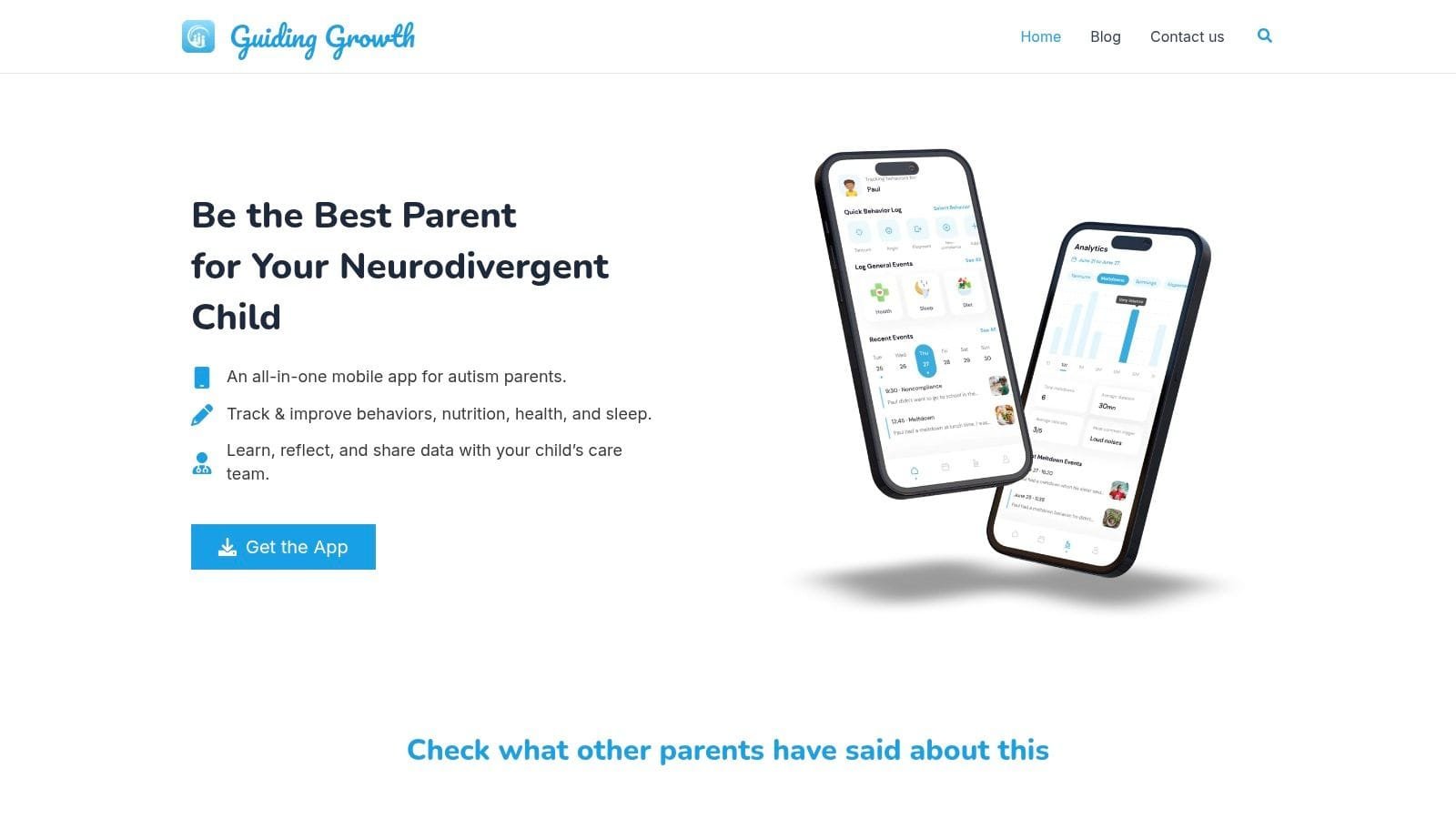
Guiding Growth gives families a place to record behaviors, context, and outcomes that matter to the classroom team. Teachers and clinicians can then compare those observations with home routines instead of relying on separate snapshots, as described on the Guiding Growth platform. The value lies in connecting events to conditions and responses, not in producing more notes.
Compare the intervention with the barrier
Generic support starts with a familiar tool. Targeted support starts with an observation and tests a specific response.
| Classroom situation | Generic response | Targeted response |
|---|---|---|
| Student doesn't begin work | Repeat the full instruction | Display the first action and check initiation |
| Student leaves during writing | Give an unscheduled break | Identify task length, offer planned movement, and record return-to-task behavior |
| Student forgets materials | Remind the student verbally | Use a departure checklist and track which transition causes the loss |
| Student becomes distressed by correction | Increase verbal prompting | Use a private cue, reduce public attention, and record the context |
Working memory is a small mental work surface. If an instruction, materials list, and writing sequence arrive together, the student may lose one part before acting on another. Tracking helps the team identify which step disappears and whether a visual cue, shorter sequence, or planned transition restores access.
A parent can log a behavior and its context, a caregiver can add a routine observation, and a professional can review the shared pattern before discussing adjustments. Families can also use this guide to parenting a child with ADHD when building routines outside school.
Medication questions belong with qualified clinicians. Families seeking professional information can review pediatric ADHD medication management and discuss individual decisions with an appropriate provider.
The purpose is not to turn teachers into clinicians or parents into data clerks. It is to give the adults around a child a shared, concrete language for what happened, what may have contributed, and what to try next. Visit the Guiding Growth site to start building a clearer home and school feedback loop for the child you support.
Real-World Case Scenarios and Outcomes
The following are composite classroom scenarios, not outcome claims about named children. Their purpose is to show how a team can move from a broad label to a testable support.
The student who avoids demands
A student regularly sharpened a pencil, asked unrelated questions, or left the table whenever independent writing began. Adults initially described the behavior as avoidance. A closer log showed that the student started more readily when the teacher offered two topic choices, displayed the first sentence stem, and checked in after the opening line.
The team kept the expectation of written work but changed the entry point. They tracked whether the student began, how much prompting was needed, and what happened after the first successful step.
The student affected by sensory load
Another student worked well during quiet reading but became restless and impulsive during group instruction in a crowded area. The teacher tested a lower-distraction seat, a quiet cue, and access to a brief planned movement activity before the group task.
The important observation wasn't just that “movement helps.” The team recorded when movement occurred, what task came next, and whether the student returned prepared to participate.
The student with learning needs alongside ADHD
A third student appeared inattentive during written mathematics but explained the concepts accurately aloud. The teacher separated calculation difficulty from attention difficulty by offering a worked example, reducing simultaneous directions, and checking one problem before assigning the next set.
That distinction changed the support conversation. Instead of treating every incomplete page as an attention problem, the team considered the student's learning profile and recorded which presentation formats allowed understanding to show.
Building a Sustainable Support Ecosystem
A sustainable plan has three qualities: consistency, collaboration, and adjustment. Consistency means adults use the same observable targets and cues long enough to learn from them. Collaboration means the teacher, family, and relevant professionals share useful information without making the child repeat the same story to everyone. Adjustment means the team changes the support when the evidence shows that the barrier has changed.
Schools already provide substantial support to many students with ADHD. In a national U.S. sample, 69.3% of students with ADHD currently received at least one school service, including 62.3% who received educational support and 32.0% who received classroom behavior management, according to the CDC national sample data. The same source reports lifetime exposure to educational support for 80.2% of students and classroom management services for 59.9%.
The challenge isn't whether support exists. It's whether the support reflects the child's actual triggers, strengths, and changing needs. A checklist, daily report card, classroom observation, and shared family record can work together when adults define the target clearly and review it regularly.
The goal isn't perfect behavior. The goal is a child who can access learning with support that becomes more precise over time.
Guiding Growth centralizes behavior and context tracking, helping families record patterns and share relevant information with caregivers and medical professionals. Visit Guiding Growth to start building a clearer home and school feedback loop for the child you support.