The cereal aisle is where it usually happens. You've been in the store for twenty minutes, the overhead lights are buzzing, a stock cart rattles past, and your child slides down between the cart and the shelf and stops responding. People are looking. You're holding a list you can't read and a phone you can't open fast enough.
That moment isn't defiance, and it isn't a parenting failure. Challenging behavior is nearly always communication about an unmet need: too much noise, too many demands, a transition that came without warning, hunger, pain, or no reliable way to say "I need to leave." Your job isn't to win the aisle. It's to work out what the behavior is doing for your child, then teach something that works better.
The eight strategies below are the ones I reach for most often, and each one is built around a decision point rather than a definition. You'll get when to use it, an example script you can adapt into your own words, and how to track whether it's working for this specific child. None of them work on the first day. All of them work better with data than with memory.
Behavior rarely appears out of nowhere. The same crash pattern shows up after school, when a day of holding everything together ends the second your child walks through the door (why autistic teens crash after school). Reading that pattern is the whole skill.
Table of Contents
- 1. Positive Behavior Support (PBS) with Functional Behavior Assessment
- 2. Functional Communication Training (FCT)
- 3. Visual Supports and Visual Schedules (TEACCH Approach)
- 4. Pivotal Response Treatment (PRT)
- 5. Special Interest Integration (Interest-Based Motivation)
- 6. Sensory Profiling and Sensory Diet Strategies
- 7. The Zones of Regulation
- 8. Social Stories and Video Modeling
- Comparing the 8 Behavior Strategies for Autism
- Pick One Strategy, Track It, and Walk Into Your Next Meeting with Data
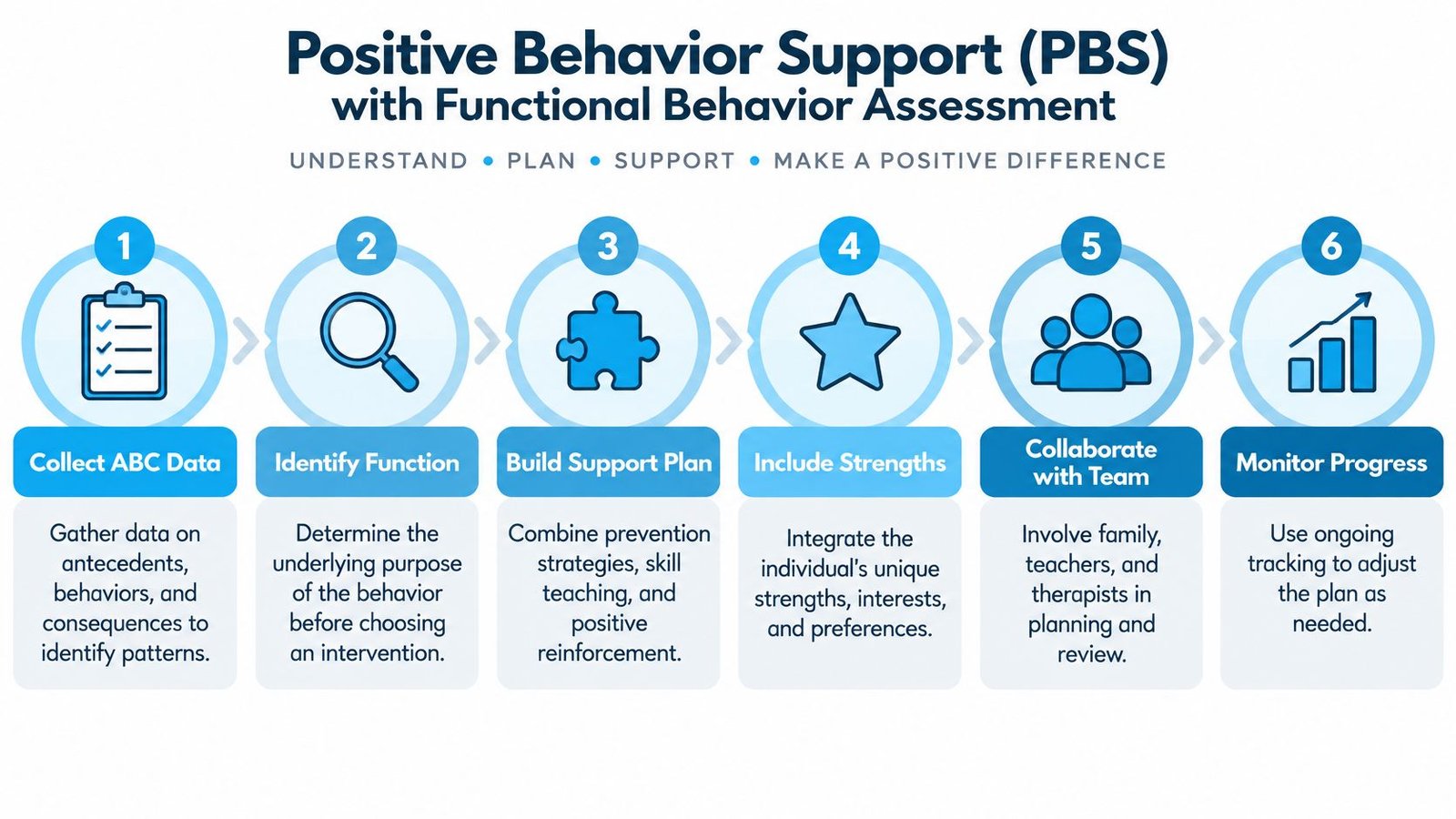
1. Positive Behavior Support (PBS) with Functional Behavior Assessment
Say a school team traces one student's hallway meltdowns to unstructured transitions, loud noise, and a route that passes the gym at peak volume. The fix isn't a firmer consequence. It's a different route, noise-reducing headphones written into the plan, and a request card the student can hand over when a break is needed.
That's Positive Behavior Support in practice. PBS treats challenging behavior as communication about an unmet need, then builds a plan in three layers: prevent the trigger, teach a replacement skill, and reinforce what already works. Everything starts with a Functional Behavior Assessment that names the antecedent, the observable behavior, and the function, usually escape, attention, sensory input, or access to something preferred.
When to use it
Start here when you don't yet know why a behavior happens. Two weeks of logging is a better starting point than a fourth strategy tried from a forum thread. If a plan is being written for your child without an FBA behind it, ask for one.
The script
What to say at the meeting: "Before we pick a consequence, can we look at what happens in the ten minutes before the behavior? We're seeing the same three triggers repeat."
What the evidence supports
The 2020 NCAEP practice review synthesized intervention studies from 1990 through 2017 and identified 28 evidence-based practices for autistic children, youth, and young adults, generally requiring either two high-quality group studies from different research teams or five single-case studies from at least three research groups involving 20 or more participants. Antecedent-focused and multicomponent interventions have held up across a review covering 20 literature reviews and meta-analyses, described as moderately to highly effective for many target behaviors (antecedent intervention review).
How to track it
- Log antecedents, not just incidents: time of day, location, who was present, the demand that came before, and last night's sleep.
- Let the app find the clusters: Guiding Growth's structured behavior entries capture triggers, intensity, duration, purpose, and location, and the analytics view shows time-of-day and day-of-week patterns before you draw conclusions.
- Write the plan in three parts: what to do before, during, and after the behavior, plus the strengths the plan builds on.
- Share one version of the story: a Smart Summary keeps the IEP team working from the same numbers, and you can see the shape of it in a worked functional behavior analysis example.
2. Functional Communication Training (FCT)
A child pushes materials away when a task feels too hard. If the behavior reliably ends the task, a useful next step may be to teach a quick way to request help or a break. Functional Communication Training (FCT) teaches a communication response that serves the same purpose as the challenging behavior, such as asking for quiet, a snack, help, or the end of an activity.

FCT was described by Edward Carr and Vicki Durand in 1985. Its practical logic is straightforward: the replacement response needs to work for the child, and be easier to use than the behavior it replaces.
When to use it
Choose a communication response that matches the likely function. A child who hits to escape a demand may need a break request. A toddler who pulls your hand toward a cupboard might use a sign or card for “more.” A nonspeaking teen may use a quiet-room symbol on an AAC device.
The script
Model the response and prompt it before distress escalates: “You want a break? Show me break. Break.” Then honor the request consistently, including when the timing is inconvenient. If a child has to repeat the request or wait unpredictably, the old behavior may remain the more reliable option.
The honest trade-off
FCT depends on identifying what the behavior is communicating and following through consistently. A request for a break is unlikely to help if the task continues every time the child uses it. Reviews of behavioral interventions report moderate, mixed effects, so assess whether the approach is helping this child rather than relying on a broad rating.
How to track it
- Count both responses: Record the challenging behavior and the replacement request. Guiding Growth's Behavior Tracking lets parents log behaviors and their triggers and outcomes, making changes over time easier to review.
- Make the request easy to use: A card or AAC symbol may be more manageable than a spoken sentence when a child is overloaded.
- Brief every adult: Agree on the prompt and what happens after the request, so the child gets a consistent response at home, school, and therapy.
3. Visual Supports and Visual Schedules (TEACCH Approach)
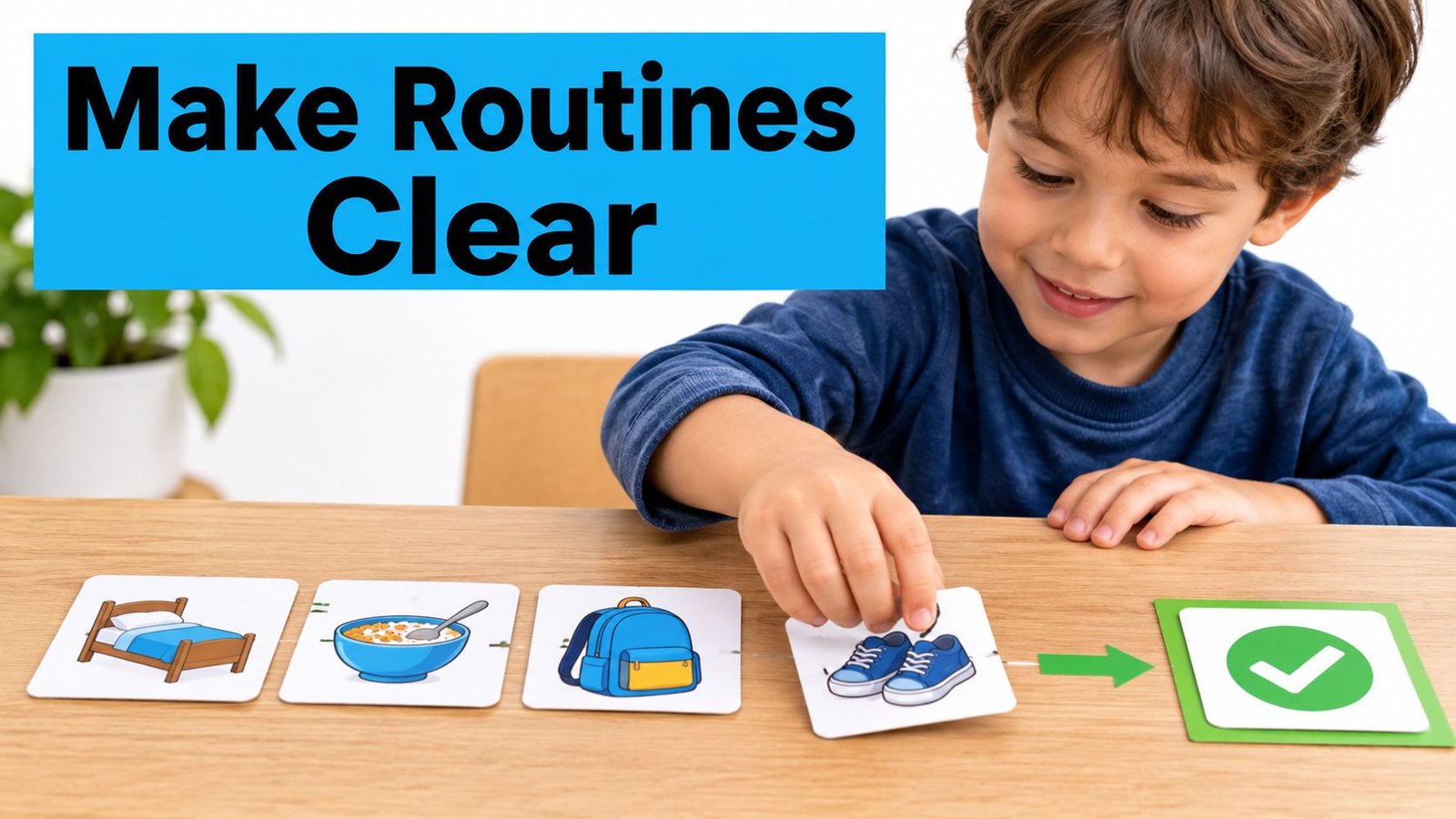
The morning routine breaks at the same step every day. Not because your child is stubborn, but because "get ready" is a ten-step instruction delivered as three words, and working memory quits under that load. A visual schedule replaces the spoken sequence with pictures, objects, or written steps your child can see, touch, and check off.
TEACCH, developed at the University of North Carolina, is the best-known model for this kind of structured teaching. The principle behind it applies whether or not you use the full program: many autistic learners process visual information more reliably than spoken language, and a schedule turns a vague expectation into a visible one.
When to use it
Reach for visuals at the transitions that fail repeatedly, not for every minute of the day. One or two cards for the hardest moment beat a laminated wall of twenty. Use the child's real photos and the objects they reach for.
The script
Narrate in first-then form. "First shoes. Then car. Shoes, then car." Keep a change card in your pocket for plan shifts, so "different" stops being a surprise your child has to absorb cold.
The trap nobody warns you about
Visual supports get built for one setting and then fall apart in another. A 2025 study found 61.8% of caregivers named externalizing behaviors such as aggression as a top concern, while school-based concerns more often centered on social differences, and the authors called for setting-specific interventions and cross-system coordination (study in the journal Autism). The chart that fixes home may be irrelevant in a classroom with different triggers, different staffing, and a different reward.
Consistency is what makes these supports stick, which is why they show up in everything from classrooms to daily living assistance at home.
How to track it
Log transition difficulties by time and location so you can see which parts of the day earn a visual support, then bring that log to the IEP meeting instead of a general impression.
4. Pivotal Response Treatment (PRT)
PRT is the strategy parents most often try to copy from a video, and the one that most often stalls without a coach. That's not a knock on parents. It's what the implementation data shows.
In a pilot study using a nonconcurrent multiple-probe design across parent-child dyads, video modules alone produced minimal gains in parent fidelity. Adding individualized early-interventionist coaching produced immediate and sustained fidelity increases, along with notable reductions in challenging behavior (pilot study in the Journal of Autism and Developmental Disorders). The skill lives in the timing, not the concept.
What it actually is
PRT targets key areas: motivation, responding to multiple cues, self-management, and self-initiated communication. Robert and Lynn Koegel developed it at the University of California, Santa Barbara, and it sits inside the naturalistic developmental behavioral family. You follow the child's lead, offer choices, reinforce attempts, and build practice into play the child already wants.
The script
Hold the train. Wait. The child reaches or vocalizes. "Go! You asked for go." Then the train moves. Reinforcement follows the attempt rather than the perfect word, and the reinforcer is the activity itself, not a sticker handed over afterward.
How to run it at home
- Pick the motivator first: the item has to be worth asking for.
- Offer a choice between two: two options raise engagement more than one.
- Keep sessions short: two minutes of real practice beats twenty minutes of drilling.
- Get watched once: a single session with a therapist observing you will beat a month of videos.
How to track it
Note which motivators produced requests and which produced shutdowns, and log both. Before your next appointment, use Alma, the AI companion inside Guiding Growth, to think through which prompts and motivators fit your child's sensory and communication profile.
5. Special Interest Integration (Interest-Based Motivation)
Ask what your child would do for three hours straight and you've found the most underused teaching tool in the house. Special interests, whether trains, elevators, maps, dinosaurs, or the entire canon of one character, are sources of competence and joy. They're not symptoms to be managed down.
Interest-based practice brings those interests into routines and learning instead of treating them as something to earn back. A 2025 community-engaged study took a related starting point, prioritizing proactive teaching of children and the people around them to respond to preferences and unmet needs, especially when behavior could be dangerous (community-engaged research on preferences and needs).
When to use it
Use it when motivation is the bottleneck: a child who can count but won't, who dresses only with the elevator video playing, or who shuts down during writing that feels meaningless. A child who loves elevators can practice counting by floor numbers. A teen who loves game design can structure a writing assignment around level progression.
The script
"Your job is three sentences about the elevator. Which floor should the character start on?" You kept the demand and handed over the content. The work is still there. The resistance drops because the child has some control over the material.
What not to do
Don't weaponize it. Interest time scheduled as part of the day is regulation. Interest time dangled as a reward for compliance is a lever, and kids learn quickly when their joy has conditions attached.
A rule that changes outcomes: interests work as an entry point, not as a bribe. Schedule them into the routine and stop withholding them.
How to track it
Log which interest appeared during a hard moment and whether it shortened the recovery. Guiding Growth's behavior logs let you tag the interest and compare recovery time across weeks, and the note travels with a Smart Summary to the care team. For the reasoning behind it, read how motivation works in autism.
6. Sensory Profiling and Sensory Diet Strategies
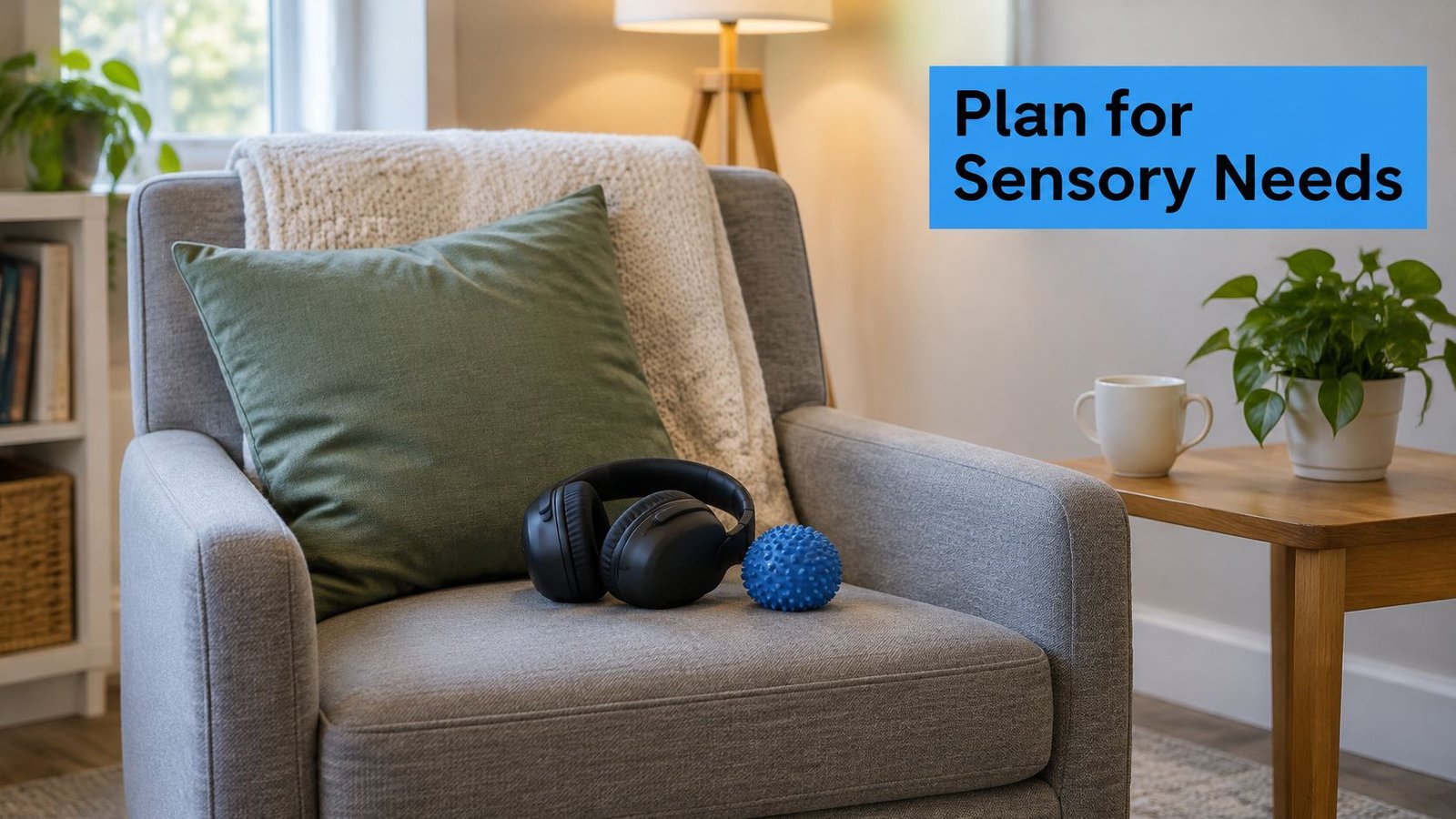
Fluorescent lights, a tag on the collar, a cafeteria at full volume. The traffic jam is often sensory, and no consequence clears a traffic jam. Sensory profiling maps how your child responds across hearing, touch, taste, smell, vision, movement, and body awareness, then separates the inputs that overwhelm from the ones that calm or that your child actively seeks.
A sensory diet is the plan that follows: movement breaks, deep pressure, chewing, quiet space, and fidgets, scheduled across the day to prevent overload instead of reacting after it. Occupational therapists built the concept on Jean Ayres's sensory integration theory and the Wilbarger work on sensory diets.
When to use it
Use it when behavior clusters around specific environments or times: hallways, assemblies, grocery stores, homework, bedtime. A behavior that only appears under fluorescents, or only after a noisy bus ride, is a sensory question before it's a compliance question.
The script
Teach the exit before you need it. "Lights hurting? Show me the card and we go to the hallway." Then practice the card on a calm day, so it still works on a hard one. A child who seeks movement gets a two-minute animal walk every hour, scheduled before the running starts.
How to track it
- Record the sensory context: lighting, noise, crowding, time of day, and location, alongside the behavior.
- Schedule breaks before predictable stress points, never only after a meltdown.
- Build a portable kit with the preferred items for home, school, and travel.
- Treat the diet as a hypothesis and test it. The CDC's autism treatment guidance states that behavioral approaches have the strongest evidence among autism treatment approaches and emphasizes that progress is tracked and measured. Hold sensory strategies to that same standard: define the target, collect observations, compare date ranges.
Keep a full week of entries before you credit or blame a sensory strategy. Overload builds across days, and a single good afternoon proves nothing.
Guiding Growth records location and time with every entry, filters by behavior and date range, and gives your occupational therapist something concrete to interpret.
7. The Zones of Regulation
A child who can name “angry” or “tired” may still need help noticing what to do next. The Zones of Regulation uses four color-coded states: blue for low energy or sadness, green for calm and ready, yellow for stress or excitement, and red for intense emotion. The aim is to recognize a zone and choose a useful tool, not to stay green all day.
When to use it
Try this approach when your child can label basic feelings but needs support connecting a feeling to a next step. If noticing body signals is still difficult, begin with interoception work, including how interoception affects emotional regulation, before introducing a color chart.
The script
Check in during predictable, low-stakes moments rather than during a meltdown. “What zone are you in? Yellow? What helped last time you felt this way?” Keep the choice grounded in the child's experience. A dinner check-in, for example, can help them name a tool that worked earlier that day.
Build the toolbox together
- Choose tools your child already likes and will use.
- Offer one or two options per zone to keep decisions manageable under stress.
- Teach one zone at a time, using your child's own examples and words.
- Agree on shared vocabulary with the adults involved, so the same color means the same thing at home and school.
How to track it
Log zone changes and the strategy used in Guiding Growth's behavior entries, then look at which tools line up with a faster return to green. Compare entries across similar situations, such as the same part of the day or the same activity, to see whether a tool is consistently helpful.
8. Social Stories and Video Modeling
A dentist visit can involve a stranger, bright lights, unfamiliar tools, and uncertainty about how to ask for a break. A Social Story can make the sequence more predictable before the appointment. The format, developed by Carol Gray, uses clear descriptions of what may happen, other people's perspectives, and actions the child can take.
Video modeling shows a person performing a skill so the child can watch and practise it. It may suit a skill the child can observe but has not yet learned to perform, such as greeting a classmate or washing hands.
When to use it
Choose a Social Story before a new or stressful event, such as a haircut, blood draw, fire drill, or day with a substitute teacher. Use video modeling when the child benefits from seeing each step. Keep the example relevant to the setting and the child's communication style.
The script
Keep the story brief, specific, and positive, with a workable way for the child to request a pause. For example: “When I sit in the chair, the dentist counts my teeth. If I need a break, I hold up my hand. The dentist stops.” Review it before the appointment, then adjust the wording if the actual sequence differs.
Here's a short walkthrough of these visual teaching approaches in practice.
How to track it
Log when the story or video was used and note what happened during the event. Record whether the child followed the steps, asked for a break, or needed a different kind of support. Guiding Growth lets parents attach photos, videos, and notes to an entry, helping them compare experiences across appointments.
The test of a good story: it tells the child what to do, not only what to avoid. If most of it is “don't,” rewrite it.
Comparing the 8 Behavior Strategies for Autism
Choose a strategy based on the decision in front of you: what is happening, when it happens, and what kind of support the child needs. The table compares each approach by its main use, who can deliver it, and the evidence described in the article.
| Best When | Primary Focus | Who Delivers It | Evidence Strength |
|---|---|---|---|
| A recurring behavior needs to be understood and addressed with a preventive, skill-based plan | Assessing behavior function and building support plans | Families, teachers, therapists, and trained PBS teams | FBA-based support |
| A child needs a reliable way to communicate the need behind a behavior | Teaching a communication response that meets the same need | Therapists, speech-language pathologists, caregivers, and teachers | Mixed meta-analysis findings for social-communication outcomes |
| Routines, expectations, or transitions are difficult to follow | Visual schedules and structured teaching | Families, special educators, and occupational therapists | Research support for structured teaching |
| Play and child-led interaction can support learning pivotal skills | Motivation, communication, and other pivotal skills | Parents, therapists, and teachers | Strong research base |
| A child's interests can help increase participation in learning or daily routines | Using personal interests in learning and daily routines | Families, special educators, and occupational therapists | Evidence strength not established in the article |
| Sensory needs appear to affect participation or regulation | Sensory profiling, environmental adjustments, and planned sensory activities | Families, teachers, and occupational therapists | Mixed evidence for some interventions |
| A child needs help identifying emotional states and choosing a regulation strategy | Emotional awareness and self-regulation | Families, teachers, occupational therapists, and therapy teams | Evidence rating not established in the article |
| A child needs preparation for a situation or instruction in a practical skill | Personalized stories and video demonstrations | Families, teachers, speech-language pathologists, and therapists | Research support for teaching social and daily living skills |
Pick One Strategy, Track It, and Walk Into Your Next Meeting with Data
Eight strategies is too many to run at once. Pick the one that matches the behavior costing your family the most right now, whether that's the morning transition, the after-school crash, or the aggression at bedtime. Run it for three weeks with the same adults doing the same thing. Then look at the data before you add anything else.
Execution is the part everyone skips. A systematic review of parent-implemented Early Start Denver Model studies found that only about half of the included studies had most parents reach the commonly used acceptable-fidelity threshold of at least 80% at post-test (review of parent-implemented ESDM fidelity). If a plan isn't working, check how consistently it's being delivered before you blame the plan.
Change is measurable once you define it. In a randomized trial in routine mental health care comparing face-to-face parent training, blended training, and a waitlist for children aged 4 to 13 with autism and disruptive behavior, 78.1% of the face-to-face group improved by at least 25% on the Home Situations Questionnaire PDD, against 55.6% in the blended group and 42.9% on the waitlist (χ² = 8.01, p = 0.02), with gains in noncompliance and irritability holding at the six-month follow-up (trial in the Journal of Autism and Developmental Disorders).
The caregiver side carries the same weight. The same three-arm trial of 97 parents found that face-to-face training improved parental self-efficacy and reduced overreactive parenting relative to the waitlist, while blended training didn't produce the same comparative effects on those measures (parent outcome analysis). Support you practice beats content you read.
One place for all of it
Guiding Growth is where those logs live. Behavior Tracking covers meltdowns, shutdowns, demand avoidance, echolalia, and stimming, with triggers, purpose, intensity, duration, and outcomes recorded per child. Sleep, diet and nutrition, medications, therapy sessions, and specialist visits sit in the same profile, so a change in one area shows up against the others instead of in a separate notebook.
Quick Log by voice turns a spoken recap of the day into structured entries in about a minute, and a Smart Summary pulls a date range into a PDF you can hand to an IEP team or a new specialist. Alma, the AI companion, answers questions about behavior and sensory strategies using your child's own logged history. Guiding Growth was built specifically to help parents identify triggers, analyze patterns, and make informed decisions, and it's available on iOS and Android.
Guiding Growth gives you one place to log the behavior, the trigger, the strategy you tried, and what happened next, then turns those entries into patterns you can review and share. It was built for parents who need to identify triggers, analyze patterns, and make informed decisions with their child's care team, not collect another notebook of guesses. Start with a single strategy from this list, log it consistently for three weeks, and see what the data says at Guiding Growth.