You're carrying the same information in too many places. A teacher has one note about a difficult transition, a therapist has another target for communication, and your phone contains the only record of how sleep, food, sensory overload, and medication affected the day. At the next meeting, everyone cares about your child, but each person is working from a different version of the story.
Collaborative goal setting creates a shared working plan. It connects the child's priorities, the family's values, and each professional's responsibilities without turning care into a collection of disconnected targets. Done well, it reduces repeated explanations, makes progress easier to see, and gives the team a practical way to adjust support when real life changes.
Table of Contents
- Why Fragmented Care Fails Neurodivergent Children
- Assembling Your Care Team and Defining Roles
- Translating Child-Led Priorities into Observable Goals
- Designing a Low-Burden Data Collection Plan
- Navigating Disagreements and Shifting Priorities
- Tracking Progress and Celebrating Wins with Guiding Growth
Why Fragmented Care Fails Neurodivergent Children
A typical week can place one child inside several separate systems. A behavior specialist may focus on transitions, a teacher may be trying to support participation in group activities, a speech therapist may be working on functional communication, and a pediatrician may be monitoring sleep or nutrition. Each concern can be valid, yet the family still ends up acting as the only information hub.
That arrangement creates predictable friction. The school may report that a strategy is working, while the parent sees distress at home after the child has spent the day coping. One provider may recommend increasing demands, while another is helping the child communicate a need for a break. Scattered notes rarely show how these experiences connect, so adults can mistake a context-specific response for a general behavior problem.
Practical rule: If the family has to retell the same story at every appointment, the care system lacks a shared record.
Collaborative goal setting isn't a corporate exercise imported into family life. It's a structured care coordination method that asks the people closest to the child to agree on what matters, how success will be observed, and who will act. The emphasis shifts from isolated provider targets to outcomes that support participation, regulation, communication, health, and quality of life.
A mature evidence base
Goal-setting theory provides the strongest historical foundation for this approach. Edwin Locke introduced the theory in 1968, and Locke and Gary Latham formalized it in 1990 after the framework had already been built on more than 50 years of research. Later synthesis covered nearly 400 studies, close to 40,000 participants, eight countries, and 88 tasks, as described in the historical review of goal-setting theory.
That history doesn't prove that every goal or intervention will work for every autistic child. It does support a disciplined principle: goals work better when they're explicit, measurable, challenging without being unreasonable, and accepted by the people responsible for carrying them out. In care coordination, acceptance matters because a technically precise goal can still fail if it ignores the child's communication, sensory profile, or family capacity.
A useful first step is creating a single source of truth for current priorities, observations, decisions, and responsibilities. The point isn't to collect more information. It's to stop important information from disappearing across notebooks, texts, school portals, and memory.
Assembling Your Care Team and Defining Roles
Before writing a goal, map the people who influence the child's day. Listing names isn't enough. Each person needs a defined contribution, a boundary, and a reliable way to share information with the rest of the team.
Start with the child and family at the center. Then identify the person who can coordinate decisions, followed by the clinical, educational, and home participants who observe different parts of the child's life.
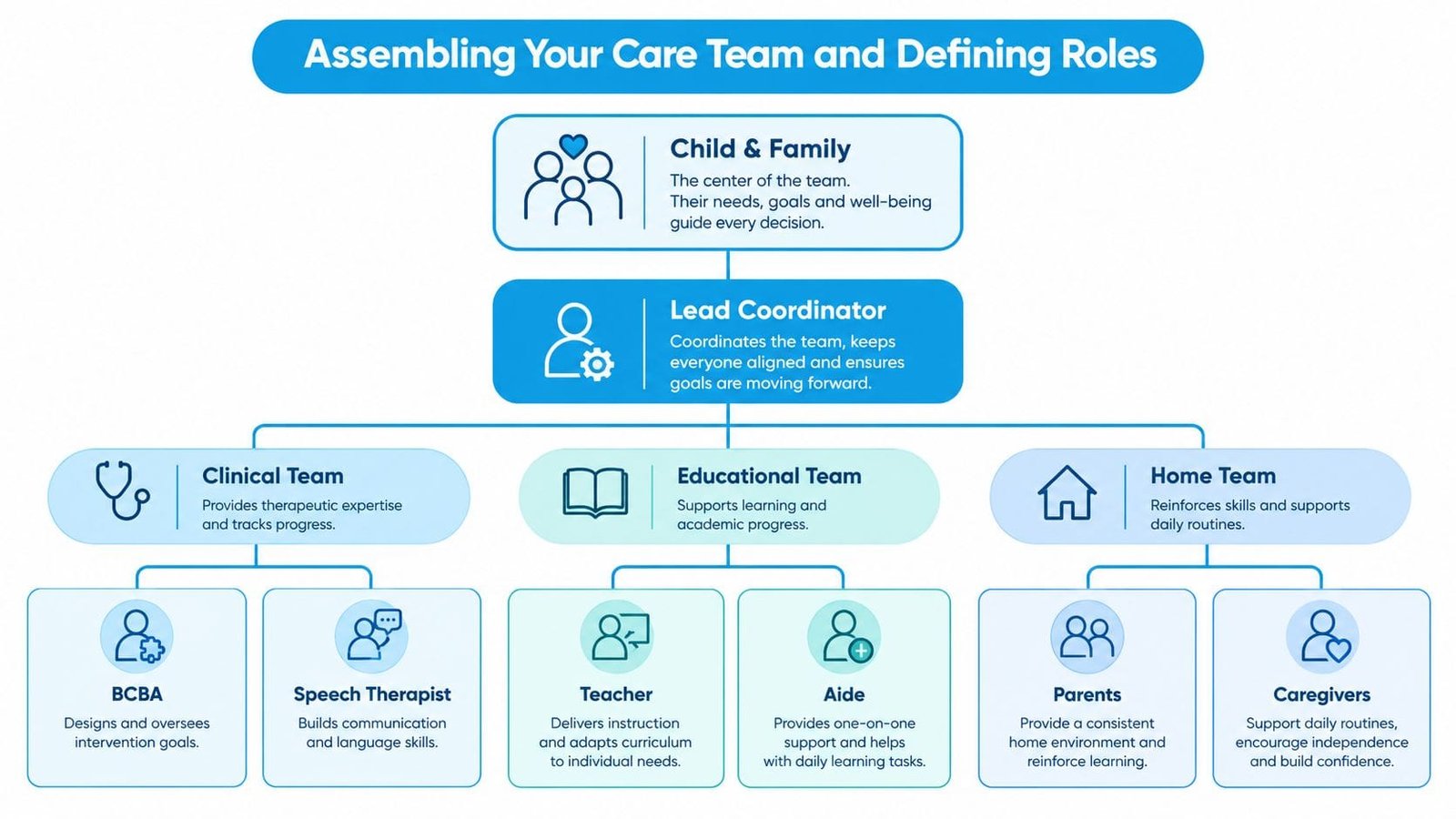
Build the role map
Use a simple four-part structure:
- Child and family: Identify what matters, describe daily realities, approve priorities, and decide which trade-offs are acceptable.
- Lead coordinator: Maintain the current plan, organize reviews, record decisions, and identify unresolved conflicts.
- Clinical team: Translate clinical expertise into support strategies, explain risks and alternatives, and define what they can measure in their setting.
- Educational and home teams: Apply agreed approaches in daily routines, record relevant observations, and report where the plan succeeds or breaks down.
A speech therapist shouldn't become the owner of sleep goals because communication difficulties appear after a poor night. A classroom aide shouldn't be expected to redesign a medical plan. Clear roles prevent well-intentioned people from managing the same issue with incompatible methods.
Person-centered planning means creating a plan for the individual rather than the system. The person should state what matters, decide what matters in life, and identify who is responsible for carrying out parts of the plan, according to Pennsylvania's explanation of person-centered planning. For a child who communicates differently, the team can use observation, assistive communication, choice-making, and trusted interpretation, while still treating the child's preferences as meaningful evidence.
Set the communication rhythm
Choose one shared location for the current goal plan and establish how updates will move through the team. A short recurring review is more useful than long meetings that happen only after a crisis. Ask each participant to report three things: what they observed, what they tried, and what should change.
Families who need help with administrative coordination may also explore a Medical virtual assistant for tasks such as organizing information, preparing appointment materials, or supporting routine communication. That kind of assistance should reduce clerical load, not transfer clinical decision-making away from qualified professionals or the family.
A centralized information sharing platform can help the team work from the same current plan. Set boundaries at the beginning: who can edit goals, who can add observations, who can see sensitive information, and how disagreements will be documented.
Translating Child-Led Priorities into Observable Goals
A child may say, show, or communicate, “I want to play with other children,” “the shop is too loud,” or “I don't want this therapy anymore.” Those statements are meaningful priorities, but they aren't yet operational goals. The team has to translate them without stripping away the reason they matter.
Start with the desired participation outcome, not the behavior adults find inconvenient. “Complies with transition instructions” describes adult expectations. “Moves from the playground to the classroom with access to a predictable warning and a break option” describes participation while acknowledging support needs.
Use a three-layer goal
A practical goal contains three connected layers:
- The priority: What does the child want to do, tolerate, communicate, or experience?
- The observable action: What will adults see or hear when the child is moving toward that priority?
- The support and context: Which tools, accommodations, people, and environments make the action possible?
For example, a broad priority such as “feel less overwhelmed at the grocery store” might become: “During a short shopping trip, the child will use a break card, gesture, device, or spoken request to indicate rising distress, and an adult will move to the agreed quiet area or end the trip safely.” The goal isn't forced endurance. It measures access to communication and a safe response.
The evidence supports precision, but precision shouldn't become rigidity. A meta-analysis covering 155 studies and 384 effect-size cases found a small, reliable positive effect of goal setting on behavior, d = .34, with a 95% confidence interval from .28 to .41. The subgroup labeled collaborative goal setting in health behaviors had a smaller positive effect, d = .28, as reported in the goal-setting meta-analysis.pdf). These findings support clear shared goals, not the assumption that one formula fits every child.
Ask questions that preserve agency
Adults often ask, “How do we get the child to do this?” A better conversation asks:
- “What part of this activity feels important to you?”
- “What makes it difficult or unsafe?”
- “How will you let us know you need help?”
- “Would you rather practice at home, school, or somewhere familiar?”
- “What should adults stop doing if the plan increases distress?”
A goal involving emotional or sensory regulation should record the child's signals and the adult response. “Uses a regulation strategy” is too vague unless the team defines which strategies count, who offers them, and whether the child can refuse. The plan might include headphones, reduced language, a visual sequence, movement, a quiet space, or a trusted person, depending on the child's preferences.
Keep adult requirements visible
Safety, medical care, school access, and therapy responsibilities still matter. The solution isn't to let adults erase the child's priorities, nor is it to ignore legitimate safety constraints. Put both on the same page, then identify the smallest safe experiment that allows the child's preference to influence the plan.
Outcome-based planning helps keep the discussion anchored in what changes for the child, rather than in whether a provider completed a procedure. A structured outcome-based planning approach can connect the priority, baseline, support, observable indicator, and review decision in one place.
Designing a Low-Burden Data Collection Plan
Data collection fails when it asks tired parents and busy teachers to become full-time clerks. The useful question isn't, “How much can we record?” It's, “What is the smallest amount of reliable information that will change our next decision?”
Current guidance often stops at SMART goals, even though families need a way to capture baseline, context, and progress across home, school, and therapy. That measurement and technology gap is described in recent research on structured collaborative goal workflows. A sustainable system records enough context to explain a pattern without making every difficult moment an administrative event.
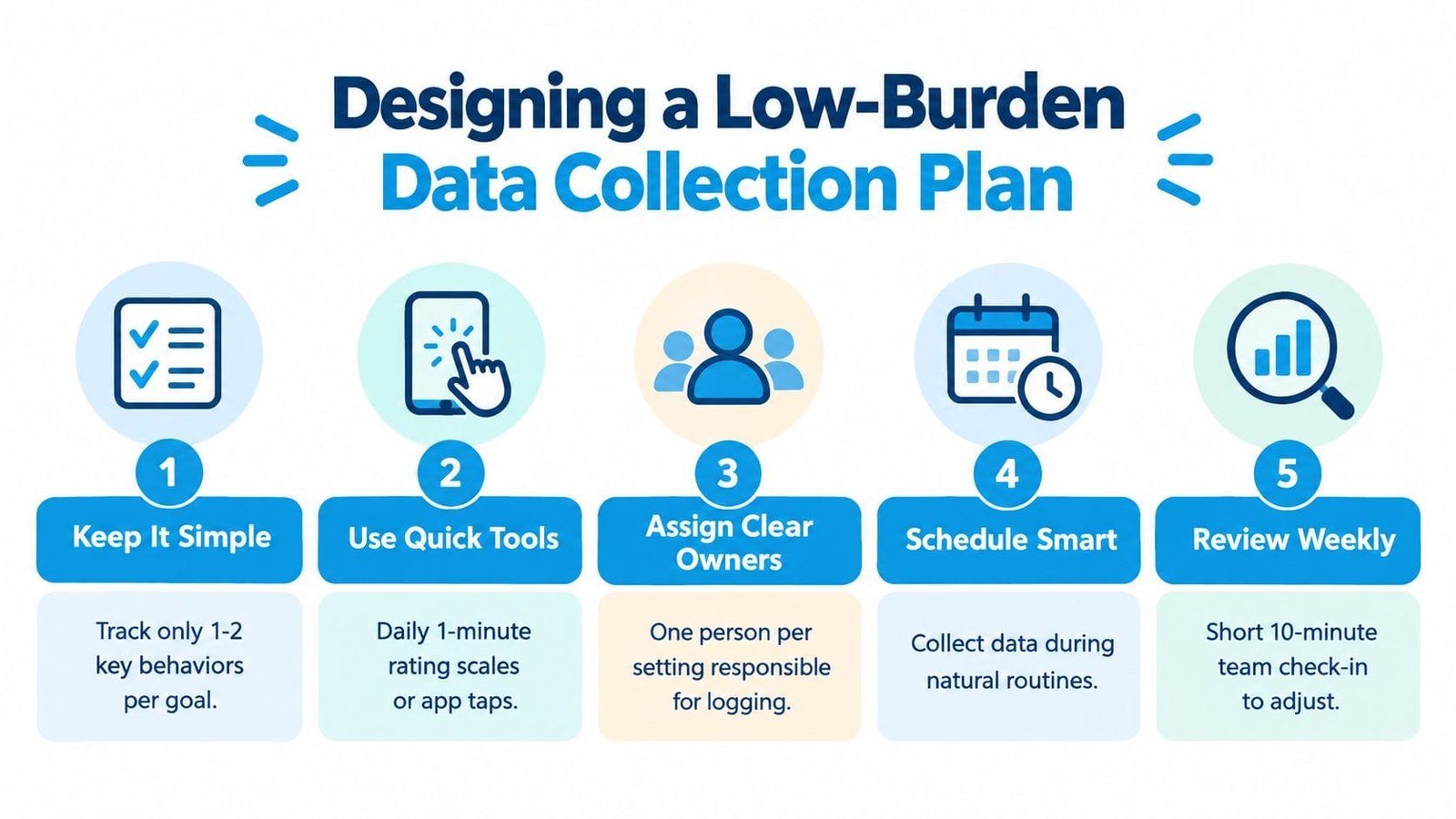
Choose the minimum useful fields
For each goal, define the baseline before changing the plan. Baseline can be a brief description of what usually happens, the conditions under which it occurs, and the support already in place. Then select only the fields that help distinguish progress from a change in context.
A practical log might include:
- Situation: Where was the child, and what activity was underway?
- Trigger or demand: What changed immediately before the event?
- Child communication: What signal, action, or communication occurred?
- Adult response: What support was offered, and was it accepted?
- Outcome: Did the child return to the activity, choose an alternative, request a break, or need the activity to end?
Don't record every detail for every goal. A sleep goal may need bedtime, waking, and notable disruptions. A school transition goal may need the transition context, warning provided, communication used, and outcome. Combining unrelated observations into one giant form makes patterns harder to interpret.
Assign ownership and timing
Give each setting one clear logging owner, while allowing others to add short observations when they have important context. Use natural routines instead of creating artificial observation sessions. A parent can record a quick evening summary, a teacher can log a transition, and a therapist can document the support used during the planned activity.
Keep review separate from logging. The person recording an event shouldn't have to interpret the whole pattern in the same moment. During a brief team review, ask whether the goal remains relevant, whether the support is feasible, and whether the data justify continuing, adapting, or pausing the plan.
A family exploring anxiety-related support may also find it useful to review practical therapy options for anxious kids, then bring specific questions back to the child's qualified care providers. The goal is informed coordination, not adding another unconnected recommendation to the family's workload.
Use a quick app tap, a short rating scale, or a voice note when typing isn't realistic. The following video can help teams think about making data collection more workable in daily practice.
Navigating Disagreements and Shifting Priorities
Consensus isn't the same as everyone getting their first choice. In autism care, disagreement can arise because the child values autonomy, the parent is protecting energy and safety, the school is responsible for access to learning, and a clinician is considering health or developmental needs. Pretending those interests never conflict usually pushes the disagreement into hallway conversations, missed appointments, or inconsistent implementation.
Research on children with special educational needs shows that children can identify different desired activities and participation goals than their caregivers. Yet mainstream family-centered guidance often offers little practical help with assent, trade-offs, dissent, or changing preferences, as discussed in research on collaborative goal setting and participation.
Separate the disagreement into parts
When a meeting becomes tense, name the actual issue:
- Priority conflict: The child wants one outcome and adults want another.
- Safety concern: Someone believes the proposed activity creates unacceptable risk.
- Feasibility problem: The plan requires time, staffing, equipment, or consistency the setting can't provide.
- Measurement disagreement: The team doesn't agree on what progress looks like.
- Consent or assent concern: The child is signaling refusal or distress.
Each problem needs a different response. A feasibility problem may need a smaller goal. A measurement disagreement needs a shared definition. A safety concern requires qualified clinical and family discussion, not a vote based on convenience.
Use respectful scripts that make room for dissent:
“The child's preference is to stop this activity. What is the adult outcome we're trying to protect, and can we test another route to it?”
“We don't agree on the priority yet. Let's document both views, identify the safety boundary, and choose a limited plan with a review point.”
The family-driven autism care pathway described in this plan-do-study-act report used serial PDSA cycles to test changes. Its success measures included the percentage of children meeting one or at least two constipation- or insomnia-related goals, along with the number of weeks from enrollment to goal completion. The transferable lesson is methodological: treat a disputed plan as something to test carefully, not as a permanent verdict about the child.
Document who disagreed, what concern they raised, what compromise was selected, and what would trigger revision. If the child's communication or preference changes, the team should update the goal rather than treating the earlier agreement as binding forever.
Tracking Progress and Celebrating Wins with Guiding Growth
A collaborative plan becomes useful when it changes what people do between meetings. The team needs to see the current goal, record what happened, notice context, and decide when to adjust. Static documents often preserve intentions, but a living record makes daily observations available to the people who can act on them.
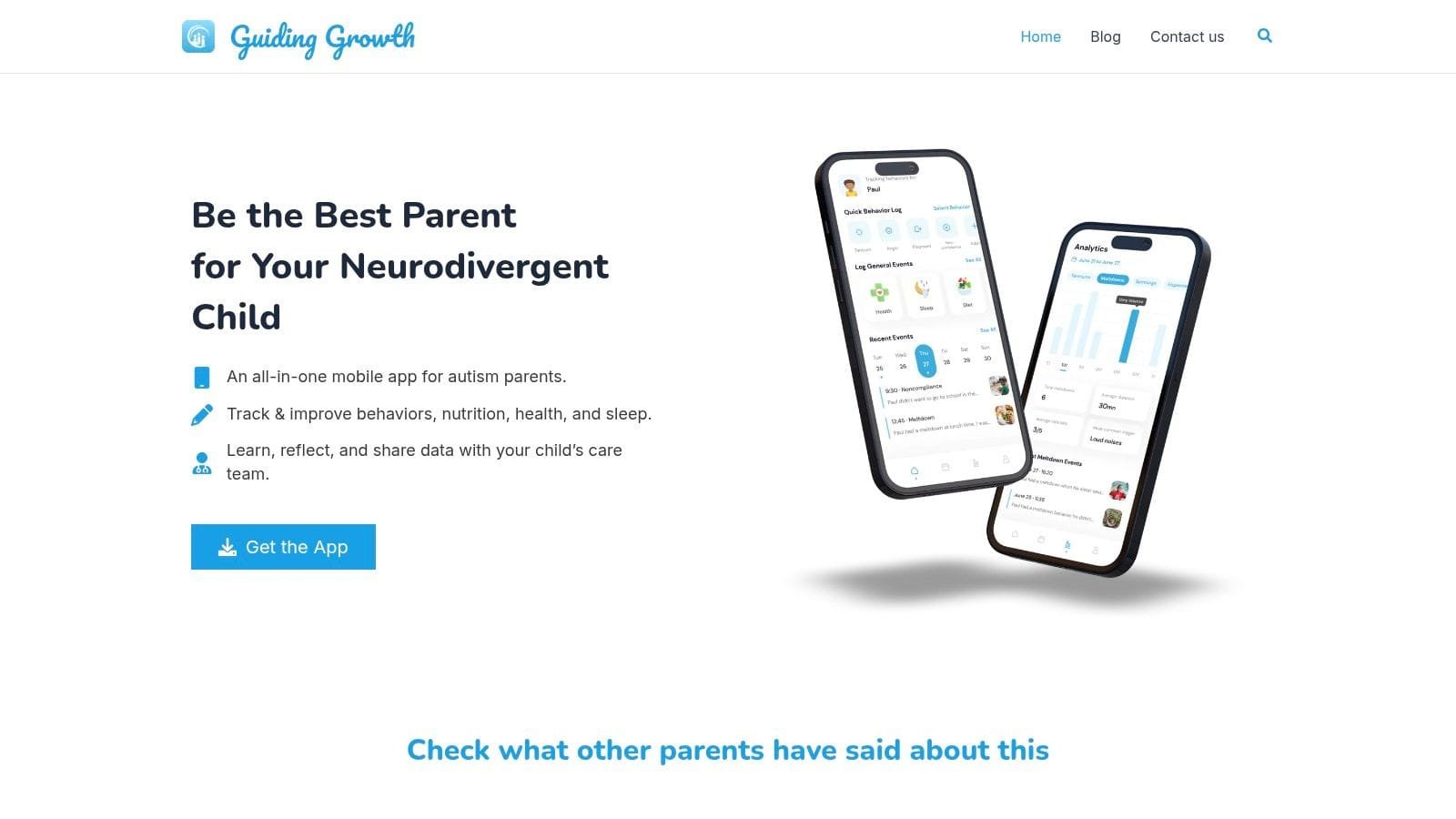
Guiding Growth is one app-based option for this workflow. It centralizes behavior logging for events such as meltdowns, shutdowns, demand avoidance, echolalia, and hand flapping, while allowing families to capture triggers and outcomes. It also supports records for sleep habits, routines, diet and nutrition details, medications, appointments, and therapy sessions, with visualizations that help families review patterns and share information with collaborators.
Turn observations into decisions
Set up each goal with a plain-language description, the child's priority, agreed supports, and the indicator the team will review. A parent might use a quick voice log after a difficult bedtime, while a caregiver adds the context of a changed routine. A school or clinical partner can contribute observations when the family has invited them to collaborate.
The value isn't the volume of entries. It's the connection between an event and the decision that follows:
- Observe: Record what happened and the surrounding context.
- Interpret cautiously: Look for repeated conditions, not one isolated event.
- Act: Adjust the support, environment, timing, or expectation.
- Review: Ask whether the change helped the child participate or communicate more safely.
Alma AI is presented within Guiding Growth as an AI autism parenting companion for questions that arise during the parenting journey. Families should still use qualified professionals for diagnosis, urgent concerns, medication decisions, and individualized treatment recommendations. AI support can help organize questions and reflections, but it shouldn't replace clinical judgment or the child's voice.
Celebrate meaningful progress
Progress may look like requesting a break before distress escalates, returning to a routine with less support, sleeping more comfortably, tolerating a previously avoided setting, or making a clear choice between two options. These changes deserve attention even when the original adult target hasn't been completed.
Families also need to protect their own capacity. If tracking becomes another source of pressure, reduce the fields, change the owner, or pause nonessential goals. Resources about neurodivergent burnout recovery can add useful context when exhaustion affects the child, caregivers, or both.
The strongest system is not the one with the most data. It's the one that lets the child's priorities remain visible, gives each adult a manageable responsibility, and helps the team make a better next decision.
Guiding Growth brings shared goal tracking, quick voice logging, routine and health records, visual progress views, and collaboration with caregivers and professionals into one mobile app. Visit Guiding Growth to replace scattered notes with a practical system for coordinating care, reviewing progress, and supporting your child with less guesswork.